
Here are all 146 Digital Communication questions asked in UPSC Electrical Engineering Optional Paper II from 1995 to 2026, arranged under the 5 topics of the official syllabus. Within each topic the latest questions come first.
Each question ends with a code such as [2024/15m/3b] – the year, the marks, the word limit (where UPSC set one) and the question number in the paper.
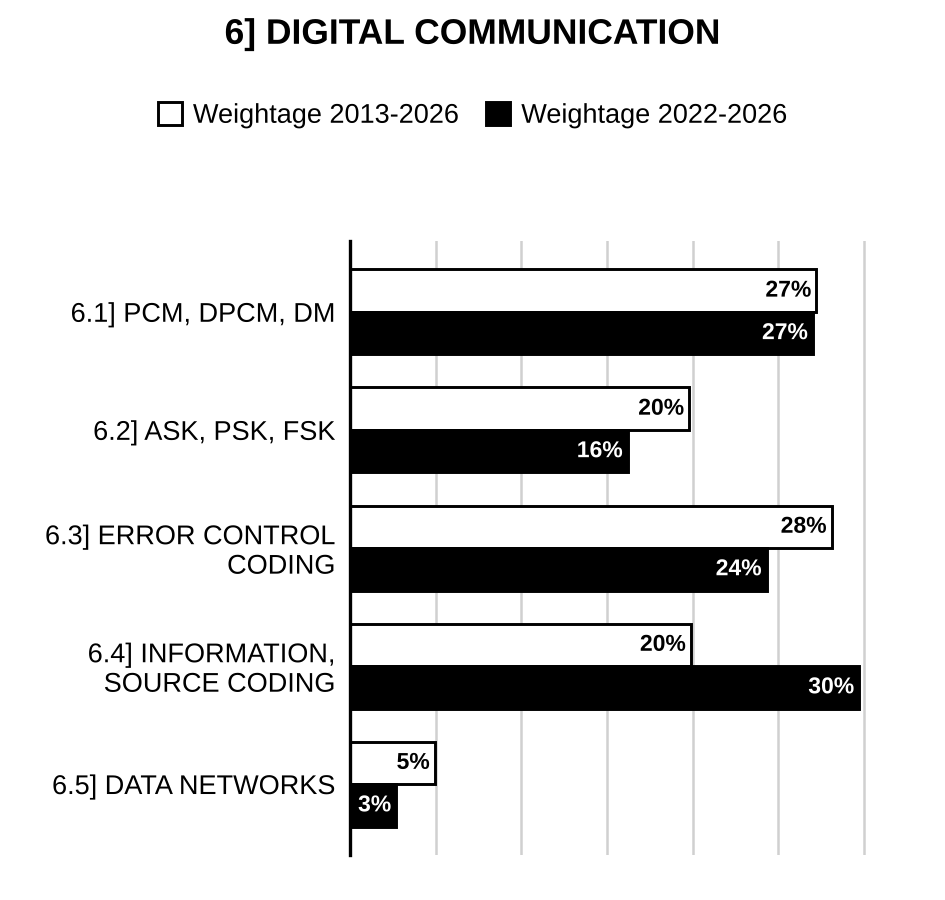
6.1] Pulse modulation
55 questions
A DM system is designed to operate at 3 times the Nyquist rate for a signal with a 3 kHz bandwidth. The quantizing step size is 250 mV. (i) Determine the maximum amplitude of a 1 kHz input sinusoid for which the delta modulator does not show slope overload. (ii) Determine the post-filtered output signal-to-quantizing noise ratio for the signal of part (i). [2026/10m/5e]
24 voice signals are sampled uniformly and then time-division multiplexed. Flat-top sampling is used with one microsecond duration. Multiplexing operation provides for synchronization by adding an extra pulse of sufficient amplitude and also one microsecond duration. The highest frequency component of each voice signal is 3.4 kHz. (i) Assuming a sampling rate of 8 kHz, find the spacing between successive pulses of the multiplexed signal. (ii) Repeat your calculations by assuming the use of Nyquist rate sampling. [2025/20m/6b]
What is line coding? For the data sequence 10101110, draw the waveforms for the following line coding schemes: 1. Polar NRZ scheme 2. Bipolar NRZ scheme 3. Differential Manchester scheme 4. RZ polar scheme. [2025/10m/7b(i)]
A PCM system uses 4096 quantization levels to handle telephone signals with a volume range of 40 dB. 1. What is the SNR for maximum sinusoidal signal level? 2. What is the SNR level for the smallest sinusoidal signal level? 3. With a 10 dB compression provided, what will be the new SNR? [2025/10m/7b(ii)]
A DM transmitter with a fixed step size of 0.25 V is given a sinusoidal message signal. Determine the maximum permissible amplitude of the message signal, if slope overload is to be avoided. Assume sampling frequency ten times the Nyquist rate. [2024/10m/6c]
A audio frequency signal band-limited to 8 kHz is to be transmitted using a PCM system. If the quantization error of any sample is to be at the most ±1% of the dynamic range of the message signal, determine the minimum value of n, the minimum sampling rate and corresponding bit rate of transmission. [2024/10m/7b(ii)]
An audio signal, whose bandwidth is 15 kHz, is to be digitized using PCM. Uniform quantization with 1024 levels and binary encoding are assumed. Determine the minimum sampling rate. If the actual sampling rate is 20% excess of the minimum rate, determine the minimum permissible bit rate. [2023/10m/1c]
A linear delta modulator is designed to transmit speech signal bandlimited to 4 kHz. The specifications are– sampling rate = 10 times Nyquist rate step size = 100 mV The system is tested with 1 kHz sinusoidal signal. Determine the maximum amplitude of the test signal so that slope overload does not occur. Calculate the maximum power that can be transmitted without slope overload. [2023/10m/2c]
Show that, with a non-uniform quantizer, the mean square value of the quantization error is approximately equal to , where is the ith step size and is the probability that the input signal amplitude lies within the ith interval. Assume that the step size is small compared with the excursion of the input signal. [2022/10m/5d]
A DPCM system uses a linear predictor with a single tap. The normalized autocorrelation function of the input signal for a lag of one sampling interval is 0.75. The predictor is designed to minimize the prediction error variance. Determine the processing gain attained by the use of this predictor. [2021/10m/1e]
In a binary PCM system, if the quantizing noise amplitude is not to exceed P percent of the peak-to-peak analog level, show that the number of bits n in each PCM word needs to be [2019/5m/1a(i)]
A 700 Mbyte CD is used to store PCM data. Suppose a voice frequency (VF) signal is sampled at 8000 samples per second and the encoded PCM signal is to have an average SNR of at least 40 dB. How many minutes of VF conversation can be stored on the hard disc? [2019/5m/1a(ii)]
Sketch a block diagram for a differential encoding and decoding system. Explain the working of the system by showing the encoding and decoding of the sequence 101100011001. Assume that the reference digit is a binary 1. Show that error propagation cannot occur with this arrangement. [2019/6m/3a(i)]
Consider a continuous input signal whose amplitude m lies in the range . This is applied to a uniform quantizer of mid-rise type where the step size is given by , where L denotes the number of representation levels. Let represent the variance of the quantization error and R represent the number of bits per sample. Show that . Using this result, show that and that the output signal to noise ratio of a uniform quantizer is [2019/8m/3a(ii)]
Consider a sine wave of frequency and amplitude , that is applied to a delta modulator of step size Δ. Derive the condition which, if satisfied, leads to the occurrence of slope overload error. [2019/6m/3a(iii)]
A signal having probability density function is quantized with four quantization levels.
(i) Determine the value of . [2018/6m/1a(i)]
(ii) Determine step size . [2018/2m/1a(ii)]
(iii) Determine the four quantization levels. [2018/2m/1a(iii)]
Design a PCM system that multiplexes three signals , and having bandwidths 5 kHz, 10 kHz and 5 kHz respectively. Each signal is sampled at its Nyquist rate and quantized to 256 levels.
(i) Sketch the block diagram of the system. [2018/6m/3a(i)]
(ii) What is the maximum bit duration that can be used? [2018/8m/3a(ii)]
(iii) What is the channel bandwidth required to pass the PCM signal? [2018/4m/3a(iii)]
(iv) What is the commutator speed in revolutions per second? [2018/2m/3a(iv)]
A delta modulation system is designed to accommodate a bandlimited analog signal with maximum frequency of 5000 Hz. The sampling rate is five times the Nyquist rate. A signal is applied to this system. Determine: (i) the minimum step size required to process the signal without slope overload distortion and (ii) maximum signal-to-quantization noise ratio of the system. [2017/10m/1b]
What do you mean by aliasing? How can aliasing be removed? State and explain Shannon’s sampling theorem. [2016/10m/1d]
Explain Delta Modulation, comparing it with Differential Pulse Code Modulation. Discuss how the choice of step size in Delta modulator affects slope overload distortion and granular noise. [2016/10m/4c(ii)]
(i) An accelerometer has an input range of 0 – 100 m/s². It has a mass of 10 g and works on a frequency of 10 Hz. Find the range for the displacement transducer used to measure the displacement of the accelerometer. (ii) 1. State and explain Nyquist criterion. 2. An information signal is sampled. Calculate the minimum sampling rate that will be needed to recover the signal back from its samples. [2016/10m/5e]
Differentiate between the Pulse Code Modulation (PCM) and Delta Modulation (DM) explaining why DM is considered as a better alternative to PCM. How does the choice of the two parameters—quantization level () and sampling interval affect the performance-noise and accuracy/data rate? [2015/10m/6c]
A sinusoidal signal is transmitted using P.C.M. The output signal to quantization noise is required to be 55.8 dB. Find the minimum number of quantization levels. Derive the equation used. [2014/20m/4c]
Derive an expression for the Bandwidth of ‘P.C.M.’ system. [2014/10m/5b]
A channel with bit rate, kbps is available for ‘P.C.M.’ voice transmission. Find the appropriate values of binary digits N, the number of quantization levels (M) and the sampling rate (), assuming kHz. [2014/10m/5c]
Derive the expression for maximum signal to quantization noise ratio for sinusoidal message input when waveform coding is done by D.M. under no-slope overload condition. [2014/10m/7c]
How is DPCM better than PCM? With the help of illustrations, show how DPCM signals are generated and decoded. [2013/10m/6c(i)]
.
(i) A binary PCM system uses a uniform quantizer and an 8-bit binary encoder. If the bit rate is 100 Mb/s, what is the maximum bandwidth for which the system operates satisfactorily? Determine the output signal to quantization ratio when full-load sinusoidal modulating wave of frequency 1 MHz is applied to the input. [2012/5m/1f(i)]
(ii) A discrete memoryless source is described by the alphabet and the corresponding probability vector Design a Huffman code for this source; find , the average codeword length for the Huffman code; and determine the efficiency of the code. [2012/5m/1f(ii)]
.
(i) Bring out the salient points of relation between DM and DPCM. Draw the block diagram of delta modulator and demodulator. [2012/8m/8b(i)]
(ii) Find the capacity of an additive white Gaussian noise channel with a bandwidth 1 MHz, power 10 W and noise power spectral density W/Hz [2012/6m/8b(ii)]
(iii) Explain cyclic codes. [2012/6m/8b(iii)]
.
(i) What is the theoretical bandwidth required to transmit a digital signal? Justify your answer. How can you relate bandwidth to bit rate? [2011/8m/4c(i)]
(ii) What is Inter-Symbol Interference (ISI)? How can this be tackled? What is the importance of Eye diagram? How is it generated? [2011/12m/4c(ii)]
.
(i) How is ‘regeneration’ in digital communication different from ‘amplification’ in analog communication? In what way regeneration is better? [2011/5m/5c(i)]
(ii) Draw the block diagram of a PCM receiver and show how a transmitted sinusoidal signal is reconstructed in the receiver. [2011/5m/5c(ii)]
(iii) Distinguish between virtual circuit and datagram in data networks. [2011/5m/5c(iii)]
(iv) What is the rationale behind error control coding? Distinguish between linear codes and non-linear codes. [2011/5m/5c(iv)]
.
(i) The information in an analog signal voltage waveform is to be transmitted over a PCM system with an accuracy of ±0.1% (full scale). The analog voltage waveform has a bandwidth of 100 Hz and an amplitude range of −10 V to +10 V. (1) Determine the maximum sampling rate required. (2) Determine the number of bits in each PCM word. (3) Determine the minimum bit rate required in the PCM signal. (4) Determine the minimum absolute channel bandwidth required for the transmission. [2011/12m/6c(i)]
(ii) Why do we need a MODEM to access Internet over telephone line? How does it work? What is the role of a ROUTER in a data network? [2011/8m/6c(ii)]
Mention the salient points of relation between the delta modulation (DM) and differential pulse code modulation (DPCM). Draw the block diagram of delta modulator and demodulator. Explain threshold and overloading effects in delta modulation. How can a slope overload noise, which occurs due to threshold and overloading, be reduced? [2010/20m/4c]
Pulse code modulation (PCM) is the most useful and widely used of all pulse modulations. How does an analog signal get converted to digital signal by the PCM? By which process non-uniform quantization is practically achieved? Draw a diagram of a model, which does this process. Explain its working. [2010/20m/5c]
(i) With a neat sketch, show the block diagram of a PCM transmitter and receiver, clearly indicating the various parts. What are the different types of quantizers? Give a sketch of the two types of uniform quantizers. How will you reduce quantization error? (ii) Bandwidth of an input signal to the PCM is restricted to 4 kHz. Input signal varies in amplitude from V to V. It has an average power of 30 mW. Required signal to noise ratio is 20 dB. The PCM modulator produces binary output. Assuming uniform quantization, find number of bits required per sample. [2009/20m/4b]
(i) What are the advantages and disadvantages of delta modulation compared to PCM? With the help of sketch, mention the various noises associated with delta modulation. How will you overcome these noises? (ii) A sine wave of frequency and amplitude is applied to a delta modulator of step size . Show that the slope overload distortion will occur if: where is sampling period. What is the maximum power that may be transmitted without slope overload distortion? [2009/20m/5c]
In a TDM digital communication system 774 voice samples (using 8 [?] bits/sample) and 36 control bytes are multiplexed in one frame. If the sampling rate for voice signals is 8000 sample/sec. calculate (i) frame duration in sec, (ii) bit rate of the system, (iii) if the upstream signal is higher in frequency than this bit rate (calculated in part ii) by 1 ppm, calculate the number of frames after which one negative stuffing byte will be provided. [2006/20m/6b]
Describe the basic elements of a PCM system. [2005/20m/6b]
Bring cut the concept of TDM with a block schematic. [2005/20m/7b]
A signal having a range of 300 to 3400 kHz is transmitted using binary PCM on a channel whose bit rate is 40,000 bits per second. Design the PCM system and draw the block diagram. [2005/20m/7c]
Select any THREE of the following statements, read them carefully and identify the correct and the incorrect ones. Justify your answer using not more than 200 words in each case:- Digital transmission has more advantages than disadvantages as compared to analog transmission. [2004/20m/200w/1d]
Select any three of the following statements, read them carefully and identify the correct and the incorrect ones. Justify your answer using not more than 200 words in each case The bandwidth of a PCM signal is much larger than that of original base band. [2003/20m/200w/5d]
A delta modulator has the message signal . Determine the minimum sampling frequency required to prevent slope overload, assuming the step size to be 0.1 m. [2002/20m/7b]
Select any three of the following statements, read them carefully and identify the correct and the incorrect ones. Justify your answer using not more than 200 words in each case PCM is considered very well, but other modulation systems are also used. [2002/20m/200w/5d]
Find the signal-to-quantization noise ratio in a binary PCM system, if the number of quantization levels is 64: [2002/20m/6b]
.
(i) Differentiate between FDM and TDM pictorially. Enumerate the advantages of one over the other. [2001/10m/5d(i)]
(ii) 24-telephones, each band limited to 3.4 kHz, are to be time division multiplexed using PCM. Calculate the bandwidth of the PCM system for 128 quantization levels with 8 kHz sampling frequency [2001/10m/5d(ii)]
Great a block diagram for a differential encoding and decoding system. Explain how it works by showing the encoding and decoding for the sequence 001111010001. Assume that the reference digit is a binary 1. Show that error proportion cannot occur. [2001/20m/6b]
Justify the statement pulse modulation is not digital whereas pulse code modulation is digital Obtain the bandwidth for 128 quantization levels and 8 kHz sampling frequency of a practical PCM system consisting of 24 telephone channels, each band limited to 3.4 kHz in time division multiplexing. Deduce formulae used. [2000/20m/5d]
.
(i) Which type of communication system will you prefer for speech processing? Why? [2000/10m/6b(i)]
(ii) With the help of a suitable schematic diagram describe the working of a delta modulation system. Discuss its limitation. [2000/10m/6b(ii)]
Briefly explain the principle of PCM, differential PCM and delta modulation. [2000/20m/6b]
Describe the schematic arrangement of pulse-code modulation by using optical fibre. [1999/20m/12b]
Select any Three of the following statements and indicate with justification whether they are correct or incorrect. Your answer must not exceed 200 words for each statement: Pulse Code Modulation (PCM) systems for voice communication employ companding. [1998/20m/200w/9a]
Explain a scheme for demodulation of PPM signals. [1998/20m/10c]
Why is companding used in PCM Systems? Describe any one companding law. [1997/20m/10b]
With the help of a block diagram, explain a Radio-telemetery transmitter using frequency-division multiplex with TDM for sub-communication. [1995/20m/12c]
6.2] Digital modulation
25 questions
A binary FSK system transmits binary data at the rate of bits per second. During the course of transmission, white Gaussian noise of zero mean and power spectral density watts per hertz is added to the signal. In the absence of noise, the amplitude of the received signal is across impedance. Determine the average probability of error assuming coherent detection of the binary FSK signal. [2026/10m/8b(ii)]
Explain the concept of a constellation diagram. Draw the PSK signal constellations for the value of M = 2, 4 and 8, if all have same transmitted signal energy . [2024/10m/1e]
A binary transmission system with a transmitted power of 300 mW uses a channel with zero-mean AWGN of two-sided PSD equal to and a total transmission loss of 80 dB. If the probability of error, is not to exceed , calculate the maximum allowable bit rate using non-coherent ASK. [2024/10m/7b(i)]
Binary data is transmitted over additive white Gaussian noise (AWGN) channel at a bit rate of 5 kilobits/sec. The single-sided power spectral density for the channel is . Non-coherent orthogonal binary FSK with higher frequency signalling tone of 1 MHz is used. The bit energy, . Determine the minimum required bandwidth and average bit error probability. [2023/10m/5d]
The received signal in a binary communication system that employs antipodal signals is , where is shown in the figure below and is AWGN with power spectral density : (i) Sketch the impulse response of the filter matched to . (ii) Sketch the output of the matched filter when the input is . (iii) Determine the variance of the noise at the output of the matched filter at . (iv) Determine the probability of error as a function of A and .
[Figure: versus t: amplitude A for , zero for , amplitude A for , zero elsewhere.] [2022/20m/8b]
Consider a signal detector with an input where and occur with equal probability and the noise variable n is characterized by the Laplacian pdf shown. (i) Determine the probability of error as a function of the parameters A and . (ii) Determine the SNR required to achieve an error probability of .
[Figure: Laplacian pdf : a symmetric curve with a sharp peak at n = 0, decaying exponentially on both sides.] [2021/20m/3b]
(i) Explain the power efficiency and bandwidth efficiency of a digital modulation scheme. (ii) Comment on the power efficiency for a given bandwidth efficiency for a good modulation scheme. (iii) Comment on the bandwidth efficiency for a given power efficiency for a good modulation scheme. (iv) Compare the bandwidth efficiency of ASK and QAM modulation techniques. (v) Comment on the bandwidth efficiency of M-ary orthogonal signalling scheme for large M. (vi) Write the fundamental tradeoff equation between power and bandwidth efficiency under which reliable communication is possible. [2020/20m/4b]
Four signals , , and are shown in the figure below. Find an orthonormal basis for this set of signals by making use of the Gram-Schmidt orthogonalization procedure. Draw the corresponding signal space diagram:
[Figure: Four rectangular pulses of amplitude 1.0: for 0 < t < T/3 (zero elsewhere); for 0 < t < 2T/3; for T/3 < t < T; for 0 < t < T] [2019/10m/5c]
Consider an ON-OFF keying version of a binary ASK system, where symbol 1 (hypothesis ) is denoted by transmitting a DC level of amplitude A and symbol 0 (hypothesis ) is denoted by not communicating any signal over the channel. Assume that symbols 0 and 1 occur with equal probability. The channel is perturbed by Additive White Gaussian Noise (AWGN) with zero mean and variance . Show that the average probability of error for this ASK system is [2019/10m/6b(i)]
Consider a phase-locked loop (PLL) consisting of a multiplier, loop filter and voltage-controlled oscillator (VCO). Let the signal applied to the multiplier input be defined as , where is the phase sensitivity and data signal is having value +1 for binary symbol 1 and −1 for binary symbol 0. The VCO output is . Evaluate the loop filter output, assuming that the filter removes the modulated components with frequency . Show that the loop filter output is proportional to the data signal m(t), when the loop is phase-locked, that is, θ(t) = 0. Illustrate your answer with a neat sketch. [2019/10m/6b(ii)]
Draw the block diagram of a DPSK communication system. [2018/8m/8a(i)]
The data stream to be transmitted by means of DPSK is . Determine the DPSK bit stream. [2018/6m/8a(ii)]
Sketch BPSK waveform if the transmitted data stream is 101000 and carrier frequency is . [2018/6m/8a(iii)]
Write down expression for the signal set and draw signal space diagram for coherent quadri-phase shift keying system. For the input binary sequence 11001001, sketch inphase and quadrature components of the modulated quadri-phase shift keying signal. [2017/15m/8b]
Draw the waveforms showing modulation of the binary signal 0011010010 using ASK, FSK and PSK. [2015/10m/7b(i)]
What is Quadrature Phase Shift Keying (QPSK)? How does it help to improve the data transmission rate? [2015/10m/7b(ii)]
What is the need for sending digital data over analog carriers? In this regard how is FSK better than PSK? [2013/5m/5c(i)]
What are the advantages of digital carrier systems over Baseband digital transmission? Develop the mathematical formulation for a BPSK signal. [2013/10m/7c]
.
(i) Explain ASK, FSK and PSK modulation schemes used for transmitting the data. Draw clearly the block diagram for coherent detection and non-coherent detection of FSK modulation scheme. [2012/10m/3c(i)]
(ii) A (6, 3) systematic linear block code encodes the information sequence into code word such that is a parity check on and , to make the overall parity even, i.e., . Similarly is a parity check on and , and is a parity check on and . (1) Determine the generator matrix of this code. (2) Find the parity check matrix for this code. (3) Using the parity check matrix, determine the minimum distance of this code. (4) How many errors of this code are capable of correcting? [2012/10m/3c(ii)]
Give the block diagram to recover baseband signal from a BPSK signal. Also plot the power spectral density of BPSK signal. From that plot, show that minimum bandwidth of BPSK signal is equal to twice of the highest frequency contained in baseband signal. Mention one major drawback of BPSK receiver. [2009/20m/6c]
Explain the difference between coherent and non coherent detection of ON/OFF keying signals. [2007/10m/7b(i)]
How is digital data converted into analog signals for telephone lines? Compare them with respect to (i) Waveforms (ii) Bit rate (iii) Baud rate. [2004/20m/6b]
Describe the basic modulation schemes in digital data transmission. [2003/20m/4b]
Select any Three of the following statements and indicate with justification whether they are correct or incorrect. Your answer must not exceed 200 words for each statement: For a given data rate, QPSK signals and BPSK signals require equal bandwidths. [1998/20m/200w/9d]
Discuss the relative merits and shortcomings of BPSK and BFSK signals. [1998/20m/10b]

Preparing for Prelims too?
Our UPSC Prelims Topic-wise PYQ eBook covers every Prelims question with detailed explanations, so you can see exactly where UPSC asks from.
View the BookDownload Free Sample6.3] Error control coding
32 questions
A parity check code has the parity check matrix: I. Determine the generator matrix . II. Find the code word that begins with 101… . III. Suppose that the received word is 110110. Decode this received word. [2026/10m/7b(ii)]
If the generator polynomial is and the message bits are 1101101, then obtain the CRC code. [2025/10m/1e]
Draw the diagram of a 1/3 rate convolution encoder. Write the corresponding code tree for the 1/3 rate convolution encoder. [2025/20m/8b]
Consider a systematic linear block code with binary elements whose parity check equations are where are message digits and are parity check digits. (i) Find the generator matrix and parity check matrix for the code. (ii) How many errors can this code detect? How many errors can be corrected? (iii) If 10100100 is the received code word, find the corresponding transmitted code word assuming that single-bit error has been made during transmission. [2023/20m/4a]
Prove that all vectors in the same coset have the same syndrome that is unique to that coset in the standard array for any linear block code. [2022/10m/5e]
The figure below shows the encoder for a rate , constraint length convolutional code: (i) Determine the encoder output produced by the message sequence 11011 … . (ii) Also, construct the code tree for the encoder. Trace the path through the tree that corresponds to the message 11011 … . Compare the resulting output with that determined in (i).
[Figure: Convolutional encoder: Input → F/F → F/F → F/F (three flip-flops in cascade). Upper modulo-2 adder inputs: the input (before the first F/F), the output of the first F/F, the output of the second F/F and the output of the third F/F; its output is . Lower modulo-2 adder inputs: the input, the output of the first F/F and the output of the third F/F; its output is . A commutating switch alternately selects and to give the Output.] [2022/20m/7a]
A convolutional code is described by Find the transfer function and the free distance for this code. Also verify whether or not this code is catastrophic. [2021/10m/2c]
Prove that the minimum distance of any linear block code satisfies . [2021/5m/8a(i)]
Show that the minimum Hamming distance of a linear block code is equal to the minimum number of columns of its parity check matrix that are linearly dependent. From this conclude that the minimum Hamming distance of a Hamming code is always equal to 3. [2021/15m/8a(ii)]
For a linear block code over GF(3), the generator matrix (G) is given by (i) Determine all right code words for this code. (ii) How many errors can this code correct? [2020/10m/1e]
(i) Write down Hamming bound condition for code C(n, k) of size M in GF(q), which can correct t errors. (ii) Explain perfect code using Hamming bound condition in GF(2). (iii) Check whether n-repetition code (for odd value of n) is perfect code or not. [2020/10m/5e]
(i) Consider the primitive polynomial over GF(2). Construct GF(8) field using the given primitive polynomial. (ii) Find the minimal polynomial for the primitive element α. (iii) Find the BCH code of length n = 15, which can correct at least one error. [2020/20m/8b]
The generator matrix of a (7, 4) linear block code is given by (1) Determine a parity check matrix H for this code. (2) Show that . (3) Determine all right code words of the dual code. (4) Find the minimum distance of the dual code. [2019/8m/8a(ii)]
The figure shows the encoder for a rate , constraint length K = 4 convolutional code. Determine the encoder output produced by the message sequence u = 1011.
[Figure: Convolutional encoder: Input passes through three cascaded Flip-flops; the upper Mod-2 adder sums the input and the outputs of all three flip-flops; the lower mod-2 adder sums the input, the output of the first flip-flop and the output of the third flip-flop; the two adder outputs go to the two contacts of a commutating switch that forms the Output] [2019/6m/8a(iii)]
A convolutional encoder is shown below:
[Figure: Convolutional encoder: input feeds a shift register of two stages (two boxes in cascade). Upper modulo-2 adder (⊕) receives the input directly, the output of the first stage (tapped at the node between the two stages) and the output of the second stage; lower modulo-2 adder (⊕) receives the input directly and the output of the second stage. Upper adder output is , lower adder output is ; a commutator switch alternately selects and to form the output ]
(i) Write down all the generator sequences and corresponding generator polynomial. [2018/4m/5c(i)]
(ii) Determine the output sequence , if the input sequence is . [2018/6m/5c(ii)]
A convolutional code is described by the following generator sequences: (i) Construct the encoder circuit corresponding to this code. (ii) Draw the state diagram for this code. (iii) Draw the trellis diagram for a message sequence length of 5 bits. (iv) Determine the encoded sequence for the message sequence 10111. [2017/20m/6a]
Discuss the concept of ‘Hamming distance’. How is the minimum Hamming distance between a set of code words related to the error detection and error correction properties of the code? Find the correct 4-bit messages from the following two Hamming codes, assuming at most a single error has occurred: [2016/10m/4c(i)]
Show that the (7, 4) cyclic codes generated by the two polynomials , and are equivalent. Find the codes for the four messages: (0011), (0101), (1010), (1101) [2016/10m/6c(i)]
Differentiate between the problems of error detection and correction. How many check/parity bits are required to correct a single error in a message of bits? [2015/10m/5e]
Describe the Cyclic Redundancy Check (CRC) scheme for error detection. Explain how the Frame Check Sequence (FCS) and divisor/pattern are chosen. Given a message (10 bits), pattern (6 bits), illustrate how FCS can be calculated. [2015/10m/8c]
The parity check matrix of a linear (7, 4) block code is given by Determine the coded word for the data 0101. [2014/10m/6c]
A systematic (7, 4) linear code has the parity matrix P given as:
(i) Find the code vectors for message vectors 1000, 0001, 0010 and 0111. [2013/8m/4c(i)]
(ii) Draw the corresponding encoding diagram. [2013/8m/4c(ii)]
(iii) If the received vector [0111110] has a single error, detect the error and correct it. [2013/4m/4c(iii)]
Consider the convolutional encoder shown in the figure below. The code is systematic: (a) Draw the state diagram using the State Transition Table (b) Draw the Code Tree.
[Figure: Convolutional encoder: the Input line goes to a node; from the node one path goes through flip-flop FF1 whose output is fed back up to the right-hand input of a modulo-2 adder (+); the node also feeds the left input of the adder directly (wire up from the node and right into the adder). The adder output is taken up and across to switch contact ; the node is also connected along the bottom directly to switch contact . A commutator switch selects or to the Output.] [2013/10m/6c(ii)]
.
(i) Explain ASK, FSK and PSK modulation schemes used for transmitting the data. Draw clearly the block diagram for coherent detection and non-coherent detection of FSK modulation scheme. [2012/10m/3c(i)]
(ii) A (6, 3) systematic linear block code encodes the information sequence into code word such that is a parity check on and , to make the overall parity even, i.e., . Similarly is a parity check on and , and is a parity check on and . (1) Determine the generator matrix of this code. (2) Find the parity check matrix for this code. (3) Using the parity check matrix, determine the minimum distance of this code. (4) How many errors of this code are capable of correcting? [2012/10m/3c(ii)]
.
(i) A convolutional encoder is given in the figure below: (1) Find the impulse response of the encoder. (2) Find the output code word if the input sequence is all 1’s (111111⋯).
[Figure: Convolutional encoder: input shifted into a 3-stage shift register , , . Upper modulo-2 adder takes inputs from and ; lower modulo-2 adder takes inputs from and . The outputs of the two adders go to the two contacts of a commutator switch (upper adder to the upper contact, lower adder to the lower contact) which forms the Output] [2012/5m/5f(i)]
(ii) Determine the channel capacity of band-limited waveform AWGN channel with an input power constraint. [2012/5m/5f(ii)]
.
(i) Draw the neat sketch of OSI model. What is the significance of data link layer? Explain the flow-control and error-control mechanism. [2012/10m/7b(i)]
(ii) Compute the CRC-4 character for the following message, using a modified divisor constant of 10011: 1100 0110 1011 01 [2012/10m/7b(ii)]
.
(i) How is error detection handled in data transfer, using checksums and cyclic redundancy characters (CRC)? Explain the concepts. [2011/8m/4b(i)]
(ii) Suppose the following data bytes are received and the last byte is the checksum character: 10, 23, 45, 04, 84 Has the data been received correctly? [2011/4m/4b(ii)]
(iii) Calculate the data polynomial for the 16-bit data stream 26F0 H. Write the generator polynomial for bisync and SDLC protocols. [2011/8m/4b(iii)]
.
(i) Distinguish among the following terms: (1) Forward error correction and Error detection method (2) Random error and Burst error (3) Block codes and Convolutional codes [2011/6m/7c(i)]
(ii) If is a valid code vector , then prove that , where is the transpose of the parity check matrix . [2011/10m/7c(ii)]
(iii) List the merits and demerits of delta modulation. [2011/4m/7c(iii)]
Two important types of error-correcting codes are: (i) block codes and (ii) convolutional codes. Write the main difference between the block codes and convolutional codes. Explain the codes, which are a subclass of linear block codes. [2010/20m/6c]
(i) A (6, 3) linear block code have the following parity-check matrix H: Determine: (i) generator matrix G and (ii) code word for the data bit 101. (ii) Give a basic sketch illustrating a convolutional encoder with k = 3, k = 1 and n = 2. What are its advantages and disadvantages over block codes? [2009/20m/7c]
‘Huffman coding is done to increase the rate of information bits to make them approach the rate of binary digits while in parity-check coding rate of binary digits is increased to make the information transmission more reliable’ Comment. [2006/20m/1d]
Discuss three kinds of error-detection codes and explain how they detect errors. [2000/20m/4b]
6.4] Information measure and source coding
21 questions
A discrete memoryless channel has the following channel matrix: (i) Draw the channel diagram. (ii) If the source has equally likely outputs, compute the probabilities associated with the channel output for . [2026/10m/1e]
Consider a discrete memoryless source with alphabet and statistics for its output. (i) Apply the Huffman algorithm to this source. Hence, show that the average code-word length of the Huffman code equals 1.3 bits/symbol. (ii) Let the source be extended to order two. Apply the Huffman algorithm to the resulting extended source and show that the average code-word length of the new code equals 1.1975 bits/symbol. (iii) Compare the average code-word length calculated in part (ii) with the entropy of the original source. [2026/20m/6b]
A discrete memoryless source has four symbols with probabilities , , , respectively. I. Calculate . II. Find the amount of information contained in the messages and and compare with the obtained in part (I). [2026/10m/7b(i)]
Show that the channel capacity of an ideal AWGN channel with infinite bandwidth is given by bit/sec. Given that: is the average signal power and is the power spectral density of white Gaussian noise. [2026/10m/8b(i)]
A code is made up of ‘dots’ and ‘dashes’. Assuming that a dash is three times as long as a dot with one-third the probability of occurrence of a dot, calculate— (i) the information in a dot and a dash; (ii) the entropy of the dot-dash code; (iii) the average rate of information, if a dot lasts for 10 ms and this time is allowed between symbols. [2025/10m/5e]
Two sources and emit messages , , and , , with the joint probability P(X,Y) as shown below in the matrix form.
| P(X, Y) | |||
Determine H(X), H(Y), H(X/Y) and H(Y/X). [2024/20m/8a]
A discrete memoryless source generates three independent message symbols , and with probabilities 0.9, 0.08 and 0.02 respectively. (i) Design a binary variable length Huffman code. (Assign ‘0’ to the message with highest probability). Determine the average code length, compression ratio and coding efficiency. (ii) Design a binary first-order extension code for this source and find the average code length for the designed code. Determine the compression ratio and efficiency for the extended code. [2023/20m/7a]
Find the capacity of the cascade connection of n binary symmetric channels with the same crossover probability ε. What is the capacity when the number of channels goes to infinity? [2022/10m/6c]
A discrete memoryless source (DMS) has five symbols , , , and with , , , and . (i) Construct a Shannon Fano code for the source and calculate the efficiency of the code. (ii) Repeat for Huffman code. Compare the results of (i) and (ii). [2021/10m/5d]
Consider a discrete memoryless source, whose output can be modeled as a discrete random variable S taking on symbols from a fixed alphabet with probabilities . Further . Assume that the symbols emitted by the source during successive signaling intervals are statistically independent. Show that the entropy of such a source is bounded by where K represents the number of symbols of the source alphabet. [2019/10m/7c]
A memoryless source S emits 6 message symbols with probabilities 0.3, 0.25, 0.15, 0.12, 0.1 and 0.08. Determine a 4-ary (quaternary) Huffman code for this source. Determine the average word length, the entropy and the efficiency of this Huffman code. [2019/6m/8a(i)]
Write the step-by-step procedure to obtain source code by using Shannon-Fano algorithm. [2018/10m/6b(i)]
Obtain the source code for a source that generates messages with the following probabilities:
Also calculate the efficiency of the code. [2018/10m/6b(ii)]
A discrete memoryless source is emitting the symbols , and with probabilities, respectively, 0.2, 0.45 and 0.35. Construct optimal binary Huffman code for the second extension of the source and calculate the coding efficiency. [2017/15m/3b]
An information source is modelled as a bandlimited process with a bandwidth of 6000 Hz. This process is sampled at a rate higher than the Nyquist rate to provide a guard band of 2000 Hz. The resulting samples takes one of the value in the set {−4, −3, −1, 2, 4, 7} with corresponding probabilities {0.2, 0.1, 0.15, 0.05, 0.3, 0.2}. Determine the rate of information of the source. [2017/10m/5d]
Eight messages are generated by a source with the following probabilities:
| Message | ||||||||
| Probability | 0.02 | 0.04 | 0.07 | 0.10 | 0.13 | 0.18 | 0.22 | 0.24 |
(i) Use Huffman scheme to code these messages. (ii) Explain and illustrate the prefix property of the code. (iii) Determine the average number of bits per message (1) with the Huffman coding, and (2) with uniform coding assuming the messages to be equiprobable. Also find the information content (entropy) in the message and hence efficiency of the Huffman coding. [2016/20m/7c]
.
(i) A binary PCM system uses a uniform quantizer and an 8-bit binary encoder. If the bit rate is 100 Mb/s, what is the maximum bandwidth for which the system operates satisfactorily? Determine the output signal to quantization ratio when full-load sinusoidal modulating wave of frequency 1 MHz is applied to the input. [2012/5m/1f(i)]
(ii) A discrete memoryless source is described by the alphabet and the corresponding probability vector Design a Huffman code for this source; find , the average codeword length for the Huffman code; and determine the efficiency of the code. [2012/5m/1f(ii)]
.
(i) A convolutional encoder is given in the figure below: (1) Find the impulse response of the encoder. (2) Find the output code word if the input sequence is all 1’s (111111⋯).
[Figure: Convolutional encoder: input shifted into a 3-stage shift register , , . Upper modulo-2 adder takes inputs from and ; lower modulo-2 adder takes inputs from and . The outputs of the two adders go to the two contacts of a commutator switch (upper adder to the upper contact, lower adder to the lower contact) which forms the Output] [2012/5m/5f(i)]
(ii) Determine the channel capacity of band-limited waveform AWGN channel with an input power constraint. [2012/5m/5f(ii)]
.
(i) Bring out the salient points of relation between DM and DPCM. Draw the block diagram of delta modulator and demodulator. [2012/8m/8b(i)]
(ii) Find the capacity of an additive white Gaussian noise channel with a bandwidth 1 MHz, power 10 W and noise power spectral density W/Hz [2012/6m/8b(ii)]
(iii) Explain cyclic codes. [2012/6m/8b(iii)]
‘Huffman coding is done to increase the rate of information bits to make them approach the rate of binary digits while in parity-check coding rate of binary digits is increased to make the information transmission more reliable’ Comment. [2006/20m/1d]
Select any three of the following statements and indicate with justification whether they are correct or incorrect. Your answer must not exceed 200 words for each statement. Modern communication system is concerned with development of transmission and not with the sorting, processing and storing of information. [1996/20m/200w/9a]
6.5] Data networks
13 questions
How does information get passed from one layer to the next in the Internet model? How do the layers of the Internet model correlate to the layers of the OSI model? [2024/10m/5e]
Consider a connected graph with N nodes and A arcs, and a weight for each arc . (i) Define minimum weight spanning tree (MST). (ii) If all arc weights of G are distinct, prove that there exists a unique MST. [2021/10m/7c]
(i) The open loop transfer function of a unity negative feedback control system is given by For what value of K, will the system work as an oscillator in its closed loop form? (ii) Identify the relevant layers of the ISO/OSI model to which the following protocols belong: SQL, HTTPS, ISDN, PPP, NFS, IP, RPC, TELNET, HDLC, X Windows. [2016/10m/1e]
Discuss and differentiate between ISO/OSI and TCP/IP. Explain how the functions of each of the seven layers of ISO/OSI are carried out by TCP/IP. [2016/10m/6c(ii)]
Explain the role of Protocol Data Unit (PDU) in communication within seven layers of OSI-ISO model. [2015/10m/5d]
With reference to the 7 layer architecture of data networks, distinguish between Protocol Data Unit (PDU) and Service Data Unit (SDU). [2013/5m/5c(ii)]
.
(i) Draw the neat sketch of OSI model. What is the significance of data link layer? Explain the flow-control and error-control mechanism. [2012/10m/7b(i)]
(ii) Compute the CRC-4 character for the following message, using a modified divisor constant of 10011: 1100 0110 1011 01 [2012/10m/7b(ii)]
.
(i) How is ‘regeneration’ in digital communication different from ‘amplification’ in analog communication? In what way regeneration is better? [2011/5m/5c(i)]
(ii) Draw the block diagram of a PCM receiver and show how a transmitted sinusoidal signal is reconstructed in the receiver. [2011/5m/5c(ii)]
(iii) Distinguish between virtual circuit and datagram in data networks. [2011/5m/5c(iii)]
(iv) What is the rationale behind error control coding? Distinguish between linear codes and non-linear codes. [2011/5m/5c(iv)]
.
(i) The information in an analog signal voltage waveform is to be transmitted over a PCM system with an accuracy of ±0.1% (full scale). The analog voltage waveform has a bandwidth of 100 Hz and an amplitude range of −10 V to +10 V. (1) Determine the maximum sampling rate required. (2) Determine the number of bits in each PCM word. (3) Determine the minimum bit rate required in the PCM signal. (4) Determine the minimum absolute channel bandwidth required for the transmission. [2011/12m/6c(i)]
(ii) Why do we need a MODEM to access Internet over telephone line? How does it work? What is the role of a ROUTER in a data network? [2011/8m/6c(ii)]
The network layer of OSI (Open Systems Interconnection) has two major functions, namely (i) routing of packets through the network and (ii) a flow control. Explain each of these two functions taking suitable examples. Prove that the network layer is the most sophisticated of the layered architecture. [2010/20m/7c]
What are the design considerations for layering in data networks? Discuss a seven-layer network architecture with a diagram. [2007/23m/6b]
Describe a communication circuit using modem and explain how modems are classified,. [2003/20m/6b]
What is a Modem? Draw and explain a Communication system using Modems. What is RS-232 interface? Explain its use for data transmission. [1995/20m/12b]

Strengthen your GS papers
Our UPSC Mains Topic-wise & Year-wise PYQ eBook (2013–2026) maps every GS question to the syllabus, so you know what UPSC asks and how often.
View the BookDownload Free Sample« Previous: Power System Protection | Next: Other Questions »
Back to: Electrical Engineering Optional PYQs – Topic-wise
Last updated: 30 October 2026