
Here are all 208 Animal Nutrition questions asked in UPSC Animal Husbandry and Veterinary Science Optional Paper I from 1995 to 2026, arranged under the 13 topics of the official syllabus. Within each topic the latest questions come first.
Each question ends with a code such as [2024/15m/3b] – the year, the marks, the word limit (where UPSC set one) and the question number in the paper.
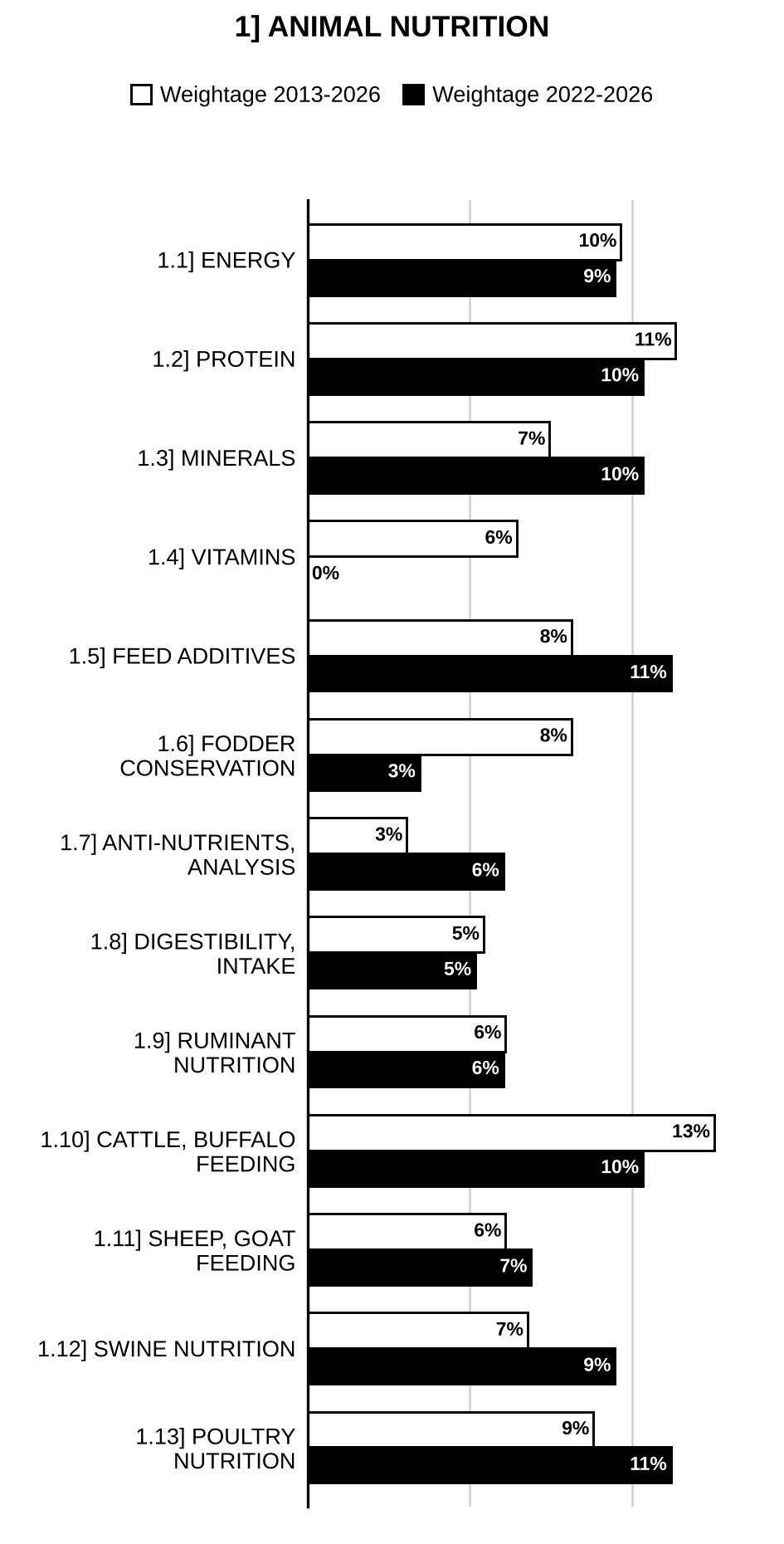
1.1] Energy nutrition
22 questions
Write about the methods to calculate energy requirements for the maintenance of animals. [2025/15m/2a]
Describe the measurement of energy retention by carbon-nitrogen balance technique. [2024/15m/2a]
Write short notes on the following: (i) Metabolizable energy (ii) Role of pancreas and liver in digestion (iii) Transgenesis (iv) Prebiotics as feed additives. [2023/20m/8a]
Define the term ‘total digestible nutrients’ and describe the various factors which affect the total digestible nutrients. [2022/15m/7a]
Describe the partitioning of food energy in animal body. [2021/10m/150w/1d]
Write short notes on the following: (i) Swollen hock syndrome (ii) Protein-energy interrelationship (iii) Respiratory quotient (iv) Total digestible nutrients (v) Protease inhibitors in feeds. [2020/20m/2a]
Describe the methods to determine the energy requirements for maintenance in adult animals. [2019/10m/1a]
Describe different types of calorimetry. [2018/10m/150w/1a]
How energy retention in animal body is measured by Carbon-Nitrogen balance study? How it differs from that of comparative slaughter method? [2017/10m/150w/1a]
Discuss in brief about the various systems of expressing the energy value of feeds and energy requirements in swine. [2017/10m/150w/1c]
Differentiate between the following: (i) Basal metabolism and Fasting metabolism. (ii) Curled-toe-paralysis and polyneuritis. (iii) Grass staggers and Blind staggers. (iv) Net protein utilization and net protein value. (v) Flushing and steaming-up. [2017/20m/2b]
Give the schematic representation of partitioning of feed energy in the body of lactating cows. [2016/10m/4b]
Differentiate between the following: (i) Starch equivalent and Net energy (ii) Crude protein and True protein (iii) Cellulose and Starch (iv) Digestible energy and Metabolizable energy (v) Concentrates and Roughages. [2015/15m/2a]
What do you mean by direct and indirect calorimetry? Describe the carbon-nitrogen balance method for estimation of heat production in animal body. [2011/25m/3a]
Enlist various systems for expressing the energy value of feeds in ruminants. [2011/10m/3b]
Discuss in brief about the total digestable nutrients system and give its demerits. [2011/25m/3c]
Heat increment of food. [2009/20m/200w/5d]
How is feed energy partitioned within animal body? Explain, how energy retention is measured by carbon and nitrogen studies. [2002/60m/2]
Thermogenic effect of feed. [1997/20m/200w/1b]
Factors influencing energy requirement of growing ruminants. [1997/20m/200w/1c]
BMR and its estimation. [1996/20m/200w/1b]
Forages as sources of energy. [1995/20m/200w/1a]
1.2] Protein nutrition
21 questions
Explain the concept of Essential Amino Acid Index (EAAI) and its significance in evaluating protein quality. [2025/10m/150w/1e]
Discuss about the protein efficiency ratio. [2024/10m/150w/1d]
Describe the methods for evaluation of protein quality in ruminant animals. [2023/20m/2a]
Enlist the various measures for evaluation of protein quality for monogastric animals and describe the biological value method. [2022/20m/7b]
How to calculate the protein requirement of growing calves? Discuss. [2021/15m/3c]
Write short notes on the following: (i) Swollen hock syndrome (ii) Protein-energy interrelationship (iii) Respiratory quotient (iv) Total digestible nutrients (v) Protease inhibitors in feeds. [2020/20m/2a]
How are non-protein nitrogenous substances utilized in ruminant animals? Enumerate the factors which affect the urea utilization in cattle. [2020/15m/2b]
Describe the methods for estimation of protein requirements for maintenance in adult cattle. [2020/10m/4a]
Explain the factors affecting efficient utilization of non-protein nitrogen (NPN) compounds in ruminants’ diet. [2019/10m/5a]
Write short notes on the following: (i) Biological value (ii) Feeding of breeding boars (iii) Essential Amino Acids Index (EAAI) (iv) Use of indicators for digestibility determination. [2019/20m/8c]
Differentiate between the following: (i) Probiotics and Prebiotics (ii) Fatty liver and kidney syndrome (FLKS) and Fatty liver and haemorrhagic syndrome (FLHS) (iii) Protein efficiency ratio and Net protein utilization (iv) Green fodder and Straws (v) Metabolic faecal nitrogen and Endogenous urinary nitrogen. [2018/20m/2a]
Discuss the methods for estimation of protein requirements for maintenance of bullocks. [2015/10m/150w/1b]
Differentiate between the following: (i) Starch equivalent and Net energy (ii) Crude protein and True protein (iii) Cellulose and Starch (iv) Digestible energy and Metabolizable energy (v) Concentrates and Roughages. [2015/15m/2a]
What is NPN compound? Write the mechanism of NPN utilization in ruminants. [2013/10m/7c]
Utilisation of non-protein nitrogen compounds in cow. [2010/12m/150w/1a]
Enlist the measures of protein quality for simple stomach (monogastric) animals and describe the nitrogen balance method. [2009/60m/4]
Bypass proteins. [2007/20m/200w/1d]
Nitrogen, Amino acid and Protein. [2002/20m/200w/1d]
Protein metabolism in ruminants and monogastrics. [2001/20m/200w/1b]
Bypass protein in ruminant nutrition. [2000/20m/200w/5d]
“Digestibility coefficients are constant for a given feed or species.” Critically examine the statement throwing light on factors affecting digestibility of feed in ruminants. Is the nitrogen balance a better indicator of feeding value of protein than a feed’s digestible protein content? Discuss. [1995/60m/3]
1.3] Minerals
17 questions
Classify the minerals required by animals and discuss the functions of calcium in animals. [2026/10m/150w/1a]
Describe about the copper-molybdenum-sulphur inter-relationship in ruminants. [2024/15m/3a]
Mention the general functions of minerals in animals. Justify the importance of Vitamin D in optimum calcium and phosphorus nutrition in animals. [2023/20m/3a]
Describe the mineral deficiency disorders of animals. [2022/15m/2c]
Classify the minerals and explain the role of calcium, phosphorus and vitamin D in bone formation. [2019/20m/6c]
Mention different metalloenzymes and their functions in livestock. [2018/10m/4c]
What are the common sources of calcium and phosphorus? How high intake of calcium affects the utilization of other minerals? Explain, how ‘Nutritional Secondary Hyperparathyroidism’ develops in animals. [2017/10m/2c]
Discuss the interrelationship of sulphur, molybdenum and copper in affecting the body functions. [2013/10m/4d]
Inter-relationship amongst calcium, phosphorus and Vit. D. [2011/12m/150w/5c]
How does interaction that inherently exists between and among different mineral sources induce mineral imbalances, deficiencies and toxicities in different livestock species? Furnish relevant examples to substantiate your answer. [2010/20m/2c]
Micro nutrients as a regulator of nutrients utilization. [2003/20m/200w/1a]
Selenium, Sulphur and Vitamin E. [2002/20m/200w/1a]
Calcium, Phosphorus and Vitamin D. [2002/20m/200w/1b]
Iron, Copper and Molybdenum. [2002/20m/200w/1c]
Mineral requirements of a lactating cow. [1998/20m/200w/1d]
In relation to swine raising: Indicate measures for preventing anaemia and hair-lessness in piglets. [1996/20m/7c]
Inter-relationships of magnesium with calcium and phosphorus in animal nutrition. [1995/20m/200w/1c]
1.4] Vitamins
14 questions
What are natural antioxidants? Describe the role of antioxidants in animal body. [2021/15m/2c]
Classify vitamins. What do you mean by essential and non-essential vitamins? Mention the coenzymes and enzyme prosthetic groups of ‘B’ vitamins along with their functions in metabolism. [2020/15m/2c]
Write in brief on the following: (i) Nutrient-parasite interrelationship (ii) The role of vitamin D in calcium absorption (iii) Feeding schedule for breeding bulls (iv) Blood-brain barrier (v) Growth curve. [2018/20m/2b]
Write the chemical nature, physiological functions and deficiency symptoms of vitamin A in animals. [2018/10m/3a]
Differentiate between the following: (i) Basal metabolism and Fasting metabolism. (ii) Curled-toe-paralysis and polyneuritis. (iii) Grass staggers and Blind staggers. (iv) Net protein utilization and net protein value. (v) Flushing and steaming-up. [2017/20m/2b]
Enumerate the water-soluble vitamins. Write the coenzymes or prosthetic groups and enzymic or other functions of B vitamins. Write the functions and deficiency symptoms of vitamin E in poultry. [2015/25m/3a]
Why Vitamin-A is important for animal body? What are the deficiency symptoms of Vit.-A in animals? [2014/10m/1c]
Physiological functions and deficiency symptoms of Vit. D in young animals. [2011/12m/150w/1b]
Discuss functions and deficiency symptoms of Vit. E in poultry. [2011/20m/8b]
Explain the relative differences that exist with respect to dietary essentiality of different vitamins between polygastric and mono-gastric livestock species. [2010/20m/2b]
Sources, functions and requirement of Vitamin ‘A’ in cattle. [2005/20m/200w/1b]
Selenium, Sulphur and Vitamin E. [2002/20m/200w/1a]
Scientific reasons for guinea-pigs being used for Vitamin C research. [2001/20m/200w/1d]
Role of B vitamins in metabolism of energy and protein. [1996/20m/200w/1a]
1.5] Feed additives and growth promoters
20 questions
Discuss the effects of ionophores on rumen metabolism. [2025/15m/2b]
Discuss about the use and abuse of antibiotics as feed additives in swine feeding. [2024/10m/3d]
Write short notes on the following: (i) Methane inhibitors (ii) Role of rumen in feed fermentation (iii) Chemical regulation of respiration (iv) Blood-brain barrier. [2024/20m/8c]
Write short notes on the following: (i) Metabolizable energy (ii) Role of pancreas and liver in digestion (iii) Transgenesis (iv) Prebiotics as feed additives. [2023/20m/8a]
Enlist the various feed additives and describe the merits of use of probiotics in animal rations. [2022/20m/2a]
Differentiate between the following: (i) Probiotics and Prebiotics (ii) Fatty liver and kidney syndrome (FLKS) and Fatty liver and haemorrhagic syndrome (FLHS) (iii) Protein efficiency ratio and Net protein utilization (iv) Green fodder and Straws (v) Metabolic faecal nitrogen and Endogenous urinary nitrogen. [2018/20m/2a]
Many non-nutritive substances are often being mixed in animal and poultry ration as growth-promoters. Discuss the uses and abuses of these growth-promoters. [2016/10m/150w/1a]
Define probiotics. Enlist important micro-organisms which are used as probiotics and also discuss the characteristics of good probiotics. [2014/15m/3a]
What do you understand by feed supplements and feed additives? Describe various groups of additives used in animal feed. [2013/20m/6a]
Enumerate the enzymes used as food additives in animal nutrition. What precise benefits does each of these enzymes offer to the animal? What properties must these enzymes possess if they are to be effective when incorporated into the animal’s diet? [2012/24m/2b]
Define the term “probiotics”. What are the key ways in which they exert their effects? What critical properties must they possess for them to be not harmful to the host animal? [2012/20m/3a]
Define the term “Growth Promoter”. Discuss the various growth promoters used in rations of ruminants and poultry, citing their mechanisms, favourable effects and possible ill-effects. [2012/20m/6b]
“For monogastric farm animals, oligosaccharides can play a useful role as prebiotics.” Explain the statement. Name five common natural sources of oligosaccharides. [2012/20m/7a]
Difference between Feed supplement and Feed additive. [2009/20m/200w/1d]
Hormones as growth stimulating substances. [2006/20m/200w/1b]
Probiotics. [2004/20m/200w/1c]
What are the feed manipulator? How are they beneficial in the feeding of ruminants and poultry? Discuss with examples as to how each category of feed manipulator affects production of these species and efficiency of feed utilization. [2003/60m/2]
Discuss the mechanism of action of various growth promoting agents to enhance the energetic efficiency and nitrogen retention in ruminants. [2001/60m/3]
Discuss in detail about feed supplements, additives and antibiotics in broiler and layer ration. [2000/60m/8]
Growth stimulants. [1995/20m/200w/1b]
1.6] Conservation of fodders and feed technology
14 questions
Discuss the development of feed industry in India and describe the activities of CLFMA. [2026/10m/150w/1b]
Write AIV method of silage preparation. [2025/10m/150w/1d]
Describe in detail about preparation of silage along with its advantages and disadvantages. [2021/15m/4b]
Discuss in brief the necessity of processing of animal feeds. [2020/10m/150w/1a]
Describe different methods of hay-making. What are the nutrient losses occurred during hay-making and how to prevent these losses? [2019/20m/2c]
What is silage? Discuss in brief about the anti-nutritional factors commonly found in animal feeds. [2016/20m/2b]
Define silage. Discuss the important methods of preparing silage. What are the important crops used for silage making? [2014/20m/2b]
Discuss processing methods for roughage to improve its utilization by animals. [2013/10m/2d]
Discuss complete feeding system for dairy farms. [2013/15m/3b]
Discuss the technological applications being put into practice for improving the digestibility and nutritive value of wheat bran and paddy straw. [2012/20m/7c]
Importance of hay and silage in livestock feeding. [2010/12m/150w/5a]
Current issues of Indian feed industry. [2006/20m/200w/1a]
Discuss the various methods of improvement of poor quality roughages. Which method is suitable and applicable under Indian conditions? Also indicate the method commonly used by the farmers to improve the nutritional value of straws. [2001/60m/8]
Preservation of fodder for its best utilisation during lean season. [1998/20m/200w/1c]

Preparing for Prelims too?
Our UPSC Prelims Topic-wise PYQ eBook covers every Prelims question with detailed explanations, so you can see exactly where UPSC asks from.
View the BookDownload Free Sample1.7] Anti-nutritional factors, feed analysis and quality control
6 questions
Describe Weende method of feed analysis. [2024/10m/150w/1e]
Classify antinutritional factors with suitable examples. [2024/15m/4b]
Describe the Van Soest method of forage fiber analysis. [2023/10m/150w/5a]
What is silage? Discuss in brief about the anti-nutritional factors commonly found in animal feeds. [2016/20m/2b]
Discuss the mode of action and inactivation/detoxification methods of protease inhibitors and cynogenetic glycosides present in feeds and fodder. [2011/20m/8a]
Agro-industrial by-products are gaining momentum day-by-day in livestock feeding. How do you proceed in preparing safer feeds from the above products? [2007/50m/2a]
1.8] Digestibility trials and feed intake
8 questions
Describe different factors which influence the voluntary feed intake in poultry. [2025/10m/4c]
Justify why more than one digestibility trial needs to be conducted during indirect method of digestibility determination of feed. [2023/10m/150w/1a]
Explain why the digestibility trial is considered as the best method for evaluating the nutritive value of animal feeds. [2022/10m/150w/1a]
Describe the methods by which feed intake in grazing animals is predicted. [2020/10m/150w/1c]
Write short notes on the following: (i) Biological value (ii) Feeding of breeding boars (iii) Essential Amino Acids Index (EAAI) (iv) Use of indicators for digestibility determination. [2019/20m/8c]
Discuss the factors affecting digestibility of feeds. [2018/15m/4b]
A buffalo is grazing on a pasture. How can the feed intake of that buffalo be predicted? [2015/15m/4a]
“Digestibility coefficients are constant for a given feed or species.” Critically examine the statement throwing light on factors affecting digestibility of feed in ruminants. Is the nitrogen balance a better indicator of feeding value of protein than a feed’s digestible protein content? Discuss. [1995/60m/3]
1.9] Ruminant nutrition
22 questions
What is bulk? Discuss its importance in feeding of ruminants. [2026/15m/2c]
Discuss in detail the microbial digestion of carbohydrates in ruminants. [2025/10m/4b]
Write short notes on the following: (i) Methane inhibitors (ii) Role of rumen in feed fermentation (iii) Chemical regulation of respiration (iv) Blood-brain barrier. [2024/20m/8c]
Write in detail the factors affecting water requirements of animals. [2018/10m/3d]
Define balanced ration. Write desirable characteristics of ration. [2018/15m/4a]
Discuss at least two methods that are utilized in formulating animal rations. [2016/15m/2c]
Differentiate between the following: (i) Crude Protein Vs. Digestible Crude Protein (ii) Water soluble vitamins Vs. Fat soluble vitamins (iii) Roughages Vs. Concentrates (iv) Maintenance ration Vs. Production ration (v) Metabolic energy Vs. Net energy. [2014/15m/4b]
Define the condition “frothy bloat”. Which kind of grazing and diets are particularly known to cause this condition? What measures can be taken to reduce its occurrence? [2012/15m/1a]
Balanced ration and its characteristics. [2011/12m/150w/1c]
Role of modified fat in ruminants’ diet. [2010/12m/150w/1b]
Which modern feeding standard would you recommend while formulating rations for high yielding cross-bred cows, giving full justification for its adoption under Indian context? [2010/20m/2a]
Write names of volatile fatty acids produced by microbial fermentation in different compartments of gastrointestinal tract of animals. [2009/8m/2a]
Name the ketogenic and glucogenic volatile fatty acids. Describe the metabolism of glucogenic volatile fatty acid to CO₂ and water. [2009/44m/2c]
Name ten agro-industrial by-products used in feeding livestock. [2007/10m/2b]
What is least cost ration? What is its significance under Indian conditions? Write the procedure of developing the least cost ration. [2006/60m/4]
What is the major source of energy in ruminants? Give energy metabolism of propionate in details. What will be the effect of cooked concentrate on milking ruminants? [2004/60m/4]
Metabolic disorders in ruminants caused due to imbalance in diet. [2001/20m/200w/1a]
Write a critical review on feeding Standards indicating their advantages and limitations. [2001/60m/4]
Role of protozoa in rumen. [1998/20m/200w/1b]
Internal environment of rumen. [1997/20m/200w/1a]
Subabool and Khejri as fodder. [1996/20m/200w/1c]
Trace the evolution of the modern-day feeding standards. Critically examine the suitability of applying one of the commonly accepted modern-day feeding standards under Indian conditions. [1996/60m/2]
1.10] Feeding of cattle and buffaloes
25 questions
Discuss the limiting nutrients and strategic feeding of high milk-yielding cows. [2025/20m/3c]
Explain about the feeding of breeding bulls. [2024/10m/3c]
Describe the nutritional factors affecting the composition of milk in dairy cows. [2023/15m/2c]
Define balanced ration and describe the ideal characteristics of a balanced ration for breeding bulls. [2022/15m/7c]
Give a brief account of feeding of calves from birth to three months of age. [2021/10m/150w/1e]
Compute a ration for a lactating crossbred cow weighing 400 kg and yielding 12 kg milk with 4% fat daily during second calving from wheat straw (0% DCP and 40% TDN) and concentrate mixture (15% DCP and 70% TDN). The requirement for maintenance is 300 g DCP and 3.30 kg TDN, whereas for production of 1 kg milk, 45 g DCP and 315 g TDN are required. [2020/20m/4b]
Describe the strategies for feeding of high-yielding dairy animals during different stages of lactation. [2019/20m/3a]
Write in brief on the following: (i) Nutrient-parasite interrelationship (ii) The role of vitamin D in calcium absorption (iii) Feeding schedule for breeding bulls (iv) Blood-brain barrier (v) Growth curve. [2018/20m/2b]
Write in brief on the following: (i) Feeding of lambs for mutton production. (ii) Feeding schedule of calves from birth to 3 months age. (iii) Mucosal block theory of Iron absorption. (iv) Role of Vitamin A in vision. [2017/20m/2a]
What points will you consider while formulating a ration for a dairy buffalo? A farmer gives 20 kg green maize (25% DM, 1.2% DCP and 16% TDN), 5 kg wheat straw (90% DM, 0% DCP and 40% TDN) and 4 kg concentrate mixture (90% DM, 14% DCP and 68% TDN) daily to a lactating buffalo weighing 450 kg and yielding 10 kg milk with 7% fat during her first lactation. The maintenance requirement is 280 g DCP and 3.4 kg TDN, whereas the requirement for 1 kg milk production is 63 g DCP and 460 g TDN. Indicate the deficiency or excess of nutrients in terms of DCP and TDN. [2017/25m/4a]
Importance of colostrum feeding and management of new born calf. [2017/10m/150w/5c]
Compute a ration for a dairy cow weighing 400 kg and yielding 10 kg of milk with 4% fat from wheat straw (0% DCP and 40% TDN), green berseem (2% DCP and 12% TDN) limited to 15 kg and concentrate mixture (12% DCP and 70% TDN). The maintenance requirement is 250 g DCP and 3 kg TDN, whereas the requirement for 1 kg milk production is 45 g DCP and 300 g TDN. [2015/15m/4b]
Guidelines to feed high yielder cows. [2015/10m/150w/5c]
Discuss the formulation of a balanced diet in the following groups:
(i) Lactating dairy cattle [2012/8m/8a(i)]
(ii) Pregnant cattle [2012/8m/8a(ii)]
(iii) Sheep reared for wool production [2012/8m/8a(iii)]
(iv) Heifers [2012/8m/8a(iv)]
Discuss the physiology of milk formation and milk let-down in dairy animals. Does the diet of the animal affect the quality and composition of milk? Explain. [2012/14m/8c]
Discuss recent trends in feeding of calf from birth to three month age. [2011/20m/7b]
Describe the importance of colostrum, calf starter and milk replacers for neonates. [2009/45m/8a]
Steaming up. [2007/20m/200w/1a]
What do you understand by balanced ration? How do we calculate nutrient requirements for a cow at three years of age, pregnant for six months and yielding 10 kg of milk with 4.0% fat? Suggest different types of green fodder crops to be grown in hot-humid climate of the country. [2005/60m/3]
Feeding regimes for bullocks during work and resting periods. [2005/20m/200w/5c]
Neonatal nutrition. [2003/20m/200w/5d]
Computation of ration for a pregnant cross-bred cow yielding 10 kg of milk. [2000/20m/200w/1c]
Nutrient requirements for milking cows and buffaloes. [1999/20m/200w/1a]
Discuss the requirements of energy, protein, minerals, vitamins and water of a dairy cow for milk production and during pregnancy. [1997/60m/3]
Feeding schedule for a 450 kg buffalo, producing 10 kg milk with 6.5% fat and 15.5% total solids in 6th month of pregnancy. [1997/20m/200w/5d]
1.11] Feeding of sheep and goats
10 questions
Describe the feeding of sheep for good quality wool production. [2026/15m/2b]
Discuss the feeding strategies of goat for chevon production. [2024/10m/150w/5d]
Describe the feeding of ewe flock during gestation and suckling period. [2022/15m/6c]
Discuss the feeding habits of goats and write the commonly available feeds and fodder for goats in India. [2020/10m/6c]
Write in brief about the feeding management of goat kids from birth to three months of age. [2020/10m/6d]
Write a short note on stall-feeding of goats. [2018/10m/150w/5c]
Write in brief on the following: (i) Feeding of lambs for mutton production. (ii) Feeding schedule of calves from birth to 3 months age. (iii) Mucosal block theory of Iron absorption. (iv) Role of Vitamin A in vision. [2017/20m/2a]
What are the feeding habits of goats? Enlist the common feeds and fodders for goats. [2015/10m/150w/1a]
Discuss the formulation of a balanced diet in the following groups:
(i) Lactating dairy cattle [2012/8m/8a(i)]
(ii) Pregnant cattle [2012/8m/8a(ii)]
(iii) Sheep reared for wool production [2012/8m/8a(iii)]
(iv) Heifers [2012/8m/8a(iv)]
With reference of goat keeping: State how does the feed and feeding habits of goats differ from other animals. [1995/20m/7c]
1.12] Swine nutrition
12 questions
Give the criteria for preparation of practical and economic ration for swine production. [2026/15m/7d]
Write short notes on the following: (i) Effect of amino acid imbalance in swine ration. (ii) Circulation and functions of cerebrospinal fluid. (iii) Reno-renal reflex and how it controls renal functions. (iv) General functions of minerals in animals. [2025/20m/4d]
Describe the significance, composition and physical forms of creep feed in piglet. [2023/15m/6a]
Describe the formulation of least cost rations for swine. [2022/15m/2b]
Write about the feeding of swine for lean meat production and its importance in human health. [2021/15m/2a]
How will you design an economic ration of pigs for production of lean meat? Explain. [2016/15m/2a]
What feeding practices are suggested for adult female pigs? [2015/15m/7a]
Feeding of pigs for lean meat production. [2011/12m/150w/5b]
What are the BIS specifications for starter, grower and finisher pig in terms of CP and ME? [2010/5m/4b]
The swine feed has become very costly. Describe as to how you will formulate a balanced swine ration most economically without adversely/affecting the growth of the baby-growing pigs and the quality of meat production. [1999/60m/3]
Discuss the requirement of protein, energy, minerals, vitamins, trace elements, amino acids and water for a fattening pig. [1998/60m/2]
In relation to swine raising: Briefly discuss the amounts of protein required by swine. Name at least three protein supplements that provide good quality protein for swine and at least three protein supplements that are unsatisfactory as the only protein supplements for stall fed pigs. [1996/20m/7a]
1.13] Poultry nutrition
17 questions
Discuss the salient features of feeding broiler chicks for meat production. [2026/20m/2a]
Write about the nutrient requirement of chicken. [2024/15m/2c]
Describe nutritional characteristics of feed ingredients which are generally incorporated in formulation of poultry feed. [2023/20m/4a]
Describe the various steps for formulation of poultry broiler starter feed. [2022/10m/150w/5a]
Describe the importance of calorie : protein ratio in poultry. [2021/10m/3d]
Define essential, critical and limiting amino acids. Enlist the factors affecting amino acids requirement in poultry. [2021/15m/4c]
Formulate an economic and balanced ration for laying hens using commonly available feed ingredients. [2021/10m/6b]
Write BIS specifications of nutrient requirements for chicken. [2018/10m/150w/1d]
Why are broilers and layers fed different types of rations? What are the similarities and dissimilarities in these two rations? [2016/10m/150w/1e]
Discuss the nutrient requirements of poultry for Meat and Egg production. [2013/10m/1c]
Give the crude protein and metabolisable energy requirements for broiler starter, broiler finisher, chick starter, chick grower and layers as per BIS recommendations. [2011/20m/8c]
How do we estimate nutrient requirement for meat and egg production in ‘chicken’? What is the difference between digestion of nutrients in chicken and pigs? [2005/60m/4]
Describe protein, energy, mineral and fibre requirements of laying hen and compute a suitable ration for 1000 layers under Indian conditions. [2001/60m/2]
Nutrient requirements and feed formulation for broilers at different ages. [1999/20m/200w/1b]
State how does nutritive requirements of broilers differ from those of chicken and layers. [1995/20m/2a]
What is the importance of protein quality in rations of poultry? Which amino acids may be deficient in practical otherwise well balanced rations for chick? Give an example of how an amino acid deficiency can be corrected. [1995/20m/2b]
Which measures of energy, net or metabolizable, is the measure of choice in formulating rations of poultry and why? Discuss in brief the utility of high energy rations for broilers and layers. [1995/20m/2c]

Strengthen your GS papers
Our UPSC Mains Topic-wise & Year-wise PYQ eBook (2013–2026) maps every GS question to the syllabus, so you know what UPSC asks and how often.
View the BookDownload Free SampleNext: Animal Physiology »
Back to: Animal Husbandry and Veterinary Science Optional PYQs – Topic-wise | Also see: Animal Husbandry and Veterinary Science Optional year-wise question papers
Last updated: 31 October 2026