
Here are all 68 Weeds questions asked in UPSC Agriculture Optional Paper I from 1995 to 2026, arranged under the 2 topics of the official syllabus. Within each topic the latest questions come first.
Each question ends with a code such as [2024/15m/3b] – the year, the marks, the word limit (where UPSC set one) and the question number in the paper.
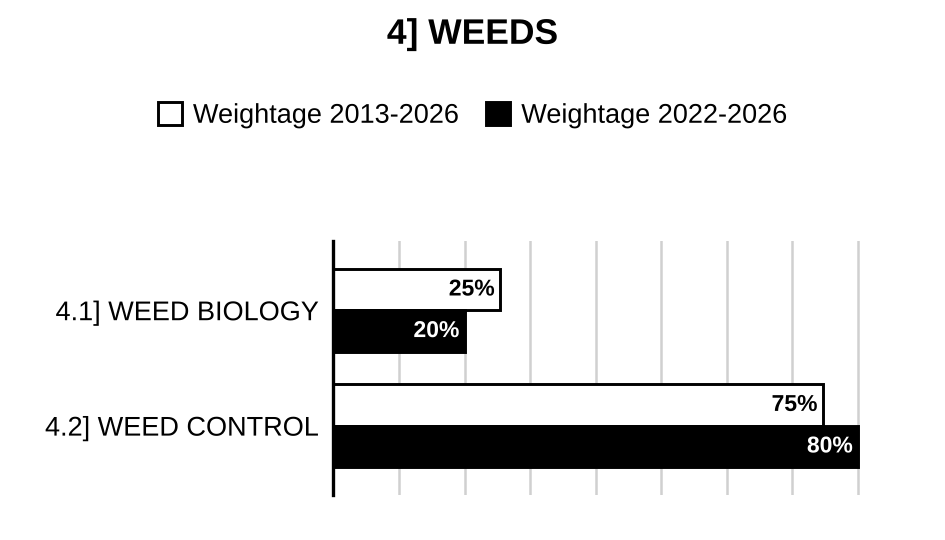
4.1] Weeds: characteristics, dissemination and association with crops
19 questions
Write down the dissemination of weeds with appropriate examples. [2026/10m/150w/1d]
Explain weed seed bank. Describe the strategies to reduce weed seeds in soil. [2025/20m/4b]
Classify the parasitic weeds on the basis of their parasitism. Explain the preventive measures and integrated management practices for Orobanche. [2023/20m/2b]
Describe the causes of increasing threats of Parthenium weed in the country. Write integrated methods of weed management with suitable examples. [2020/20m/3b]
Define crop weed competition. Describe various factors affecting crop weed competition. Explain the factors affecting the efficacy of herbicides. [2020/20m/7a]
Describe crop-weed-competition. Discuss the different factors affecting the efficiency of herbicides. [2017/20m/4a]
Explain the critical period of crop-weed competition with suitable examples. [2016/10m/3c]
Describe crop-weed competition. [2014/20m/4c]
Discuss the factors affecting crop-weed competition. What do you mean by critical period of crop-weed competition? [2013/10m/200w/2b]
Relative and Obnoxious weeds. [2013/10m/150w/3c]
Persistence of weeds. [2013/12.5m/200w/8a]
What is crop-weed competition? Give principles of integrated weed management. [2012/12m/150w/1b]
Seed Dormancy. [2009/20m/200w/1c]
Allelopathy. [2007/20m/200w/1a]
Allelopathy. [2001/20m/200w/1b]
Relative & Obnoxious weeds. [2001/15m/8b]
What is crop-weed competition? Examine the significance of critical period of weed control. Critically assess the use of herbicides in weed control in rice and wheat. [1999/60m/3]
Define plant ecology. Discuss the role of autotoxicity in crop production. [1997/60m/3]
Enumerate the ill-effects of weed competition in field crops and briefly describe the methods of their control. [1995/60m/3]

Preparing for Prelims too?
Our UPSC Prelims Topic-wise PYQ eBook covers every Prelims question with detailed explanations, so you can see exactly where UPSC asks from.
View the BookDownload Free Sample4.2] Weed control
49 questions
Suggest suitable chemical weed management practices for the following crops: (i) Maize (ii) Moong (iii) Cotton (iv) Sugarcane. [2026/10m/3c]
Explain weed control efficiency (WCE). Work out WCE from the given data and offer your critical comment:
| Sl. No. | Treatment | Weed Population/m² |
| 1 | T₁–Unweeded check | 90 |
| 2 | T₂–Hand weeding | 55 |
| 3 | T₃–Herbicide A | 45 |
| 4 | T₄–Herbicide B | 40 |
| 5 | T₅–Herbicide C | 50 |
[2025/10m/150w/1e]
Explain weed seed bank. Describe the strategies to reduce weed seeds in soil. [2025/20m/4b]
Enumerate the harmful effects of herbicide residues in soil. Discuss the remedial measures to overcome the above problem. [2025/20m/6a]
Discuss the cultural methods of weed control. [2024/10m/150w/1d]
Describe in detail about the weed control measures in Black Gram and Sesame. [2024/10m/4c]
Briefly write about cultural and chemical weed control methods of soybean and wheat. [2023/10m/150w/1d]
Classify the parasitic weeds on the basis of their parasitism. Explain the preventive measures and integrated management practices for Orobanche. [2023/20m/2b]
Discuss selection criteria of successful bioagent and bio-herbicides. State at least two examples of biocontrol of weeds. [2022/10m/150w/1d]
Discuss about the types of herbicide resistance in weeds with specific example in Indian perspective. Discuss the management practices dealing with herbicide resistance in weeds. [2022/20m/4a]
The major weeds of rice and their management practices under both upland and lowland conditions. [2021/10m/150w/1d]
Discuss the activity and selectivity of herbicides. [2021/10m/2c]
Describe the major biological control methods of weeds. [2021/10m/4c]
Describe the causes of increasing threats of Parthenium weed in the country. Write integrated methods of weed management with suitable examples. [2020/20m/3b]
Define crop weed competition. Describe various factors affecting crop weed competition. Explain the factors affecting the efficacy of herbicides. [2020/20m/7a]
Current status of biological weed management. [2019/10m/150w/1e]
Differentiate the following with example:
(i) Catch crop and trap crop. [2019/5m/2a(i)]
(ii) Narrow spectrum and broad spectrum herbicides. [2019/5m/2a(ii)]
(iii) Fodder and forage crops. [2019/5m/2a(iii)]
(iv) Social forestry and agroforestry. [2019/5m/2a(iv)]
Calculate weed index in wheat crop with the given information and draw the inference.
| Treatment | Dose (gai/ha) | Grain yield (Kg/ha) |
| T₁ – Sulfosulfuron | 25 | 5,200 |
| T₂ – Isoproturon | 750 | 5,000 |
| T₃ – 2,4-D | 500 | 4,500 |
| T₄ – Weed free | Two Hand Weeding | 5,500 |
[2019/10m/3c]
What is the phenomenon of herbicide resistance in weeds? Discuss the factors responsible for development of herbicide resistance. [2018/10m/4c]
Innovations in biological weed management. [2018/10m/150w/5a]
What are the advances in chemical weed management? [2018/10m/8d]
Describe the method of biological weed control with suitable examples. [2017/10m/2c]
Describe crop-weed-competition. Discuss the different factors affecting the efficiency of herbicides. [2017/20m/4a]
Decoy crop vs Trap crop. [2016/10m/150w/1d]
List out the factors affecting efficacy of herbicides. [2016/10m/4c]
Discuss about the factors affecting the efficacy of herbicides. [2015/20m/2b]
Write the approaches of biological weed control with suitable examples. [2015/15m/4c]
Elaborate the problems of residual toxicity of herbicide and its management. [2015/10m/150w/5c]
Describe biological weed control with suitable example. [2014/10m/150w/1e]
Write the importance of quarantine check of weed seeds in importing foodgrain. [2014/10m/3b]
Write about the factors of development of herbicide resistance in weeds. What are the management options? [2013/15m/250w/4b]
Mode of herbicidal action. [2013/10m/150w/6b]
What is crop-weed competition? Give principles of integrated weed management. [2012/12m/150w/1b]
What are the factors of herbicide selectivity? Briefly discuss about selective herbicides for rice and wheat. [2012/15m/200w/4b]
Biological weed control. [2011/15m/150w/1d]
Selective and non-selective herbicides. [2011/10m/3e]
Herbicide Residue Management. [2009/20m/200w/1b]
Define integrated weed management. Suggest integrated weed management for rice-wheat, and groundnut-pigeon pea, inter-cropping systems. [2007/60m/6]
Weed control in wheat. [2006/20m/200w/1d]
Biological methods of weed control. [2005/20m/200w/1a]
Biological control of weeds. [2004/15m/200w/1d]
Classify herbicides used for weed control with examples. Discuss the advantages and limitations of using herbicides in crop production. What precautions should be taken during their application? [2004/60m/3]
What are the losses caused by weeds? Suggest chemical control of weeds in direct sown and transplanted rice, wheat, maize, sugarcane and soybean. [2003/60m/3]
Integrated Weed Control in Wheat. [2000/20m/200w/1c]
Classification of Herbicides. [2000/20m/200w/5b]
What is crop-weed competition? Examine the significance of critical period of weed control. Critically assess the use of herbicides in weed control in rice and wheat. [1999/60m/3]
Discuss the weed menace in upland rice and suggest management methods. [1998/60m/3]
Classify the herbicides used for weed control in field crops. Discuss the integrated weed management practices for paddy-wheat rotation of North-Western India. [1996/60m/4]
Enumerate the ill-effects of weed competition in field crops and briefly describe the methods of their control. [1995/60m/3]

Strengthen your GS papers
Our UPSC Mains Topic-wise & Year-wise PYQ eBook (2013–2026) maps every GS question to the syllabus, so you know what UPSC asks and how often.
View the BookDownload Free Sample« Previous: Forestry and Agroforestry | Next: Soils and Soil Fertility »
Back to: Agriculture Optional PYQs – Topic-wise
Last updated: 30 October 2026