
Here are all 134 E.M. Theory questions asked in UPSC Electrical Engineering Optional Paper I from 1995 to 2026, arranged under the 3 topics of the official syllabus. Within each topic the latest questions come first.
Each question ends with a code such as [2024/15m/3b] – the year, the marks, the word limit (where UPSC set one) and the question number in the paper.
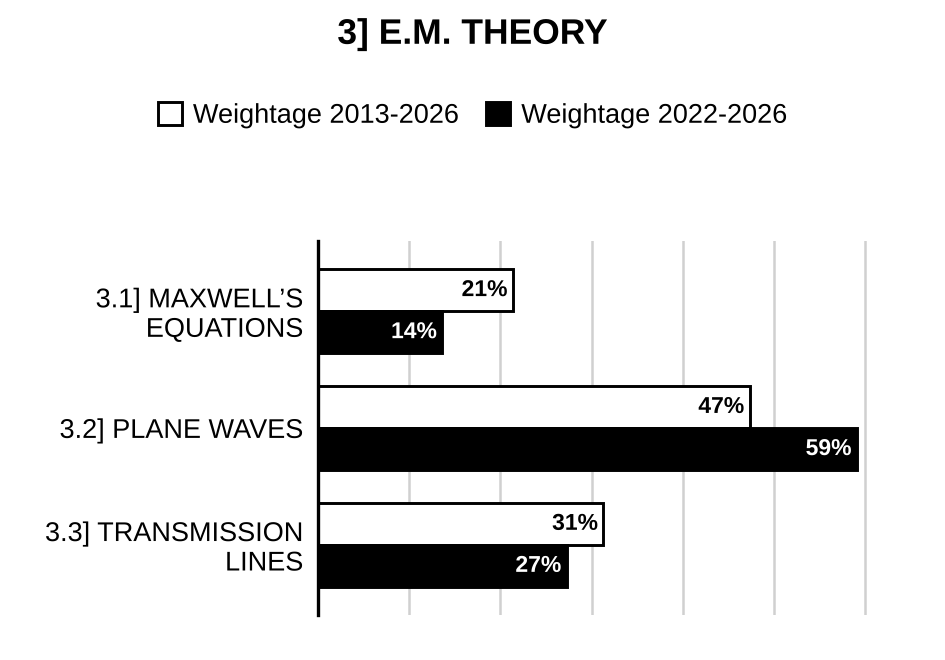
3.1] Maxwell’s equations
36 questions
Two line currents of infinite extent in the -direction are at distance apart along the -axis. The current is located at and the current is located at as shown in the figure. Find the magnetic field at any point in the plane, when the currents are equal, i.e., :
[Figure: – axes ( to the right, upward); current shown as a dot on the positive -axis and current as a dot on the negative -axis, symmetric about the origin; a double-headed arrow to the left marks the separation between them] [2026/10m/1c]
A metal bar slides over a pair of conducting rails in a uniform magnetic field with a constant velocity m/s as shown below in the figure. A resistance ‘R’ Ω is connected between terminals 1 and 2. Prove that this system upholds the principle of conservation of energy. Neglect the electrical resistance of the metal bar and the pair of conducting rails, and the mechanical friction of this ideal system.
[Figure: Two parallel conducting rails along the X-axis, separated by h meters (Y direction); resistance R connected between the rail ends at terminals 1 (upper rail) and 2 (lower rail) on the left; a metal bar lies across the rails and moves with velocity in the +X direction; uniform magnetic field shown as dots (out of the page, +z) over the region between the rails.] [2023/10m/1e]
Evaluate both sides of Stokes theorem for the field and for the open surface defined by , , . [2022/10m/7c]
In a certain material with , and , the magnetic field intensity component is given by Find the following: (i) Displacement current density (ii) Electric field intensity. [2021/10m/5b]
A parallel plate capacitor is made of circular discs of radius 0.1 m. The medium inside is air. The spacing between the two plates is 0.05 m. A voltage of volts is applied between the two plates. Find the rms value of the displacement current flowing through the capacitor using Maxwell’s equations. Also show that the rms value of the total capacitor current calculated from voltage equation is same as the displacement current. Assume permittivity of free space . [2020/10m/5b]
(i) A two-dimensional electric field is given by . Show that this electric field cannot arise from a static distribution of charge. (ii) A transmission line of length 5 m is tested at a frequency of 20 MHz. When the far end of the line is short circuited, the impedance measured at the sending end is 4.61 Ω and when the far end is open circuited, the impedance becomes 1390 Ω. Calculate the characteristic impedance and propagation constant of the line. [2019/10m/4c]
(i) Derive the Maxwell’s equation for time varying magnetic field based on Ampere’s circuital law. (ii) A parallel plate capacitor with plate area of and plate separation of 3 mm has a voltage of V applied to its plates. Calculate the displacement current assuming . [2018/10m/5d]
The electric field and magnetic field in free space are given by Express these fields in phasor form and determine the constants and such that these fields satisfy Maxwell’s equations. The permeability and permittivity of the free space are and respectively. [2017/20m/7a]
Derive an expression for Maxwell’s equation in integral form from Ampere’s law. [2016/10m/1c]
Starting from Maxwell’s equations show that and . [2014/10m/1b]
The net power flowing out of a given volume is equal to the time rate of decrease in the energy stored within minus the conduction losses. Derive equations to explain. [2014/20m/2a]
A conductor is charged by repeated contacts with a metal plate which, after each contact, is recharged to a quantity of charge by connecting it to a constant voltage source. If is the charge of the conductor after the first operation, show that the ultimate charge on the conductor is . [2013/10m/1c]
Write the Maxwell’s equations including the continuity equation in vector form for time-varying fields in general medium naming each of them. [2013/5m/1e(i)]
Three small spheres each carrying a charge are placed on the circumference of a circle of radius to form an equilateral triangle. Find the electric field and the potential at the centre of the circle. [2011/15m/1c]
Fig. 3 (b) shows two identical parallel-plate capacitors connected to a battery with switch closed. The switch is opened and the free space between the plates of the capacitors is filled with a dielectric of dielectric coefficient . Find the ratio of the total electrostatic energy stored in both capacitors after the introduction of the dielectric.
[Figure: Fig. 3 (b): Battery V connected directly across capacitor ; capacitor connected in parallel with through switch S in its upper lead (S between the top of and the top of )] [2011/20m/3b]
Draw the field lines and equipotential surface when a point charge is placed near an infinite grounded conducting plane. [2007/10m/7a(i)]
Derive the expression for the force between the point charge and the conductor with the help of the above concept. [2007/5m/7a(ii)]
Explain the cause of polarisation in a dielectric. [2007/5m/7a(iii)]
Given in a region, where k is a constant. Find the time average Poynting vector. [2006/5m/1b(ii)]
Prove that if at t = 0 there is a charge density inside a conductor, then seconds later the density will decrease to . For copper ( S/m), calculate this time. [2006/5m/6a(ii)]
Write the integral form of Maxwell’s equations and identify each equation with the proper experimental law. [2002/20m/1b]
Figure below shows a coil of N turns placed in a time varying flux ϕ(t), The coil direction is such that for the direction of current i (as shown) in the flux direction is an indicated in the figure. Assume infinite conductivity of the conductor of the coil. Using relevant Maxwell’s equation obtains an expression for e. Indicate how this expression will be in conformity with Lenz’s law.
[Figure: A coil of N turns wound helically around a vertical flux path carrying flux ϕ(t) (arrow pointing upward); the top end of the coil is connected by a wire to the upper terminal on the left, current i flowing along this wire (arrow pointing right, from the terminal towards the coil); the bottom end of the coil is connected to the lower terminal; the emf e is marked between the two terminals with an arrow pointing up towards the upper terminal.] [2001/20m/5b]
Determine the electric field in the overlap region of two spheres A and B shown in the above figure. Sphere A carries a charge and the sphere B, a charge of .
[Figure: Two overlapping spheres (drawn as circles): Sphere A on the left with radius a m, Sphere B on the right with radius b m; their centres are a distance d m apart (dimension line between the two centres); the two spheres overlap in a lens-shaped region between the centres] [1999/20m/1c]
Determine the emf induced in the triangular loop ABC due to the flux set up by a sinusoidal current flowing in an infinitely long wire shown in the above figure.
[Figure: An infinitely long straight vertical wire (“Long wire”) carrying current (arrow upwards); in the same plane a right-angled triangular loop ABC: vertex A at a distance a from the wire, vertex C at a distance b from the wire on the same horizontal line (side AC horizontal, perpendicular to the wire), vertex B vertically above C at a height c (side BC parallel to the wire); hypotenuse AB] [1999/20m/3b]
Two conductors have a potential coefficient matrix Each conductor is given a charge 1 C. One of the conductors is then momentarily grounded. Thereafter it is connected to the other conductor. Determine the final potential of the composite conductor. [1999/20m/3c]
There are three concentric conducting spherical surfaces of radii a, b and c (). The sphere of radius b carries a charge Q and the surfaces of spheres of radii a and c are grounded. Find the potential of the sphere of radius b. [1998/20m/1a]
State Faraday’s Law of induction. A rectangular loop of sides a, b has its plane normal to a magnetic flux density of strength , . What is the voltage induced in the loop? [1998/15m/3c]
Two perfectly insulated condensers are connected in series. One is an air condenser with a plate area of 100 and the plates being 1 mm apart; the other has a plate area of 10 , the plates being separated by dielectric of 0.1 mm thick with a permittivity of 5. Find the voltage across the combination if the potential gradient in the air condenser is 20 KV per cm. [1998/20m/6c]
A charge Q is distributed over two concentric hollow spheres of radii r and R () such that their surface densities are equal. Find the potential at the common centre of spheres. [1997/20m/1b]
A 10 kV is applied across an air-filled capacitor formed by two parallel plates with a separation of 1.2 cm. A glass sheet of 2mm thickness and of 6.5 relative permittivity is inserted in the air dielectric and kept on one plate. Find the capacitance per unit area of the parallel plates along with the glass, the electric field intensities in air glass dielectric, and the charge density on the plates. [1997/20m/2a]
A hollow cylindrical conductor of length L and radius R and carrying a surface current of density A/m is placed in a B-field given by Find the magnitude and direction of torque on the conductor. [1996/20m/1b]
A 2 μC charge is located at (0, 3, 0) m and a 4 μC charge at (4, 0, 0) m. Find the electric field at (0, 0, 5) m due to both these charges. [1996/20m/3b]
Consider the electric field due to an infinitely long uniform line charge. Show that the divergence of this field is zero. [1995/20m/1a]
Consider an electric displacement vector in cylindrical coordinates r, φ, z. Calculate the outward flux crossing a right circular cylinder of radius , its axis coinciding with the z-axis and with the two plane faces at and , where cm. [1995/20m/3a]
Derive an expression for the inductance per unit length of a coaxial cable with radii a and b. Also calculate the value when cm and cm. [1995/20m/3b]
A 2 m long current carrying conductor is aligned in y-direction, its x-and z-coordinates being 5 m each. The current is 8 A in the negative y-direction. The conductor is subjected to a uniform magnetic field and the resulting force on the conductor is . Find the magnetic flux density (of the applied field). [1995/20m/3c]

Preparing for Prelims too?
Our UPSC Prelims Topic-wise PYQ eBook covers every Prelims question with detailed explanations, so you can see exactly where UPSC asks from.
View the BookDownload Free Sample3.2] Plane waves and boundary conditions
60 questions
A uniform plane wave in air is normally incident onto a lossless dielectric plate of thickness and intrinsic impedance . Determine the standing wave ratio in front of the plate. [2026/10m/2c]
As shown in the figure, just inside the surface of a dielectric slab, the electric field () is 15 V/m and it makes an angle of 30° with the surface. The electric field () makes 65.5° angle with the surface, just above the surface. Determine the magnitude of and the dielectric constant of the slab.
[Figure: Horizontal interface between region (1) below (dielectric slab) and region (2) above. In region (1), field arrives at the interface making 30° with the surface; in region (2), field leaves making 65.5° with the surface; the normal component (vertical arrow) and the tangential component (horizontal arrow) are shown; a dashed vertical normal line continues below the interface] [2025/10m/5a]
It is given that in free space .
(i) Determine , and . Plot and at . State clearly if any assumption is made. [2025/10m/7a(i)]
(ii) Show that these and fields constitute a wave travelling in the z-direction. Also demonstrate that the wave speed and E/H depend solely on the properties of free space. Given: , and . [2025/10m/7a(ii)]
In the figure given below, determine the amplitudes of the reflected and transmitted and at the interface, if in region 1, where , and . Given: Region 2 is a free space and assume normal incidence. Also, and .
[Figure: Vertical planar interface (hatched line). Left side, region 1 (, ): incident wave with field (upward arrow) travelling towards the interface (direction , arrow pointing right) and reflected wave with field (upward arrow) travelling away from it (direction , arrow pointing left). Right side, region 2 (, ): transmitted wave with field (upward arrow) travelling to the right (direction )] [2025/10m/8a(ii)]
A uniform plane wave travels in vacuum along direction. The electric field of the wave at some instant is given as . Find the vector magnetic field . (Given, , ) [2024/10m/5a]
A medium has infinite conductivity for , and , and for . The electric field for is given as , as shown below. Determine the surface charge density and surface current density at location (3, 4, 0) at . Given, , :
[Figure: A perfectly conducting boundary (hatched) at ; the -axis points upwards and the field is drawn as an upward arrow (along ) standing on the surface .] [2024/10m/7c]
In the figure given below, region 1 is the side of the plane containing the origin and in this region, . In region 2, . It is given that . Determine and . Given, :
[Figure: – plane with origin O; the plane drawn as a hatched line from the -axis to the -axis; region ① () on the origin side below the line, region ② () above it.] [2024/20m/8a]
An absorber material of relative permeability and relative permittivity of is coated on a perfectly conducting sheet and this combination is placed in free space as shown in the figure given below. A 500 MHz wave is incident on it normally from free space. Calculate the thickness of the absorber required to attenuate the reflected wave by 30 dB.
[Figure: Incident wave arriving normally from Free Space (left) onto a slab of Absorber material backed by a Conducting sheet (hatched) on the right; the absorber thickness is marked by a double-headed dimension arrow.] [2023/20m/6b]
The plane wave in air normally hits a lossless medium (, ) at . (i) Find reflection coefficient (), transmission coefficient (), standing wave ratio (S). (ii) Calculate the reflected electric and magnetic fields. [2022/20m/6a]
The magnetic field intensity of a linearly polarized uniform plane wave propagating in the +Y-direction in sea water (, , ) is At , determine the following: (i) The attenuation constant, intrinsic impedance, the wavelength and skin depth. (ii) The location at which the amplitude of H is 0.01 A/m. (iii) The expression for and at (m) as functions of t. [2021/20m/6a]
A uniform plane wave travelling in air is having an electric field of 50 V/m and is normally incident on an infinitely thick slab of dielectric constant 10. Find the electric and magnetic fields just inside the slab surface. Also find the penetrated power inside the slab and the reflected electric and magnetic fields from the slab surface. Assume and . [2020/10m/7c]
Two extensive homogeneous isotropic dielectrics meet on a plane at z = 0. For z > 0, and for z < 0, . A uniform electric field exists for . Find: (i) for (ii) The energy densities (in ) in both dielectrics. [2019/10m/1b]
An aeroplane flies over the surface of the ocean for which σ = 4 S/m, and . The aeroplane transmits the signal in the form of 1 MHz plane wave having an electric field intensity of 1000 V/m and propagating vertically downward. If a submarine requires a minimum signal of 20 μV/m for adequate reception, determine the maximum communication depth of the submarine. [2019/20m/6a]
A travelling field in the free space of amplitude 100 V/m strikes a perfect dielectric as shown in Figure 7(a)(i). Determine the value of .
[Figure: Figure 7(a)(i): A dielectric slab (, , ) of thickness 1 mm between planes A and B, with free space on both sides. On the left (free space) the incident field , labelled , is drawn as an upward arrow with a dot-in-circle symbol (field into/out of the page) and a wavy arrow showing propagation to the right towards the slab; on the right (free space) the transmitted field is drawn as an upward arrow with a dot-in-circle symbol and a wavy arrow propagating to the right away from the slab] [2018/10m/7a(i)]
A uniform plane wave in air partially reflects from the surface of a material whose properties are unknown. Measurements of the electric field in front of the interface region yield a 1.5 m spacing between maxima, with the first maximum occurring 0.75 m from the interface. A standing wave ratio of 5 is measured. Determine the intrinsic impedance of the unknown material. [2018/10m/7a(ii)]
(i) Determine the propagation constant for a material having , and , if the wave frequency is 1.6 MHz. (ii) Find the skin depth at a frequency of 1.6 MHz in aluminium, where and . Also find and the wave velocity . [2016/20m/4b]
If a propagating wave in free space has a potential gradient at any point as then determine— (i) the vertical direction of propagation; (ii) the wavelength of the propagating wave; (iii) the frequency of the propagating wave; (iv) the phase velocity and phase velocity vector. What are the apparent velocities and wavelengths along , and directions? [2016/10m/4d]
A voltage of a wave travelling in a non-magnetic medium is given by the equation . Find: (a) , (b) The time-average power carried by the wave. [2015/10m/1b]
Derive Helmholtz equation in terms of magnetic field. [2014/20m/3b]
Plane monochromatic waves are propagated parallel to the -axis in both positive and negative directions. At the origin, the field strengths are given by Calculate the mean intensity of the radiation in each of the two directions in terms of , and the constants of the medium. [2013/20m/3a]
Show that the energy stored in a plane electromagnetic wave is equally divided between the electric and magnetic fields. [2013/20m/3b]
A particular lossless material has and . A 10 MHz uniform plane wave is propagating in the direction with V/m and at P(0.6, 0.6, 0.6) at ns. Determine:– (i) , , and (ii) (iii) . [2012/20m/3b]
A uniform plane wave is described by the phasor A/m. If the velocity of the wave is m/s and the relative permeability is 1.8, determine the frequency, relative permittivity, wavelength and electric intensity. [2011/20m/3c]
A plane wave has and in free space, satisfying Maxwell’s equations. Find the general expressions for phase constant and intrinsic impedance , in terms of medium parameters. Hence, calculate their values at 10 MHz. Identify the direction of propagation and type of polarization. [2010/10m/3c(i)]
A lossy non-magnetic medium has and a phase constant of 0.10 rad/m at 2.0 MHz. Determine its loss tangent, conductivity, propagation constant, intrinsic impedance and skin depth. [2010/10m/7c(i)]
A plane wave having is normally incident on a medium of , and , from a perfect dielectric medium of . Find the reflection and transmission coefficients, phase constants and list out the time-domain expressions for incident, reflected and transmitted electric fields. [2010/10m/8c(i)]
A plane wave in free space () is incident normally on a large block of material with , and which occupies . If the incident electric field is determine– (i) the standing wave ratio; (ii) the reflected magnetic field. [2009/20m/3c]
Define the following: Skin depth; Intrinsic impedance; Phase velocity; Group velocity; Surface impedance. [2009/10m/5d(i)]
In a medium Determine the skin depth. [2009/5m/5d(ii)]
Write the Maxwell’s equation in a lossy dielectric and explain that the electric field leads the magnetic field in time phase. [2007/10m/3a(i)]
Explain the term intrinsic impedance and its value in free space. [2007/5m/3a(ii)]
From Maxwell’s equation state the significance of the term . What will be its value for a good conductor and a good dielectric? [2007/5m/3a(iii)]
At great distances from the Hertzian dipole antenna the EM fields resemble those of a uniform plane wave. Write the similarities and differences (at least five points). [2006/10m/1d(ii)]
List in ascending order the frequencies of the five lowest (frequency) modes of an air–filled rectangular cavity of dimensions 5 × 4 × 2.5 cm. [2006/5m/4a(iii)]
A plane wave is normally incident on a half-space of copper. If f = 2 GHz, calculate (1) propagation constant, impedance and skin depth for the conductor. (2) reflection and transmission coefficients. Given S/m. [2006/5m/7a(iii)]
Calculate the depth of penetration for copper at 1 MHz. The conductivity for copper is and permeability is [2005/5m/1d(i)]
A parallel plate waveguide consists of two parallel perfectly conducting infinite planes situated 8 cm apart. Determine the propagating for a wave of 6000 MHz, assuming free space between the plates. Find also the cut-off frequency , waveguide wavelength , waveguide intrinsic impedance . [2005/9m/2a(ii)]
Explain boundary conditions for time-varying fields. [2005/5m/4a(ii)]
An air-filled rectangular waveguide of dimension a = 4 cm, b = 2 cm, transports energy in the dominant mode at a rate of 2 mW if the frequency of operation is 10 GHz. Determine the peak value of electric field in the waveguide. [2005/5m/5a(iv)]
Obtain the three-dimensional wave equation for an absorbing medium, assumed to be both magnetically and electrically homogenous and isotropic. The charge density in the field may be assumed to be zero. Hence, determine the wave equation if the field is varying harmonically with time. [2005/8m/6a(ii)]
For plane waves in free space, show that the intrinsic impedance of free space is given by . [2004/10m/5b(i)]
A TEM wave travels in free space with the electic field component V/m. Determine ω and λ. [2004/10m/5b(ii)]
What are the criteria for a material to be an imperfect di-electric or a good conductor? Write Maxwell’s equations in terms of phasors for sinusoidally varying electromagnetic fields. Consider a uniform plane wave in an isotropic and homogeneous medium, and show that the electric and magnetic field are not in time phase. [2003/15m/5a(i)]
A uniform plane wave is traveling at a velocity of 3.0 10 m/s [?] in a non-magnetic good conductor and its wavelength is 0.35 mm. Find the frequency of the wave, and the conductivity and the intrinsic impedance of the conductor. [2003/5m/5a(ii)]
A rectangular hollow metal waveguide of internal cross-section 7366 cm × 3.556 cm carries a 3 GHz signal in the mode. Calculate the maximum power handling capability of the waveguide assuming the maximum permissible electric field inside the waveguide to be 30 kV/cm. [2003/10m/6b(i)]
What is uniform plane wave? Define all the parameters associated with it. What is meant by group velocity? A uniform plane electro-magnetic wave travelling in region 1(, , ) is incident normally on a plane boundary separating the region 2(, , ), How are the reflected and the transmitted waves at the interface related to the incident wave? [2003/20m/7a]
A standard air-filled rectangular waveguide with dimensions a = 8.6 cm and b 4.3 cm is fed by 4 GHz carrier from a coaxial cable. Determine if a mode will be propagated. If so, calculate the phase velocity and the group velocity. [2002/20m/6a]
In a certain region with , and , the magnetic field of an EM wave is Find the phase constant β and the corresponding (electric field) using Maxwell’s equations. [2002/20m/6c]
In a non-magnetic medium Find.
(i) relative permittivity and intrinsic impedance. [2002/10m/7c(i)]
(ii) the time average power carried by the wave. [2002/10m/7c(ii)]
Define a uniform plane wave, Show that a uniform plane wave progressing in x-direction does not have the x-component of E. Explain what does this mean physically. [2001/20m/4a]
A rectangular wave guide has cross-sectional area a = 7 cm and b = 4 cm. Obtain all TE modes that will propagate frequency less than 5 GHz. How these modes are designated and what are the corresponding cut-off frequencies. [2001/20m/4c]
What is the order of magnitude of velocity of an electromagnetic wave in a good conductor as compared to sound wave in air? Discuss. Calculate the depth of penetration of a MHz wave into copper which has and permeability equal to that of free space. [2001/20m/6a]
.
(i) Justify that a thin sheet of a conducting material acts as a low-pass filter for electromagnetic waves. [2000/10m/1b(i)]
(ii) A radio signal at a frequency of 20 MHz is transmitted through sea-water having and . Find the distance at which 80% of the wave amplitude is attenuated. [2000/10m/1b(ii)]
.
(i) Explain the phenomenon of attenuation in TE and TEM waves. [2000/10m/6a(i)]
(ii) Determine the guide wavelength to propagate a 20 GHz signal through a parallel plate waveguide having a plate separation of 5 cm. [2000/10m/6a(ii)]
Enumerate the salient features of wave guides with diagrams based on band width and power handling capabilities. [1999/20m/11c]
Select any Three of the following statements and indicate with justification whether they are correct or incorrect. Your answer must not exceed 200 words for each statement: The dominant mode of propagation in a rectangular waveguide is TEM. [1998/20m/200w/9c]
Find the required size of a cubic cavity resonator to have a dominant mode at 8 GHz. Name the dominant modes for this cavity. [1997/20m/12a]
An aeroplane flies over the surface of the ocean and sends a 1 MHz plane wave vertically downwards with a field intensity of 1000 V/m just at the ocean surface. If a submarine requires a 10 μV/m field, how deep can it be submerged and still be contacted by the aeroplane. The ocean water constants are S/m, and . [1996/20m/3a]
The phase velocity of a wave of frequency f and wavelength λ is given by where c and are constants. Derive an expression for the group velocity in terms of and . [1996/20m/3c]
What is resonator? Define and obtain expression for the Q-factor of a parallel plate resonator. The parallel plates of a resonator are 1.5 cm apart and have free space in between them. Find Q of the resonator for fundamental frequency of oscillations. For copper S/m, H/m. [1995/20m/11a]
3.3] Transmission lines
38 questions
The outer diameter of the inner conductor and the inner diameter of the outer conductor of a coaxial copper transmission line are 2 mm and 7 mm, respectively. Both the conductors have thickness much greater than the skin depth. The dielectric is lossless and the operating frequency is 400 MHz. Calculate the resistance per meter length of the transmission line. The resistivity and relative permeability of the copper are approximately and 1, respectively. [2026/10m/3c]
A lossless transmission line is 50 cm in length and operating at a frequency of 100 MHz. The line parameters are and . The line is terminated in a short circuit at and there is a load across the line at . What average power is delivered to the load , if the input voltage is 100 V? [2026/10m/4c]
Show that the Smith chart constructed for a lossless transmission line gives a family of r-circles, having a radius of for each circle which is centred at and . Here, = normalized resistance of the load impedance, and = real and imaginary parts of voltage reflection coefficient of the load impedance, respectively. [2025/10m/8a(i)]
A transmission line is 25 m long. It has characteristic impedance and operates at 2 MHz. The line is terminated with a load of . If the wave velocity is (with ) on the line, determine (i) the reflection coefficient and (ii) the input impedance. [2024/10m/5e]
When a transmission line of characteristic impedance 50 Ω is short-circuited at the termination, the voltage minima were found to be 25 cm apart. If the short circuit is replaced by unknown load impedance Ω, the minima shifted 8 cm towards the load and the standing wave ratio was found to be 4. Calculate the unknown load impedance . [2023/10m/5d]
An ideal lossless extension line of is terminated with a load resistance of 60 Ω. Find the value of . [2022/10m/5b]
A lossless transmission line has characteristic impedance . Its length is 30 m and operates at 5 MHz. The line is terminated with a load . If the phase velocity on the line, find the following: (i) The reflection coefficient ‘’ (ii) The standing wave ratio ‘S’ (iii) The input impedance ‘’ [2021/10m/7c]
Under what conditions do the attenuation constant α and the velocity of propagation v, for a distortionless transmission line, become independent of the frequency simultaneously? Why is it not practical to have such a transmission line? [2020/20m/6a]
A lossless line has a characteristic impedance of 50 Ω and is terminated in a load resistance of 75 Ω. The line is energized by a generator which has an output impedance of 50 Ω and an open circuit output voltage of . The line is assumed to be 2.25 wavelength long. Determine: (i) The output impedance (ii) The magnitude of the instantaneous load (iii) The instantaneous power delivered to the load. [2019/10m/2b]
(i) A two-dimensional electric field is given by . Show that this electric field cannot arise from a static distribution of charge. (ii) A transmission line of length 5 m is tested at a frequency of 20 MHz. When the far end of the line is short circuited, the impedance measured at the sending end is 4.61 Ω and when the far end is open circuited, the impedance becomes 1390 Ω. Calculate the characteristic impedance and propagation constant of the line. [2019/10m/4c]
A low loss transmission line has characteristic impedance and is terminated by another impedance of . The wavelength on the line is 2.5 m. Find: I. SWR (Standing Wave Ratio) II. Maximum and minimum line impedance, and [2018/10m/2b(i)]
If the input impedances of a short and open circuited transmission line of length 1.5 m are and respectively, determine the characteristic impedance and propagation constant of the line. [2018/10m/2b(ii)]
Show that for a distortionless transmission line, the attenuation constant does not depend on frequency, whereas the phase constant depends linearly on it. [2017/10m/1c]
(i) What is meant by an infinite transmission line? Also, explain the term ‘electrical length’ of a transmission line. In what units is it measured? (ii) Determine the electrical length of a 20 m long transmission line operating at 1 MHz, if on the line. Take . [2017/20m/2b]
(i) A transmission line has the following parameters: , Determine the voltage standing wave ratio and reflection coefficient of the line. (ii) (1) Write the significance of Smith chart. (2) Find the length of of the 100 Ω transmission line which converts a load impedance to a pure resistance. Also find the value of the resistance . Assume VSWR = 2.6. [2016/20m/3b]
A distortionless line has , , where c is the velocity of the wave in vacuum. Find R, L, G, C and at 100 MHz. [2015/20m/3b]
A lossless transmission line with air dielectric is 12 m long. What is the line length in wavelengths and what is the value of the phase constant at 15 MHz? [2013/10m/3c]
A lossless transmission line having a length of 100 metre is terminated by a resistive load of 200 ohms. It is fed by a generator of voltage volts and has impedance 100 ohms. If characteristic impedance of the line is 300 ohms, calculate the transmission loss and return loss in decibels. [2012/12m/1d]
A 50 ohm lossless line connects a matched signal of 100 kHz to a load of 100 ohm. Load power is 100 mW. Estimate: (i) Voltage reflection coefficient of load. (ii) VSWR of the load. (iii) Position of first and . (iv) Impedance at and and values of and . Define the terms Attenuation loss, Reflection loss, Transmission loss, Return loss and Insertion loss. [2012/20m/4b]
Determine the primary constants of a 50-ohm lossless line at 100 MHz, if it has a phase constant of 3.14 rad/m. Sketch its π-type equivalent circuit. Is this a distortionless line? [2010/5m/1d(i)]
Find the reflection coefficient and VSWR of a 75 Ω rf line terminated in each case with a load of (1) short circuit, (2) open circuit, (3) and (4) , and compare the results with those of matched load. What is the shortest length of such a line to produce an input reactance of , if its propagation constant is ? [2010/7m/4c(i)]
A lossless coaxial cable has the two-conductor diameter ratio of 2.0. Find its inductance, capacitance and , assuming a filling of dielectric with . [2010/3m/4c(ii)]
A 50-ohm lossless line is terminated with a dipole of input impedance . Find the reflection coefficient, VSWR, and estimate the reflected and transmitted powers, if the input power to the line is 10 W. Also calculate the maximum and minimum impedances on the line, and suggest two methods of matching such a load to the line appropriately. [2010/10m/5d(i)]
What is characteristic impedance of a transmission line? Write the expression of characteristic impedance of lossless line and distortionless line in terms of the primary constants , , , of the transmission line. What is the relation between characteristic impedance and input impedance of a matched line? [2009/8m/8c(i)]
Explain the use of quarter-wave transformer for transmission line matching. [2009/6m/8c(ii)]
A lossless transmission line having characteristic impedance of 500 Ω is connected to a load . Determine the reflection coefficient and transmission coefficient. [2009/6m/8c(iii)]
A certain microstrip line has the following parameters: , h = 8 mils, t = 2.8 mils, W = 10 mils. Calculate the characteristic impedance of the line. [2007/10m/6c(i)]
An airline has characteristic impedance of 75 ohms and phase constant of 3 rad/m at 100 MHz, Find the inductance and capacitance per meter of the line. [2006/5m/2a(iii)]
A lossless parallel strip line has a conducting width W. The substrate dielectric constant is 10 and has a thickness of 4 mm. Calculate the value of W to have a characteristic impedance of 75 Ω and also the line capacitance. [2006/5m/5b(ii)]
A transmission line of characteristics impedance is terminated by load impedance . Find voltage standing wave ratio VSWR, minimum impedance and maximum impedance . [2005/5m/1a(iii)]
Explain test setup for VSWR measurement. [2005/10m/7c(ii)]
A microstrip line is to be designed on alumina substrate having relative dielectric constant . The W/h ratio = 0.95. Compute (i) effective relative dielectric constant (ii) characteristic impedance (iii) phase velocity (iv) guide wavelength. [2004/20m/6c]
A loss-less transmission of length m and characteristic impedance ohm is excited at both the ends as shown in the above figure. Determine the currents delivered by the two sources. Determine also the current at the mid-point of the line.
[Figure: A two-conductor loss-less line of length m (dimension line under the line); at the sending (left) end an a.c. voltage source (+ terminal to the upper conductor, − to the lower conductor) and at the far (right) end a second a.c. voltage source (+ terminal to the upper conductor, − to the lower conductor); each source carries a label of the form [?] (labels too blurred in the source to be read with certainty)] [1999/20m/2a]
Draw the input impedance variation of an o.c. lossless line of characteristic impedance (purely resistive) when the length varies from zero to . Indicate the nature of the impedance at every 0.2 separation. [1998/20m/11b]
Describe a method of measuring impedance at microwave frequencies. [1998/20m/11c]
Define the attenuation coefficient and phase coefficient in the context of a transmission line. A correctly terminated transmission line has , dB/m and /m (with usual notations). The line is 5 m long and is fed from a 600 Ω source of e.m.f. 3V. Find the magnitude of the received current at the output and its phase relative to the input voltage. [1997/20m/3a]
Select any three of the following statements and indicate with justification whether they are correct or incorrect. Your answer must not exceed 200 words for each statement. In comparison with wave-guides and co-axial lines, strip line has reduced bulk, lower bandwidth, higher power-handling capability and components made of it are readily adjustable. [1996/20m/200w/9c]
What is the importance of impedance matching in RF transmission lines? Explain single stub-matching and double stub-matching. A loss-less line has a characteristic impedance of 75 ohms and is terminated in a load of 300 ohms. The line is energised by a generator which has an open circuit voltage of 20 V (r.m.s) and output impedance of 75 ohms. The line is assumed to be wavelengths long. Determine: (i) the input impedance (ii) the magnitude of instantaneous load voltage, and (iii) the instantaneous power delivered to the load. [1996/20m/11a]

Strengthen your GS papers
Our UPSC Mains Topic-wise & Year-wise PYQ eBook (2013–2026) maps every GS question to the syllabus, so you know what UPSC asks and how often.
View the BookDownload Free Sample« Previous: Signals and Systems | Next: Analog Electronics »
Back to: Electrical Engineering Optional PYQs – Topic-wise
Last updated: 30 October 2026