
Here are all 158 Engines questions asked in UPSC Mechanical Engineering Optional Paper II from 1995 to 2026, arranged under the 5 topics of the official syllabus. Within each topic the latest questions come first.
Each question ends with a code such as [2024/15m/3b] – the year, the marks, the word limit (where UPSC set one) and the question number in the paper.
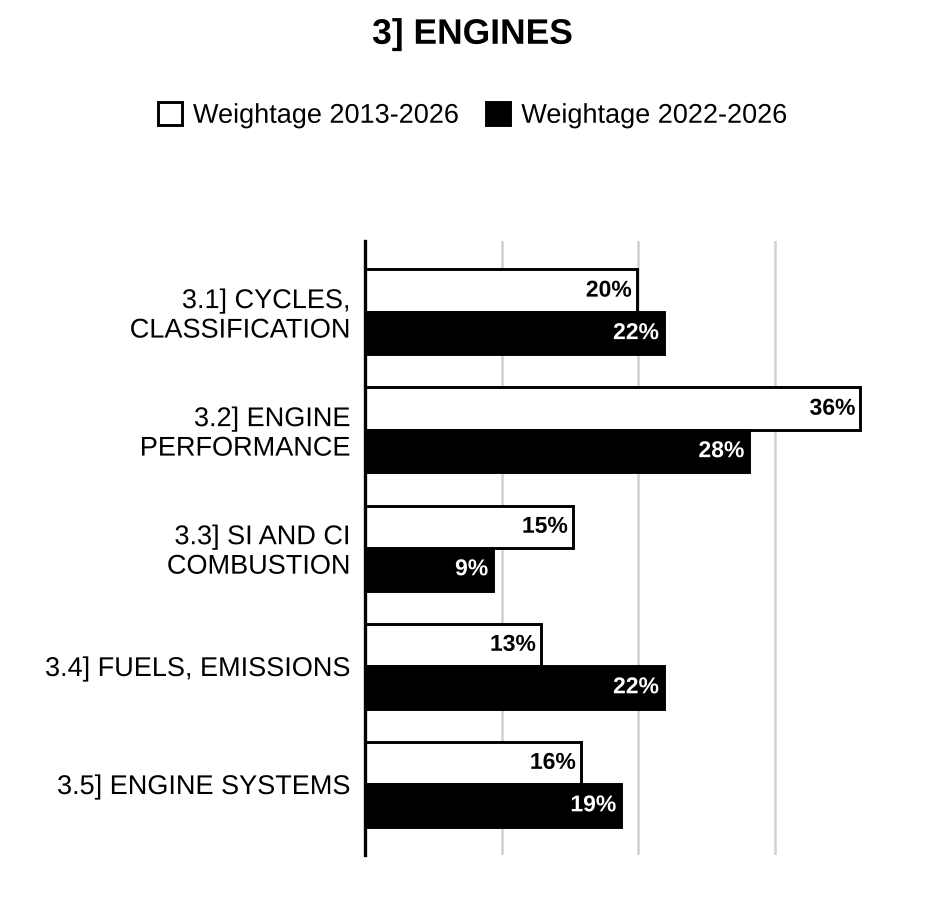
3.1] Engine classification and cycles
24 questions
In an Otto cycle, the pressure and temperature at the beginning of compression are 1 bar and 47 °C, respectively. Calculate the theoretical thermal efficiency of this cycle, if the pressure at the end of the compression is 15 bar. The peak temperature during the cycle is 2100 K. Calculate– (i) the heat supplied per kg of air; (ii) the work done per kg of air; (iii) the pressure at the end of expansion. Take and . [2026/20m/6a]
A single-cylinder, two-stroke, high-speed diesel engine working on ‘dual cycle’ has a compression ratio of 15 : 1. The engine takes in atmospheric air at 1 bar and 27 °C. The maximum temperature in the cylinder is 1312 K. The cutoff ratio is 1.093. The engine has a bore of 200 mm and stroke length of 250 mm. The engine speed is 3000 r.p.m. Calculate the following: (i) The cycle efficiency (ii) The net work output per unit mass of air (iii) The power output (iv) The mean effective pressure (v) The ratio of heat added in the constant-pressure process to that in the constant-volume process Draw the P-V and T-s diagrams of the cycle. For air, , kJ/kg-K. [2025/20m/6a]
An SI engine working on the Otto cycle has cylinder bore of 210 mm and stroke length of 240 mm. The clearance volume is 1550 cc. The pressure and temperature at the beginning of compression are 1 bar and 17 °C respectively. The maximum pressure of the cycle is 50 bar. Determine the pressure and temperature at the salient points in the cycle, the air-standard efficiency, the work done and the mean effective pressure. Show the cycle on – and – diagrams. Evaluate the fuel consumption in kg/kWh, if the calorific value of the fuel is 40 MJ/kg. Take and of air as 1.005 kJ/kg-K and 0.718 kJ/kg-K respectively. [2023/20m/8a]
An IC engine working on an ideal Otto cycle has AFR of 15 : 1 and compression ratio of 9 : 1. The pressure and temperature at the start of compression are 1 bar and 27 °C, respectively. Find the maximum temperature and pressure of the cycle. Assume that compression process follows the law , the calorific value of fuel is 43000 kJ/kg and of working fluid is 0.717 kJ/kg-K. [2022/10m/7a(ii)]
Combustion in a diesel engine is assumed to begin at inner dead centre and to be at constant pressure. The air-fuel ratio is 27 : 1, the calorific value of the fuel is 43000 kJ/kg, and the specific heat (at constant volume) of the products of combustion is given by: kJ/(kg K) R for products = 0.287 kJ/(kg K) If the compression ratio is 15 : 1, and the temperature at the end of compression is 870 K, determine the percentage of stroke at which combustion is completed. [2021/10m/1e]
An oil engine operating on air-standard dual cycle has cylinder bore of 250 mm and stroke length of 300 mm. The compression and expansion ratios are 10 and 6 respectively. The initial pressure and temperature of air before compression are 1.0 bar and 27 °C respectively. The heat added at constant pressure is twice the heat added at constant volume. Determine the pressure and temperature at all the salient points in the cycle, and the air-standard efficiency of the cycle. Also, calculate the clearance volume of the engine. Draw the P-V diagram of the cycle. Take, for air, and . [2020/20m/6a]
Explain why most of the medium-sized automobile engines are close to square shape with the cylinder bore diameter approximately equal to the stroke length. [2020/10m/7c]
An engine working on ideal diesel cycle has a compression ratio of 15 : 1. The temperature of air at the beginning of the compression stroke is 27 °C and the air-fuel ratio used is 35 : 1. Find the air-standard efficiency of the cycle. The calorific value of the fuel is 42000 kJ/kg. [2019/10m/8c]
A heat engine working on ideal Otto cycle has a compression ratio 6. The temperature and pressure at the start of the compression stroke are 27 °C and 1 bar respectively. Heat addition in combustion stroke is 1170 kJ/kg. Find out the following parameters: (i) Maximum temperature of the cycle (ii) Maximum pressure of the cycle (iii) Work output per kg of air (iv) Air standard efficiency of the cycle Assume the following values for air: and [2018/20m/3a]
Draw valve timing diagrams of 4-stroke high speed and low speed SI internal combustion engine. [2017/10m/1d]
A six cylinder 4-stroke diesel engine has a bore of 60 mm and a crank radius of 32 mm. The compression ratio is 9 : 1 and engine volumetric efficiency is 90%. Determine: (i) Stroke length (ii) Mean piston speed at 1000 rpm (iii) Swept volume per cylinder (iv) Clearance volume per cylinder (v) Cubic capacity of the engine (vi) Actual volume of air aspirated per stroke in each cylinder. [2017/20m/4a]
What is meant by firing order in internal combustion engines? [2012/2m/1c(i)]
What are the firing orders used in 4 and 6 cylinder inline engines? [2012/4m/1c(ii)]
What are the three purposes of firing order in ‘V’ engines? [2012/6m/1c(iii)]
Draw the actual p – v diagram of a four stroke Otto cycle engine and indicate the pumping loss by hatching. [2012/4m/5c(i)]
Explain four deviations of the actual p – v diagram from the hypothetical p – v diagram of four stroke Otto cycle engine. [2012/8m/5c(ii)]
Draw the characteristic curves between the following parameters for an SI engine (i) Air standard efficiency vs Compression ratio (ii) Relative efficiency vs Air–fuel ratio (iii) Brake thermal efficiency vs Load (iv) Volumetric efficiency vs Engine speed (v) Peak–cycle temperature vs Equivalence ratio. Discuss significant points in each case in the light of design parameters. [2006/20m/1c]
Explain the following: (i) Why is rich mixture used during idling? (ii) As the engine speed increases, the ignition timing should be advanced. (iii) S.I. engines are generally not supercharged. (iv) Two stroke cycle engines find wider applications either in small two-wheelers or in large marine propulsion engines. [2004/20m/1c]
Define scavenging efficiency, trapping efficiency and scavenge factor in two-stroke I.C. engines. Develop a relationship between them. [2002/20m/4a]
Explain the following (i) Rich mixture is used during idling. (ii) As the engine speed increases, the ignition timing should be advanced. (iii) S.I. engines are generally not supercharged. (iv) Two stroke C.I. engines find wide applications in marine propulsion. [2001/30m/3b]
A three liter V 6 S.I. engine operates on a four stroke cycle at 3600 rpm. The compression ratio is 9.5, the length of the connecting rod is 16.6 cm and the engine is square (bore = stroke). At this speed, the combustion ends at 20° ATDC. Calculate (i) cylinder bore and stroke length (ii) average piston speed (iii) clearance volume of one cylinder (iv) piston speed at the end of combustion (v) distance the piston has travelled from TDC at the end of combustion. (vi) volume in the combustion chamber at the end of combustion. [2001/30m/4a]
Discuss with suitable graphs, how the efficiency of the Otto cycle varies with (i) compression ratio and (ii) ratio of specific heats of the working medium. [1997/25m/2a]
What is the percentage change in the efficiency of Otto cycle having a compression ratio 7, if the specific heat at constant volume increases by 1%? [1997/35m/2b]
Explain why:
(i) Two stroke compression-ignition engines which are widely employed for marine applications and rail traction, are not used for surface transport applications. [1995/10m/200w/1b(i)]
(ii) Gas turbines which have a near monopoly in air transport systems, are not used for surface transport applications. [1995/10m/200w/1b(ii)]
3.2] Engine performance
41 questions
Describe the method of finding indicated power of an IC engine using Morse test. [2026/5m/8b(i)]
The following details are noted in a test on a four-cylinder, four-stroke engine: Diameter = 100 mm Stroke = 125 mm Speed of the engine = 1500 r.p.m. Fuel consumption = 0.2 kg/min Calorific value of fuel = 44000 kJ/kg Difference in tension on either side of the brake pulley = 450 N Brake drum circumference = 300 cm If the mechanical efficiency is 80%, calculate the– (1) brake thermal efficiency; (2) indicated thermal efficiency; (3) indicated mean effective pressure; (4) brake-specific fuel consumption. [2026/15m/8b(ii)]
Describe the phenomenon of ‘blowby losses’. What are the factors that increase the blowby losses? What are the effects of increased blowby losses on the engine performance? [2025/10m/5b]
A four-cylinder gasoline engine has a bore of 75 mm and a stroke length of 100 mm. It is operated at 3000 rpm and tested at this speed against a brake which has a torque arm of 40 cm. The net brake load is 150 N and the fuel consumption is observed as 7.8 /h. A Morse test is carried out and the cylinders are cut-out in the order 1, 2, 3, 4 with the corresponding brake loads of 110 N, 108 N, 106 N and 104 N respectively. The specific gravity of the fuel may be taken as 0.79 and it has a calorific value of 44000 kJ/kg. Calculate the following: (i) brake power (ii) bmep (iii) bsfc (iv) indicated power (v) mechanical efficiency (vi) imep. [2024/20m/6a]
The power output of a six-cylinder, four-stroke CI engine is absorbed by a hydraulic dynamometer for which the law is , where is the power in kW, is the brake load in newton and is the engine speed in r.p.m. The following observations are made during a test on the engine: Bore = 100 mm; Stroke = 110 mm; Brake load = 540 N; Engine speed = 2500 r.p.m.; C/H ratio of the fuel (by mass) = 83/17; Ambient pressure = 1.0 bar; Ambient temperature = 27 °C; Time taken for 100 cc of fuel consumption = 18 s; Fuel density = ; Calorific value of the fuel = 45 MJ/kg; Mass flow rate of atmospheric air consumed by the engine = 5.301126 kg/min. Calculate the bmep, bsfc, brake thermal efficiency, volumetric efficiency and the percentage of excess air. Given, kJ/kg-K. [2023/20m/6a]
A four-cylinder diesel engine with swept volume of 0.98 litre is tested on a performance bed. The engine running at a speed of 2500 r.p.m. against a brake with arm of 0.3 m produces brake load of 190 N with fuel consumption of 6.8 litres/hr. The calorific value of fuel is 45000 kJ/kg and specific gravity of fuel is 0.82. A Morse test is carried out on the engine by cutting off the fuel supply of individual cylinder in the order 1, 2, 3, 4 with corresponding brake loads 131 N, 135 N, 133 N and 137 N, respectively. Calculate the b.p., b.m.e.p., brake thermal efficiency, b.s.f.c., i.p., mechanical efficiency and i.m.e.p. of the engine at test speed. [2022/20m/6a]
Why is it more difficult to turbocharge spark ignition engines than compression ignition engines? Under what circumstances might supercharger be more appropriate? [2021/10m/4c]
A six-cylinder four-stroke SI engine is required to develop 190 kW of power running at 4500 r.p.m. The brake thermal efficiency is 32%. The air/fuel ratio is 12.5 : 1 and the volumetric efficiency at this speed is 68%. If the stroke/bore ratio is 0.8, determine the engine displacement required and the dimensions of bore and stroke. The calorific value of the fuel is 44200 kJ/kg and the free air conditions are 1.013 bar and 15 °C. If the mechanical efficiency is 80%, calculate the brake-specific fuel consumption and the indicated thermal efficiency. . [2020/20m/8b]
A four-cylinder, four-stroke SI engine has an output of 80 kW at 3000 r.p.m. A Morse test is carried out and the brake torque readings are 175 N-m, 170 N-m, 174 N-m and 172 N-m, respectively. The specific fuel consumption for normal running at this engine speed is 0.385 kg/kWh. The calorific value of fuel is 44000 kJ/kg. Calculate the mechanical and brake thermal efficiencies of the engine. [2019/20m/6b]
During an engine trial of a four-stroke diesel engine, the following observations were recorded: No. of cylinders = 4 Diameter of piston = 10 cm Stroke length = 15 cm Indicated mean effective pressure = 0.67 MPa Speed = 2000 r.p.m. No. of explosions = 980 per minute Brake torque = 181.5 N-m Fuel consumption = 11.89 kg/hr Calorific value of fuel = 41800 kJ/kg Relative efficiency (on brake power basis) = 0.5 Quantity of jacket cooling water = 1020 kg/hr Rise in temperature of cooling water = 35 °C Specific heat of cooling water = 4.18 kJ/kg-K Based on the above observations, find out the following engine parameters: (i) Mechanical efficiency (ii) Brake thermal efficiency (iii) Air standard efficiency (iv) Brake specific fuel consumption (v) Percent heat loss to jacket cooling water. [2018/20m/7a]
A single cylinder 4 stroke SI engine is producing 100 KW power at an overall efficiency of 20%. Engine uses a fuel-air ratio of 0.07 : 1. Determine how many m³/hr of air is used if air density is 1.2 kg/m³. The fuel vapour density is 4 times that of air. How many m³/hr of mixture is required? Calorific value of fuel is 42000 kJ/kg. [2017/20m/3b]
The engine test on a single cylinder four stroke diesel engine has following observations: Test duration = 1 hr Bore × Stroke = 0.3 m × 0.45 m Fuel consumption = 11.4 kg Calorific value of fuel = 42 MJ/kg Indicated mean effective pressure = 6 bar Net load on brake = 1500 N Engine rpm = 300 rpm Brake drum diameter = 1.8 m Brake rope diameter = 20 mm Quantity of the jacket cooling water = 600 kg Temperature rise of cooling water = 55°C Quantity of exhaust measured = 290 kg Exhaust gas temperature = 420°C Specific heat of exhaust gas = 1.03 kJ/kg-K Ambient temperature = 20°C Estimate: (i) The indicated power (ii) The brake power (iii) The indicated thermal efficiency (iv) Draw up an energy balance sheet. [2017/20m/8a]
What are the supercharging limits of SI and CI engines? What are the modifications recommended for supercharging an IC engine? [2016/10m/1e]
A nine (9)-cylinder, 4-stroke petrol engine of bore 14.5 cm and stroke 18 cm, has a compression ratio of 7 : 1 and develops 350 kW at 2000 rpm when running on a mixture of 15% weak. The fuel used has a heating value of 47 MJ/kg and contains 85.2% C and 14.8 . Assuming a volumetric efficiency of 76% at 15°C and 1 bar and mechanical efficiency of 90%, calculate the indicated thermal efficiency of the engine. Given, R = 287 J/kg-K. [2015/20m/3b]
Explain with a neat sketch, how air charge, air consumption, torque and mechanical efficiency vary with the range of speed in I.C. engines. [2015/10m/5b]
A 2-stroke oil engine was subjected to a test at room temperature of 20 °C with fuel oil of calorific value 44000 kJ/kg. Calculate the indicated and brake power, mechanical and brake thermal efficiency, and draw the heat balance sheet using the following data: Cylinder bore = 20 cm; Stroke-bore ratio = ; Speed = 500 r.p.m.; Brake drum diameter = 120 cm; Rope diameter = 3 cm; Net brake load = 460 N; Indicated MEP = 2.8 bar; Oil consumption = 3.7 kg/hr; Jacket cooling water rate = 456 kg/hr with a rise in temperature of 27 °C; Exhaust gas temperature entering calorimeter is 320 °C and leaving 220 °C; Temperature rise in calorimeter water is 8 °C with a rate of flow 8 kg/min. [2014/20m/6a]
The following data refer to a 4-stroke, 4-cylinder diesel engine: Cylinder diameter = 36 cm; Stroke = 40 cm; Speed = 315 r.p.m.; Indicated MEP = 7 bar; Brake power = 250 kW; Fuel consumption = 80 kg/hr; Calorific value = 44 MJ/kg; Air consumption = 30 kg/min; Cooling water circulated = 90 kg/min with rise in temperature 38 °C; Exhaust gas temperature = 324 °C and Room temperature = 45 °C kJ/kg K; , , . In exhaust gases, partial pressure of steam is 0.03 bar and fuel contains 13% . Find mechanical efficiency, indicated thermal , brake specific fuel consumption: Draw heat balance sheet for the engine in hourly basis. [2014/10m/7c]
In a 4-stroke, 2-cylinder diesel engine, the following data was collected: Piston stroke = 60 cm; Diameter of the cylinder = 40 cm; Speed of the engine = 250 r.p.m.; Indicated mean effective pressure = 8 bar; Brake power of the engine = 220 kW; Fuel consumption = 80 kg/hr; CV of fuel used = 43000 kJ/kg; Hydrogen content in fuel = 13% and remaining is carbon; Air consumption = 30 kg/min; Cooling water circulated = 90 kg/min; Rise in temperature of cooling water = 38 °C; Piston cooling oil used = 45 kg/min; Rise in temperature of cooling oil = 23 °C; of water = 4.18 kJ/kg-K; of cooling oil = 2.2 kJ/kg-K; of exhaust gases = 1.1 kJ/kg-K; of superheated steam = 2 kJ/kg-K; Latent heat of steam = 2520 kJ/kg; Exhaust gas temperature = 450 °C; Ambient temperature = 27 °C. Find the following quantities per minute: (i) Heat converted to useful brake power (BP) (ii) Heat carried away by cooling water (iii) Heat carried away by cooling oil (iv) Heat carried away by dry exhaust gases (v) Heat carried away by steam formed (vi) Heat supplied by fuel. Draw up also a heat balance sheet on minute basis and percentage basis. [2013/40m/6a]
During a trial of a single cylinder, 4 stroke diesel engine the following observations were recorded: Bore = 340 mm Stroke = 440 mm rpm = 400 Area of indicator diagram = 465 Length of diagram = 60 mm Spring constant = 0.6 bar/mm Load on hydraulic dynamometer = 950 N Dynamometer constant = 7460 Fuel used = 10.6 kg/h Calorific value of fuel () = 49500 kJ/kg Cooling water circulated = 25 kg/min Rise in temp. of cooling water = 25°C Mass analysis of fuel: Carbon = 84% Hydrogen = 15% Incombustible = 1% Volume analysis of exhaust gas: Carbon dioxide = 9% Oxygen = 10% Temp. of Exhaust gases = 400°C Sp. heat of exhaust gas = 1.05 kJ/kg °C Partial pressure of steam in exhaust gas = 0.030 bar Sp. heat of superheated steam = 2.1 kJ/kg °C Saturation temp. of steam at 0.030 bar = 24.1°C Draw up heat balance sheet on minute basis. [2011/30m/8b]
During a test on a two stroke engine on full load, the following observations were recorded: Speed = 350 rpm; Net brake load = 590 N; Mean effective pressure = 2.8 bar; Fuel oil consumption = 4.3 kg/h; Cooling water required = 500 kg/h; Rise in cooling water temperature = 25 °C; Air used per kg of fuel = 33 kg; Room temperature = 25 °C; Exhaust gas temperature = 400 °C; Cylinder diameter = 220 mm; Stroke length = 280 mm; Effective brake diameter = 1 m; C.V. of fuel oil = 43900 kJ/kg; Proportion of hydrogen in fuel = 15%; Mean specific heat of exhaust gases = 1.0 kJ/kg-K; Specific heat of steam = 2.09 kJ/kg-K. Calculate the following: (i) Indicated power (ii) Brake power (iii) Draw heat balance sheet on the basis of kJ/min. [2010/20m/4b]
Two identical petrol engines having the following specifications are used in vehicles: Engine 1: Swept volume = 3300 cc, Normally aspirated, bmep = 9.3 bar, rpm = 4500, Compression ratio = 8.2, Efficiency ratio = 0.5, Mechanical efficiency = 0.9, Mass of the engine = 200 kg. Engine 2: Super charged, Swept volume = 3300 cc, bmep = 12.0 bar, rpm = 4500, Compression ratio = 5.5, Efficiency ratio = 0.5, Mechanical efficiency = 0.92, Engine mass = 220 kg. If both the engines are supplied with just adequate quantity of petrol for the test run, determine the duration of test run so that the specific mass per kW of brake power is same for both the engines. Calorific value of petrol = 44000 kJ/kg. Assume both the engines operate on four stroke cycle. Also compare two engines and suggest their applications with reasoning. [2010/20m/5a]
(i) Discuss the requirements of an injection system of a diesel engine. (ii) With the help of a sketch discuss the working of common rail injection system. (iii) Show the performance curves of a S.I. engine on constant speed and constant load tests. [2010/20m/6a]
(i) Discuss the objectives of supercharging and show the process on p-v diagram. (ii) Give sketches of two common type of supercharging and turbocharging configurations. (iii) Discuss parameters affecting engine heat transfer. [2010/20m/8a]
How is the heat balance of a CI engine often diagrammatically represented by means of the following? (i) Pie chart (ii) Bar chart (iii) Sankey diagram (iv) Graph with x-axis as power output in percentage and y-axis as total heat input in percentage. [2009/20m/5b]
Explain the effect of the following factors on the performance of an SI engine: (i) spark timing (ii) engine speed (iii) mass of induced charge (iv) heat losses. [2008/20m/200w/1d]
The following set of observations refer to a trial on a Single-cylinder, Four-stroke, Solid injection diesel engine of 200 mm-bore and 400 mm stroke: Gross mean effective pressure = 6.2 bar; Pumping mean effective pressure = 0.44 bar; Speed of the engine = 262 rpm; Brake torque = 668 N-m; Fuel supply rate = 4.5 kg/hr; Calorific value of the fuel = 52,000 kJ/kg; Cooling water flow rate = 6 kg/min; Cooling water temperature gain = 47°C. Calculate the Indicated Power, Brake Power and Mechanical efficiency of the engine. Draw up a heat balance sheet for the trial expressing various quantities in kJ/min, if the fuel contains 13.5% (by mass) and air supply to the engine is 2.71 kg/min at 17°C. The exhaust gases leave the engine at 400°C. The following data may be used: Mean specific heat of exhaust gases = 1 kJ/kgK; Specific heat of steam = 2.1 kJ/kgK; Latent heat of steam = 2250 kJ/kg. Estimate the heat carried away by steam in exhaust gases. [2008/50m/4a]
Draw the characteristic curves between the following parameters for an SI engine (i) Air standard efficiency vs Compression ratio (ii) Relative efficiency vs Air–fuel ratio (iii) Brake thermal efficiency vs Load (iv) Volumetric efficiency vs Engine speed (v) Peak–cycle temperature vs Equivalence ratio. Discuss significant points in each case in the light of design parameters. [2006/20m/1c]
A four-stroke petrol engine develops 30 kW at 2600 r.p.m. The compression ratio of the engine is 8 and its fuel consumption is 8.4 kg/h with calorific value of 44 MJ/kg. The air consumption of the engine as measured by means of a sharp edge orifice is per min. If the piston displacement volume is 2 liters, calculate (i) Volumetric efficiency (ii) Air-fuel ratio (iii) Brake mean effective pressure (iv) Brake thermal efficiency (v) Relative efficiency. The ambient temperature of air can be taken as 27°C, R for air as 287 J/kg-K and . The barometer reads 755 mm of mercury. [2006/30m/3b]
A six-cylinder, 4-stroke petrol engine has a swept volume of 3.0 liters with a compression ratio of 9.5. Brake output torque is 205 N-m at 3600 r.p.m. Air enters at 85 and 60°C. The mechanical efficiency of the engine is 85% and air-fuel ratio is 15:1. The heating value of fuel is 44,000 kJ/kg and the combustion efficiency is 97%. Calculate: (i) Rate of fuel flow (ii) Brake thermal efficiency (iii) Indicated thermal efficiency (iv) Volumetric efficiency (v) Brake specific fuel consumption. [2005/30m/3a]
The air flow to a four cylinder 4-stroke oil engine is measured by means of a 4.5 cm diameter orifice, having . During a test the following data was recorded: Bore = 10 cm, Stroke = 15 cm, Engine speed = 1000 RPM, Brake torque = 135 Nm, Fuel consumption = 5.0 kg/hour, , Head across orifice = 6 cm of water, Ambient temperature and pressure are 300 K and 1.0 bar respectively. Calculate: (i) Brake thermal efficiency (ii) The brake mean effective pressure (iii) The volumetric efficiency Take R = 287 J/kg K for air. [2004/30m/3a]
The brake thermal efficiency of a diesel engine is 30%. If the air to fuel ratio by weight is 20 and the calorific value of fuel is 41800 kJ/kg, find brake mean effective pressure at S.T.P. (15°C and 760 mm of Hg). [2003/20m/200w/1d]
A six cylinder, four stroke petrol engine with a bore of 120 mm and stroke of 180 mm under test, is supplied petrol of composition: C = 82% and = 18% by mass. The Orsat gas analysis indicated that = 12%, = 4% and = 84% by volume. Determine (i) that air-fuel ratio and (ii) the percentage of excess air. Also calculate the volumetric efficiency of engine based on intake conditions when the mass flow rate of petrol 32 kg/min at 1600 RPM. Intake conditions are 1 bar and 17°C. Consider the density of petrol vapour to be 3.5 times that of air at same temperature and pressure. Air contains 23% oxygen by mass. [2003/30m/3a]
An eight cylinder automobile engine of 80 mm diameter and 90 mm stroke with a compression ratio of 7, is tested at 4000 RPM on a dynamometer of 600 mm arm length. During a ten minutes test period at a dynamometer scale reading of 450 N, 4.8 kg of gasoline having a calorific value of 45000 kJ/kg was burnt and air at 27°C and 1.0 bar was supplied to the carburettor at the rate of 6.6 kg/min. Find (i) the brake power delivered, (ii) the brake mean effective pressure, (iii) the brake specific fuel consumption, (iv) brake thermal efficiency, (v) the volumetric efficiency and (vi) the air-fuel ratio. [2003/40m/4a]
The following data related to a test trial of a single-cylinder four-stroke gas engine (i) Cylinder dia. 24 cm. stroke length 48 cm. (ii) Compression ratio = 5.9 (iii) Net brake load applied at brake wheel having an effective circumference of 3.86 m is 1260 N at average speed of 227 r.p.m. (iv) Number of explosions/minute = 77. (v) Gas used/mt at 771 mm of mercury and 15°C = 0.217 cum (vi) Lower calorific value of gas at NTP 49350 . (vii) Mean effective pressure from indicator card = 7.5 bar (viii) Weight of Jacket cooling water/mt = 11 kg (ix) Temperature rise of cooling water = 34.2 °C (x) Specific heat of water = 4.2 kJ/kg °C. Estimate (i) mechanical efficiency, (ii) indicated thermal efficiency and (iii) efficiency ratio, and draw a heat balance sheet for the engine assuming that exhaust gases carry away 24% of heat. [2000/40m/3b]
A single cylinder, two-stroke oil engine gave the following test data: Cylinder bore = 150 mm, stroke = 250 mm, engine speed 420 rev/min, the brake consists of a belt carrying a dead load of 48 kg on one end while the other end is attached to a spring balance reading 3 kg, the mean diameter of the friction brake = 1 m, area of indicator diagram = , length of indicator diagram = 6.75 cm, the indicator spring rating is 0.92 mm/bar. Calculate the mechanical efficiency of the engine. [1999/30m/2b]
Explain the reasons for using supercharging in industrial diesel engines. What are the possible limitations in the application of supercharging in diesel engines? [1998/20m/200w/1d]
Describe the laboratory method of determination of volumetric efficiency of I.C. engines giving the details of calculation. [1998/20m/3a]
A four cylinder two stroke cycle diesel engine running at 3000 rpm has a bore of 120 mm and stroke of 125 mm. The brake torque was measured as 420 Nm. The volumetric efficiency of the engine is 0.62. The air fuel ratio is 21 : 1. Calorific value of the fuel is 45000 kJ/kg. The density of air at suction was . Determine the brake thermal efficiency and brake mean effective pressure. If an orifice tank with orifice diameter of 90 mm was used, determine the water head across the orifice. Take coefficient of discharge for orifice () = 0.61. [1998/40m/3b]
A two stroke engine subjected to full [?] load test gave the following results: cylinder dia 22 cm; stroke 27 cm; brake dia 1.5 m; speed 450 rev/min; brake load 4.6 kg; imep 2.9 ; fuel consumption 5.4 kg/hr; rise in temperature of jacket water 36°C; jacket water flow 440 kg/hr; air/fuel ratio by mass 31; temperature of exhaust gas 355° C; room temperature 20°C; atmospheric pressure 76 cm Hg; calorific value of fuel 10500 kcal/kg; proportion of hydrogen by mass in fuel 15. Take R = 29.27 for air, = 0.24 for exhaust gas, = 0.49 kcal/kg K for the [?] steam. Determine (i) the indicated thermal efficiency (ii) the specific fuel consumption in gm/BHP hr (iii) the volumetric efficiency. Draw up the heat balance on percentage basis. [1997/60m/3]
An eight cylinder petrol engine is to deliver 160 b.h.p. at a piston speed 750 m per minute with an indicated thermal efficiency of 23 per cent. The stroke to bore ratio is 1.25 the volumetric efficiency is 85 per cent ( and 40° C intake condition) and mechanical efficiency is 83 per cent Assume petrol contains 10,200 kcal of heat kcal of heat of combustion per kg and requires 14 kg of air per kg for complete combustion. The engine uses a mixture having 10 percent excess air. Calculate the diameter of the cylinder and stroke, the brake specific fuel consumption and the brake mean effective pressure. [1996/35m/2b]
A single-cylinder 4-stroke gas engine with a hit and miss governing has 200 mm bore and 400 mm stroke. It recorded a gas consumption of 153 litre/min at 8.75 cm of water above atmospheric pressure, when barometer reading was 759mm of mercury, atmospheric and gas temperature was 17°C. The gas used had gross calorific value of and density both at N.T.P. hydrogen present in the gas was 12 per cent by mass, air consumed was 0.0242 kg/s, for dry exhaust gas was 1.05 kJ/kg K. The mean effective pressure of positive loop was 5.72 and of negative loop 0.274 bar in firing and 0.38 bar in missing strokes, the engine speed as 285 rpm; and explosions per minute 114. The brake torque was 330 Nm. Cooling water used was 9.2 kg per minute with its temperature raised by 20° C. Exhaust temperature was 400°C The total heat of steam at atmospheric pressure is 2676 kJ per kg and C for superheated steam 1.8 kJ/Kg K. Calculate the percentage of the indicated power used for pumping work and for mechanical friction and draw up an energy balance for the engine. [1995/40m/2b]

Preparing for Prelims too?
Our UPSC Prelims Topic-wise PYQ eBook covers every Prelims question with detailed explanations, so you can see exactly where UPSC asks from.
View the BookDownload Free Sample3.3] Combustion in SI and CI engines
24 questions
With the help of P-θ (pressure-crank angle) diagram, compare the knock in SI and CI engines. Explain that “the factors which tend to prevent knock in SI engines in fact promote knock in CI engines”. [2025/10m/5a]
What are the advantages and disadvantages of the Indirect Injection (IDI) swirl chamber over the open-type Direct Injection (DI) combustion chamber in CI engines? [2025/10m/8b(ii)]
Show in the form of a table, how the increase in the following variables affects (increase or decrease) the ignition delay period of a compression ignition (CI) engine: (i) Self-ignition temperature (ii) Cetane number (iii) Compression ratio (iv) Intake pressure (v) Intake temperature (vi) Air-fuel ratio (vii) Exhaust gas recirculation. [2023/10m/5a]
(i) How does the mixture combustion in the combustion chamber of a C.I. engine differ from that of an S.I. engine? (ii) What is meant by combustion induced swirl? Show with sketches two important designs of C.I. combustion chamber using this method of swirl. [2021/20m/6a]
Give a comparative statement in the form of a table of the various factors desired to be high or low which tend to reduce knock in SI and CI engines.
| Sl. No. | Factor | SI engine (High/Low) | CI engine (High/Low) |
[2020/10m/5a]
Explain knocking in SI engines with the help of a p-θ diagram. [2019/6m/7c(i)]
Discuss the effect of compression ratio and inlet gas temperature on knocking in SI engines. [2019/4m/7c(ii)]
Differentiate between physical delay and chemical delay with respect to ignition delay period. Also discuss the important engine parameters that affect the ignition delay period. [2018/10m/1d]
What is the difference between direct injection and indirect injection type combustion chambers of CI engines? Make labelled diagrams of any two types of combustion chambers used in CI engines. [2018/10m/6c]
Explain what do you mean by Highest Useful Compression Ratio (HUCR) for S.I. engines and also state its importance. [2015/10m/4c]
Differentiate between normal and abnormal combustion in SI engines. List out the three major knock limited parameters and explain its use in the engine design. [2015/10m/7b]
How do the following parameters influence knocking in SI engine combustion? (i) Self-ignition temperature of the fuel (ii) Air-fuel ratio (iii) Dilution by residual gas (iv) Shrouded inlet valve (v) Combustion chamber design. [2013/10m/5b]
In the pressure crank angle diagram of normal combustion SI engine, show the point of ignition, point of combustion, angle of advance, ignition lag and combustion period. [2013/10m/6b]
What is the purpose of shrouding the inlet valve in compression ignition engines? [2012/4m/6c(i)]
With the help of cross-section figures and schematics show the shrouded inlet valve and masked cylinder head for producing net in-cylinder angular momentum viz., swirl in compression ignition engine. [2012/12m/6c(ii)]
Give two disadvantages and their effects of open combustion chambers. [2012/4m/6c(iii)]
(i) Explain the phenomena of knocking in S.I. engine. Discuss the effects of following factors on the knocking tendency of S.I. engine: (1) Compression ratio (2) Spark timing (3) Engine speed (4) Air-Fuel Ratio. (ii) What are the functions of an additive? Discuss different type of additives and their effect on the properties of lubricating oil. How the lubricating oils are graded as per SAE? (iii) What are the important points that should be borne in mind when considering the new combustion chamber design? What are the different types of combustion chamber used in C.I. engine? Discuss them in detail with specific advantages and disadvantages and show for different combustion chambers. [2011/30m/7a]
Justify in brief, the following statements: (i) By advancing the spark timing, the possibility to knock in a S.I. engine increases. (ii) Willans line method for estimating frictional power can be used only in case of unthrottled engines. (iii) Exhaust hydrocarbon emissions increase with increase in surface to volume ratio of an engine. (iv) Carbon monoxide emissions are low for fuel lean mixtures. [2005/20m/200w/1c]
Explain the various stages of combustion in a diesel engine. [2005/15m/3b(i)]
Describe the different phases of combustion in a S.I. engine. How should the following factors be changed to reduce the tendency of knock in a S.I. engine: (i) Compression ratio (ii) Distance of flame travel (iii) Inlet mixture temperature (iv) Turbulence Justify your answer with proper reasoning. [2004/30m/4b]
Describe various stages of combustion in C.I. engine by illustrating on pressure-crank angle diagram. Discuss the effect of following operating variables on the first stage of combustion (i) ignition advance (ii) compression ratio (iii) speed. [2003/20m/200w/1c]
‘Knocking in SI Engines is due to auto ignition of the “end charge” while knocking in CI Engines is due to autoignition of the “first charge”. Discuss this statement and tabulate the effect of engine operating and design parameters on the knock intensity in SI and CI engines, giving reasons for the effects indicated by you. [2000/30m/2a]
Explain the phenomenon of preignition in S.I. engines and how it can be detected. How does preignition lead to detonation and vice versa? What are the dangers of preignition? [1999/20m/200w/1b]
Knocking in SI engine is due to auto-ignition of End charge while knocking in CI engine is due to auto ignition of the ‘First charge. In the light of this show in a tabular form the effect of various engine operating parameters on knocking is SI and CI engines. [1996/25m/2a]
3.4] Fuels, additives and emissions
40 questions
How are the ratings of SI and CI engine fuels done? Explain in brief. [2026/10m/7c]
SI or CI, which engine emits higher unburnt HC emissions? What are the causes for UHC emissions from IC engines? Explain in brief. [2024/10m/5d]
The fuel of an IC engine contains 85% carbon, 10% hydrogen, 3% oxygen and the remaining is nitrogen in composition by weight. Determine the chemically correct Air/Fuel ratio. If 30% excess air is supplied, find the percentage composition of dry products of combustion exhaust by weight and by volume. [2024/20m/8b]
Explain in brief, how the molecular structure of the IC engine fuels affects the tendency to knock. [2024/10m/8c]
Can alcohols be used as fuel in IC engine? Explain with advantages and disadvantages. [2022/10m/5a]
Briefly discuss HC, CO and emission formation in SI engine. Explain the dependence of these emissions on equivalence ratio with a neat diagram. [2022/10m/7a(i)]
What do you understand by the term EGR? Explain how EGR reduces emission in CI engines. [2021/10m/5a]
Briefly explain different methods for the use of alcohols as alternate fuel in SI engines. Also, write the merits and demerits of alcohol as fuel. [2019/10m/5d]
How are the ratings of the SI and CI engine fuels done? Explain in brief. [2018/10m/5a]
Briefly describe the effect of volatility on the following performance characteristics of SI engine: (i) Cold starting (ii) Hot starting (iii) Vapour lock (iv) Evaporation loss. [2016/10m/2c]
What are the effects of the following additives that are added to petrol to improve its combustion and other characteristics? 1. Antioxidant 2. Corrosion inhibitor 3. Anti icing agent 4. Antiknock agent 5. Metal deactivator. [2012/10m/4c(i)]
What are the measures required for the reduction of the following emissions from diesel engine? 1. Particulate Emission 2. Smoke Emission 3. Emissions 4. HC Emissions 5. Emissions. [2012/10m/4c(ii)]
Explain how the Diesel Fuel is rated by the following with their salient features: Critical Compression Ratio Method – CCR. [2012/8m/7b(i)]
Calculated Cetane Index – CCI. [2012/4m/7b(ii)]
Diesel Index. [2012/8m/7b(iii)]
Discuss briefly how the following alternate fuels considered for Compression Ignition Engines i.e., Diesel Engines compare with respect to introduction into the engine, calorific value, part load and full load operation and safety aspect: (i) Biogas produced from cow dung, water hyacinth, algae and municipal wastes (ii) Hydrogen Gas (iii) Ethyl Alcohol (iv) Cashewnut Shell Liquid (CNSL) [2012/20m/8c]
A taxicab is equipped with a flexible four cylinder S.I. engine running on a mixture of methanol and gasoline at an equivalence ratio of 0.95. How must the air-fuel ratio change as the fuel flow to the engine shifts from 10% methanol (M10) to 85% methanol (M85)? [2011/15m/5d]
What are the main pollutants emitted by petrol and diesel engine? Discuss their effect on human and biological life. [2011/20m/6a]
What do you understand by catalytic converter? Explain the principle and the working of 3-way catalytic converter. [2011/20m/6b]
List the advantages and disadvantages of hydrogen as an alternative IC engine fuel. Explain two methods by which hydrogen can be used in CI engine. [2008/10m/4b]
Justify in brief, the following statements: (i) By advancing the spark timing, the possibility to knock in a S.I. engine increases. (ii) Willans line method for estimating frictional power can be used only in case of unthrottled engines. (iii) Exhaust hydrocarbon emissions increase with increase in surface to volume ratio of an engine. (iv) Carbon monoxide emissions are low for fuel lean mixtures. [2005/20m/200w/1c]
An I.C. engine fuel has the following composition: , , and rest . Determine the chemically correct air-fuel ratio. If 40% excess air is supplied, find the percentage of dry products of combustion by volume. [2005/20m/200w/1d]
Discuss the effect of volatility of gasoline on engine starting, acceleration and vapour lock. [2005/15m/3b(ii)]
Explain the necessary modifications that have to be made to convert a bus running on diesel fuel to Compressed Natural Gas (CNG). [2005/20m/4b]
What are the different sources of emissions from an I.C. engine? Discuss the mechanism of formation of oxides of nitrogen and carbon monoxide. Explain various methods that can be used for the control of emissions of oxides of nitrogen. [2004/30m/3b]
A six cylinder, four stroke petrol engine with a bore of 120 mm and stroke of 180 mm under test, is supplied petrol of composition: C = 82% and = 18% by mass. The Orsat gas analysis indicated that = 12%, = 4% and = 84% by volume. Determine (i) that air-fuel ratio and (ii) the percentage of excess air. Also calculate the volumetric efficiency of engine based on intake conditions when the mass flow rate of petrol 32 kg/min at 1600 RPM. Intake conditions are 1 bar and 17°C. Consider the density of petrol vapour to be 3.5 times that of air at same temperature and pressure. Air contains 23% oxygen by mass. [2003/30m/3a]
The exhaust gas analysis of an engine using Octane () as fuel gives equal volumes of and unused . Compute the actual and stoichiometric air-fuel ratios. For equivalence ratio of 1, calculate (i) the volume of mixture per kg of fuel at pressure of 100 kPa and temperature 70°C (ii) the volume of the products of combustion per kg of fuel when the temperature of products of combustion is 127°C at pressure 1 bar. [2002/40m/3a]
Explain Cetane rating of a fuel. Discuss its importance for the selection of fuels. Justify the range of Cetane numbers of commercial diesel fuels. [2002/20m/3b]
A four cylinder engine of a truck has been converted to run on propane fuel. A dry analysis of the engine exhaust gives the following volumetric percentages – 4.90 CO – 9.79 and – 2.45. Calculate the equivalence ratio at which the engine is operating. [2001/30m/3a]
Distinguish between biogas, producer gas, and liquefied petroleum gas (LPG) and compressed natural gas (CNG). Discuss the feasibility of each one of them for use in motor vehicles explaining why you do not consider any of them fit for use in present-day vehicles if you so consider. [2000/20m/200w/1a]
Explain why the exhaust effluent from the tail pipe of a diesel vehicle is black in colour with an obnoxious odour, while it is not so with that from petrol driven vehicles. Which of these exhaust effluent is likely to have higher concentration of oxides of nitrogen and why? [2000/20m/200w/1b]
What do you understand by the term ‘dopes’ used in IC Engine practice? Name at least two organic and two metallic dopes. Explain how addition of very small amount of metallic dopes per liter of gasoline completely suppresses knocking in SI engines. What additives are used to increase the cetane rating of diesel oil? [2000/30m/2b]
The mass analysis of the petrol used in an engine was 85% C and 15% . The dry exhaust gas analysis showed that the percentage by volume of carbon-dioxide was six times that of oxygen and that no carbon-monoxide was present. Calculate (i) the air-fuel ratio by mass. (ii) the percentage excess air supplied. Assume air contains 23.2% by mass or 20.9% by volume. [1999/30m/3a]
What is cetane number of diesel fuel and how is it determined? What is the relationship between cetane number and octane number for petroleum derived fuels? [1999/15m/3c]
What are the causes of smoke formation in a diesel engine? Describe the mechanism of smoke formation. What are the ways of controlling diesel smoke? [1999/15m/4b]
Explain what do you understand by ‘Octane number’ of a fuel. Describe how it determined experimentally is. [1998/20m/200w/1c]
Discuss the requirements of fuel for spark ignition (SI) engines. In the light of these compare ethanol and methanol as alternate fuels for automotive SI engines. [1996/20m/200w/1a]
What are the major pollutants in evaporative emissions blow by emission and exhaust emission from an automobile? Describe a suitable method for controlling evaporative emissions. [1996/20m/200w/1c]
Explain why:
(i) Lead free gasoline is not supplied to cars not fitted with catalytic convertors in India [1995/10m/200w/1c(i)]
(ii) The exhaust from diesel engine powered vehicles is black in colour with an obnoxious odour while the exhaust coming from petrol engine operated vehicles is not so. [1995/10m/200w/1c(ii)]
Discuss the advantages of fuel injection in SI engines over Carburation. How does mixture strength affect the concentration of carbon monoxide, hydrocarbons and oxides of nitrogen in SI engine exhaust? [1995/20m/2a]
3.5] Engine systems
29 questions
The air-fuel ratio of an SI engine varies under different operating conditions. Write the air-fuel ratio requirement for an engine under the following conditions with reasons: (i) Idling or no-load condition (ii) Cruising or part-load condition (iii) Maximum power or full-load condition. [2026/10m/5a]
What are the functions of lubricant used in IC engines? Mention the essential properties of IC engine lubricant. [2026/10m/5b]
Why is it necessary to cool IC engines? What are the disadvantages of overcooling an IC engine? [2025/10m/7c]
What are the important properties of lubricants used in IC engines? Discuss their significance. [2025/10m/8b(i)]
IC engine cooling is a complex issue. Discuss in brief various factors affecting the heat transfer from IC engines. [2024/10m/7c]
Explain how the following characteristics of the lubricating oils affect the operation of an internal combustion (IC) engine: (i) Viscosity (ii) Viscosity index (iii) Pour point (iv) Flash point and fire point. [2023/10m/7c]
A six-cylinder four-stroke diesel engine develops a power of 250 kW at 1500 rpm. The brake specific fuel consumption is 0.3 kg/kWh. The pressures of air in the cylinder at the beginning of injection and at the end of injection are 30 bar and 60 bar respectively. The fuel injection pressures at the beginning and end of injection are 220 bar and 550 bar respectively. Assume the coefficient of discharge for the injector to be 0.65, specific gravity of fuel to be 0.85 and the atmospheric pressure to be 1.013 bar. Also assume the effective pressure difference to be the average pressure difference over the injection period. Determine the nozzle area required per injection if the injection takes place over 15° crank angle. If the number of orifices used in the nozzle are 4, find the diameter of the orifice. (Conversion 1 bar = Pascal) [2021/10m/7c]
What are the desired properties of lubricants used in IC engines? How do different additives help to achieve these desired properties? [2019/10m/5a]
What are the different engine cooling systems? Also, mention the important functions performed by the lubrication systems of internal combustion engine. [2018/10m/2c]
The air-fuel ratio of an SI engine varies from no-load to full load condition. Write air-fuel ratio requirement for an engine under following conditions with reason: (i) Idling condition (ii) Cruising condition (iii) High load condition (iv) Cold-start condition. [2017/10m/5d]
An engine having a single-jet carburettor consumes 6.0 kg/h of fuel. The density of fuel is . The level in the float chamber is 3 mm below the top of the jet when the engine is not running. The ambient conditions are: Pressure = 1.013 bar and Temperature = 21 °C The jet diameter is 1.2 mm and its discharge coefficient is 0.65. The discharge coefficient of air is 0.80. The air/fuel ratio is 15.3 : 1. Determine– (i) critical air velocity; (ii) depression at the throat in mm of ; (iii) effective throat diameter. Neglect the compressibility of air. [2016/20m/3b]
Discuss the lubrication of the following engine parts with the help of neat sketches: (i) Main bearings (ii) Cylinder and small end bearing of connecting rod (iii) Crank and Gudgeon pin. [2015/15m/8b]
(i) Explain the phenomena of knocking in S.I. engine. Discuss the effects of following factors on the knocking tendency of S.I. engine: (1) Compression ratio (2) Spark timing (3) Engine speed (4) Air-Fuel Ratio. (ii) What are the functions of an additive? Discuss different type of additives and their effect on the properties of lubricating oil. How the lubricating oils are graded as per SAE? (iii) What are the important points that should be borne in mind when considering the new combustion chamber design? What are the different types of combustion chamber used in C.I. engine? Discuss them in detail with specific advantages and disadvantages and show for different combustion chambers. [2011/30m/7a]
(i) Discuss the requirements of an injection system of a diesel engine. (ii) With the help of a sketch discuss the working of common rail injection system. (iii) Show the performance curves of a S.I. engine on constant speed and constant load tests. [2010/20m/6a]
(i) Briefly explain ‘Evaporative Cooling System’ which is generally used for big-capacity stationary IC engines, with a schematic diagram. (ii) List four advantages and disadvantages each of a water-cooled system in a CI engine. [2009/20m/6a]
A simple carburetor has a venturi throat diameter of 20 mm and the coefficient of flow is 0.8. The diameter of the fuel orifice is 1.14 mm and the coefficient of fuel is 0.65. The gasoline surface is 5 mm below the throat. Calculate– (i) The air-fuel ratio for a pressure drop of 0.08 bar when the nozzle tip is neglected; (ii) The air-fuel ratio when the nozzle tip is taken into account; (iii) The minimum velocity of air or critical air velocity required to start the fuel flow when the nozzle tip is provided. Assume the density of air and fuel to be and respectively. [2007/20m/200w/1c]
Derive an expression for air-fuel ratio delivered by a simple carburetor, neglecting the effect of compressibility. Discuss the limitations of simple carburetor. What are the modifications incorporated for its use in automotive vehicles? [2006/30m/3a]
A 4-stroke petrol engine has a swept volume of 20 liters and is running at 4000 r.p.m. The volumetric efficiency at this speed is 0.75 and the air-fuel ratio is . The venturi throat diameter of the carburettor fitted to the engine is 30 mm. Estimate the air velocity at the throat if the discharge coefficient for air is 0.9. The ambient conditions are pressure = 1.0 bar, temperature = 20°C. Calculate the diameter of the fuel jet if the fuel density is 760 . For air and R = 287 J/kg K. Assume . [2005/30m/4a]
Discuss the advantages of using multi-point fuel injection system in place of conventional carburettor. [2005/10m/4c]
Explain the following: (i) Why is rich mixture used during idling? (ii) As the engine speed increases, the ignition timing should be advanced. (iii) S.I. engines are generally not supercharged. (iv) Two stroke cycle engines find wider applications either in small two-wheelers or in large marine propulsion engines. [2004/20m/1c]
Determine the air-fuel ratio at 6000 m altitude in a carburettor adjusted to give an air-fuel ratio of at sea level where air temperature is 27° C and pressure is 1.013 bar. The temperature of air decreases with altitude and is given by the expression where h is height in metres and is the sea level temperature in °C. The air pressure decreases with altitude as per the relation where P is in bar. [2004/20m/1d]
An 8-cylinder, 4-stroke diesel engine has a power output of 368 kW at 800 RPM. The fuel consumption is 0.238 kg/kW-hr. The pressure in the cylinder at the beginning of injection is 35 bar and the maximum cylinder pressure is 60 bar. The injector is adjusted to operate at 210 bar and the maximum pressure in the injector is set at 600 bar. Calculate the orifice area required per injector if the injection takes place over 12° crank angle. Assume the coefficient of discharge for the injector = 0.6, specific gravity of fuel = 0.85 and the atmospheric pressure = 1.013 bar. Take the effective pressure difference to be the average pressure difference over the injection period. [2004/30m/4a]
The venturi of a sample carburettor has a throat diameter of 20 mm and the fuel orifice has a diameter of 1.12 mm. The level of petrol surface in the float chamber is 6.0 mm below the throat venturi. Coefficients of discharge for venturi and fuel orifice are 0.85 and 0.78 respectively. Specific gravity of petrol is 0.75. Calculate (i) the air-fuel ratio for a pressure drop of 0.08 bar, (ii) petrol consumption in kg/hr and (iii) the critical air velocity. The intake conditions are 1.0 bar and 17°C. For air and [2003/30m/3b]
Discuss why a carburettor is being replaced by an injection system in S.I. engine these days. [2002/20m/200w/1d]
A 4-stroke petrol engine of 2 liters capacity is to develop maximum power at 4000 rpm. The volumetric efficiency at this speed is 0.75 and the air-fuel ratio is 14 : 1. The venturi throat diameter is 28mm. The coefficient of discharge of venturi is 0.85 and that for fuel jet is 0.65. Calculate (i) the air velocity at the throat and (ii) the diameter of the fuel jet. The specific gravity of petrol is 0.76. Atmospheric pressure and temperature are 1 bar and 17°C respectively. [2002/40m/4b]
Explain the following (i) Rich mixture is used during idling. (ii) As the engine speed increases, the ignition timing should be advanced. (iii) S.I. engines are generally not supercharged. (iv) Two stroke C.I. engines find wide applications in marine propulsion. [2001/30m/3b]
Derive an expression for the air-fuel ratio delivered by a simple carburettor. Discuss its limitations. What are the systems incorporated to overcome the limitations of a simple carburettor? [2001/30m/4b]
Explain, giving reasons, the requirements of air-fuel ratio in petrol engine using carburetor for the following range of operations (i) Starting (ii) Idling (iii) Maximum power (iv) Acceleration. State the additional systems provided in the simple carburettor to achieve the mixture strength for the above modes of operation. [1999/30m/4a]
Discuss the advantages of fuel injection in SI engines over Carburation. How does mixture strength affect the concentration of carbon monoxide, hydrocarbons and oxides of nitrogen in SI engine exhaust? [1995/20m/2a]

Strengthen your GS papers
Our UPSC Mains Topic-wise & Year-wise PYQ eBook (2013–2026) maps every GS question to the syllabus, so you know what UPSC asks and how often.
View the BookDownload Free Sample« Previous: Heat Transfer | Next: Steam Engineering »
Back to: Mechanical Engineering Optional PYQs – Topic-wise
Last updated: 30 October 2026