
Here are all 171 Plant Protection questions asked in UPSC Agriculture Optional Paper II from 1995 to 2026, arranged under the 8 topics of the official syllabus. Within each topic the latest questions come first.
Each question ends with a code such as [2024/15m/3b] – the year, the marks, the word limit (where UPSC set one) and the question number in the paper.
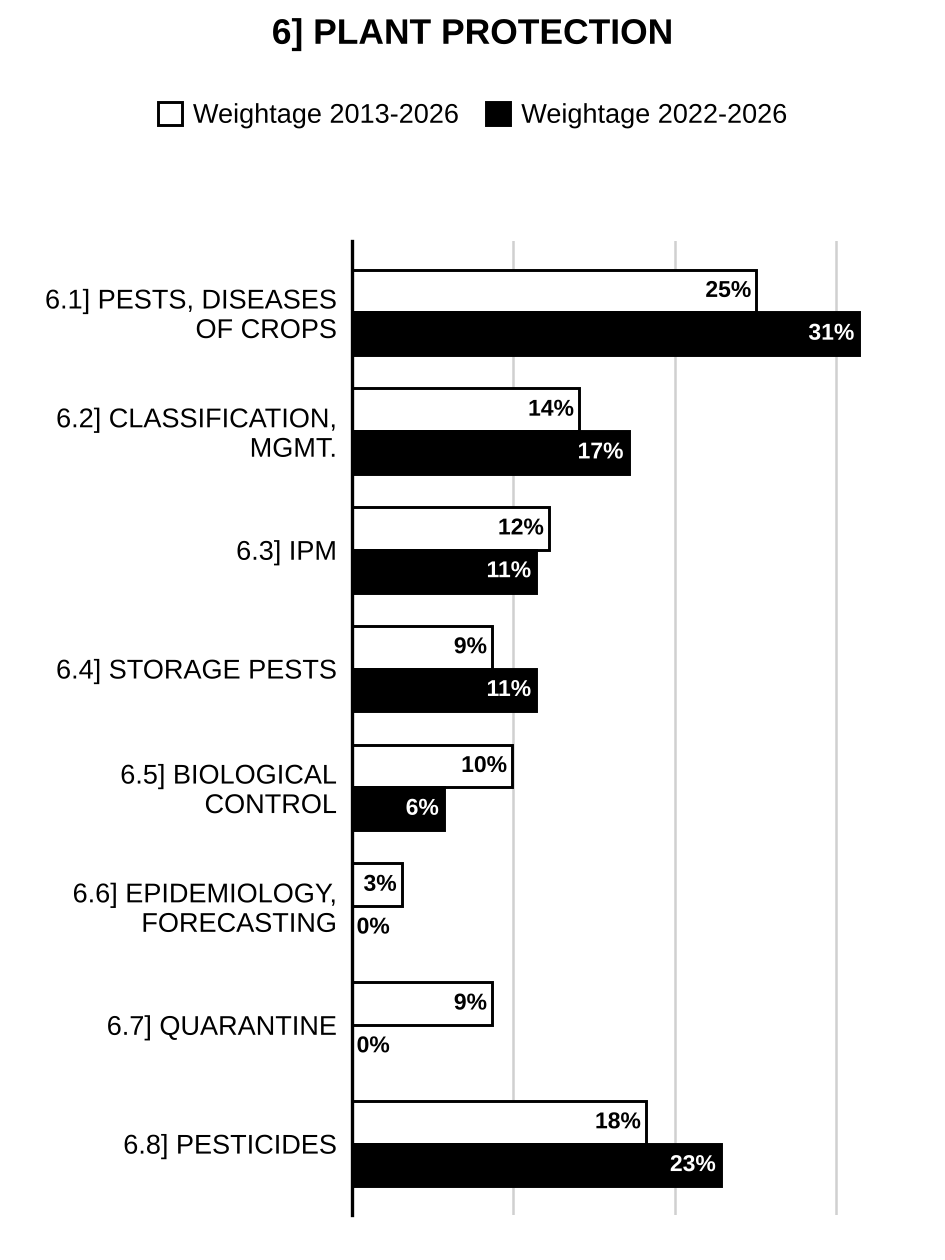
6.1] Diagnosis and economic importance of pests and diseases
54 questions
Explain the strategies to manage citrus decline in India. [2025/10m/150w/5b]
What do you understand by mango malformation? Elucidate symptoms, causal organism and control measures of floral mango malformation. [2025/10m/150w/5c]
Give an account on mycoplasmal diseases and physiological disorders of Potato. [2025/10m/8c]
Discuss the systematic position, nature of damage and management of insect and mite pests of brinjal. [2024/10m/150w/5c]
Discuss the causal organism, symptoms and management of tungro disease in rice. [2024/20m/7b]
Describe the principles, components and strategies for Integrated Disease Management in crops. Write down its application in management of rice blast and bacterial blight of pomegranate. [2023/20m/6a]
Describe symptoms and management of leaf curl and mosaic diseases in tomato. [2018/10m/150w/5d]
Give a brief account of major pests and diseases of mango with their management measures. [2017/20m/7a]
Write the diagnostic symptoms of Blister Blight of Tea. Explain the causal organism and management of the disease in tea plantation. [2015/12.5m/2b]
Write the distribution of mango malformation in India. What are the causes of different malformations? Suggest to combat the malformation. [2015/12.5m/4b]
Name the causal agent of black Sigatoka disease of banana. Enumerate the diagnostic symptoms of the disease. Suggest remedial measures to control the disease. [2014/12.5m/6b]
Woolly apple aphid and its control. [2013/10m/150w/5d]
Powdery mildew of rose and its control. [2013/12.5m/200w/6b]
Cotton whitefly and its control. [2013/12.5m/200w/7c]
Describe in detail occurrence, symptoms, etiology, epidemiology and management of apple scab disease. [2012/12m/150w/5b]
Describe the diagnostic symptoms, etiology and management of rhizome rot of ginger or bacterial wilt of solanaceous crops. [2012/15m/200w/7b]
What are the abiotic and biotic factors responsible for citrus decline? Suggest remedial measures to combat the problem. [2012/15m/200w/7d]
Write the diagnostic symptoms of potato spindle tuber disease, its mode of transmission and management. [2011/15m/150w/5b]
List out the major insect pests of citrus. Write in detail about citrus psylla with its management. [2011/15m/150w/6b]
Write in brief the diagnostic symptoms of bunchy top of banana, its mode of transmission and management practices to combat the problem. [2011/15m/150w/7c]
How can the pest faunal complex be managed in paddy? [2010/20m/200w/2b]
Bring out the diagnostic symptoms, pathogen, pre-disposing factors and management of late blight of potato. [2010/15m/150w/5b]
Write the typical symptoms caused by ‘litchi mite’ in ‘litchi’. Suggest its management practices. [2009/20m/200w/2c]
Describe the etiology, diagnostic symptoms, predisposing factors and management practices of blister blight of tea. [2009/20m/200w/3b]
Describe the virus-vector relationship of leaf curl of tomato. [2009/20m/200w/5c]
Ug 99 and wheat cultivation. [2009/15m/150w/8d]
Fusarium Wilt. [2007/20m/8b]
Mango Mealy Bug. [2007/20m/8c]
List five important diseases of sugarcane and mention their nature of incidence and management. [2006/20m/200w/6b]
Bring out five important pests of rice and mention their nature of damage and management. [2006/20m/200w/6c]
Describe the causal organism, life history, nature of damage and control of powdery mildew disease of grapes. [2003/20m/2a]
Describe the causes and control of mango malformation. [2003/20m/3c]
Red rot of sugarcane. [2003/20m/7c]
Disease complex of cotton. [2002/20m/4c]
Describe the nature of damage, life history and management of following insect-pests and diseases: Melong fruit fly. [2002/20m/6a]
Describe the nature of damage, life history and management of following insect-pests and diseases: Spotted ball worm of cotton. [2002/20m/6b]
Describe the nature of damage, life history and management of following insect-pests and diseases: Rice Tungro Virus. [2002/20m/6c]
Explain the causes of guava wilt and describe its control measures. [2001/20m/200w/5b]
What are the principles of integrated insect-pest management in agriculture? Describe the methods used for control of pests of citrus fruits. [2001/20m/7a]
Write about the causative organisms, symptoms of damage and chemical control of the following diseases: (i) Dieback in citrus (ii) Damping off in cauliflower (iii) Sooty mould in mango (iv) Anthracnose in grapes. [2000/20m/3c]
Describe the management of the following crop pests: (i) Fruitfly in mango (ii) Fruit borer in tomato (iii) Red hairy caterpillar in groundnut (iv) Stem borer in sugarcane. [2000/30m/6b]
What are the important diseases of paddy? Name the causative organisms of these diseases. Give the management schedule of these diseases. [2000/20m/7a]
Mention the various insect pests of cashew with their scientific names. Write about the damage and management practices of tea mosquito in cashew orchards. [1999/20m/6b]
Mention important diseases of potato with scientific names of their causative organisms. Write about the symptoms of damage and control of potato blight disease. [1999/20m/6c]
Write about the management practices of coconut black headed caterpillar. [1999/20m/7b]
Write in details about the management practices of red rot and smut diseases in sugarcane. [1999/20m/7c]
Control of Banana wilt. [1999/10m/8c]
What are bacteria? How do they differ from fungi? Describe bacterial diseases of paddy, acid lime and cotton with control measures. [1998/20m/200w/5b]
Explain damage done by blackstem rust of wheat, pigeon pea (arhar) wilt and sorghum (jowar) grain smut with their control measures. [1998/20m/200w/5c]
Describe pests and diseases of chilli with plant protection schedule followed in central India. [1998/20m/200w/6c]
Describe the insects and pests of cotton. [1997/20m/2c]
Enumerate 10 most important differences between prokaryotes and eukaryotes. List five diseases of national importance caused by organisms in each of above two groups and mention their ‘hot spots’ in India. [1996/20m/200w/5c]
Black arm of cotton. [1995/7.5m/8e]
Rice Tungro. [1995/7.5m/8f]
6.2] Classification of pests and diseases and their management
25 questions
Enlist and explain the symptoms of plant diseases which disrupt the photosynthesis function. [2022/10m/150w/5b]
Describe the various methods of pest control with appropriate examples. [2022/20m/8b]
List biotic and abiotic causes of plant diseases. Give an account of the classification of major physiological processes affected by diseases and symptom types. [2020/15m/7b]
Write in detail about bacterial diseases of crop plants and their suitable management practices. [2019/15m/6c]
Ionizing radiations and insect control. [2016/12.5m/8b]
Vascular wilt and xylem wilt. [2016/12.5m/8c]
Satellite viruses. [2012/12m/150w/8b]
NETO and NEPO viruses. [2011/15m/150w/8b]
How do phytophagous insects select their host? Explain the role of plant chemicals in host selection. [2010/20m/200w/2a]
How do the root-knot nematode damage the crop plants? Suggest some measures to overcome the root-knot problem. [2009/20m/200w/6c]
Molecular basis of disease diagnosis. [2009/15m/150w/8a]
Critically discuss on vector borne diseases and their management. [2006/20m/200w/3a]
Pheromones. [2006/20m/200w/8a]
Define pest. Bring out various groups of crop pests quoting an insect for each and discuss how an insect outbreak occurs. [2004/20m/200w/5b]
Discuss in brief the microbial toxins. [2004/20m/7c]
Pheromones. [2002/20m/4b]
What are bacteria? How do they differ from fungi? Describe bacterial diseases of paddy, acid lime and cotton with control measures. [1998/20m/200w/5b]
What are nematodes? How do plant nematodes damage crops and trees? List out five important nematode pests of crops and mention nematode management practices. [1998/20m/200w/7a]
Plant virus indexing. [1998/7.5m/8a]
What are pheromones? How do they affect behaviour of insects? [1996/20m/200w/5d]
Discuss the advantages of alternation of generations in aphids. [1996/30m/6b]
Feeding habits of insects. [1995/10m/4f]
How do plant mycoplasmas differ from bacteria and viruses? How was mycoplasmal etiology proved in India? Mention the principles of control of mycoplasmal disease. [1995/20m/200w/5d]
Critically discuss with suitable examples seed-borne pathogens and their controls. [1995/20m/6c]
Cross protection. [1995/7.5m/8g]
6.3] Integrated pest and disease management
16 questions
Briefly discuss Integrated Pest Management in cotton. [2023/10m/150w/5d]
Describe the principles, components and strategies for Integrated Disease Management in crops. Write down its application in management of rice blast and bacterial blight of pomegranate. [2023/20m/6a]
What do you mean by “Economic Injury Level” (EIL) and “Economic Threshold Level” (ETL)? Describe their roles in classifying the pests in relevance to Integrated Pest Management (IPM). [2021/15m/7a]
What do you mean by Integrated Pest Management (IPM)? Discuss the constraints in successful implementation of IPM. [2018/20m/8a]
Why are the concepts of economic threshold and economic injury levels important in IPM? [2016/12.5m/6c]
Discuss plant disease occurrence, epidemics and IDM. [2016/12.5m/7c]
What is a pheromone trap? Discuss its use in pest management. [2011/15m/150w/5d]
The success story of “Juvenile hormone” (J.H.) in insect pest management. [2010/15m/150w/1b]
Describe different techniques of I. P. M (Integrated Pest Management). [2007/20m/200w/5a]
Describe the IPM technique for Mango. [2007/20m/6c]
Write on cultural practices for the management of pest and diseases. [2006/20m/200w/3c]
What is Integrated Pest Management? Describe the role of allelopathy to control insect-pests and plant pathogens. [2005/60m/6]
Discuss in brief the significance of Integrated Pest Management (IPM) in crop production. Suggest suitable IPM measures for sugarcane. [2004/20m/6c]
What are the principles of integrated insect-pest management in agriculture? Describe the methods used for control of pests of citrus fruits. [2001/20m/7a]
Explain integrated pest management. How does it differ from insect pest management? [1997/20m/2a]
Define botanical pesticides. Give examples of their successful use in integrated pest and disease management. [1995/20m/200w/5c]
6.4] Storage pests and their management
10 questions
Explain the factors encouraging infestation of pests during storage. Discuss control measures for pest infestation during storage. [2026/20m/8a]
Enlist the storage pests of pulses with their nature of damage. Write their management practices. [2019/10m/150w/1e]
Red flour beetle and Angoumois grain moth. [2016/12.5m/8d]
Name three important stored grain pests of Rice. Describe the biology and management of any one of them. [2015/10m/150w/5b]
Describe in brief the preventive and curative methods for the control of storage pests. [2010/20m/200w/2c]
Specify the prevention and control strategies of stored grain pests. [2009/20m/200w/5d]
Storage pests of wheat or gram and their control. [2005/15m/8a]
Stored grain pests. [2004/20m/8b]
Discuss in detail the storage pest problem of pulses and their control. [2003/20m/200w/1c]
Define Grain storage and describe integrated pest management of a storage pest. [2002/20m/200w/5b]

Preparing for Prelims too?
Our UPSC Prelims Topic-wise PYQ eBook covers every Prelims question with detailed explanations, so you can see exactly where UPSC asks from.
View the BookDownload Free Sample6.5] Biological control of pests and diseases
19 questions
Explain the mode of action of organophosphate and Bacillus thuringiensis which are used in pest management. [2024/20m/8a]
Write the principles of biological control of plant pathogens. Describe the recent trends in bio-control strategies in the field of crop disease management. [2019/15m/8c]
Compare the inoculative and augmentative releases of natural enemies for biological control of pests. [2016/10m/150w/5c]
Predator and parasites. [2015/12.5m/8a]
Biological control of pests and diseases. [2015/12.5m/8c]
Microbial pesticides and their use in agriculture. [2012/15m/200w/4d]
What are different types of entomogenous virus? Describe in brief Nuclear Polyhydrosis Virus (NPV) and its merits and demerits in pest management. [2010/20m/200w/7a]
Cultural versus biological control of pests. [2009/20m/200w/7b]
Describe Biopesticides and their use in Agriculture. [2007/20m/200w/5d]
Define microbial control. Describe the procedure for mass production of NPV of a lepidopteran pest. [2004/20m/200w/5d]
Bacillus thuringiensis. [2004/20m/8c]
Neem in pests control. [2002/20m/8c]
Describe briefly the biological methods of pest control in agricultural and horticultural crops with suitable examples. [2000/20m/2c]
Bio-pesticides. [2000/15m/4b]
Write about the microbial control of American Boll worm. [1999/20m/7a]
Trichoderma and Pseudomonas in disease control. [1999/10m/8d]
Use of HNP virus in cotton plant protection. [1998/7.5m/8f]
What is the mode of action of Bacillus thuringiensis endotoxin? Give a critical account of its exploitation in the control of insect pests in field crops. [1996/15m/7a]
Define botanical pesticides. Give examples of their successful use in integrated pest and disease management. [1995/20m/200w/5c]
6.6] Epidemiology and forecasting of pests and diseases
7 questions
Discuss plant disease occurrence, epidemics and IDM. [2016/12.5m/7c]
What is plant disease epidemic? Why do disease epidemics occur? How can they be managed? [2014/12.5m/3d]
Define epidemiology. Describe the forecasting models used for pests and diseases of major food crops in India. [2009/20m/200w/4c]
Define disease epidemic. Discuss in brief the causes of epidemics. [2004/20m/4a]
Define pest forecasting. Describe how the pest forecasting is done in India and the fruits are made available to the farmers. [2004/20m/6b]
What is the role of seed borne infection in epiphytotics? Give examples in support of your answer. [1996/20m/200w/5a]
Describe the Puccinia path in relation to the management of wheat rusts through deployment of host resistant genes. [1996/30m/6a]
6.7] Plant quarantine measures
9 questions
What is “Plant Quarantine”? Describe the plant quarantine measures with suitable examples in Indian context. [2021/10m/150w/5d]
Suggest the measures to prevent the spread of exotic pests and diseases in the country. [2017/20m/7b]
Define Quarantine. Explain the plant quarantine regulation with respect to wart disease of Potato and bunchy top disease of Banana. [2015/10m/150w/5c]
Describe the principles and practices of plant quarantine. Can import quarantine be exempted by submitting a phytosanitary certificate issued by the government of the exporting country? Also, are disinfestations of planting material in the exporting country prior to importation or disinfestations in transit performed on the high seas considered to fulfil the requirements for quarantine inspection? [2014/12.5m/8a]
What is legislative control? Write various acts on pest control legislation adopted in India. [2012/12m/150w/5d]
Plant biosecurity. [2012/12m/150w/8c]
Phytosanitary measures. [2012/12m/150w/8e]
What is plant quarantine? How does it regulate the import and export of plants and seed material? [2011/15m/150w/6c]
Plant quarantine. [1995/7.5m/8d]
6.8] Pesticides: formulations and modes of action
31 questions
Explain the mode of action of organophosphate and Bacillus thuringiensis which are used in pest management. [2024/20m/8a]
What are pesticide formulations? Discuss the different types of formulations used in pest control. [2022/10m/150w/5c]
Enlist and explain ‘Dos’ and ‘Don’ts’ in pesticides’ usage with reference to purchase, handling, application and disposal of pesticides. [2022/20m/6b]
Define ‘Pests’ and ‘Pesticides’ in relation to pest management. Give a brief account of types and need for pesticide formulations. [2021/10m/150w/5b]
Classify pesticides according to target pests. Describe the trend in pesticide consumption in India. [2020/20m/6a]
What is pesticide resistance? Differentiate between simple and multiple resistance in insect pests with examples. Prescribe measures to overcome pesticide resistance problems. [2019/15m/7b]
What are fungicides? How fungicides are classified on the basis of chemical nature? [2015/12.5m/7a]
What is a pesticide formulation? Differentiate active ingredient from inert ingredient. Give at least two examples each of active and inert ingredients. [2014/12.5m/8b]
What are the causes of pest outbreak? Discuss the role of pesticides in pest resurgence. [2012/12m/150w/1e]
Pesticide residue toxicity in fruits and vegetables. [2011/15m/150w/8d]
What are synthetic pyrethroids? Explain their mode of action. [2010/20m/200w/6a]
Insecticidal poisoning, symptoms and treatment. [2010/15m/150w/8b]
Antifeedant. [2009/15m/150w/8b]
Differentiate between Pesticide and Insecticide. [2007/20m/7b]
Organophosphates. [2007/20m/8a]
Write on the judicious use of pesticides. [2006/20m/200w/1d]
Describe the different formulations of pesticides with examples. [2006/20m/200w/5d]
Briefly mention the use of fungicides for the control of diseases of potato. [2004/20m/7b]
Discuss the mechanism and management of insecticidal resistance in insect pest. [2003/20m/2b]
Define and discuss insecticide resistance management (I. R. M.) for a pest. [2002/20m/200w/5a]
Carbamate insecticides. [2002/20m/8a]
Discuss the use of herbicides in agriculture and the hazards from their use. [2001/20m/200w/5c]
Use of fungicides for the control of diseases in vegetables crops. [2001/15m/8d]
Write about the seed treatment chemicals which are used for the control of diseases and pests in agriculture with suitable examples. [1999/20m/200w/5a]
Write about the mode of action of organophosphatic insecticides. Give some examples of systemic and non-systemic insecticides. [1999/20m/200w/5b]
What precautions are taken while using toxic insecticides? Also mention the safety measures and devices. [1999/20m/200w/5d]
Granular pesticides. [1999/10m/8b]
What are the conditions under which insecticides should not be applied? [1997/20m/2b]
Organochlorines. [1997/12m/8b]
Describe the role of organic functional groups found in pesticidal molecules. [1996/20m/200w/5b]
Synthetic pyrethroids. [1995/7.5m/8b]

Strengthen your GS papers
Our UPSC Mains Topic-wise & Year-wise PYQ eBook (2013–2026) maps every GS question to the syllabus, so you know what UPSC asks and how often.
View the BookDownload Free Sample« Previous: Horticulture | Next: Food Production, Food Security and Nutrition »
Back to: Agriculture Optional PYQs – Topic-wise
Last updated: 30 October 2026