
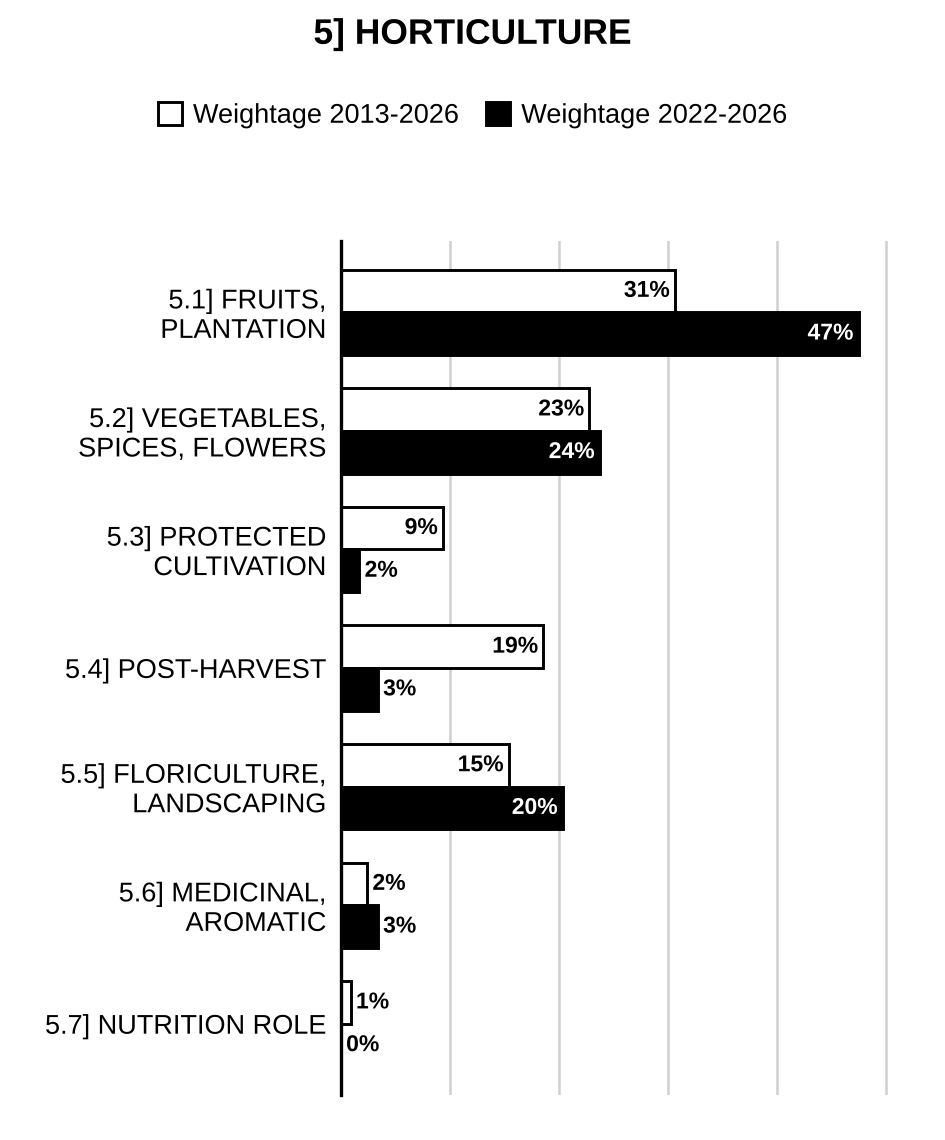
Here are all 156 Horticulture questions asked in UPSC Agriculture Optional Paper II from 1995 to 2026, arranged under the 7 topics of the official syllabus. Within each topic the latest questions come first.
Each question ends with a code such as [2024/15m/3b] – the year, the marks, the word limit (where UPSC set one) and the question number in the paper.
5.1] Major fruits and plantation crops
47 questions
What is high density orcharding? Describe management practices for high density orcharding in citrus group. [2026/20m/6a]
Describe the scientific cultivation of mango with reference to regular bearer varieties, propagation, transplanting time, management of mealy bug and powdery mildew. [2026/20m/7a]
Why do fruit plants need to be propagated vegetatively? Explain the advantages and disadvantages of asexual and sexual propagation. [2025/20m/3a]
Explain the strategies to manage citrus decline in India. [2025/10m/150w/5b]
What do you understand by mango malformation? Elucidate symptoms, causal organism and control measures of floral mango malformation. [2025/10m/150w/5c]
Write the cultivation practices of grapes in respect of soil and climatic requirements, improved varieties, training and pruning, fruit thinning and plant protection. [2025/20m/6a]
Discuss banana crop in respect of its varieties, nutrient management, plant protection and post-harvest handling. [2024/20m/6b]
What do you understand by graft incompatibility? Describe the symptoms and causes of graft incompatibility in plants with suitable examples. [2023/10m/3c]
Discuss the package of Guava cultivation with reference to soil and climate, propagation, varieties, disease management and bahar treatment. [2023/20m/6b]
Describe the importance of fruit cultivation in India. Discuss the role of horticulture with respect to poverty alleviation and nutritional security. [2021/15m/7b]
Describe mango cultivation with respect to propagation, intercropping, biennial bearing, fruit drop and black-tip. [2020/15m/6b]
Name the major fruit crops along with the states commercially growing these crops. Describe the package of practices for papaya cultivation in India. [2019/15m/4c]
Give package of cultivation of pomegranate with reference to planting materials and methods, irrigation, nutrition, plant protection and post-harvest management. [2018/20m/7a]
Enlist different vegetative propagation methods for fruit plants. Describe the different layering techniques employed for fruit plant propagation. [2018/15m/7b]
Write the distribution of mango malformation in India. What are the causes of different malformations? Suggest to combat the malformation. [2015/12.5m/4b]
Write the importance of prunning and Training in fruit crops. Describe the procedure adopted in Grapes. [2015/10m/150w/5e]
Effects of dormant pruning on trees. [2013/12.5m/200w/6c]
Use of root stocks in apple cultivation. [2013/12.5m/200w/6d]
Define parthenocarpy. What are the different types of parthenocarpy in fruits? How can it be induced in fruits? [2012/12m/150w/5a]
Write the causes responsible for alternate bearing in mango and apple. Suggest effective measures to overcome the problem. [2012/20m/250w/6b]
What are the abiotic and biotic factors responsible for citrus decline? Suggest remedial measures to combat the problem. [2012/15m/200w/7d]
Define polyembryony. Discuss its significance in horticulture with special reference to mango and citrus. [2011/15m/150w/5a]
What is micropropagation? What are its advantages? Give suitable examples of its utilization in horticultural crops. [2011/15m/150w/5c]
Discuss the present status of cashewnut industry in India with reference to production, productivity, consumption and export. Suggest strategies for its further improvement. [2011/15m/150w/7d]
Sex expression in papaya. [2011/15m/150w/8c]
Explain the present status of arid fruit culture in India. Describe major constraints in fruit productivity in arid regions. [2010/20m/200w/4b]
Discuss in brief the points to be considered for cost and return analysis in fruit cultivation. [2010/20m/200w/7b]
Describe the techniques of Nursery raising, Manuring and Pest control for successful cultivation of Papaya. [2007/20m/6a]
Give the climatic requirements of tomato, garlic, sweet orange and dahlia crops. [2006/20m/200w/5a]
Describe in brief the package of practices for cultivation of pineapple. [2006/20m/200w/6a]
Describe in brief the package of practices for cultivation of papaya. [2004/20m/200w/5c]
Describe the causes and control of mango malformation. [2003/20m/3c]
Fruit production, processing and distribution in India. [2003/20m/6b]
Discuss the relevance of pruning and training of horticultural crops. [2001/20m/200w/5a]
Discuss the reasons for biennial bearing in fruits, and the measures for its alleviation. [2001/20m/200w/5d]
Describe the ecological classification of horticultural crops in the country. Discuss the climate requirements for litchi, pineapple and cherry, and name three commercial varieties of each of these fruits. [2001/20m/6a]
Principles of orchard planning. [2001/15m/8b]
Describe the climatic and soil requirements for ‘banana’ cultivation. Mention the names of popular varieties of banana. Explain how planting material is prepared for banana cultivation. [2000/20m/2a]
What are the factors contributing to low production of Fruits in India? What measures are necessary to increase their production and productivity? [2000/30m/6a]
What is the situation of export of fruits from India? Give examples of fruits and vegetables varieties suitable for export. [1998/20m/200w/6a]
Describe propagation method, planting season and two methods of training of grape-vine suitable for Thompson seedless variety. [1998/20m/200w/6b]
Explain climate and soil requirements of sapota (chiku), santra (orange) and ber (jujube). [1998/20m/200w/7b]
Use of cultar in mango cultivation. [1998/7.5m/8g]
Describe fruit and vegetable production in India vis-a-vis world production. Support your answer with figures. [1997/30m/6b]
Comment upon fruits as a major export earning product. [1996/15m/7b]
What is the origin of mango, grape and tomato? Mention the names of their cultivated varieties and packages of practices including plant protection measures; also mention their yield per hectare. [1995/20m/7a]
Root-stocks. [1995/7.5m/8c]
5.2] Vegetables, spices and flower crops
29 questions
Discuss the quality indices for cauliflower, cabbage and broccoli. [2026/10m/150w/5c]
Discuss the production technologies of peas in relation to varieties, climate requirement, sowing time, seed rate and plant protection. [2025/20m/7a]
Give an account on mycoplasmal diseases and physiological disorders of Potato. [2025/10m/8c]
Write the methods of production of seed tubers from true potato seeds (TPS) under protected cultivation. [2024/10m/150w/5b]
Briefly discuss round-the-year marigold cultivation with reference to varieties, sowing and transplanting, disease management and value-addition. [2023/10m/6c]
Enlist the seed spices grown in India. Briefly discuss the cultivation and post-harvest management practices for coriander and cumin. [2022/20m/8a]
What is meant by physiological disorders? Describe physiological disorders of potato. [2020/10m/150w/5c]
Give a brief account of tomato cultivation with respect to climate and soils, sowing time, and nutrient, water and post-harvest management. [2020/20m/8a]
Give the present status of vegetable cultivation in India and describe the package of practices of rabi and kharif onion cultivation in India. [2019/20m/7a]
Describe the post-harvest management and value-added products of black pepper. [2018/15m/7c]
Explain the production technology for commercial cultivation of marigold and aster flowers. [2016/12.5m/6b]
Define cole crops. Explain on what basis cole crops are grouped. [2015/12.5m/3a]
Write the package and practices of Potato cultivation under the heads of soil and climatic condition, seed rate, nutrients requirement, time of planting, earthing and yield. [2015/12.5m/6b]
Write the production technology of Marigold as it is one of the important flowers cultivated throughout the year. [2015/12.5m/7c]
Various methods of planting onions, and post-harvest management of onions. [2013/10m/150w/5e]
Cauliflower cultivation under the following heads: transplanting and post-harvest management. [2013/12.5m/200w/7d]
Recommend a viable package of practices for commercial production of marigold. [2009/20m/200w/6b]
Describe the climatic requirement, seed rate, nursery sowing and disease control measures for Sweet Pepper Cultivation. [2007/20m/6b]
Give the climatic requirements of tomato, garlic, sweet orange and dahlia crops. [2006/20m/200w/5a]
Write the present status and expected prospects of vegetable crops cultivation in India. [2006/20m/200w/7b]
Write scientific technique of raising table potato or vegetable pea under the following heads: Soil, season and climate. [2005/15m/7a]
Write scientific technique of raising table potato or vegetable pea under the following heads: Row spacing, seed rate & method of sowing/planting. [2005/15m/7b]
Write scientific technique of raising table potato or vegetable pea under the following heads: Manuring and fertilization. [2005/15m/7c]
Write scientific technique of raising table potato or vegetable pea under the following heads: Yield. [2005/15m/7d]
Discuss in brief the factors responsible to low yield of vegetables in India. What measures are necessary to increase their production? [2004/20m/6a]
Discuss in brief the package of practices for the cultivation of tomato. [2002/20m/200w/5c]
Describe fruit and vegetable production in India vis-a-vis world production. Support your answer with figures. [1997/30m/6b]
What is the origin of mango, grape and tomato? Mention the names of their cultivated varieties and packages of practices including plant protection measures; also mention their yield per hectare. [1995/20m/7a]
Suggest the vegetables to be grown in kitchen gardens located in Trivandrum, Jaipur and Shimla. Give reasons for your choice. [1995/20m/7c]
5.3] Protected cultivation and high-tech horticulture
8 questions
Write the methods of production of seed tubers from true potato seeds (TPS) under protected cultivation. [2024/10m/150w/5b]
Discuss the importance of green-house in agriculture. [2021/10m/150w/5e]
What is protected cultivation? What are its problems and prospects in comparison to open cultivation? [2021/20m/7c]
Define protected cultivation along with its major advantages and challenges for adoption in India. Describe the plastic low tunnel technology for off-season cultivation of vegetables. [2019/20m/6a]
How does high-tech horticulture technology play role in enhancing resource use efficiency and farmers’ income? [2017/10m/6c]
What is meant by protective cultivation? Briefly discuss importance of greenhouse in protective cultivation. [2014/12.5m/8d]
Describe the production technology for Orchids under protected conditions. [2012/15m/200w/7c]
Describe the production technology for carnation under greenhouse conditions. [2011/15m/150w/7b]

Preparing for Prelims too?
Our UPSC Prelims Topic-wise PYQ eBook covers every Prelims question with detailed explanations, so you can see exactly where UPSC asks from.
View the BookDownload Free Sample5.4] Post-harvest technology and value addition of fruits and vegetables
35 questions
Write down the constraints of fruit processing industry in India. [2023/10m/150w/5a]
Narrate the role of post harvest technology in minimising losses in fruits and vegetables. [2021/10m/150w/5c]
What are the causes of post-harvest deterioration of flowers? Elaborate the techniques to enhance shelf-life of flowers. [2020/15m/8b]
Enlist factors affecting the post-harvest life of flowers. How can it be controlled by growth regulators? [2018/10m/150w/5c]
Describe the post-harvest management and value-added products of black pepper. [2018/15m/7c]
Give a brief account of post-harvest losses in fruits. Suggest various management techniques to avoid losses due to post-harvest diseases. [2017/10m/150w/5c]
What are various ways of value addition in fruits and vegetables? [2017/20m/8a]
How does maturity control the post-harvest quality and storage life of fruits? Give maturity indices for some fruits and vegetables. [2016/12.5m/7a]
Briefly discuss handling methods for export of mango. [2014/12.5m/7d]
Define jelly. Explain the principle of jelly formation. Briefly describe the preparation of jelly and enumerate problems in jelly making. [2014/12.5m/8c]
The roles of curing and degreening in reducing post-harvest losses of fruits and vegetables. [2013/10m/150w/5c]
Various methods of planting onions, and post-harvest management of onions. [2013/10m/150w/5e]
Fermentation for fruit and vegetable preservation. [2013/12.5m/200w/7b]
Cauliflower cultivation under the following heads: transplanting and post-harvest management. [2013/12.5m/200w/7d]
Preservation of fruits and vegetables by sugar. [2013/12.5m/200w/8c]
Describe candied fruits, glazed fruits and crystallized fruits and give the principles involved in their preservation. [2011/15m/150w/6a]
What are the principles of preservation of fruits and vegetables? Briefly describe the method for preparation of guava jelly. [2010/15m/150w/5d]
Define vinegar. Describe its classification and bring out the methods of its preparation. [2010/20m/200w/7c]
Explain the concept of total post-harvest losses in mango. What methods can be used for enhancing shelf-life of the mango? [2009/20m/200w/6a]
Discuss about Post-Harvest losses in fruits. Describe the technology to minimize the losses in Mango. [2007/20m/200w/5c]
Discuss Post-Harvest Management of Citrus. [2007/20m/7c]
Discuss briefly on handling and marketing problems of vegetables. [2006/20m/200w/5b]
Describe in brief the principal methods of fruit preservation. [2005/20m/5c]
Preservation methods of fruits and vegetables. [2004/20m/8a]
Fruit production, processing and distribution in India. [2003/20m/6b]
Marketing problems of fruits and vegetables in India. [2003/20m/6c]
Discuss in brief the post harvest losses in fruits and vegetables, and the measures to minimize these losses. [2002/20m/7c]
Describe the factors responsible for post-harvest losses in fruits and vegetables and the measures to minimise these losses. [2001/20m/6c]
Discuss the importance and scope of processing of fruits and vegetables. Briefly describe the methods of vegetables preservation with the help of suitable examples. [2001/20m/7b]
Differentiate between climacteric and non-climacteric fruits. Explain the changes that occur during maturity and ripening of these fruits. [2001/20m/7c]
Market intelligence and marketing of fruits and vegetables. [2001/15m/8a]
Write about the principles and methods of preservation of fruits and vegetables and their products. [1999/20m/200w/5c]
Ripening of fruits. [1999/10m/8e]
What is the situation of fruit and vegetable processing industry in India? What are their export projections? Support your answer with figures. [1997/30m/6a]
Canning. [1997/12m/8c]
5.5] Landscaping and commercial floriculture
27 questions
What is topiary? Describe the characteristics of plants ideal for it. [2026/10m/150w/5a]
Describe terrace garden and moon garden. [2026/10m/150w/5b]
Discuss the production technology of carnation for cut flower in relation to improved varieties, growing requirements and season, flower regulation, post-harvest handling and physiological disorders. [2026/20m/8b]
Enlist the different commercial flowers cultivated on a large scale for cut flower trade. Briefly discuss the factors affecting the keeping quality of cut flowers and the remedies. [2022/20m/7a]
Discuss the scope and importance of roof-gardening in cities. [2020/10m/150w/5d]
What are the causes of post-harvest deterioration of flowers? Elaborate the techniques to enhance shelf-life of flowers. [2020/15m/8b]
Name the commercial floriculture crops being grown in India. Describe the package of practices of year round cultivation of chrysanthemum in India. [2019/20m/8a]
Enlist factors affecting the post-harvest life of flowers. How can it be controlled by growth regulators? [2018/10m/150w/5c]
What are the important new varieties of carnation? Explain the importance of pinching operation for producing quality carnation. [2016/10m/150w/5a]
Describe the procedure of tissue culture for multiplying new cultivars of gladiolus. [2016/10m/150w/5e]
Write the package and practices of Gladiolus cultivars citing method of propagation, soil, climatic conditions, harvesting and yield. [2015/10m/150w/1b]
What is landscape architecture? State the principles of landscaping. What are the steps involved in landscaping a public place? [2012/12m/150w/5c]
Write commercial cultivation practices of Anthurium with reference to microclimate, propagation and planting, harvesting and yield of Anthurium cutflowers. [2012/15m/200w/7a]
Ikebana. [2011/15m/150w/8a]
Bring out the extent and scope of rose cultivation in India with special reference to export. [2010/20m/200w/4a]
Briefly describe the various popular designs of ornamental gardens. [2010/10m/200w/4c]
Write about the problems and prospects of commercial floriculture in India. [2009/20m/200w/3c]
Discuss about Planting material, Irrigation, Manuring and Harvesting of Gladioli. [2007/20m/7a]
Give the precautions in raising ornamental plants. [2005/20m/5d]
Describe the cultivation of roses and its marketing. [2003/20m/5b]
Layout of lawn and garden. [2003/20m/7b]
Methods of raising ornamental plants. [2002/20m/8b]
Apical dominance has great significance in floriculture and landscape gardening. [2001/15m/4d]
What is the scope for floriculture in India particularly for export purposes? Discuss the package of practices for the cultivation of roses. [2001/20m/6b]
Write about the importance of floriculture in India. Give suggestions for development of scientific floriculture in India. [1999/20m/6a]
Methods of Lawn establishment. [1997/12m/4b]
Growing export opportunities of floriculture. [1996/20m/8c]
5.6] Medicinal and aromatic plants
4 questions
Describe mentha cultivation with reference to varieties, soil and climate, nutrient management and processing. [2023/10m/150w/5b]
Define medicinal and aromatic plants. Discuss their importance and uses. [2017/10m/150w/5e]
Elucidate the medicinal uses of ‘Sarpagandha’ (Rauwolfia serpentina). Recommend the viable production technology for ‘Sarpagandha’. [2011/15m/150w/7a]
Describe the medicinal importance of Indian aloe (Aloe vera) along with its production technology. [2009/20m/200w/2a]
5.7] Fruits and vegetables in human nutrition
6 questions
Describe the importance of fruit cultivation in India. Discuss the role of horticulture with respect to poverty alleviation and nutritional security. [2021/15m/7b]
Antioxidant rich fruits and vegetables. [2012/12m/150w/8a]
Write on the role of fruits in human nutrition. [2006/20m/200w/5c]
The role of vegetables in human nutrition. [2003/20m/8b]
Explain the significance of vegetables in human nutrition with suitable examples. [2000/20m/3a]
Role of vegetables in human nutrition. [1996/20m/8a]

Strengthen your GS papers
Our UPSC Mains Topic-wise & Year-wise PYQ eBook (2013–2026) maps every GS question to the syllabus, so you know what UPSC asks and how often.
View the BookDownload Free Sample« Previous: Plant Physiology | Next: Plant Protection »
Back to: Agriculture Optional PYQs – Topic-wise
Last updated: 30 October 2026