
Here are all 83 Seed Technology questions asked in UPSC Agriculture Optional Paper II from 1995 to 2026, arranged under the 5 topics of the official syllabus. Within each topic the latest questions come first.
Each question ends with a code such as [2024/15m/3b] – the year, the marks, the word limit (where UPSC set one) and the question number in the paper.
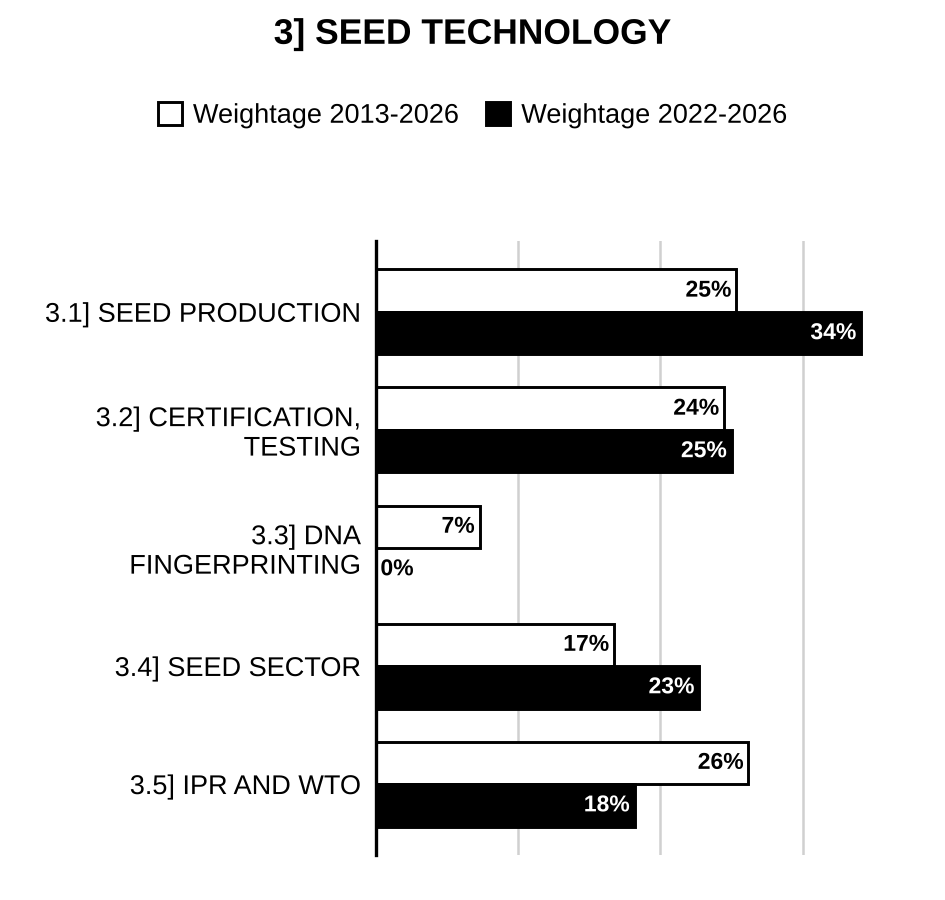
3.1] Seed production and processing technologies
28 questions
Discuss the principles and practices of seed production in self-pollinated and cross-pollinated crops. [2026/20m/3b]
Describe the different seed enhancement techniques used in seed industry and their benefits. [2026/10m/4c]
Define ‘Grow-out test’. Explain briefly the methods of roguing in seed fields. [2025/10m/150w/1d]
Define genetic purity. How can the maintenance of genetic purity of varieties be done outside their normal cultivation area? [2025/20m/3b]
Discuss the guidelines for planning and organization of seed production programme. [2024/10m/4c]
Briefly discuss the requirements for production of certified seeds. [2023/10m/150w/1c]
What is the role and importance of “Seed treatment campaign” in India in the context of quality crop establishment? [2021/15m/4a]
Differentiate between the following: (i) Varietal seed production and Hybrid seed production (ii) Conventional and Molecular breeding. [2020/10m/150w/1a]
Explain seed enhancement with its merits. Describe in brief about the various practices used for seed enhancement. [2018/10m/150w/1d]
Enumerate the various types of seeds. Give a stepwise account of techniques associated with seed production. [2018/20m/3a]
What are the genetic and agronomic principles of seed production? [2017/10m/150w/1c]
Classes of improved seed. [2013/12.5m/200w/3b]
What is roguing? Discuss its importance in quality seed production. [2011/15m/150w/1c]
Classify different types of seed. How will you proceed for producing the certified seed of paddy? [2009/20m/200w/1c]
What is seed? Discuss different types of seed. [2007/20m/200w/1a]
What is isolation distance? Describe its need in seed production of different crops. [2007/20m/3a]
Describe the genetic purity of seed and its importance in agriculture. [2006/20m/200w/2c]
Certified seed and foundation seed. [2006/20m/200w/4a]
Give an account in brief on hybrid rice production. [2004/20m/2b]
Briefly explain the various classes of seeds. Describe the requirements for certified seeds. [2004/20m/200w/5a]
Discuss the foundation and certified seed production. [2003/20m/3b]
Briefly describe hybrid seed production of bajra. [2001/20m/200w/1c]
Certified seed. [1998/7.5m/4c]
Characters of quality seed and safeguards for maintaining purity of seed. [1998/7.5m/8h]
Describe the Genetic Purity of Seed. [1997/20m/200w/1b]
Acid Treatment of Seed. [1997/12m/4a]
Foundation Seed. [1997/12m/4d]
Define Seed. What are the major constraints in quality seed production in India? Mention the main seed production centres of forage crops in the country. [1997/30m/7a]
3.2] Seed certification, testing and storage
22 questions
What are the biochemical changes that take place in seeds under prolonged storage? [2026/10m/150w/1b]
Define ‘Grow-out test’. Explain briefly the methods of roguing in seed fields. [2025/10m/150w/1d]
Discuss various tests undertaken in seed testing laboratories. [2024/10m/150w/1d]
Describe the role of State Seed Certification Agencies. [2023/10m/4c]
Define seed quality. Describe the characteristics of a seed which decide its quality. [2022/10m/150w/1d]
What are the factors that affect the longevity of seeds during storage in warehouses? Describe. [2022/10m/2c]
What do you understand by the term ‘seed quality’? Describe the regulatory and certification systems that are in place to ensure seed quality. [2020/15m/2b]
Write important objectives of seed testing along with the methods used for testing of seed viability, seed vigour and genetic purity of a variety. [2019/15m/2c]
Describe the various types of field and seed standards followed in seed production and certification programmes. [2019/15m/4b]
Describe various steps involved in seed certification and the institutions associated in the production of certified seeds. [2017/20m/2a]
What are objectives of seed testing? Write the testing procedure adopted in paddy and wheat crops. [2015/10m/150w/5a]
Explain the meaning of genetic purity of seed. Briefly describe the various approaches for testing genetic purity of seed. [2014/10m/150w/1b]
Discuss the usefulness of field inspection for seed certification. [2013/10m/150w/1a]
Differentiate between seed vigour and viability. How are the two assessed in a seed testing programme? [2012/15m/200w/3c]
Briefly describe the various methods of seed-testing for seed certification. [2010/10m/200w/4d]
Certified and Truthfully labelled seed. [2007/20m/4c]
Define seed and differentiate it from grain. Discuss the role of National Seeds Corporation and state seed certification agencies in production of quality seeds and its distribution. [2005/60m/2]
Briefly explain the various classes of seeds. Describe the requirements for certified seeds. [2004/20m/200w/5a]
Describe in brief the requirements of certified seeds. [2004/20m/7a]
Seed quality attributes for vegetables. [1999/10m/4e]
Characteristics of quality seed. [1997/12m/8a]
What is seed certification? Give a critical account of procedures of seed certification and how the genetic purity of seed is maintained. [1995/20m/200w/1a]

Preparing for Prelims too?
Our UPSC Prelims Topic-wise PYQ eBook covers every Prelims question with detailed explanations, so you can see exactly where UPSC asks from.
View the BookDownload Free Sample3.3] DNA fingerprinting and seed registration
4 questions
What is DNA fingerprinting? Discuss its applied aspects in modern agriculture. [2021/15m/4b]
Give justification that “DNA fingerprinting is a vital tool for identification of the cultivars”. [2018/15m/4b]
DNA fingerprinting in plant variety registration/protection. [2013/12.5m/200w/4c]
Seed registration. [2011/15m/150w/4c]
3.4] Public and private sectors in seed production and marketing
12 questions
Discuss about the problems and intricacies in the profitable marketing of seeds. [2026/20m/4a]
Describe the Indian Seeds Act, 1966. Also discuss the essential activities required for the success of seed industry in India. [2025/10m/4c]
Discuss the involvement of public and private sectors in production and marketing of seeds. [2024/20m/3b]
What do you understand by the term ‘seed quality’? Describe the regulatory and certification systems that are in place to ensure seed quality. [2020/15m/2b]
Elaborate the role of seed industry in the development of Indian agriculture. [2019/15m/8b]
Explain formal and informal seed supply systems in India. [2016/12.5m/4c]
Discuss the role of National Seeds Corporation in quality seed production in India. [2014/12.5m/2a]
Discuss critically the strengths and weaknesses of seed industry in India. [2011/15m/150w/2c]
Give a brief account of seed legislation in India. [2011/15m/150w/3c]
Formal versus informal seed supply systems. [2009/20m/200w/7c]
Define seed and differentiate it from grain. Discuss the role of National Seeds Corporation and state seed certification agencies in production of quality seeds and its distribution. [2005/60m/2]
Briefly describe the Indian Seed Act (1966). [2002/20m/200w/5d]
3.5] IPR and WTO issues and their impact on agriculture
17 questions
What do you mean by Intellectual Property? Discuss the protection of Intellectual Property Rights in reference to patent, plant breeders’ rights and copyright. [2025/10m/2c]
Discuss different forms of Intellectual Property Rights (IPR) in India. [2023/20m/4a]
What is the need for protection of intellectual property rights of traditional knowledge? Explain sui generis protection of traditional knowledge. [2022/10m/3c]
‘Intellectual Property Rights (IPR)’ issue is a sensitive topic in agriculture. Concisely describe this with your conclusions. [2021/10m/150w/1d]
Explain the Protection of Plant Varieties and Farmers’ Rights Act, 2001. Give an account of protection provided to farmers, breeders and indigenous property rights under this Act. [2020/20m/3a]
How is the patent system different from plant variety protection system? [2019/10m/150w/1d]
Define Intellectual Property Rights (IPRs). Discuss IPRs’ relevance to agriculture. [2018/15m/3c]
Discuss the impact of PPV & FRA in varietal protection of crop plants. [2017/10m/4c]
Explain Intellectual Property Rights. Give the present status of IPR in relation to agriculture. [2016/10m/150w/1c]
Discuss the sui generis protection of traditional knowledge. [2016/12.5m/2c]
TRIPS Agreement. [2014/12.5m/4a]
The Protection of Plant Varieties and Farmer’s Rights Act (2001). [2013/12.5m/200w/3a]
Plant breeder’s right and variety protection. [2012/15m/200w/4b]
What do you mean by “Intellectual Property”? How can the Intellectual Property be protected? What is the relevance of Intellectual Property Right (IPR) in agriculture? [2012/20m/250w/6c]
Basmati rice. [1999/10m/4b]
IPR. [1996/10m/4e]
GATT agreement. [1995/10m/4e]

Strengthen your GS papers
Our UPSC Mains Topic-wise & Year-wise PYQ eBook (2013–2026) maps every GS question to the syllabus, so you know what UPSC asks and how often.
View the BookDownload Free Sample« Previous: Plant Breeding | Next: Plant Physiology »
Back to: Agriculture Optional PYQs – Topic-wise
Last updated: 30 October 2026