
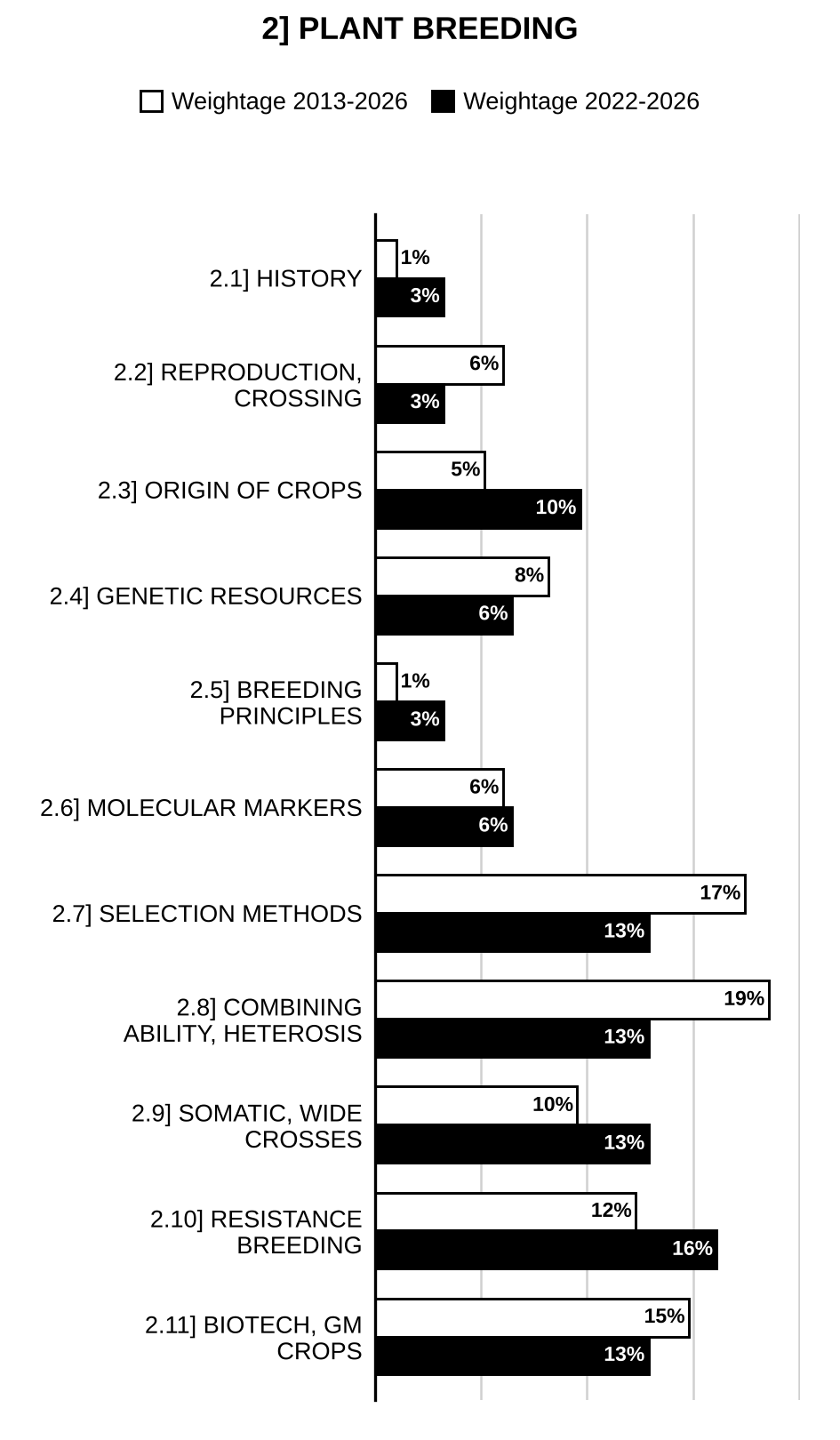
Here are all 185 Plant Breeding questions asked in UPSC Agriculture Optional Paper II from 1995 to 2026, arranged under the 11 topics of the official syllabus. Within each topic the latest questions come first.
Each question ends with a code such as [2024/15m/3b] – the year, the marks, the word limit (where UPSC set one) and the question number in the paper.
2.1] History of plant breeding
1 question
Describe the history of plant breeding in India. Write the objectives of plant breeding and methods for creation of variability for crop improvement. [2023/20m/3a]
2.2] Modes of reproduction; selfing and crossing techniques
16 questions
Describe the characteristics of a clone. [2026/10m/150w/1d]
Write short notes on the following: (i) Asexual Reproduction (ii) Progeny Test (iii) Seed Bank (iv) Genetically Modified Crop. [2021/10m/150w/1e]
Describe self-pollination, cross-pollination and often cross-pollination. Discuss different mechanisms for facilitating self-pollination and cross-pollination. [2021/20m/3c]
What are the genetic consequences of self- and cross-pollination? [2016/12.5m/2b]
Discuss the relevance of mode of reproduction in plant breeding. [2014/12.5m/3a]
What is detasselling? How it helps in hybrid breeding? [2012/15m/200w/2b]
What is hybridization? Briefly discuss the techniques in hybridization. [2011/15m/150w/3b]
Various types of apomictic seedlings and their use in plant propagation. [2010/15m/150w/1c]
Define dichogamy. Describe in brief protogyny and protoandry. [2009/20m/200w/5b]
What is clone? Compare clones, inbreds and pure lines. [2004/20m/3b]
Pollination and Fertilization. [2003/15m/4c]
Define dichogamy. Describe in brief protogyny and protandry. [2002/20m/200w/1a]
Describe in brief emasculation and discuss the various methods of emasculation. [2002/20m/2a]
Role of Apomixis in horticulture. [2001/15m/8c]
Apomixis. [1999/10m/4d]
Explain in brief Chimera, Xenia and Metaxenia in plants. [1998/20m/200w/1d]
2.3] Origin, evolution and domestication of crop plants
6 questions
Write down about the origin and domestication of rice. [2023/10m/150w/1e]
Discuss the concept of centre of origin of crops and its role in plant breeding. Describe the role of N. I. Vavilov in identifying centre of origin of various crops with appropriate examples. [2022/20m/2b]
What do you understand by centre of origin? Discuss the law of homologous series of variation. [2021/15m/3b]
Explain the law of homologous series. How is it helpful in genetic resources, conservation and utilization? [2015/12.5m/3b]
Describe importance and origin of wheat and cotton and state hybrid cotton varieties in cultivation in India. [1998/20m/200w/3c]
What is the centre [?] of origin of maize and cotton? Describe the methodology for production of hybrids seeds in each. [1995/20m/2c]
2.4] Crop genetic resources: conservation and utilization
11 questions
Discuss the importance of crop genetic resource conservation and utilization. [2024/20m/2b]
What do you mean by gene pool concept and genetic erosion? Classify the gene pool of a crop. [2021/10m/150w/1a]
Describe the role of plant genetic resources conservation in crop improvement. [2019/10m/150w/5c]
Give a brief account of conservation of crop genetic resources. [2017/10m/150w/1b]
Explain the law of homologous series. How is it helpful in genetic resources, conservation and utilization? [2015/12.5m/3b]
Discuss the importance of conservation of plant genetic resources for crop improvements. [2015/12.5m/6d]
Gene Banks. [2014/12.5m/4d]
“Genetic erosion caused by human activities is a threat to agriculture” – Comment. [2012/15m/200w/3b]
Discuss the role of conservation and utilization of plant genetic resources giving examples. [2001/20m/2c]
Define ‘germplasm’. How do you maintain germplasm? List donor genetic resources for various traits being used for developing the new plant type in rice. [2000/20m/7c]
Biodiversity. [1996/10m/4f]
2.5] Principles of plant breeding and improvement of crop plants
7 questions
Describe the history of plant breeding in India. Write the objectives of plant breeding and methods for creation of variability for crop improvement. [2023/20m/3a]
Define hybridization. Describe in-brief the various types of hybridization. [2002/20m/200w/1d]
Improved crop varieties have contributed significantly to green revolution in India. [2001/15m/4b]
Write about the various methods of crop improvement in plant breeding. [1999/20m/2b]
Describe the role of Physiology in crop improvement. [1997/30m/3b]
What is hybridisation? Briefly describe various steps involved in crop improvement by hybridisation. [1996/20m/200w/1c]
Idiotype. [1995/10m/4a]

Preparing for Prelims too?
Our UPSC Prelims Topic-wise PYQ eBook covers every Prelims question with detailed explanations, so you can see exactly where UPSC asks from.
View the BookDownload Free Sample2.6] Molecular markers in plant improvement
9 questions
Describe the importance of molecular markers in plant improvements. [2026/10m/2c]
Define Marker-Assisted Selection and give suitable examples. Discuss the applications of marker-assisted selection in recurrent selection, gene pyramiding and QTL introgression. [2025/10m/150w/1c]
Differentiate between the following: (i) Varietal seed production and Hybrid seed production (ii) Conventional and Molecular breeding. [2020/10m/150w/1a]
Describe the role of molecular markers and marker-assisted selection in crop improvement. [2020/15m/3c]
Describe the applications of molecular markers in crop improvement. [2017/20m/2b]
What is marker-assisted selection? Discuss its advantages over conventional phenotype-based selection in crop improvement. [2012/12m/150w/1b]
Molecular markers and their applications in plant improvement. [2011/15m/150w/4b]
Molecular markers and transgenics. [2010/15m/150w/8a]
Molecular marker approach in plant breeding. [2000/15m/4d]
2.7] Selection methods
35 questions
How is the detailed record of relationship between the selected plants and their progenies maintained in the pedigree selection method? Discuss the procedure for pedigree selection method, with the help of a simplified schematic diagram. [2025/20m/4b]
Give an account of bulk method of breeding. Discuss its merits and demerits. [2024/10m/3c]
What are the applications of mass selection in self-pollinated crops? Describe its merits and demerits. [2022/10m/150w/1b]
Describe the advantages and disadvantages of mass selection, simple recurrent selection and clonal selection. [2021/10m/150w/1b]
What is clone? What do you understand by clonal selection? Describe the various steps involved in clonal selection. [2021/15m/3a]
What is mass selection? Discuss its applications in varietal improvement. [2020/10m/150w/1b]
Define pedigree method and give its importance in crop improvement, with suitable examples. [2019/15m/2b]
Write the various methods of plant breeding and describe the back cross method with its importance in development of crop varieties. [2019/20m/4a]
Define mass selection. Explain its applications in self-pollinated crops. [2018/10m/150w/1b]
Define ‘pure lines’ along with their characteristics. How are they used in crop improvement? [2016/10m/150w/1b]
Define pureline. Discuss the relevance of pureline selection in self- and cross-pollinated crops. [2014/12.5m/2b]
Define general combining ability. Describe the procedure for recurrent selection for general combining ability. [2014/12.5m/3c]
Purelines become genetically variable with time. [2013/12.5m/200w/2a]
Genetic consequences of repeated backcrossing. [2013/12.5m/200w/4b]
Describe the methods of transfer of two or more characters to a single recurrent parent. [2010/15m/3b]
In what situations are different recurrent selection methods used and compare their effectiveness. [2010/15m/3c]
Differentiate mass selection from pure-line selection and also explain why pure-line selection has been widely used than mass selection. [2009/20m/200w/1b]
Discuss the technique of clonal selection in crop breeding. [2007/20m/2b]
Discuss about Back Cross and Test Cross. [2007/20m/3c]
Mass selection and recurrent selection. [2006/20m/200w/4c]
Pedigree method. [2006/20m/200w/8b]
Back cross and test cross. [2005/20m/4b]
Define mass selection. Describe the procedure of mass selection in brief. [2004/20m/200w/1d]
Define pure line selection. Discuss the merits and demerits of pure line selection. [2004/20m/3a]
What is clone? Compare clones, inbreds and pure lines. [2004/20m/3b]
Describe the breeding procedures which are used for producing new varieties of self pollinated crops. [2003/20m/2c]
Mass and recurrent selection. [2003/20m/7a]
Define mass selection. Explain the procedure of mass selection and discuss its merits and demerits. [2002/20m/2c]
Briefly describe the bulk method of breeding and its applications in crop improvement programme. [2002/20m/3a]
Discuss in brief the progeny selection and describe its merits and demerits. [2002/20m/3b]
Describe the method of back cross breeding used for transfer of recessive disease resistance. Can this method improve yield potential? Justify your answer. [2001/20m/2a]
Describe the pure-line selection. How far has this method been useful in evolving high yielding varieties of cereal crops? [2001/20m/2b]
Explain with the help of a flow chart how backcross method of breeding can be used for transfer of disease resistance controlled by a dominant gene. List the merits and limitations of backcross method of breeding. [2000/20m/200w/1c]
Back-cross. [1998/7.5m/4b]
What is Synthetic Variety? How does a synthetic variety differ from a pure line? [1997/20m/200w/5c]
2.8] Combining ability and heterosis
36 questions
Briefly discuss significant features of heterosis and explain the dominance and overdominance hypotheses of heterosis, giving their main features. [2025/10m/150w/1b]
Describe different approaches for improving the characteristics of inbred lines. [2024/10m/150w/1c]
Give an account of cytoplasmic genetic male sterility and its utilization in plant breeding. Also discuss its limitations. [2024/20m/4a]
Explain inbreeding depression and its effect in crops. Also explain the degrees of inbreeding depression. [2023/10m/150w/1b]
Describe the physiological and molecular basis of heterosis. [2021/15m/2b]
Classify types of male sterility and self-incompatibility system in plants. Describe the limitations of cytoplasmic genetic male sterility system in hybrid seed production. [2021/20m/2c]
Define synthetic variety. Discuss the operations involved in the production of synthetic varieties. [2020/10m/150w/1d]
Explain sterility systems in crop plants. Describe the role of male sterility in hybrid seed production in vegetable crops with suitable examples. [2019/15m/3c]
What do you mean by heterosis? Describe the physiological bases of heterosis. [2018/10m/150w/1c]
What do you mean by hybrid seed production? Describe the different types of sterility systems to facilitate hybrid seed production. [2018/20m/2a]
Define heterosis. How is heterosis being exploited in the development of hybrids? [2017/20m/3a]
Discuss sterility systems used in hybrid seed production. Briefly mention chemically induced male sterility. [2016/10m/150w/1e]
Define ‘general combining ability’. Explain the genetic basis and methods for estimating SCA in diallel mating system. [2016/12.5m/2a]
“Heterosis is observed in both self and cross-pollinated crops, but hybrid varieties are more common in cross-pollinated crops”. Comment on this statement on the basis of relevant information. [2014/10m/150w/1c]
Explain the use of cytoplasmic-genetic male sterility in hybrid seed production. [2014/12.5m/2c]
Define general combining ability. Describe the procedure for recurrent selection for general combining ability. [2014/12.5m/3c]
Briefly describe the molecular mechanisms involved in heterosis. [2013/10m/150w/1b]
Cross-pollinated species show more inbreeding depression than self-pollinated species. [2013/12.5m/200w/2d]
What are male sterile lines? Describe its role in seed production. [2012/12m/150w/1c]
What is detasselling? How it helps in hybrid breeding? [2012/15m/200w/2b]
Define heterosis. Discuss its application in crop improvement. [2012/15m/200w/3a]
Over dominance hypothesis. [2012/12m/150w/8d]
What is heterosis? Explain its role in crop improvement. [2004/20m/200w/1c]
Give an account in brief on hybrid rice production. [2004/20m/2b]
Discuss the role of biotechnology in hybrid and improved varieties production in crops and explain the hybrid vigour. [2003/20m/200w/1b]
Combining ability and its significance in plant breeding. [2003/20m/6a]
What is inbreeding? Discuss in brief the effects of inbreeding. [2002/20m/2b]
Briefly describe hybrid seed production of bajra. [2001/20m/200w/1c]
Combining ability. [2000/15m/8b]
How are hybrid seeds produced on a commercial scale? Offer your comments on terminator seeds. [1999/20m/200w/1c]
What is hybrid vigour? How is it beneficial in crop improvement? Give examples of hybrid varieties. [1998/20m/200w/2a]
Describe importance and origin of wheat and cotton and state hybrid cotton varieties in cultivation in India. [1998/20m/200w/3c]
Why are hybrids preferred in maize instead of variety? Explain. [1997/20m/200w/5b]
What is Synthetic Variety? How does a synthetic variety differ from a pure line? [1997/20m/200w/5c]
What is the centre [?] of origin of maize and cotton? Describe the methodology for production of hybrids seeds in each. [1995/20m/2c]
Diallele cross. [1995/10m/4d]
2.9] Somatic, interspecific and intergeneric hybridization
13 questions
What is somatic hybridization? Explain its steps in production of hybrid plants. [2026/10m/150w/1a]
What is distant hybridization? Discuss its applications, achievements and limitations in plant breeding. [2024/20m/4b]
Explain the techniques involved in somatic hybridization in crop plants. [2022/10m/4c]
Explain the importance of somatic hybridization in agriculture. [2021/10m/150w/1c]
What is embryo rescue? Write its advantages in crop improvement. Indicate the technique with special reference to interspecific and intergeneric hybridization. [2017/10m/150w/1e]
Highlight the various contributions of inter-specific hybridization in crop improvement. [2014/10m/150w/1e]
Interspecific hybrids show variable degrees of sterility. [2013/12.5m/200w/2b]
Usefulness of somatic hybridization for creating genetic variation. [2013/12.5m/200w/4a]
Explain the techniques used in production of distant hybrids. What are the problems in using improved varieties in distant hybridization? [2009/20m/200w/5a]
Somatic hybridization versus protoplast fusion. [2009/20m/200w/7a]
What is distant hybridization? Describe in brief the limitations of distant hybridization in crop improvement. [2004/20m/4b]
Distinguish between intra- and inter-specific hybridization. Explain the barriers encountered during inter-specific hybridization and methods to overcome them. [2000/20m/200w/5a]
Embryo-rescue. [1996/10m/4a]
2.10] Breeding for disease and pest resistance
19 questions
Describe the causes and sources of disease resistance in plants. [2026/20m/2a]
Describe Systemic Acquired Resistance (SAR) and source of disease resistance with suitable examples. Write the advantages of breeding for disease resistance in plants. [2023/20m/3b]
What do you understand by the vertical and horizontal disease resistance in crop plants? [2022/10m/150w/1c]
Describe gene pyramiding and gene introgression with their importance in developing disease resistant varieties. [2019/15m/7c]
Explain the mechanism involved in breeding for resistance to insect-pests. [2017/20m/4b]
Discuss the importance of gene pyramiding and gene introgression in developing disease-resistant cultivars. [2016/12.5m/3d]
Horizontal and vertical resistance. [2016/12.5m/8a]
Horizontal disease resistance is preferable to vertical resistance. [2013/12.5m/200w/2c]
What is host plant resistance? Give a detailed account of the biophysical and biochemical bases of resistance. [2012/15m/200w/2c]
Phytoalexins. [2012/15m/200w/4a]
Gene for gene hypothesis. [2012/15m/200w/4c]
Discuss the use of multiline or composite varieties to control epidemic diseases of self pollinated crops. [2009/20m/200w/3a]
Define insect resistance in plants. Narrate achievements and accomplishments attained so far. [2004/20m/2c]
Define the host plant resistance and discuss about its importance in cropping system. [2003/20m/200w/1d]
Describe the method of back cross breeding used for transfer of recessive disease resistance. Can this method improve yield potential? Justify your answer. [2001/20m/2a]
Explain with the help of a flow chart how backcross method of breeding can be used for transfer of disease resistance controlled by a dominant gene. List the merits and limitations of backcross method of breeding. [2000/20m/200w/1c]
Phytoalexins. [2000/15m/8c]
Describe the Puccinia path in relation to the management of wheat rusts through deployment of host resistant genes. [1996/30m/6a]
What do you understand from vertical and horizontal resistance? Give suitable examples on their utilisation in various crops. [1995/20m/3c]
2.11] Genetic engineering, biotechnology and GM crops
32 questions
Give an account on double haploid and its applications in plant breeding. Also discuss the production methods of haploid. [2025/20m/2b]
Describe the latest advances in biotechnology for crop improvement. [2024/10m/150w/1b]
Describe in brief the applications of genetic engineering for insect and herbicide resistance in crop plants. [2022/20m/3b]
Write short notes on the following: (i) Asexual Reproduction (ii) Progeny Test (iii) Seed Bank (iv) Genetically Modified Crop. [2021/10m/150w/1e]
What do you understand by ‘genetically modified crop plants’? Give an account of their uses in management of insect-pests, diseases and weeds. [2020/15m/4b]
Write the merits and limitations of using genetically modified crops. Present a brief account on the application of GM technology in India. [2019/10m/150w/5d]
Narrate the role of genetic engineering in crop improvement. [2017/10m/3c]
Describe the procedure of tissue culture for multiplying new cultivars of gladiolus. [2016/10m/150w/5e]
What do you mean by genetically modified crop plants? Write its advantages and disadvantages. [2015/12.5m/2d]
Somaclonal variation. [2014/12.5m/4b]
Gene cloning and development of transgenics. [2014/12.5m/4c]
Genetically modified food. [2013/12.5m/200w/3c]
Transgenic plants for disease/insect resistance. [2013/12.5m/200w/4d]
Discuss the role of transgenic technology for enhancing shelf life of fruits, vegetables and flowers. [2012/15m/200w/3d]
What are transgenics? Discuss the major biosafety concerns of genetically modified crops. [2011/15m/150w/1a]
Somaclonal variation and its use in crop improvement. [2011/15m/150w/4a]
What is micropropagation? What are its advantages? Give suitable examples of its utilization in horticultural crops. [2011/15m/150w/5c]
Molecular markers and transgenics. [2010/15m/150w/8a]
How does Agrobacterium and its plasmids play role in transformation of dicotyledonous plants? Whether can they be utilized in the transformation of any monocotyledonous plants? [2009/20m/200w/1d]
Write down the need and benefits of biotechnology. [2007/20m/200w/1c]
Write on tissue culture and its application in modern agriculture. [2006/20m/200w/2b]
Define genetic engineering. Discuss different components and its role in crop breeding. [2005/20m/200w/1b]
Give the definition of bio-technology. Discuss its importance in crop improvement. [2005/20m/200w/1c]
Discuss the role of biotechnology in hybrid and improved varieties production in crops and explain the hybrid vigour. [2003/20m/200w/1b]
Transgenic plants. [2002/20m/4a]
Give an account in brief on Genetically Modified Crops. [2002/20m/7b]
Adoption of bio-technological techniques in horticulture are quite useful. [2001/15m/4c]
Define biotechnology. Explain about some of the recent trends in the application of biotechnology in plant protection. [1999/20m/200w/1a]
How are hybrid seeds produced on a commercial scale? Offer your comments on terminator seeds. [1999/20m/200w/1c]
Genetic engineering. [1998/7.5m/4d]
Tissue culture. [1998/7.5m/4f]
Genetic Engineering. [1997/12m/4c]

Strengthen your GS papers
Our UPSC Mains Topic-wise & Year-wise PYQ eBook (2013–2026) maps every GS question to the syllabus, so you know what UPSC asks and how often.
View the BookDownload Free Sample« Previous: Cell Biology and Genetics | Next: Seed Technology »
Back to: Agriculture Optional PYQs – Topic-wise
Last updated: 30 October 2026