
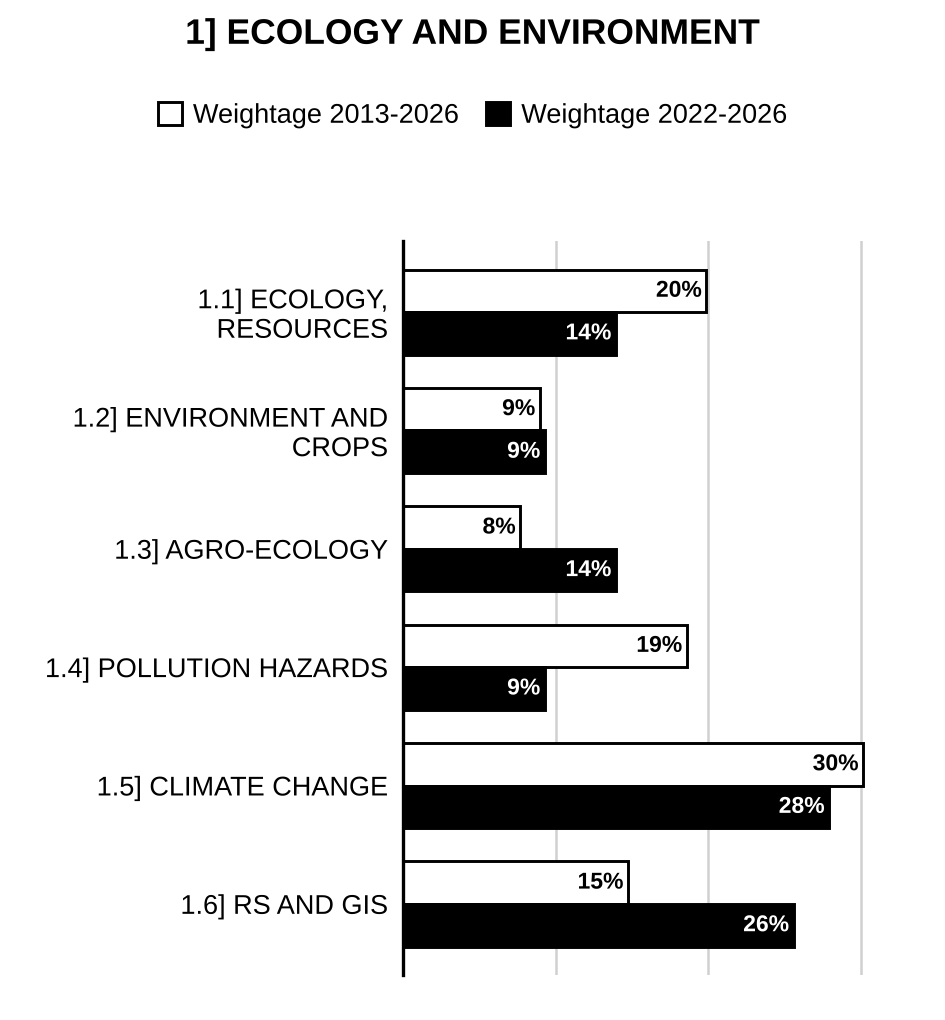
Here are all 84 Ecology and Environment questions asked in UPSC Agriculture Optional Paper I from 1995 to 2026, arranged under the 6 topics of the official syllabus. Within each topic the latest questions come first.
Each question ends with a code such as [2024/15m/3b] – the year, the marks, the word limit (where UPSC set one) and the question number in the paper.
1.1] Ecology and its relevance to man
22 questions
Classify natural resources. Discuss the natural resource management with reference to ecological conservation. [2025/10m/150w/1a]
Classify various natural resources. Discuss the steps for long term conservation of natural resources. [2022/20m/3b]
The major ways for sustainable management of natural resources. [2021/10m/150w/1a]
Define ecology. Mention its basic concepts and relevance in crop production. [2021/20m/7a]
Ecological principles for productive and sustainable agriculture. [2017/10m/150w/1b]
Intensive agriculture and Sustainable agriculture. [2015/10m/3b]
Discuss ecological principles to develop productive and sustainable ecosystems. [2014/10m/150w/1a]
Explain ecological concept of productivity. [2014/20m/2b]
What are the important features of xerophytes for ecological adaptation? [2014/10m/4a]
Suggest measures which can help to meet major challenges in agriculture and food security for stabilizing crop yields. [2013/10m/200w/2e]
Define sustainable agriculture. What are the criteria of sustainability in agricultural system? What are the various approaches to achieve sustainability? [2013/25m/400w/7a]
Why are agroecosystems losing diversity? Give characteristics of crop-land ecosystem. [2012/12m/150w/1e]
What is the difference between modern and sustainable agriculture? Give resource management for sustainable agriculture. [2012/15m/200w/2a]
What do you understand by sustainable agriculture? Compare it with intensive agriculture and discuss in detail the management practices in sustainable agriculture. [2009/60m/4]
What is sustainable agriculture? Give its limitations and strategies to achieve food security for the 21st century. [2006/60m/6]
Conservation of natural resources. [2004/15m/200w/1a]
Sustainable agriculture. [2003/20m/200w/1a]
What are the major challenges in agriculture and food security in our quest for elevating and stabilising crop yields and remunerative self-employment? Suggest measures which can help to meet these challenges. [2003/60m/6]
Suggest suitable measures for evergreen revolution on sustainable basis to meet food and nutritional requirements in the new millenium. [2002/60m/3]
Natural Resource Management. [2000/20m/200w/1d]
Define plant ecology. Discuss the role of autotoxicity in crop production. [1997/60m/3]
Wasteland management. [1995/20m/200w/5c]
1.2] Physical and social environment as factors of crop distribution and production
8 questions
Write down the physical environmental factors affecting the crop production. Discuss the effects of changing rainfall pattern on crop production in India. [2024/20m/2a]
Write different elements of weather affecting crop production with suitable examples. [2020/10m/150w/1c]
Indian farmers usually choose crops and their varieties based on their socio-economic aspects and resources at their disposal. Critically comment. [2020/10m/150w/5c]
Define the theory of tolerance and relate it to the principles of plant distribution and adaptation. [2014/20m/3c]
Photoperiodism and Thermoperiodism. [2013/10m/150w/3a]
Cardinal temperature. [1999/20m/200w/5b]
Role of solar radiation in rice. [1996/20m/200w/5c]
Cardinal temperature. [1995/20m/200w/1b]
1.3] Agro-ecology; cropping pattern as indicators of environments
6 questions
Briefly discuss the principles of agro-ecology. [2024/10m/150w/1a]
What do you understand by agroecology? How does agroecology help in crop distribution and sustainable food production? [2023/20m/2a]
How are the agro-climatic zones determined? [2015/10m/150w/1e]
What are suitable agroecological management strategies? [2014/10m/2a]
Discuss the climatic parameters in relation to agro-ecosystem. What are the major threats to agro-ecosystem? [2013/10m/150w/1b]
Importance of agro-ecological factors in land use planning. [2011/15m/150w/1a]

Preparing for Prelims too?
Our UPSC Prelims Topic-wise PYQ eBook covers every Prelims question with detailed explanations, so you can see exactly where UPSC asks from.
View the BookDownload Free Sample1.4] Environmental pollution and associated hazards to crops, animals and humans
17 questions
What are the major sources of water pollution in India? What are the ways to check it? [2026/10m/150w/1a]
Write the various factors responsible for soil pollution. How organic and natural farming can play role in minimizing soil pollution? [2022/20m/2a]
Describe in-situ and ex-situ management of Paddy Crop residue (Parali) in India. [2020/10m/150w/1b]
Describe environmental pollution. Write the role of afforestation in minimizing the effects of environmental pollution. [2020/10m/4c]
Effect of agricultural inputs on soil pollution. [2019/10m/150w/1b]
What are the effects of ozone layer depletion? [2019/10m/150w/1c]
What are the different sources of soil and water pollutions? Describe the impact of soil and water pollution on crop productivity and environment. [2018/20m/6a]
Describe the role of afforestation in minimising environmental pollution. [2017/20m/3b]
Phytostabilisation. [2016/10m/150w/5b]
Elaborate the environmental pollutions along with the role of afforestation in minimizing their effects. [2015/20m/2a]
What are the causes of soil degradation and pollution? What measures may be adopted to control soil pollution? [2013/15m/250w/4c]
Soil pollution. [2007/20m/200w/1c]
Modernisation in agriculture & environmental pollution. [2005/20m/200w/1d]
Environmental pollution hazards to crops. [2003/20m/200w/1b]
Environmental Pollution. [2000/20m/200w/5a]
Discuss environmental pollution and its hazards to men, animals and crops. Suggest concrete measures to mitigate it in a developing country like India. [1999/60m/4]
Soil pollution. [1997/20m/200w/1a]
1.5] Climate change
20 questions
Give an account of greenhouse gas (GHG) emissions from agriculture. State the mitigation strategies for reducing greenhouse gas (GHG) emissions in agriculture. [2026/20m/2a]
Enumerate the impact of climate change with reference to agricultural production. Present the opinion of public on climate change. [2025/20m/2a]
Write down the agronomic measures for climate-resilient crop production in rainfed areas. [2025/20m/2b]
Discuss the response of crop plants to rising temperature and carbon dioxide levels in relation to climate change, with suitable examples. [2023/10m/150w/1a]
What is greenhouse effect? Write in detail about various greenhouse gases and their impact on crop production. [2021/20m/2a]
Discuss various international conventions and recent global initiatives pertaining to climate change. [2021/10m/3c]
Explain El-Nino effect. Give causes and its impact on Indian Agriculture. [2020/10m/2c]
Explain the effects of climate change on crop production. [2019/10m/4c]
What do you mean by carbon-sequestration? Give the role of cropping systems for improving c-sequestration. [2019/10m/6c]
Global warming and its impact on crop productivity. [2018/10m/150w/1a]
Role of forestry in carbon sequestration. [2018/10m/150w/5b]
Greenhouse effect and global warming. [2017/10m/150w/1c]
Discuss the global initiatives and international conventions on climate change. What does NICRA stand for? What are the initiatives taken by the Indian Government in this regard? [2016/20m/4a]
Explain El Nino effect, its causes and impact on Indian agriculture. [2015/15m/7b]
Explain Indian efforts towards environmental problems at international level. [2014/10m/150w/1b]
What are the major causes of global warming? [2014/10m/150w/5b]
What are the impacts of climatic change in agriculture? How can the impacts be mitigated in crop environment? [2013/20m/250w/4a]
Green house effect and global warming. [2013/10m/150w/5b]
Enlist important greenhouse gases. How can agriculture affect climate change? Describe the importance of carbon sequestration. [2011/40m/4a]
Bring out the possible impact of climate change on Indian agriculture. What are the possible mitigation options? Comment on any National and/or International Regulatory Mechanisms in this regard. [2010/60m/2]
1.6] Advance tools for ecosystem analysis
11 questions
How can GIS be utilised for land use analysis and micro-watershed planning? [2026/10m/2c]
Discuss the Remote sensing system used for ecosystem analysis. Briefly discuss the use of Remote sensing for drought monitoring. [2024/20m/4b]
Write about the various tools used in proximal and remote sensing. [2023/10m/3c]
Give a brief note on GIS-based soil mapping and yield mapping. [2023/10m/4c]
What is “Geographic Information System” (GIS)? Discuss its elements and prospects in agriculture. [2022/10m/150w/1a]
Explain the utility of remote sensing and geographic information system (GIS) in agriculture. [2019/20m/4a]
Discuss the utility of Remote Sensing in context of Indian Agriculture. [2018/10m/3c]
Describe the utility of remote sensing and GIS in forest plantation. [2017/10m/3c]
What do you mean by the terms remote sensing and GIS? What are their applications in agriculture and forestry? [2016/10m/2c]
What is remote sensing? How can we use it in agriculture? [2013/10m/150w/1c]
Comment on the use of Remote Sensing and Geographic Information System (GIS) in agricultural planning. [2010/15m/4b]

Strengthen your GS papers
Our UPSC Mains Topic-wise & Year-wise PYQ eBook (2013–2026) maps every GS question to the syllabus, so you know what UPSC asks and how often.
View the BookDownload Free SampleNext: Cropping Patterns and Crop Production »
Back to: Agriculture Optional PYQs – Topic-wise
Last updated: 30 October 2026