
Here are all 354 Philosophy of Religion questions asked in UPSC Philosophy Optional Paper II from 1995 to 2026, arranged under the 10 topics of the official syllabus. Within each topic the latest questions come first.
Each question ends with a code such as [2024/15m/3b] – the year, the marks, the word limit (where UPSC set one) and the question number in the paper.
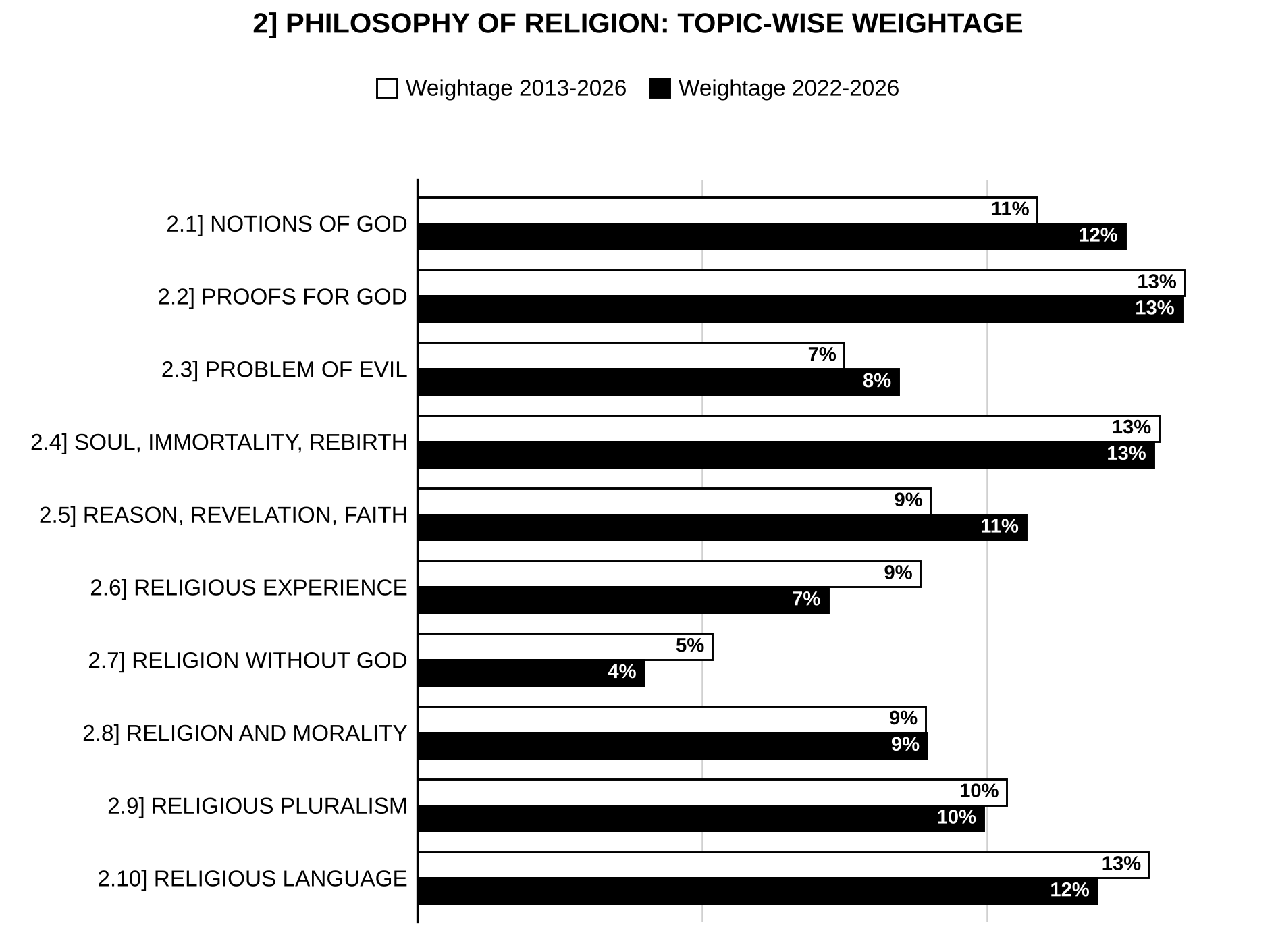
2.1] Notions of God (Indian and Western)
38 questions
Discuss the difference between personalistic and impersonalistic notions of God in the context of devotion. [2026/15m/7b]
Present an account of criticisms against omniscience and omnipotence as attributes of God. [2026/15m/8c]
How does the notion of God in Spinoza’s philosophy embedded in his metaphysics of substance and attributes? Critically discuss. [2024/15m/6b]
“In order to be conceived as the ultimate cause of the world, God must necessarily have some form of physical manifestation.” Do you agree with this view? Give reasons and justifications for your answer. [2024/15m/8b]
Elucidate the personalistic and impersonalistic aspects of God. [2023/10m/150w/5a]
In what sense is God both immanent and transcendent in theism? Discuss. [2023/15m/6b]
Write an essay on Spinoza’s notion of God and His attributes. [2022/10m/150w/5a]
Explain the relation between the God and the Self according to Rāmānujācārya. [2022/15m/6b]
Critically examine the idea of Brahman in Advaita philosophy of Śaṁkara. Does Śaṁkara’s conception of Brahman leave room for theism? Discuss. [2022/15m/8c]
Discuss the nature of God as propounded in Nyāya philosophy. [2021/10m/150w/5a]
Is there any compatibility between ‘Freedom of Will’ and ‘Omnipotent God’? Discuss. [2020/10m/150w/5d]
Discuss the nature of God in Hinduism with special reference to Vishishtadvaita (Qualified non-dualism). [2020/20m/7a]
State and evaluate the personalistic and impersonalistic aspects of God. [2019/15m/8b]
Discuss the relationship between man and God according to any one of the religions in India. [2019/15m/8c]
Is Hinduism poly-theistic? Give reasons for your answer. [2018/10m/150w/5e]
Critically discuss the relationship of man with God in the Yoga system of philosophy. [2017/10m/150w/5e]
What is a non-theological concept of God? How is it different from a theological concept of God? Discuss with arguments. [2017/15m/8b]
Critically discuss the view that ‘modern sensibility and total obedience to a despotic God’ do not go hand in hand. [2016/10m/150w/5a]
Compare and contrast the relation of man to the world in the oriental religions. [2016/20m/6b]
Show how the attributes of immanence and transcendence of God go with omnipresence and infinitude. [2016/15m/6c]
Write a critical note on the attributes of God. [2015/10m/150w/5a]
Elucidate the status of man in the realm between ‘immanence’ and ‘transcendence’. [2014/20m/8a]
Do the concepts of Ishvara and Brahman signify the same reality in Advaita Vedanta? [2012/12m/150w/5e]
Explain the distinction between Deism and Theism. [2012/20m/7a]
“To be Man is to strive to be God.” [2009/30m/7a]
Can the ‘God’ of Religion be identified with the ‘Absolute’ of Philosophy? [2009/30m/8a]
Can Deism be a satisfactory theory in the context of God of grace and devotion? Discuss. [2008/20m/200w/5c]
God is not subject to the Laws of Logic. [2007/20m/200w/5c]
Traditionally omnipotence has been seen as one of the attributes of God. But according to some critics the notion of omnipotent being is paradoxical. In response some theists have tried to resolve the alleged paradox. Describe the paradox and explain the attempts to resolve it. [2007/60m/6]
The difference between impersonalistic and naturalistic conceptions of God. [2006/20m/200w/5d]
Traditionally omnipotence has been regarded as one of the attributes of God. But according to some critics, the notion of omnipotent being is paradoxical. In response, some theists have tried to resolve the alleged paradox. Describe the paradox and explain the attempts to resolve it. [2006/60m/6]
“If God is omniscient, then humans are not free.” [2004/20m/200w/5a]
What do immanence and transcendence mean in talking about God? Is God really immanent or transcendent? [2003/20m/200w/5c]
Impersonalistic conception of God. [2002/20m/200w/5c]
Impersonality Concept of God. [2000/20m/200w/5a]
Naturalistic notion of God. [1999/20m/200w/5c]
Personalistic notion of God. [1997/20m/200w/5a]
Islam as a theo-centric religion. [1995/20m/200w/5c]
2.2] Proofs for the existence of God and their critique (Indian and Western)
47 questions
Discuss Aquinas’ argument from the contingency of the world to prove the existence of God. [2026/10m/150w/5b]
Explain and examine Madhvacharya’s arguments for the existence of God. [2026/15m/8b]
Present an account of Design argument to prove the existence of God along with its criticism by David Hume. [2025/20m/6a]
What proofs do Nyāya philosophers offer for the existence of God? Discuss. [2025/15m/7b]
Present an exposition of ontological proof for the existence of God along with its criticism. [2024/15m/7c]
Critically examine the arguments of Nyaya for the existence of God. [2023/20m/7a]
Present a critical exposition of different arguments offered by St. Thomas Aquinas to prove the existence of God also known as ‘Five Ways’. Which one of them do you find philosophically most interesting? Give reasons in support of your answer. [2022/20m/6a]
Discuss the main points of distinction between a priori and a posteriori arguments for the existence of God. Which one according to you should be preferred over the other? Give reasons and justifications for your answer. [2022/20m/8a]
Give a critical account of moral argument to prove the existence of God. [2021/15m/7b]
Is the ontological proof for the existence of God by St. Anselm logical? Discuss. [2020/20m/6a]
State and evaluate the proofs for the existence of God as propounded in Jainism. [2019/10m/150w/5e]
Does the concept of God entail the existence of God? Examine from the perspective of ontological argument. [2018/15m/6c]
Compare St. Thomas Aquinas’ five ways of knowing God with the arguments of the Nyāya School of Indian Philosophy for the existence of God. [2018/20m/8a]
Critically evaluate the Buddhistic arguments against the existence of God as the creator of the world. [2018/15m/8b]
Compare and contrast the different forms of cosmological argument for the existence of God. [2017/15m/6c]
“It would be self-contradictory to say that the most perfect conceivable being lacks the attribute of existence.” Analyse. [2016/15m/7c]
“The natural world is as complexly and manifestly designed as a watch.” Evaluate. [2016/15m/8c]
Examine the Nyāya arguments in favour of the existence of God. [2015/20m/7c]
Examine the ontological and cosmological arguments in favour of the existence of God. [2015/15m/8b]
Can it be self-contradictory to accept the ‘idea’ of God but deny the ‘existence’ of God? [2014/15m/6c]
Discuss cosmological argument for the existence of God, and show its merits and demerits. [2014/15m/7b]
State and elucidate the cosmological argument for the existence of God in Western and Indian philosophy. [2013/15m/250w/6a]
Discuss two main objections against this argument. Are theists able to answer these satisfactorily? [2013/15m/250w/6b]
Critically evaluate three major objections against the argument from design for the existence of God. [2013/20m/250w/6c]
Can the existence of God be proved with cogent and convincing rational arguments? [2012/12m/150w/5b]
Why is a proof for the existence of God necessary for the growth of a religion? Discuss. [2011/15m/150w/5c]
Is contingent argument for the existence of God anything more than a logical exercise? Discuss. [2010/20m/200w/6a]
If each and every argument has to take that its premises are true, would the causal argument for the existence of God as First Cause be different from assuming that it is true? Argue in favour of your position. [2010/20m/200w/6b]
Human mind is such that it naturally observes order in nature. Given this, can one use argument from Design for the existence of God? Discuss. [2010/20m/200w/6c]
Critically examine the ‘Causal’ argument as a proof for the existence of God. [2009/20m/200w/5a]
Analyze the ‘Teleological’ argument as a proof for the existence of God. [2009/30m/6a]
Different versions of ontological argument and Kant’s critique of this argument. [2008/20m/200w/5b]
State and evaluate the cosmological argument for the existence of God. What are its two forms? What is the difference between a dependent being and self existent being? Why the self-existent being be Theocentric? Can’t the nature itself be conceived as self-existent being? Discuss. [2007/60m/7]
“God is the first reason of things.” [2005/20m/200w/5a]
“If God exists only in someone’s mind, the greatest conceivable being is not after all the greatest conceivable being.” [2005/20m/200w/5b]
Some theists question the relevancy of proofs and arguments for theistic beliefs. Believers, in their view, are not irrational for want of proof for their belief in God, because proofs are neither necessary nor sufficient for religious life. Would you agree with such a view? Discuss. [2004/60m/7]
Is the ontological argument for the existence of God really invalid? [2003/20m/200w/5a]
Does any of the received “proofs” for the existence of God succeed in proving God’s existence? Discuss. In this context critically consider especially the cosmological argument. [2003/60m/6]
Ontological proof for the existence of God. [2002/20m/200w/5a]
The possibility of ontological argument for the existence of supremely powerful devil. [2001/20m/200w/5a]
State and evaluate the teleological argument for the existence of God. What does it indicate about the origin of the Universe? Is the hypothesis of the Designer plausible? Or, can the orderliness of the Universe be accounted in terms of the process of chance and necessity? Discuss. [2001/60m/6]
Discuss traditional proofs for the existence of God and give your own criticism on each. [2000/60m/6]
Explain the ontological argument for God’s existence and examine the fallacies involved in this argument. [1999/60m/6]
Common consent argument for the existence of God. [1998/20m/200w/5a]
Suppose the traditionally received arguments for the existence of God are all fallacious. Would that prove non-existence of God? If your answer is in the negative then consider whether there can be a proof for God’s nonexistence. [1998/60m/6]
State and examine the Cosmological Argument for the existence of God. [1997/60m/6]
Ontological Argument for the existence of God. [1996/20m/200w/5c]
2.3] Problem of evil
25 questions
In what sense does St. Augustine’s identification of all evil as either sin or as the punishment of sin succeed or fail in providing a coherent account of both moral and natural evil? Evaluate. [2026/20m/6a]
Explain the main tenets of the Process Theodicy as an explanation of the problem of evil. [2025/15m/6b]
“The problem of evil is a direct offshoot of how God is conceptualised in a system.” Critically discuss. [2024/15m/6c]
“All evil is either sin or punishment for sin.” – St. Augustine. Critically discuss. [2023/20m/8a]
If God is the Absolute Creator, then the responsibility of the evil cannot belong to the human agent. Critically examine. [2022/15m/6c]
Discuss the paradox of omnipotence of God in the context of the existence of evil. [2021/10m/150w/5e]
What is the logical problem of evil? Discuss. [2020/15m/6b]
What role do the concepts of evil and profane play to provide a firm foundation to religion? [2019/15m/6b]
How do you define a non-theological concept of evil? Explain. [2017/10m/150w/5b]
“If God is all-powerful, God must wish to abolish all evils; but moral and natural evils are rampant in the world.” How would a theist react to this? [2016/20m/8a]
Is God the cause of natural evil? Explain. [2015/10m/150w/5d]
Do you think that evil is a bitter pill which no theist can easily swallow? Discuss. [2015/15m/7a]
Is evil reconcilable with the benevolent God? [2014/20m/7a]
Do theists succeed in explaining the natural evil in the world as a necessary counterpart to good? [2013/10m/150w/5d]
“God permitted suffering to discipline the human being.” [2012/12m/150w/5a]
“The problem of evil arises when we attribute infinite knowledge, power and goodness to God acknowledging the fact of innocent persons’ suffering. One cannot be mistaken about one’s own experience, and suffering is an experience. Hence, God cannot have at least one of the three attributes: infinite knowledge, power and goodness.” Evaluate this argument. [2010/15m/150w/5b]
If evils and sufferings are the real experiences of individual selves, what role do they play in realizing self-transcendence? [2009/20m/200w/5b]
How can a theist resolve the problem of evil? Does evil not tell upon omnipotence and omniscience of God? Can God be thought of as imperfect and powerless in this regard? Discuss critically for and against the two possible opposite views and justify your own position. [2008/60m/8]
‘God permitted evil to exist in order to bring about greater good; Adam’s fall was a Felix culpa (happy sin).’ Leibniz. [2007/20m/200w/5b]
“God permitted evil to exist in order to bring about greater good, Adam’s fall was felix culpa (happy sin)”. (Leibniz) [2006/20m/200w/5a]
“The Problem of evil is the problem of reconciling the imperfect world with the goodness of God.” [2005/20m/200w/5c]
Describe the problem of evil. Some theologians utilize the free-will argument to resolve this problem. How? Discuss. [2004/60m/6]
What is the problem of evil? Discuss the theistic solution to this problem. [1999/60m/7]
Can we reconcile evil with benevolence and omnipotence of God? Discuss. [1997/60m/7]
Should there be evil in a world governed by God? Discuss with reference to Hinduism and Christianity. [1996/60m/7]
2.4] Soul
54 questions
Discuss the nature of embodied liberation (jīvanmukti) with reference to Advaita Vedānta. [2025/10m/150w/5d]
Is the concept of immortality of soul a necessary condition for Rebirth? Discuss with reference to the Bhagavad Gītā. [2025/15m/7c]
Discuss the concept of liberation (Apavarga) according to Nyāya-Vaiśeṣika. [2024/10m/150w/5c]
Is it necessary to adhere to the notions of immortality of soul and rebirth in order to have a robust conception of liberation? Give reasons and justifications for your answer. [2024/20m/6a]
Critically examine Plato’s apriori proofs for the immortality of the soul. [2023/20m/6a]
Examine the significance of the concept of rebirth in the theory of Karma. [2023/15m/7b]
“Immortality of Soul is a necessary postulate for rebirth.” Critically examine with reference to Buddhism. [2022/10m/150w/5c]
Is it possible to have an idea of Liberation without the conception of a real agent? In this context, discuss the difference between Advaita and Viśiṣṭādvaita systems of thought. [2022/15m/7b]
Discuss the nature of Soul and Bondage according to Jainism. [2022/15m/8b]
Discuss the concept of immortality of soul with special reference to Hindu tradition. [2021/20m/6a]
Elucidate the concept of liberation according to Advaita Vedānta. Explain the role of knowledge in the attainment of liberation. [2021/15m/6b]
Discuss and evaluate the doctrine of Karma as an essential postulate of Hinduism. [2021/15m/8b]
The concept of ‘Immortality’ is a basic presupposition of religion. Elaborate your answer. [2020/10m/150w/5b]
Do you accept that Knowledge, Action and Devotion are the means to attain liberation in Indian tradition? Discuss. [2020/15m/8c]
State and explain the doctrines of Karma, Rebirth and Reincarnation in Hinduism. [2019/20m/8a]
How far is it plausible to argue that the anti-theistic religions’ stand on the concept of rebirth is philosophically significant? [2018/10m/150w/5b]
Evaluate the concept of Bhakti (Devotion) as a pathway to attain liberation. [2018/15m/7c]
Discuss whether the doctrine of immortality of soul is indispensable for a religion. [2017/10m/150w/5d]
Is there an essential difference between the concept of Liberation in theological and non-theological approaches to life? Discuss. [2017/20m/6a]
Buddhism disbelieves in the immortality of soul, but accepts the phenomenon of rebirth. Examine. [2016/10m/150w/5d]
“Immortality means absence of Karma and Rebirth.” Discuss. [2015/15m/7b]
What is liberation? Briefly discuss the ways to attain it as outlined in the systems of Vedānta. [2015/20m/8c]
What are the arguments given in favour of the immortality of the Soul? [2014/10m/150w/5c]
How do you justify ‘rebirth’ with or without the Soul? [2014/10m/150w/5e]
Compare and contrast the concept of liberation according to ‘Advaita’ and ‘Viśiṣṭādvaita’. [2014/15m/7c]
Is there anything else other than human efforts which may be conducive to attainment of liberation? [2013/10m/150w/5c]
Are rebirth and liberation analagous concepts? Explain. [2012/12m/150w/5c]
Is the idea of immortality of the soul utopian or it is realizable? Discuss. [2012/20m/7b]
Is a belief in the immortality of the soul a necessary precondition for religion? Discuss. [2011/20m/200w/8a]
Is a belief in rebirth and reincarnation possible without a belief in the immortality of the soul? Discuss. [2011/20m/200w/8b]
What sort of criterion can one provide for identifying rebirth as opposed to birth? Discuss. [2010/15m/150w/5c]
Why is grace of God needed for liberation? Discuss with an example. [2010/20m/200w/7a]
Distinguish between Indian concept of ‘Jivatma’ and Plato’s concept of ‘Soul’. [2010/20m/200w/7b]
If ignorance is the cause of suffering, knowledge should remove suffering. What is the notion of knowledge which a liberated person acquires? Discuss. [2010/20m/200w/7c]
Examine why Man has a desire for Immortality. [2009/30m/6b]
Possibility of rational understanding of immortality and liberation. [2008/20m/200w/5d]
Without some conception of immortality, religion has no meaning. [2007/20m/200w/5a]
Explain the doctrine of the Law of Karma. Is it compatible with the freedom of the will? Discuss. [2007/60m/8]
“Without some conceptions of immortality of soul, religion is meaningless.” [2006/20m/200w/5c]
Is Christian doctrine of the immortality of the soul compatible with Gita’s doctrine of atman? Discuss. [2005/60m/6]
What do you understand by ‘liberation’? Is it possible for one to be liberated in this very life? If it is, what are the, characteristics of a liberated person? Discuss. [2005/60m/8]
Relation between religion and salvation. [2004/20m/200w/5d]
Freedom as liberation from Samsara. [2003/20m/200w/1c]
Can the results of a finite action of an individual (karma) determine the nature of the immortal soul (atman)? [2003/20m/200w/5d]
Advaita Vedanta theory of jivanmukti. [2002/20m/200w/5b]
What is meant by immortality of soul? Analyze the arguments of the Bhagavad-Gita in this regard. [2002/60m/8]
Immortality of Soul. [2000/20m/200w/5b]
Elaborate the nature of Liberation according to Advaita Vedanta. [2000/60m/8]
Jivanmukti. [1999/20m/200w/5b]
Explain the significance of the doctrine of reincarnation in the Indian religious thought. Examine the chief arguments give in support of the doctrine. [1998/60m/8]
Immortality of Soul. [1997/20m/200w/5b]
The path of Disinterested Action. [1997/20m/200w/5c]
The Path of Knowledge. [1996/20m/200w/5d]
Bring out the inter-relationship between various paths leading to moksha and indicate the nature of moksha. [1995/60m/7]
2.5] Reason, revelation and faith
34 questions
How does Paul Tillich’s idea of faith as ultimate concern address the relation between faith, doubt and reason? Evaluate. [2026/10m/150w/5c]
“If religion were a subject of reason alone, it would have lacked an experiential account.” Do you agree with this statement? Give reasons in support of your answer. [2026/10m/150w/5e]
How does Aquinas’ account of Faith as “an intellectual assent” reconcile the juxtaposition between Reason and Faith? Discuss. [2025/10m/150w/5e]
Distinguish between Natural Theology and Revealed Theology in the context of the Propositional view of Revelation. [2025/15m/6c]
Discuss the role of reason in religion. [2024/10m/150w/5d]
What kind of epistemic justifications are possible with regard to claims to revelation? Discuss with your own comments. [2024/15m/7b]
Can religious beliefs be justified? Discuss. [2023/10m/150w/5b]
Explain the rational and irrational aspects of faith in the discourse of religion. [2023/15m/6c]
Examine the relation between mystical experience and revelation and expound their significance in the religious life. [2023/15m/8c]
Is the notion of faith indispensable for the idea of revelation? Critically comment. [2022/10m/150w/5d]
Discuss the role of reason and faith in religion. Can reason be a regulative force in the formulation of religious beliefs? Explain. [2021/20m/7a]
Discuss the significance of ‘Religion’ vis-à-vis the present scientific and technological development. [2020/10m/150w/5a]
What are the basic tenets of faith? Distinguish between faith and belief. [2020/15m/7c]
What is instrumental to self-revelation: Faith or Reason? Justify your position. [2019/10m/150w/5a]
Discuss whether the voluntarist’s theories of faith are adequate. [2017/15m/7c]
Faith means human awareness of God; but it cannot be irrational. Analyse. [2016/10m/150w/5e]
The content of revelation is a body of truths expressed in statements or propositions. But it cannot be against reason. Discuss. [2016/15m/6a]
Do faith and reason go together? Discuss. [2015/10m/150w/5e]
Can revelation be justified by reason? Discuss. [2015/15m/6c]
Can reason be used to justify faith? [2014/15m/8b]
Is religious faith opposed to reason? [2013/10m/150w/5e]
The concept of revelation is essentially opposed to religious pluralism. Do you agree? Give reasons for your answer. [2012/30m/8b]
Discuss roles of reason, revelation and faith in the sphere of religion. Are they compatible? If not, how to resolve their apparent inconsistency? [2008/60m/6]
Explain the notion of revelation. Does revelation stand in need of confirmation? Discuss and also explain the difference or similarity between revelation and ‘Shruti’. [2006/60m/8]
Some theists question the relevancy of proofs and arguments for theistic beliefs. Believers, in their view, are not irrational for want of proof for their belief in God, because proofs are neither necessary nor sufficient for religious life. Would you agree with such a view? Discuss. [2004/60m/7]
Point out the relative importance of reason and revelation in religion. Are the two compatible? Discuss. [2002/60m/6]
Miracles (religious) are impossible. [2001/20m/200w/5d]
Reason and Revelation. [2000/20m/200w/5d]
Religion, Theology and Philosophy of Religion. [1999/20m/200w/5a]
Elucidate the nature of religious knowledge. Is revelation a sufficient of religious knowledge? Discuss. [1999/60m/8]
Bring out the roles of Reason and Revelation in Religious Knowledge. [1997/60m/8]
Difference between Theology and Philosophy of Religion. [1996/20m/200w/5b]
“The philosophical problems are identical with religious problems in India.” [1995/20m/200w/5b]
Discuss the nature and inter-relationship of different foundations of religious belief. [1995/60m/6]

Preparing for Prelims too?
Our UPSC Prelims Topic-wise PYQ eBook covers every Prelims question with detailed explanations, so you can see exactly where UPSC asks from.
View the BookDownload Free Sample2.6] Religious experience (Indian and Western)
26 questions
On what grounds does William James characterize mystical states as a genuine expression of religious experience? Elaborate. [2026/10m/150w/5a]
“If religion were a subject of reason alone, it would have lacked an experiential account.” Do you agree with this statement? Give reasons in support of your answer. [2026/10m/150w/5e]
Evaluate the nature and object of Religious Experience as explained by Radhakrishnan in ‘The Hindu View of Life’. [2025/20m/8a]
Discuss the main features of religious experience according to Advaita Vedanta. [2024/15m/8c]
Examine the relation between mystical experience and revelation and expound their significance in the religious life. [2023/15m/8c]
Discuss the nature and variety of religious experiences as presented by William James. [2022/15m/7c]
Explain the concept of religious experience in the light of Vedāntic tradition. [2021/15m/7c]
Distinguish between prayer and worship and determine their place in religion. [2020/15m/7b]
Discuss whether and how does religious symbolism lead to mysticism. [2019/20m/6a]
How far can religious experience be made a topic of public discourse? Analyse. [2019/15m/7c]
The terms ‘Sacred’ and ‘Holy’ have come to serve as generic names for the object of religion. Do you agree that one can have God as the object of religion? Discuss. [2018/20m/7a]
State and evaluate the nature and validity of mystic experience. [2016/20m/7a]
Explain the nature of mysticism in Hinduism and Islam. [2015/15m/6b]
Discuss the conflicting nature of religious experiences with special reference to Buddhism and Jainism. [2014/15m/8c]
What is the nature of mystical experience? [2013/15m/250w/7a]
Is mystical experience open to different interpretations? [2013/15m/250w/7b]
Can mystical experience be regarded as a valid source of knowledge? [2013/20m/250w/7c]
What is the object of religious experience? Is it empirical or trans-empirical? Explain in detail. [2012/30m/8a]
If religious experience is unique, what makes it an experience? How is this experience logically different from the experience of loneliness, happiness, etc.? [2010/20m/200w/8a]
Explain the nature of religious experience. Can this experience be validated? [2009/20m/200w/5c]
The difference between ‘numinous’ and ‘mystical’ experience. [2007/20m/200w/5d]
“Mysticism is the power of spiritual access to domains of knowledge closed off to ordinary thought.” [2005/20m/200w/5d]
State and explain the chief doctrines of Mysticism. [2000/60m/7]
Place of Prayer in religion. [1998/20m/200w/5b]
Logic and Mysticism. [1998/20m/200w/5d]
Describe the characteristics of mystical experience and indicate its religious and Philosophical implications. [1996/60m/6]
2.7] Religion without God
27 questions
Discuss Cārvāka’s critique of the belief in the existence of suprasensible entities. [2025/10m/150w/5a]
State and evaluate Buddhism as a religion without God. [2024/20m/7a]
What is Agnosticism? How do agnostics conceptualize the relation between religion and God? Discuss. [2023/10m/150w/5e]
Can humanism be a substitute for religion? Explain and evaluate in the context of the present Indian society. [2021/15m/2c]
Is religious life possible without the belief in God? Discuss. [2021/10m/150w/5d]
Critically examine the concept of God as prerequisite for a religion. [2020/15m/6c]
State and evaluate the proofs for the existence of God as propounded in Jainism. [2019/10m/150w/5e]
How would a religious person deny the possibility of a religion without God? Discuss. [2019/15m/6c]
How far is it plausible to argue that the anti-theistic religions’ stand on the concept of rebirth is philosophically significant? [2018/10m/150w/5b]
Can you justify religion without God? Support your answer. [2018/10m/150w/5c]
Critically evaluate the Buddhistic arguments against the existence of God as the creator of the world. [2018/15m/8b]
Is God necessary for religion? Justify your answer. [2017/10m/150w/5c]
Is existence of God a necessary condition for the survival of religion? Explain. [2015/10m/150w/5b]
Is God indispensable for religion? [2013/10m/150w/5a]
“Religion is not just false, it is harmful.” Discuss. [2011/15m/150w/5d]
Can Buddhism, because of its doctrine of ‘anatta’, be regarded as a religion or not? Discuss. [2011/20m/200w/8c]
What is the central concept in a religion without God? Discuss. [2010/15m/150w/5a]
Comment on the statement that “Religion only promised but never fulfilled the promise”. [2009/30m/8b]
Can Atheism be a religion? Discuss. [2005/60m/7]
is God dead (Nietzsche) or living (faithful people)? [2003/20m/200w/5b]
When religion is defined as religare, is Buddhism or Jainism a religion? What are the criteria for an organization to be called a religion? Should there be a transcendent reality in a religion? Discuss. [2003/60m/8]
Religion without God. [2002/20m/200w/5d]
What do you understand by religion? Do you think that the belief in the existence of God is an essential feature of religion? Discuss. [2001/60m/7]
Atheistic Religion. [1998/20m/200w/5c]
Religion is generally viewed to be based on beliefs in the supernatural. But some thinkers (e.g. Augusta Comte, John Dewey, Huxley, Erich Fromm) reject the supernatural and try naturalistic reconstruction of religion. Critically consider some of the major attempts in this direction. [1998/60m/7]
Common elements and basic differences in Jainism and Buddhism. [1995/20m/200w/5a]
What are the main contemporary philosophies which reject traditional religions and belief in God? How can you defend ‘religion’ against such attacks? [1995/60m/8]
2.8] Religion and morality
34 questions
How does the issue of moral autonomy conflict with conception of religion as a source of morality? Critically discuss. [2026/15m/6b]
Critically evaluate the shift in Gandhi’s view from ‘God is Truth’ to ‘Truth is God’, in the context of interrelation between religion and morality. [2026/20m/8a]
Present an account of Nietzsche’s criticism of religion and morality. [2025/10m/150w/5c]
Is it necessary for the normative principles to bear reference to God in order to produce a feeling of obligation in a moral agent? Critically discuss. [2025/15m/8b]
Can there be a religion without morality? Discuss. [2024/10m/150w/5a]
Does religion influence the moral behaviour? Explain the interactive relation between religion and morality. [2023/10m/150w/5c]
“One can have morality without religion but not religion without morality.” Discuss. [2022/10m/150w/5b]
Do you consider that religion and morality are inseparable? Give reasons for your answer. [2021/15m/6c]
Are religious beliefs and practices incompatible with moral behaviour? Discuss. [2020/15m/8b]
Does a devoted commitment to a religious way of life make man go astray from social morality? Examine. [2019/10m/150w/5d]
Secular ethics cannot fully resolve as to why one should be moral all the time. Examine. [2019/15m/7b]
Can one claim that there is an inter-relatedness between ‘religiosity’ and ‘immorality’? Discuss. [2018/10m/150w/5d]
Does a committed religious person go against social morality? Discuss from the moral perspective. [2017/10m/150w/5a]
What will be the authority and acceptance of the absolute ethical values in the non-theological system of social practices? Discuss. [2017/15m/7b]
“Moral principles function better when they remain independent and unconnected with religion.” Discuss. [2016/15m/7b]
Is morality necessarily based on religion? Discuss. [2015/10m/150w/5c]
“An atheist may be a better man than a religious person bereft of moral values.” Discuss. [2015/15m/8a]
How far can religious morality incorporate individual freedom? [2014/20m/6a]
Is religious morality consistent with individual freedom? [2013/10m/150w/5b]
“If God does not exist then why should one be moral all the time?” Discuss. [2012/20m/6a]
“I can be moral without being religious, but I cannot be religious without being moral.” Do you agree? Give reasons for your answer. [2012/20m/7c]
Examine the view that the foundation of morality is possible only in a religious framework. [2011/15m/150w/5b]
If morality has to follow from religion, can there be rational justification for moral actions? Discuss. [2010/15m/150w/5d]
Propriety of religion without morality. [2008/20m/200w/5a]
Distinguish between religious and secular ethics: Discuss in this context, the view that holds that secular ethics are superior to religious ethics because religious ethics are essentially based on rules without decisive regard for consequences, whereas secular ethics, as their best, aim at producing the best overall consequences. [2006/60m/7]
“Secular ethics cannot satisfactorily answer the question, ‘Why should I be moral all the time?’” [2004/20m/200w/5b]
Are God and religion necessary presuppositions of morality? Elucidate your answer following Kant. Also consider critically in this context the possible ground(s) of morality for an atheist. [2003/60m/7]
‘Religion without morality is empty and morality without religion is blind’. Do you agree with this contention? Give reasons in support of your view. [2002/60m/7]
“If God does not exist, everything is permissible.” – Dostoevsky. [2001/20m/200w/5b]
There are two incompatible views regarding the relationship between religion and morality. According to one view morality requires some divine transcendental source in order that it is binding and objective. The second view argues in favour of purely secular morality, based entirely on human reason. Which one of these two views is correct in your opinion and why? Discuss. [2001/60m/8]
Religion and Morality. [2000/20m/200w/5c]
Religion and Morality. [1999/20m/200w/5d]
Religion and Morality. [1997/20m/200w/5d]
State and examine the various definitions of ‘dharma.’ What one of these is most acceptable and why? [1995/60m/4]
2.9] Religious pluralism and the problem of absolute truth
35 questions
Does the idea of Religious Pluralism necessarily entail moral relativism? Critically discuss. [2026/15m/6c]
Can conflicting truth claims among religions be reconciled within the framework of religious pluralism? Critically discuss. [2026/15m/7c]
Is the idea of secularism necessarily related to the idea of religious pluralism? Discuss. [2025/10m/150w/1c]
How does the Vedantic view of Religious Pluralism address the conflicting truth claims of different faiths? Answer with reference to Swami Vivekananda’s view of Universal Religion. [2025/20m/7a]
Write a note on the notion of absolute truth in the context of religion. [2024/10m/150w/5b]
Does religious pluralism invite inter-religious conflicts and destroy the truth of religion? Discuss. [2023/15m/8b]
“An unquestionable acceptance of only one Absolute Truth will inevitably result in religious exclusivism.” Discuss. [2022/20m/7a]
Discuss the possibility of Absolute Truth in the context of religious pluralism. [2021/10m/150w/5b]
Is religious freedom possible in a multireligious society? Explain. [2021/10m/150w/5c]
Is it acceptable that the History of Religions is the History of Conflicts? Discuss. [2020/10m/150w/5c]
What is the importance of religious tolerance in a multicultural pluralistic society? Justify your answer. [2020/10m/150w/5e]
Is religion a uniting force for humanity in the globalizing world as of today? Discuss. [2019/10m/150w/5b]
Can there be a philosophical argument to support violence in the name of religion? Discuss. [2019/10m/150w/5c]
Expound and explain the central problem in the discussion between religious pluralists and religious exclusivists. [2019/20m/7a]
Distinguish between Exclusivism, Inclusivism and Pluralism with regard to the conflicting truth-claims of different religions. [2018/20m/6a]
“Truth is one, yet people perceive differently.” Critically evaluate by considering the present Indian context. [2018/15m/6b]
Does religion guarantee the absolute truth? Discuss in the context of religious pluralism. [2017/15m/6b]
Can a religious person take an elastic view about religious ideals, principles and practices, etc. which are supposed to be eternal? Will it make the religion progressive or will it demolish its authority? Discuss critically. [2017/20m/8a]
“World-religion is a spiritualistic and humanistic composite.” Evaluate. [2016/10m/150w/5b]
Is Religious absolutism a threat to Religious pluralism? Discuss. [2016/10m/150w/5c]
If God is regarded as ‘One’, will it give rise to religious conflicts? [2014/10m/150w/5a]
Can pluralist perspective vindicate Absolute Truth? [2014/10m/150w/5d]
Can the notion of absolute truth be justified on rational grounds? [2012/12m/150w/5d]
The concept of revelation is essentially opposed to religious pluralism. Do you agree? Give reasons for your answer. [2012/30m/8b]
Is William James right in holding that religious disputes are like conflicts in aesthetic appreciation? Discuss. [2011/20m/200w/6a]
Explain the notion of truth as “Ekam Sat Viprah Bahudha Vadanti” (Truth is one, the learned interpret it differently.) [2011/20m/200w/7a]
Does the notion of absolute truth give rise to intolerance and religious conflicts? Discuss. [2011/20m/200w/7b]
How can religious conflicts about truth be resolved? Discuss. [2011/20m/200w/7c]
The fact that different religions originated at different places and in different centuries proves that plurality of religions is a fact. How correct would it be to say that all religions are essentially the same? Discuss. [2010/20m/200w/8c]
“There are no whole truths; all truths are half truths. It is trying to treat them as whole truths that plays the devil.” [2009/30m/7b]
In a pluralistic society how can religious pluralism be practised? Point out distinction among (a) Sarvadharmasamanvaya, (b) Sarvadharmasamabhāva and (c) Sarvadharmasadbhāva. [2008/60m/7]
What is the central issue in the debate between religious pluralists and religious exclusivists? Discuss in this context the arguments they advance in support of their views. [2004/60m/8]
Mahatma Gandhi on sarvadharmasambhava. [2002/20m/200w/1b]
Religious Tolerance in Hinduism. [1996/20m/200w/5a]
Bring out the universal aspects of religious life with reference to Hinduism Christianity and Islam. [1996/60m/8]
2.10] Nature of religious language
34 questions
Critically discuss the views of R. B. Braithwaite on the nature of religious language. [2026/10m/150w/5d]
Analyse R. M. Hare’s concept of ‘blik’ and assess whether it successfully defends the meaningfulness of religious language. [2026/20m/7a]
Is religious language symbolic? Give reasons and justification in support of your answer. [2025/10m/150w/5b]
Discuss the Advaitic notion of indescribability (anirvachanīyatā) in the context of nature of religious language. [2025/15m/8c]
Explain the analogical nature of religious language. [2024/10m/150w/5e]
Distinguish between cognitivist and non-cognitivist account of religious language. Does the cognitivist account lead to any contradiction? Answer with reference to the philosophical views of R. B. Braithwaite. [2024/20m/8a]
Discuss Wittgenstein’s view about the non-cognitive nature of religious language. [2023/10m/150w/5d]
Explain the symbolic nature of religious language according to Tillich. [2023/15m/7c]
Explain the difference between the cognitivist and non-cognitivist approaches to the religious language with reference to the statement–“God exists”. [2022/10m/150w/5e]
What is non-cognitive theory of religious language? Explain critically in the light of R.B. Braithwaite’s views. [2021/20m/8a]
Explain the symbolic nature of religious language with special reference to Paul Tillich. [2021/15m/8c]
Does religious language carry cognitive content? Elucidate in detail. [2020/20m/8a]
Discuss whether and how does religious symbolism lead to mysticism. [2019/20m/6a]
In what sense is the secular use of language different from the religious use of language? Discuss. [2018/10m/150w/5a]
Critically examine Braithwaite’s non-cognitive theory of religious language. [2018/15m/7b]
Explain the significance of religious symbols as transcendent referent that mediates into the cultural, spatial and temporal world. [2018/15m/8c]
Is not the language of analogies more confusing and the language of symbols more unintelligible? Evaluate it in the case of a religious language. [2017/20m/7a]
In order to make expressions of religious experiences communicable, what kind of language needs to be constructed and used? Explain. [2017/15m/8c]
Among the different views of religious language, which one is more satisfactory and why? [2016/15m/8b]
How can the religious language be verified? Is it correct to say that religious language is verified because it cannot be falsified? Discuss. [2015/20m/6a]
How do you formulate religious language as non-cognitive? [2014/15m/6b]
What is meant by saying that religious language is non-cognitive? [2013/15m/250w/8a]
Can religious language be said to be verifiable? [2013/15m/250w/8b]
Do cognitivists provide a cogent answer to the objection based on falsifiability? [2013/20m/250w/8c]
Analyse Paul Tillich’s statement that “symbolic language alone is able to express the ultimate.” [2012/20m/6b]
Discuss the cognitivist account of the nature of religious language. [2012/20m/6c]
Are religious doctrines and debates verifiable? Discuss. [2011/20m/200w/6b]
Examine the view that, religious doctrines are not ‘quasi-scientific’ doctrines, but represent a form of life. [2011/20m/200w/6c]
Religious language is dependent on natural language for an analogy and a symbol to work. Why not then treat religious language as a specialized language like telegraphic language? Discuss. [2010/20m/200w/8b]
Is religious language symbolic? Discuss. [2009/20m/200w/5d]
“Religious faith consists of a set of profoundly unfalsifiable assumptions that govern all of a person’s other beliefs.” (R. M. Hare) [2006/20m/200w/5b]
“Man’s ultimate concern must be expressed symbolically, because symbolic language alone is able to express the ultimate.” – Paul Tillich. [2004/20m/200w/5c]
Emotive meaning in religious language. [1996/20m/200w/1d]
Is religious language meaningless? Justify your answer by adequate arguments. [1995/60m/3]

Strengthen your GS papers
Our UPSC Mains Topic-wise & Year-wise PYQ eBook (2013–2026) maps every GS question to the syllabus, so you know what UPSC asks and how often.
View the BookDownload Free Sample« Previous: Socio-Political Philosophy | Next: Other Questions »
Back to: Philosophy Optional PYQs – Topic-wise
Last updated: 30 October 2026