
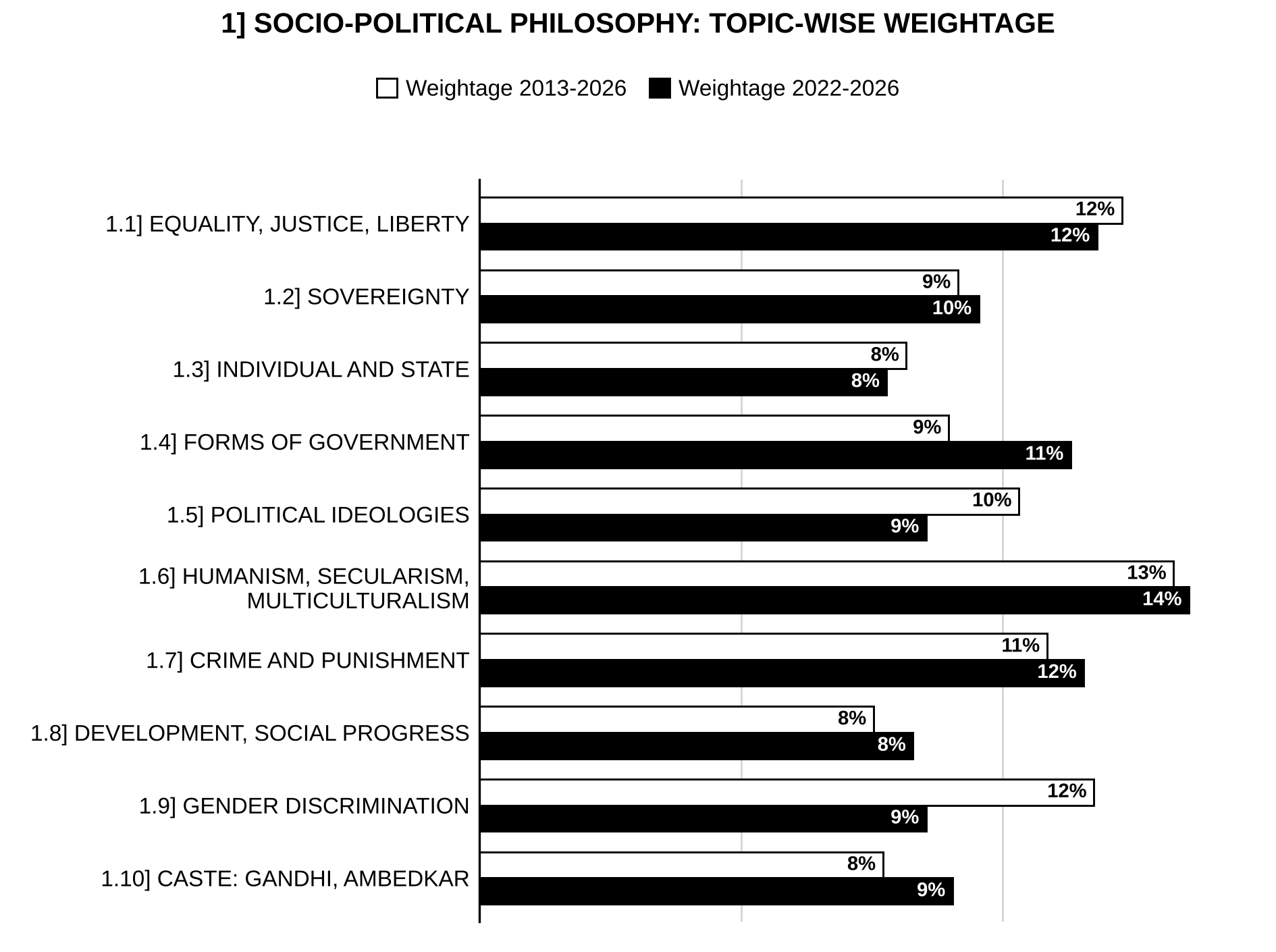
Here are all 368 Socio-Political Philosophy questions asked in UPSC Philosophy Optional Paper II from 1995 to 2026, arranged under the 10 topics of the official syllabus. Within each topic the latest questions come first.
Each question ends with a code such as [2024/15m/3b] – the year, the marks, the word limit (where UPSC set one) and the question number in the paper.
1.1] Social and political ideals
51 questions
Why does Rawls consider it necessary that the two principles of justice be applied in lexical order? Explain. [2026/10m/150w/1a]
Negative liberty seems to embody the idea of ultimate personal freedom, whereas positive liberty enables individuals to achieve their full potential. Discuss. [2026/15m/3c]
Discuss the salient features of equality according to J.S. Mill. [2025/10m/150w/1e]
How are both equality and liberty inadequate as social and political ideals without justice? Discuss. [2025/20m/4a]
Briefly discuss Plato’s concept of justice. [2024/10m/150w/1a]
Critically evaluate the concepts of liberty and equality as political ideals. [2024/15m/2b]
What is meant by justice as fairness? Explain Rawls’ theory of justice. [2023/10m/150w/1a]
“Complete liberty may lead to inequality while order and restrictions imply a necessary loss of freedom.” Critically discuss. [2022/10m/150w/1d]
What arguments does Bodin present to contend that sovereignty must be absolute, perpetual and undivided? Is Bodin’s conception of sovereignty compatible with the social and political ideals of equality, justice and liberty? Critically discuss. [2022/20m/2a]
Explain the difference between the notion of equity and equality with reference to Marxian philosophy. [2022/15m/2c]
Discuss critically the distributive theory of justice as propounded by R. Nozick. [2021/10m/150w/1a]
How does Rousseau distinguish between natural and artificial inequality? Explain. [2021/10m/150w/1b]
Discuss whether Amartya Sen’s idea of justice is an improvement upon Rawl’s theory of justice. [2021/20m/2a]
Is the concept of ‘liberty’ realizable in the modern technological society? Explain. [2020/10m/150w/1a]
How far do you think John Rawls is continuing with Plato’s concept of justice? [2019/10m/150w/1a]
Does liberty put limitations to equality? Discuss. [2019/15m/4b]
How far can liberty and equality be considered as distinctive features of democracy? Discuss. [2018/20m/2a]
Discuss the different aspects of the fundamental distinction between democratic equality and the Marxian notion of equality. [2017/10m/150w/1e]
How far do Marx, Gandhi and Amartya Sen agree and disagree on the concept of justice in the Indian democracy? Discuss. [2017/15m/4b]
A well-ordered society, according to Rawls, is effectively regulated by a public conception of justice. Do you agree? Give reasons. [2016/10m/150w/1b]
Is liberty a positive and equal opportunity of self-realization? Discuss. [2016/15m/2a]
“Equality does not mean treating everyone equal.” Discuss. [2015/10m/150w/1a]
“Equality will be of no value without fraternity and liberty.” Discuss. [2015/15m/4b]
If caste discrimination has continuity and hierarchy, which principle of justice can dissolve this problem? [2014/10m/150w/1a]
Discuss Amartya Sen’s principle of Nīti as a critique of Nyāya. [2014/15m/3c]
Explain and evaluate Aristotle’s conception of justice. [2013/15m/250w/4a]
What is meant by ‘justice as fairness’? Explain the basic tenets of Rawls’ theory of justice. [2013/15m/250w/4b]
How is Amartya Sen’s approach to justice different from that of Rawls? [2013/20m/250w/4c]
Woman empowerment and Social Justice. [2012/12m/150w/1d]
The Fundamental idea of the conception of justice is fairness. Discuss. [2011/20m/200w/4a]
Can issues relating to gender discrimination be met by the conception of justice as fairness? Discuss. [2011/20m/200w/4b]
Which principle of justice can, in your view, be most helpful in addressing the issues related to caste discrimination and why? [2011/20m/200w/4c]
Discuss the nature of relationship between Liberty and Equality. [2010/15m/150w/1a]
Does the right to property bring economic disparity and threaten human fraternity? Discuss. [2010/20m/200w/2c]
Comment on the relationship between equality and freedom. [2009/30m/3a]
‘Justice is treating equals as equals and unequals as unequals.’ [2008/20m/200w/1a]
Free-market economy is the only way to attain social justice. [2007/20m/200w/1a]
Negative freedom can, perhaps, ensure freedom to choose, but without any credible assurance for its actual fulfillment. [2007/20m/200w/1b]
According to some Liberal Political thinkers social and economical inequalities can be justified only if they work to the advantage of the least advantaged members of society. Is this view consistent with Liberalism’s cardinal advocacy of individual freedom? Discuss. [2007/60m/4]
“Unless the ideal of equality is embedded within a broader theory of politics and society, it can be given no specific content.” [2004/20m/200w/1d]
Despite their self-proclaimed commitment to the ideal of individual freedom, this ideal is one of the most contentious issues between socialism and liberalism. Why? Discuss. [2004/60m/4]
Freedom from and freedom to are mutually exclusive. [2003/20m/200w/1a]
The concept of equality as a political ideal. [2002/20m/200w/1a]
What is meant by justice? What are the necessary and sufficient conditions for its availability? Discuss. [2002/60m/3]
Consider the following argument: Justice means getting what one deserves. A person who contributes more to society deserves more than a person who contributes less to society. The only fair way to determine how much a person has contributed to society is to let people as a whole decide through free market. Therefore, free market is the only way to attain justice. Would you agree with the above point of view? Defend your answer. [2001/60m/2]
Some thinkers distinguish between two mutually irreducible senses of freedom, namely, “negative” freedom and “positive” freedom. Explain and critically consider the distinction. [2001/60m/3]
Explain the fundamental tenets of liberal democracy. Consider in this context the extent to which justice, which is one of the basic ideals of liberal democracy, can be realized. [2001/60m/4]
J. S. Mill on Liberty. [2000/20m/200w/1a]
Some philosophers believe that the task of political philosophy is only conceptual i.e. to analyze concepts which are typically political, such as ‘justice’, ‘equality’, ‘right’ and the like. Some others believe that the task is inescapably normative which requires political philosophers to formulate and defend substantive principles which can serve to answer normative questions concerning different political ideals such as social justice, individual freedom and rights and the like. In the above context state and defend what you think is the proper task of political philosophy. [1998/60m/3]
The notion of justice is usually divided into distributive and retributive justice. Explain the distinction and critically discuss the grounds on which the distinction is made. [1998/60m/4]
Liberty. [1997/20m/200w/1a]
1.2] Sovereignty
29 questions
Evaluate the importance of Kautilya’s theory of Rajamandala in the context of sovereignty. [2026/20m/2a]
Explain the contrast between the monistic and pluralistic approaches to sovereignty. [2026/15m/4b]
‘There is no permanent friend or permanent enemy.’ Discuss this statement in the light of Kautilya’s view on Sovereignty. [2025/15m/2c]
What insights does the Arthaśāṣtra offer with regard to the concept of sovereignty? Does it have any relevance in the modern times? Critically discuss. [2024/15m/4b]
Elucidate why the absolute nature of sovereignty was rejected by Laski. [2023/20m/2a]
What arguments does Bodin present to contend that sovereignty must be absolute, perpetual and undivided? Is Bodin’s conception of sovereignty compatible with the social and political ideals of equality, justice and liberty? Critically discuss. [2022/20m/2a]
Is Austin’s theory of sovereignty compatible with democracy? Discuss. [2021/10m/150w/1c]
Discuss Kautilya’s contribution regarding the concept of sovereignty. Is it applicable in a democratic form of government? Explain. [2021/15m/3c]
Explain the importance of Bodin’s theory of sovereignty. [2020/10m/150w/1d]
State and explain the relevance of the doctrine of sovereignty in times of globalization. [2020/15m/4b]
Discuss how far does Austin’s concept of sovereignty go along with Kautilya’s concept of sovereignty. [2019/20m/3a]
Discuss Kautilya’s concept of sovereignty in the light of ‘Danda-neeti’. [2018/10m/150w/1d]
Critically evaluate Laski’s view on sovereignty as a satisfactory position in political theory. [2018/15m/2b]
Discuss in the context of anarchy whether the freedom of an individual is consistent with the sovereignty of the State. [2017/10m/150w/1a]
Discuss whether Kautilya’s concept of sovereignty turns into a despotic rule. How far is it comparable to Bodin’s concept? Discuss. [2017/15m/2c]
“Sovereignty is the supreme power over citizens and subjects, unrestrained by law.” Discuss. [2016/10m/150w/1a]
On what grounds does Laski criticize Austin’s concept of sovereignty? [2016/15m/2b]
Explain Harold Laski’s critique of sovereignty. [2015/10m/150w/1c]
Explain the significance of John Austin’s theory of sovereignty. How does it differ from that of Hobbes? [2014/10m/150w/1d]
Who amongst Austin, Bodin and Laski, is the most consistent in his analysis of the concept of sovereignty? [2012/12m/150w/1b]
Compare and contrast Kautilya’s Saptanga theory of the Sovereign State with Bodin’s theory of Sovereignty. [2011/15m/150w/1a]
Why did Kautilya think that sovereignty is hierarchical? Explain. [2010/15m/150w/1b]
Does Bodin’s theory of sovereignty ‘float in the air’? Critically examine. [2010/20m/200w/4b]
Compare Bodin’s and Austin’s views on sovereignty. [2009/20m/200w/1c]
Kautilya’s Saptanga theory of Sovereign State. [2008/20m/200w/1c]
Explain the notion of sovereignty. Critically consider, in this context, the claim that sovereignty is illimitable and logically indivisible. [2006/60m/4]
Give a critical account of Austin’s view that power is the determining factor of sovereignty. [1999/60m/3]
Explain Bodin’s principle of absolute sovereignty. What was his argument for preferring monarchical sovereignty over democratic sovereignty? Consider in this context whether his advocacy of undivided sovereignty was consistent with his belief in constitutionalism. [1998/60m/2]
Kautilya on Sovereignty. [1997/20m/200w/1b]
1.3] Individual and State
33 questions
Is Plato’s vision of an ideal state compatible with the rights and liberties of individual citizens? Discuss. [2026/10m/150w/1b]
“Duties are of the nature of obligation while Rights are of the nature of entitlement. Therefore there is no necessary connection between the two.” Do you agree with this statement? Give reasons and justification for your answer. [2025/15m/4c]
Present a brief account of origin and development of Social Contract Theory. [2024/10m/150w/1b]
Do you agree with the view that Aristotle was more successful than Plato in steering a middle course between ‘Statism’ and ‘individualism’? Discuss with arguments. [2024/20m/3a]
Do you agree that duty and accountability must be given priority over rights for the better functioning of a State? Justify your answer. [2023/15m/2b]
Does idea of unconditional rights necessarily lead to anarchy? Critically examine. [2022/15m/4b]
Evaluate whether the social contract theory adequately addresses the different issues of human rights. [2021/15m/4c]
Is Indian tradition antagonistic to Individual Rights? Consider it by taking recourse to the doctrine of ‘Human Rights’. [2020/15m/2c]
Do rights make citizens accountable to the State? Argue in the context of the present Indian scenario. [2019/20m/2a]
“Human rights and human dignity would no longer be the product of a particular culture, rather a common human aspiration for an ideal world.” Discuss. [2018/20m/4a]
Out of rights and duties, which one is prior to the other? Discuss in the context of accountability. [2017/10m/150w/1d]
Evaluate the statement that all human beings have certain unalienable rights. [2016/10m/150w/1d]
“The right of free speech implies the genuine independence of the judiciary and its complete separation from the executive.” Evaluate. [2016/20m/2c]
Is civil disobedience in a democratic State justifiable? Discuss. [2015/10m/150w/1b]
“All human rights are centred on individual rights.” Discuss. [2014/20m/4a]
What is the significance of including duties of citizens in the Indian Constitution? [2013/10m/150w/1b]
Can we dissociate rights of citizens from their duties? [2012/12m/150w/1e]
In a Democracy does a citizen ever have the moral right to break a law? Discuss citizens right to civil disobedience. [2011/15m/150w/1b]
Can citizens have rights without duties? Discuss with examples. [2011/20m/200w/2a]
Discuss Kant’s distinction between duties of perfect and imperfect obligation. [2011/20m/200w/2b]
Can the conception of ‘rights’ of citizens be sustained in a society characterized by caste discrimination? Discuss. [2011/20m/200w/2c]
Does Accountability necessarily contribute to moral perfection? Offer your views. [2010/15m/150w/1c]
Does the right to property bring economic disparity and threaten human fraternity? Discuss. [2010/20m/200w/2c]
“Rights and duties are complementary.” Explain. [2009/20m/200w/1d]
Do rights necessarily imply corresponding obligations? To whom does one primarily own obligations–individuals or State? Discuss. [2008/60m/2]
‘Acceptance of authority of the state is inconsistent with the highest duty of mankind, “the duty to act autonomously”.’ (Robert Paul Wolff) [2007/20m/200w/1d]
“Acceptance of authority of the state is inconsistent with the highest duty of mankind, the duty to act autonomously.” (Robert Paul Wolff). [2006/20m/200w/1d]
“State is the ‘actuality of concrete freedom’.” [2005/20m/200w/1a]
‘In democratic State strike by government employees is unjustified’. [2003/20m/200w/1d]
Are the claims of the State and the Individual really mutually conflicting? Discuss. [2000/60m/3]
‘We obey the state because in the end it most truly represents ourselves.’ Discuss the relation of the individual and the state in the light of the above concept of the state. [1999/60m/2]
‘The individual is not merely a constituent, but a significant constituent contributing to the development of the State’. Explain and examine. [1997/60m/3]
Bloodless revolution. [1995/20m/200w/1c]
1.4] Forms of government
38 questions
On what grounds does Marxism criticize pure democracy? [2026/10m/150w/1d]
“The two antagonistic state structures – monarchy and democracy, both share some common features with dictatorship”. Do you agree with this view? Give reasons and justifications for your answer. [2026/15m/3b]
Examine the relationship between democracy and development. Does democracy promote or hinder development? [2026/15m/4c]
Comment on Plato’s critique of Democracy. [2025/10m/150w/1d]
Can Theocracy be accepted as a valid form of Government? Give reasons and justification in support of your answer. [2025/15m/4b]
If monarchs are above politics, can monarchy be a systematic form of government? Discuss. [2023/10m/150w/1e]
Explain the challenges faced by a democratic state and the ways to overcome them. [2023/15m/4b]
Discuss propaganda as a challenge to democratic form of government. [2022/20m/4a]
Are monarchy and theocracy necessarily related? Discuss with reference to the theory of Divine Right. [2022/15m/4c]
Does monarchy as a form of government leave room for individual freedom? Explain. [2021/10m/150w/1d]
How far do the liberal democracies safeguard the interests of minorities? Evaluate critically. [2020/10m/150w/1b]
Discuss the status of theocracy in the modern secular state. [2019/10m/150w/1b]
What is meant by liberal democracy? Does it require deeper principles for social cohesion to balance its own strong affirmation of individual rights? Give reasons from the Indian context. [2018/10m/150w/1a]
How far can liberty and equality be considered as distinctive features of democracy? Discuss. [2018/20m/2a]
Discuss whether a blending of monarchy with democracy is conceivable to avoid their undesirable defects for making the governance better for citizens and State. [2017/10m/150w/1b]
How are individual and group rights reconciled in democracy? Explain. [2015/10m/150w/1d]
Evaluate the nature and functions of parliamentary democracy. [2015/20m/3c]
In what sense is democracy a better form of Government than theocracy? [2014/15m/4c]
Is there any impact of caste discrimination on democracy in Indian context? [2013/10m/150w/1e]
What is meant by ‘democracy’? What are the various forms of democratic governments? [2013/15m/250w/2a]
Is a democratic government able to represent the interests of minority groups? [2013/15m/250w/2b]
Is a democratic government better than a benevolent dictatorship? Give reasons for your answer. [2013/20m/250w/2c]
“Democracy, committed to treating everybody equally, is ineffective as a system of government.” [2012/12m/150w/1a]
Is majority-rule meaningfully reflected in present-day democratic governments? Substantiate your answer with suitable examples. [2010/20m/200w/3a]
Define Monarchy. Is it ethically justified? [2009/20m/200w/1a]
Is Theocracy an outdated ideology? Discuss. [2009/30m/2a]
‘Democratic government claims to be promoting the principles of political philosophy of democracy.’ [2008/20m/200w/1b]
Democracy that gives equal weight to every one’s opinion is inefficient in determining the right or wrong thing to do. [2007/20m/200w/1c]
“Democracy, which treats everybody’s opinion equally, is inefficient in determining the right thing to do.” [2006/20m/200w/1c]
“Political democracy is hollow unless accompanied by power in the area of economics.” [2005/20m/200w/1b]
“The concept of democracy is an essential contested concept.” [2004/20m/200w/1b]
Do you think that Democracy is the best form of government? Is there any scope of ‘Beyond Democracy’? In this context analyze the notion of ‘Meritocracy’. [2002/60m/2]
The idea of democracy is paradoxical. [2001/20m/200w/1a]
Explain the fundamental tenets of liberal democracy. Consider in this context the extent to which justice, which is one of the basic ideals of liberal democracy, can be realized. [2001/60m/4]
Liberal Democracy. [1999/20m/200w/1b]
“Democracy is not merely a form of Government, but a way of life as well.” Discuss. [1997/60m/2]
Ideals of democracy. [1995/20m/200w/1a]
Theocracy as a political ideology. [1995/20m/200w/1b]
1.5] Political ideologies
47 questions
Anarchism is not an independent political ideology in itself, rather it is inspired by liberalism on the one hand and socialism on the other. Analyze. [2026/10m/150w/1c]
On what grounds does Marxism criticize pure democracy? [2026/10m/150w/1d]
Evaluate Marxism as a Political Ideology. [2025/15m/2b]
Present an exposition of the concept of alienation as propounded by Marx. [2024/10m/150w/1d]
Compare socialism and communism as two distinct political ideologies. [2024/10m/150w/1e]
Critically examine the anarchist’s view that “all States always and everywhere are illegitimate and unjust.” [2023/10m/150w/1b]
Explain Historical Materialism and discuss its relevance in the context of social development and change. [2023/20m/3a]
Explain the difference between the notion of equity and equality with reference to Marxian philosophy. [2022/15m/2c]
Does idea of unconditional rights necessarily lead to anarchy? Critically examine. [2022/15m/4b]
Discuss anarchism as a political ideology. Is it possible to dispense with political authority completely? Give reasons for your answer. [2021/20m/3a]
Discuss the distinctive features of Gandhian Socialism and its contemporary relevance. [2021/15m/3b]
Do you think that the prevailing pandemic will lead to anarchism in society? Discuss. [2020/10m/150w/1e]
How far is Marxism as a philosophical doctrine relevant in the present context? Justify your answer. [2020/15m/2b]
Evaluate Mahatma Gandhi as a political anarchist. [2019/10m/150w/1c]
Can gender equality be realised within a socialist regime? Analyse. [2019/10m/150w/1e]
What do you consider to be the future of Marxism in the context of the prevalent free market economy? [2019/15m/3c]
Do you subscribe to the political ideology of Anarchists? Justify your answer. [2018/15m/2c]
Are Marxian Socialism and individual freedom consistent? Discuss critically. [2018/15m/3b]
Discuss in the context of anarchy whether the freedom of an individual is consistent with the sovereignty of the State. [2017/10m/150w/1a]
Discuss the different aspects of the fundamental distinction between democratic equality and the Marxian notion of equality. [2017/10m/150w/1e]
Does Marxism curb individual freedom in the name of protecting social justice? Discuss. [2017/20m/3a]
“Socialism itself is the fulfilment of democracy.” Analyse. [2016/10m/150w/1c]
Is the State an agency for expressing the will of the ruling classes? Examine. [2016/20m/3a]
How do we distinguish Liberal humanism and Marxist humanism? [2014/10m/150w/1c]
By eliminating alienation can we bring social progress? Critically analyse. [2014/15m/2c]
Does the combination of democracy and socialism lead to a more equitable society? [2013/10m/150w/1d]
The ‘political ideology’ of Anarchism. [2012/12m/150w/1c]
In what ways is Humanism different from Marxism? Discuss. [2012/20m/2c]
What are the basic differences between Marxism and Socialism? [2011/20m/200w/3a]
Can it be said that Socialism is a weaker version of Marxism? Discuss. [2011/20m/200w/3b]
Is Democratic Socialism a contradiction in terms? Discuss. [2011/20m/200w/3c]
Which type of Socialism, according to you, is superior–Utopian or Democratic? Why? [2010/20m/200w/2a]
Which type of individual, according to you, can contribute more to strengthen the State–a liberalist or a socialist? [2010/20m/200w/4a]
Describe your understanding of Socialism. Must it be defined in normative terms of a set of values and ideals which socialists seek to realize, or in descriptive terms of the specific economic and political institutions of socialist society? Can the tension between the two be adequately resolved? Discuss. [2007/60m/3]
Describe your understanding of socialism. Must it be defined in normative terms of a set of values and ideas which socialists seek to realize, or in descriptive terms the specific character of the economic and political institutions of socialist society? Can the tension between the two be adequately resolved? Discuss. [2006/60m/3]
“Socialism avoids the totalitarian implications of Communism, and works within liberal democratic Constitutions.” [2005/20m/200w/1d]
What is humanism? What are its different kinds? In what way, if any, is M.N. Roy’s Radical Humanism different from Marxism? Discuss. [2005/60m/4]
“Gender equality can be realized only within a socialist regime.” [2004/20m/200w/1a]
Despite their self-proclaimed commitment to the ideal of individual freedom, this ideal is one of the most contentious issues between socialism and liberalism. Why? Discuss. [2004/60m/4]
What do you understand by ‘Sarvodaya’? Consider in this connection the following statement of Mahatma Gandhi: “Every individual must have fullest liberty to use his talents consistently with equal use by neighbours, but no one is entitled to the arbitrary use of the gain from the talents. He is part of the nation or, say, the social structure surrounding him. Therefore, he can use his talents not for self but for the social structure of which he is but a part and on whose sufferance he lives.” Would you agree with the above point of view? Defend your position against possible objections. [2003/60m/4]
Evaluate M. N. Roy’s Humanism as a response to Marxism. [2002/60m/4]
Point out the doctrinal differences between Socialism and Marxism. [2000/60m/4]
Sarvodaya. [1999/20m/200w/1c]
Compare and contrast Marxism with the ideal of ‘Sarvodaya’. [1997/60m/4]
Philosophical aspects of Sarvodaya. [1996/20m/200w/1c]
Discuss critically the relation between philosophical and social aspects of communism. [1996/60m/3]
Relevance of varnavyavastha for Sarvodaya. [1995/20m/200w/1d]

Preparing for Prelims too?
Our UPSC Prelims Topic-wise PYQ eBook covers every Prelims question with detailed explanations, so you can see exactly where UPSC asks from.
View the BookDownload Free Sample1.6] Humanism, secularism and multi-culturalism
47 questions
Examine the challenges faced by a multicultural society in creating a harmonious balance between group rights and individual rights. [2026/15m/2c]
Is the idea of secularism necessarily related to the idea of religious pluralism? Discuss. [2025/10m/150w/1c]
How does the reconciliation of opposites take place in the Humanism of Tagore? Evaluate. [2025/15m/3b]
Delineate the central tenets of Humanism. How does advent of enlightenment in Europe pave the way for Humanism? Discuss. [2024/20m/2a]
Present an exposition of Gandhi’s views on secularism as one of the foundational principles of democracy. [2024/15m/2c]
Discuss the role of ethical principles of tolerance and coexistence for the rise of multicultural societies. [2024/15m/4c]
Critically examine the challenges faced by a multicultural society with reference to India. [2023/10m/150w/1d]
Secularism is not a rejection of religion but acceptance of all religions. Discuss. [2023/15m/4c]
Discuss the role of enlightenment movement in the rise of humanism. [2022/10m/150w/1a]
Critically analyze the descriptive and normative aspects of multiculturalism. [2022/15m/3c]
Can humanism be a substitute for religion? Explain and evaluate in the context of the present Indian society. [2021/15m/2c]
How far do the liberal democracies safeguard the interests of minorities? Evaluate critically. [2020/10m/150w/1b]
Do you think that secularism requires complete separation of ‘religion’ and ‘state’? Discuss. [2020/10m/150w/1c]
What do you understand by multiculturalism? Explain the structural characteristics that make a nation multicultural. [2020/15m/3b]
Discuss the status of theocracy in the modern secular state. [2019/10m/150w/1b]
What are the descriptive and normative perspectives on ideas of multiculturalism? [2019/15m/2b]
Examine whether there is any difference between the views of Mahatma Gandhi and Dr. Babasaheb Ambedkar on the philosophical foundations of secular democracy. [2019/20m/4a]
Do you subscribe to the view that Indian cultural identity needs to integrate the principles of multi-culturalism and respect for the dignity of each person? Justify your answer. [2018/10m/150w/1b]
What do you understand by multi-culturalism? How are globalization and multi-culturalism related? How does their relationship affect cultural changes? [2018/20m/3a]
What form of humanism do you approve as relevant in the present day context? Discuss in detail. [2018/15m/3c]
Do you agree with the view that secularism as a western ideal is redundant in the Indian context? Discuss in the context of the multicultural Indian society. [2017/20m/2a]
Can we consider “freedom from domination” as one of the justifications for multiculturalism? Give reasons for your answer. [2016/15m/3b]
How are individual and group rights reconciled in democracy? Explain. [2015/10m/150w/1d]
Is multiculturalism a need of global society? Discuss. [2015/15m/3a]
How is religious nationalism a threat to secular State? Explain. [2015/20m/4c]
How does multiculturalism redefine liberal notions like identity, freedom and equality and reformulate its assumptions? [2014/10m/150w/1b]
How do we distinguish Liberal humanism and Marxist humanism? [2014/10m/150w/1c]
Explain descriptive and normative perspectives on multiculturalism. [2014/15m/4b]
Does the idea of equal respect to all religions provide a consistent and viable state policy? [2013/10m/150w/1c]
Is a democratic government able to represent the interests of minority groups? [2013/15m/250w/2b]
“Secularism in the Indian context is not a rejection of religion but a fellowship of religions.” Discuss. [2012/20m/2a]
In what ways is Humanism different from Marxism? Discuss. [2012/20m/2c]
What is multiculturalism? Can it be an impediment for development and progress? Discuss. [2012/20m/3a]
The Term ‘multi-culturalism’ has been used in both a descriptive and a normative sense. Discuss. [2011/15m/150w/1c]
Is social progress possible without Humanism? Examine. [2010/15m/150w/1d]
Is Secularism analogous to Atheism? Examine in the Indian context. [2009/30m/2b]
Is multiculturalism a boon or a bane? Discuss. [2008/60m/4]
“Christian Humanism is a contradiction in terms.” [2006/20m/200w/1a]
What is humanism? What are its different kinds? In what way, if any, is M.N. Roy’s Radical Humanism different from Marxism? Discuss. [2005/60m/4]
Role of scientific temper in a good life. [2002/20m/200w/1d]
Evaluate M. N. Roy’s Humanism as a response to Marxism. [2002/60m/4]
“Politics bereft of religion are absolute dirt, ever to be shunned.” – Mahatma Gandhi. [2001/20m/200w/1c]
Secularism in Indian Context. [2000/20m/200w/1d]
Scientific Temper. [1999/20m/200w/1d]
Explain humanism and discuss the essential features of radical humanism. [1999/60m/4]
Socialistic Humanism. [1998/20m/200w/1a]
Secularism, sectarianism and religion. [1995/20m/200w/5d]
1.7] Crime and punishment
40 questions
How does value based education address the problem of corruption? [2026/10m/150w/1e]
Retributivism presents a deontological justification for capital punishment, whereas deterrence presents a consequential justification for it. Explain. [2026/20m/3a]
“Corrupt practices reveal an inherent tension between particularistic and universalistic normative standards.” Do you agree with this statement? Give reasons and justification for your answer. [2025/10m/150w/1a]
Can one’s right to life be absolute? Answer with reference to the idea of Capital Punishment. [2025/20m/3a]
On what grounds would you accept or reject the idea of capital punishment as an effective deterrent? Discuss. [2024/15m/3b]
“Severity of punishment should be proportionate to the seriousness of the crime.” – Do you agree that while punishing a juvenile, the nature of the crime should be considered? Justify your answer. [2023/20m/4a]
Is corruption a systemic issue or an ethical issue? Give your critical comments. [2022/10m/150w/1c]
What are the moral justifications of capital punishment? Discuss. [2022/10m/150w/1e]
Explain the reformative theory of punishment and discuss whether this is in tune with human dignity. [2021/15m/2b]
Do you think that retributive theory of punishment is against human rights? Discuss. [2020/15m/3c]
How far do the social and political regimes condition corrupt practices in a nation-state? Discuss. [2020/15m/4c]
Is corruption not a form of mass violence? Discuss. [2019/10m/150w/1d]
Does capital punishment weaken the doctrine of social justice? Discuss. [2019/15m/4c]
What measures do you suggest to eradicate corruption in Indian democracy? [2018/10m/150w/1e]
Can you justify capital punishment for crimes like rape, murder and corruption? Discuss. [2017/15m/3b]
Will a severe punishment for crimes against women change the mind-set of society? Justify your position. [2017/15m/4c]
“The goal in punishing should be to reform the individual.” Comment. [2016/10m/150w/1e]
“The aim of punishment is to defend the moral law and to do justice to criminal.” Discuss. [2015/15m/3b]
Can we say that racial supremacy is the main reason for genocide? Give reasons for your answer. [2014/10m/150w/1e]
Which theory of punishment, retributive or restorative, do you recommend and why? [2014/20m/2a]
Analyse the statement with reasons that “Power corrupts, absolute power corrupts absolutely”. [2014/20m/3a]
Does corruption have not only a moral dimension but also an economic dimension? [2013/10m/150w/1a]
Which of the theories of punishment would help us prevent the crime of corruption in Indian society? Discuss. [2012/20m/3b]
What can be the causes for mass violence? Can mass violence ever be justified on moral grounds? Discuss. [2012/30m/4b]
Can capital punishment be justified? Answer with reference to the theories of punishment. [2011/15m/150w/1d]
If capital punishment is legally awarded, then no ethico-political consideration should subvert it. Express your opinion for or against. [2010/20m/200w/3c]
List the various ‘sanctions’ permitting genocide and clearly bring out the ethical counter-arguments against each. [2010/20m/200w/4c]
“You are not punished for stealing the sheep, but you are punished so that no sheep is stolen.” Discuss as to which theory of punishment the statement belongs. [2009/20m/200w/1b]
Is capital punishment, in your view, ethically justified? [2009/30m/3b]
‘Punishment rules all creatures; punishment preserves them all.’ [2008/20m/200w/1d]
Consider why punishment is generally thought to require justification. In this context give your critical and comparative account of the main theories of punishment. [2007/60m/2]
Describe the tension between consequentialist and retributivist theories of punishment. Discuss critically, in the context, the view that argues that since no existing penal system for crime prevention has adequate justification, state punishment cannot be justified, and, therefore, it should be completely abolished. [2006/60m/2]
Discuss the notion of punishment. Consider in this context the importance and implications of the principle of proportionality of punishment, which requires that the severity of punishment be proportionate to the seriousness of the crime. [2004/60m/2]
Retributive and deterrent theories of punishment are mutually complementary. [2003/20m/200w/1b]
The deterrent theory of punishment has no justification. [2001/20m/200w/1d]
Retributive Theory of Punishment. [2000/20m/200w/1b]
Reformative theory of punishment. [1999/20m/200w/1a]
Retributivist justification of punishment. [1998/20m/200w/1c]
The notion of justice is usually divided into distributive and retributive justice. Explain the distinction and critically discuss the grounds on which the distinction is made. [1998/60m/4]
Reformative Theory of Punishment. [1997/20m/200w/1c]
1.8] Development and social progress
26 questions
Examine the relationship between democracy and development. Does democracy promote or hinder development? [2026/15m/4c]
Is it possible to reconcile the concept of development with tribal values to bring social and economic progress? Discuss. [2025/15m/3c]
Is economic development a necessary condition, sufficient condition, both or neither, in order to achieve social progress? Give reasons and justifications for your answer. [2024/15m/3c]
In the present scenario, will the emphasis on skill education enhance development? Evaluate. [2023/15m/2c]
Explain Historical Materialism and discuss its relevance in the context of social development and change. [2023/20m/3a]
Do you agree that economic development does not on its own lead to human development and social progress? Give reasons and justifications for your answer. [2022/20m/3a]
State and examine the Gandhian concept of social development. [2020/20m/2a]
Does technological development lead to progress in the ethical standards of the society? Explain. [2019/15m/2c]
What do you understand by multi-culturalism? How are globalization and multi-culturalism related? How does their relationship affect cultural changes? [2018/20m/3a]
Critically evaluate whether the ideal of social progress gives a secondary significance to an individual’s freedom over his duties. [2017/15m/2b]
Evaluate the concept of social development as rooted in ethical principles against the concept of social progress being based on economic and political ideals. [2017/20m/4a]
Is it possible to measure social progress independent of economic development? Discuss. [2016/15m/3c]
“Inequitable development leads to social conflicts rather than social progress.” Explain. [2015/10m/150w/1e]
“Man must grow materially as well as spiritually.” Evaluate this statement of Ambedkar. [2015/15m/4a]
By eliminating alienation can we bring social progress? Critically analyse. [2014/15m/2c]
Is there a necessary connection between social progress and protection against female foeticide? Discuss. [2012/20m/2b]
What is multiculturalism? Can it be an impediment for development and progress? Discuss. [2012/20m/3a]
Is social progress possible without Humanism? Examine. [2010/15m/150w/1d]
What do you understand by ‘progress’? Have human beings made progress in all fields of their activity? Discuss. [2005/60m/2]
Examine the central issues in the philosophy of ecology. Are these concerns merely utilitarian? Discuss. [2005/60m/3]
What do you understand by the philosophy of ecology? In this context, discuss its main concerns. [2004/60m/3]
What does eco-philosophy mean? Discuss in this context the central thesis of ecological humanism and also explain the distinction between ‘ecological understanding’ and ‘ecological awareness’. [2003/60m/3]
Concept of Sustainable Development. [2000/20m/200w/1c]
Scientific Progress. [1998/20m/200w/1d]
Philosophy of Ecology. [1997/20m/200w/1d]
Revaluation through Constitutionalism. [1996/20m/200w/1b]
1.9] Gender discrimination
36 questions
Does providing land and property rights to women constitute a necessary condition or a sufficient condition or both for ensuring social equality among the genders? Discuss. [2026/15m/2b]
How does gender as a social construct affect individuals’ opportunities, rights, and access to resources? Critically discuss. [2025/10m/150w/1b]
Discuss gender equality as a necessary condition to achieve empowerment of women. Also examine the role of women empowerment in curbing the menace of female foeticide. [2024/20m/4a]
Do you agree that the rights concerning land and property have empowered women? Discuss. [2023/10m/150w/1c]
How does gender discrimination lead to female foeticide and social imbalance? Discuss. [2023/15m/3c]
Discuss gender as a cultural category as opposed to sex as a biological category. [2022/15m/3b]
How far can land and property rights be effective in empowerment of women? Explain. [2021/10m/150w/1e]
What are the main causes of female foeticide in India? Is it the result of demonic application of technology only? Discuss. [2021/15m/4b]
Do you agree that empowering women can eliminate gender discrimination? Discuss. [2020/20m/4a]
Can gender equality be realised within a socialist regime? Analyse. [2019/10m/150w/1e]
Consider critically, that gender discrimination is a rather man-made concept but not naturally endowed. [2019/15m/3b]
How do you evaluate gender discrimination in the context of female foeticide? [2018/15m/4b]
Is feminism an ideology for empowerment or for equality? Discuss. [2018/15m/4c]
Is empowerment of women a sufficient means to their equal rights to land, property and divorce? Discuss in the context of religious sanctions. [2017/15m/3c]
Will a severe punishment for crimes against women change the mind-set of society? Justify your position. [2017/15m/4c]
“To me the female sex is not the weaker sex. It is the nobler of the two.” Evaluate this statement of Gandhi. [2016/15m/4a]
Do you agree that women become empowered through collective reflection and decision-making? Discuss. [2016/15m/4b]
What does gender discrimination mean? Is it not a violation of equality and social justice? Discuss. [2015/15m/2a]
Does economic empowerment of women eliminate gender discrimination? Discuss. [2015/15m/2b]
“One is not born a woman, but she becomes a woman.” Critically comment on it. [2014/15m/2b]
What do you understand by ‘gender equality’ and why is it important? [2013/15m/250w/3a]
Is economic independence essential for equality between men and women? [2013/15m/250w/3b]
Why is adequate representation of women in political institutions important in this context? [2013/20m/250w/3c]
Woman empowerment and Social Justice. [2012/12m/150w/1d]
Is there a necessary connection between social progress and protection against female foeticide? Discuss. [2012/20m/2b]
“Denial of access and inheritance of land and property to women is a denial of their fundamental rights as humans.” Discuss. [2012/20m/3c]
Can issues relating to gender discrimination be met by the conception of justice as fairness? Discuss. [2011/20m/200w/4b]
Can only the political empowerment of women wipe out gender discrimination in a male-dominated Indian society? [2010/20m/200w/3b]
Examine the Land and Property Rights of women in India. How far do they contribute to empower women? [2009/60m/4]
“Sex is the biological category, whereas gender is the culturally shaped expression of sexual difference.” [2005/20m/200w/1c]
“Gender equality can be realized only within a socialist regime.” [2004/20m/200w/1a]
What in your view is the source(s) of gender inequality? Is it Primarily rooted in human biology? In what way if at all, can this inequality be bridged? Explain and defend your position on these issues. [2003/60m/2]
Gender-equality: meaning and need. [2002/20m/200w/1c]
The cause of gender inequality is entirely biological. [2001/20m/200w/1b]
“The thing women have yet to learn is nobody gives you power. You just take it.” Comment. [2000/60m/2]
Gender Injustice. [1998/20m/200w/1b]
1.10] Caste discrimination: Gandhi and Ambedkar
21 questions
How has Ambedkar applied the concept of ‘Social Endosmosis’ for annihilation of castes. Evaluate its relevance for contemporary debates on identity and the politics of difference. [2026/20m/4a]
Present a detailed account of the debate between Gandhi and Ambedkar on the issue of caste discrimination. [2025/20m/2a]
Discuss the main factors responsible for caste discrimination. [2024/10m/150w/1c]
Critically analyse the social and political significance of Ambedkar’s notion of annihilation of caste. [2023/15m/3b]
In the age of individualism and universal franchise, what role does caste play in body-politic? Discuss. [2022/10m/150w/1b]
Critically evaluate Gandhi’s views on eradication of caste discrimination. [2022/15m/2b]
Discuss the views of Dr. B.R. Ambedkar regarding caste-discrimination in Indian society. What are the measures suggested by him for its elimination? Explain. [2021/20m/4a]
State and examine B.R. Ambedkar’s contribution towards social changes in Independent India. [2020/20m/3a]
It is said that the traditional hold of caste-based groups on Indian social behaviour has survived all attempts to build alternate identities. Discuss in the light of M.K. Gandhi. [2018/10m/150w/1c]
Is caste discrimination a result of the superiority complex of a privileged class of the society or of religious rituals? Discuss with reference to the views propounded by Dr. B.R. Ambedkar. [2017/10m/150w/1c]
How did Ambedkar analyse the caste system from the historical and social perspectives? Explain. [2016/20m/4c]
Evaluate Ambedkar’s critique of caste system. [2015/20m/2c]
If caste discrimination has continuity and hierarchy, which principle of justice can dissolve this problem? [2014/10m/150w/1a]
What are the basic differences between Gandhi and Ambedkar regarding caste system in India? [2014/15m/3b]
Is there any impact of caste discrimination on democracy in Indian context? [2013/10m/150w/1e]
What were Gandhi’s views on varṇa and jāti? Critically discuss Ambedkar’s disagreement with Gandhi’s treatment of varṇa. [2012/30m/4a]
Can the conception of ‘rights’ of citizens be sustained in a society characterized by caste discrimination? Discuss. [2011/20m/200w/2c]
Which principle of justice can, in your view, be most helpful in addressing the issues related to caste discrimination and why? [2011/20m/200w/4c]
“Caste is not a sin, but caste discrimination is.” As a concerned citizen, comment critically on this statement. [2010/20m/200w/2b]
Discuss the impact of caste discrimination – affirmative or otherwise, on the harmony of the society as a whole. [2008/60m/3]
Relevance of varnavyavastha for Sarvodaya. [1995/20m/200w/1d]

Strengthen your GS papers
Our UPSC Mains Topic-wise & Year-wise PYQ eBook (2013–2026) maps every GS question to the syllabus, so you know what UPSC asks and how often.
View the BookDownload Free Sample« Previous: Indian Philosophy | Next: Philosophy of Religion »
Back to: Philosophy Optional PYQs – Topic-wise
Last updated: 30 October 2026