
Here are all 390 Indian Philosophy questions asked in UPSC Philosophy Optional Paper I from 1995 to 2026, arranged under the 9 topics of the official syllabus. Within each topic the latest questions come first.
Each question ends with a code such as [2024/15m/3b] – the year, the marks, the word limit (where UPSC set one) and the question number in the paper.
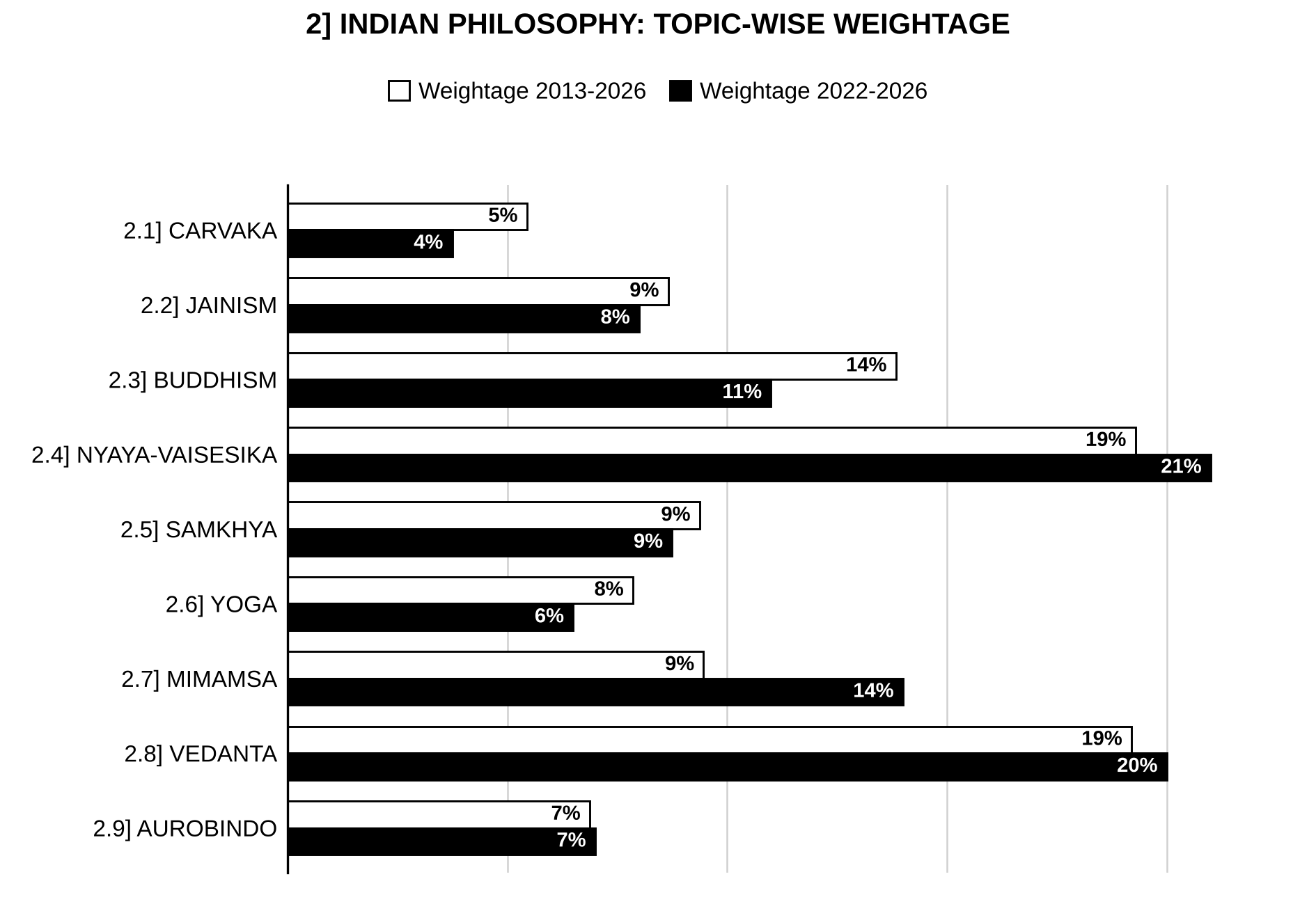
2.1] Carvaka
26 questions
Explain the ground on which Cārvāka rejects inference (anumāna) as a valid source of knowledge. [2025/10m/150w/5a]
Do you think Cārvāka’s philosophy is positivistic in nature? Give reasons and justifications for your answer. [2024/10m/150w/5a]
Differentiate between the Cārvākas’ refutation of self as a transcendental category and the Buddhist rejection of ātmā. [2024/20m/6a]
How do Naiyāyikas respond to Cārvāka’s objections against inference (anumāna) and establish inference as an independent means of knowledge? Critically discuss. [2022/15m/7c]
Comment on the bearing of Cārvāka epistemology on the rejection of transcendental entities by them. [2021/10m/150w/5e]
Critically evaluate Cārvākas’ rejection of Ākāśa as one of the elements of reality and examine their criticism of transmigration of Soul. [2020/15m/6b]
Explain the differences of conception of Reality between Cārvāka and Jainism. [2020/15m/7c]
Are the Cārvākas consistent when they hold that inference is not a source of knowledge? Discuss. [2019/10m/150w/5c]
What is wrong according to the Cārvākas with the following argument? All men are mortal. Socrates is a man. Therefore, Socrates is mortal. Justify your answer with arguments. [2019/15m/6c]
Is Cārvāka rejection of inference acceptable to the other systems of Indian philosophy? If not, why? Do you think the views of other systems to be justified? Give reasons for your answer. [2018/15m/8b]
“The soul is nothing but conscious body.” What are the reasons for Cārvāka in holding this view? [2017/10m/150w/5a]
What would be Cārvāka’s view on Vyāpti? Can this view be acceptable to the Naiyāyikas? Give reasons for your answer. [2016/15m/7b]
Explain the arguments of Carvaka to reject transcendental entities. [2015/15m/7c]
“Limits of knowledge and world are determined by my sense perception.” Discuss this claim of Carvakas. [2014/10m/150w/5a]
Why do Carvākas not believe in the validity of inference? What logic do they give for their belief? [2012/12m/150w/5a]
On what basis does Cārvāka reject the cause-effect relationship? Give reasons for your answer. [2012/15m/200w/7c]
Why do Cārvākas reject the concept of Ākāśa. Discuss. [2011/30m/8a]
“Just as the skepticism of Hume helped Kant to come out of his dogmatic slumber, so also the Carvaka philosophy saved Indian philosophy from dogmatism”. Discuss. [2010/20m/200w/6a]
Carvaka’s views on the nature of soul. [2007/20m/200w/5b]
Discuss the theory of knowledge, according to Charvaka Philosophy. [2006/20m/200w/5a]
Dehatmavada of Carvakas. [2004/20m/200w/5a]
Carvaka’s refutation of anumana is itself a process of anumana. Discuss. [2003/60m/6]
State and evaluate critically Carvaka view that perception is the only valid source of knowledge. [2002/60m/6]
The Carvaka theory of consciousness. [2001/20m/200w/5a]
Ethics of Carvaka school. [2000/20m/200w/5d]
“The soul is nothing but the conscious body” [1998/20m/200w/5a]
2.2] Jainism
33 questions
Explain the meaning of seven steps of judgement (Saptabhaṅgīnaya) and its application in Jaina’s Syādvāda for advocating a philosophy of non-absolutism (Anekāntavāda). [2026/15m/7b]
Is Jaina philosophy pluralistic and realistic? Critically discuss. [2025/15m/7c]
What is the distinction between Bhāvabandha and Dravyabandha, according to the Jainas? Discuss. [2024/15m/6c]
“All human knowledge is empirical and therefore relative.” Critically examine Jaina theory of sevenfold judgement (saptabhanginaya) in the light of above statement. [2023/10m/150w/5a]
How does Jaina view of Karma bear upon their soteriology? Critically discuss. [2022/10m/5d]
‘The doctrine of ‘Relativism’ of Jain Philosophy cannot be logically sustained without postulating ‘Absolutism’.’ Critically examine this view and give reasons in the favour of your answer. [2022/15m/6b]
Explain the Jain view of seven-fold (sapta-bhaṅgī) ‘Naya’. [2021/15m/7c]
Examine the concept of Karma according to Jainism. How does it bear upon their conception of Liberation? [2020/10m/150w/5a]
Explain the differences of conception of Reality between Cārvāka and Jainism. [2020/15m/7c]
How is reality defined by the Jainas? How is this theory of reality reflected in their view on judgements? Discuss. [2019/20m/6a]
How do the Jaina philosophers explain ‘bondage’? What, according to them, is the distinction between ‘liberated soul’ and ‘bound soul’? What do the Jainas think about the condition of the ‘liberated soul’? Discuss. [2018/15m/6c]
“The Jaina metaphysics is relativistic and realistic pluralism.” Discuss. [2017/15m/6b]
Differentiate the concept of ‘Kaivalya’ as discussed in Jaina and Yoga philosophies. [2016/10m/150w/5a]
Examine Jaina stance of ‘Naya’. How does it differ from ‘Syādvāda’? [2016/10m/150w/5d]
Can the ‘Tattvārtha’ theory of Jainism be acceptable for scientific explanations? Explain. [2016/15m/6b]
Jain concept of Dravya. [2015/10m/150w/5b]
What do Saṁvara and Nirjara mean? Explain their significance in Jaina theory of liberation. [2015/15m/8b]
Explain the concept of Karma and discuss its various types according to Jain philosophy. [2014/15m/6b]
Analyse the relation between the theory of saptabhanginaya and anekantavada. [2013/10m/150w/5a]
Critically evaluate Jaina doctrine of relative pluralism or Anekāntvāda. [2012/12m/150w/5b]
What according to Jainism is Path to Liberation? Discuss. [2011/15m/5a]
Why is Saptabhaṅgi Naya not treated as a doctrine of Scepticism? Discuss. [2011/20m/6a]
Is Syādvāda a self-contradictory doctrine? Discuss. [2010/30m/300w/7b]
Anekāntavāda. [2009/20m/200w/5a]
Nature of Pudgala in Jaina philosophy. [2007/20m/200w/5a]
Explain the theory of Substance according to Jainism. [2006/20m/200w/5b]
Jaina definition of Dravya. [2005/20m/200w/5a]
State and discuss the Jaina doctrine of jiva. [2004/60m/7]
Expound Anekantavada of Jainism. Is it a consistent theory of reality? Give reasons. [2003/60m/7]
Relation between anekantavada and saptabhangi-naya. [2001/20m/200w/5b]
Saptabhangi Naya. [2000/20m/200w/5b]
The Jaina arguments for anekantavada. [1999/20m/200w/5d]
Ekantavada and Anekantavada. [1998/20m/200w/5b]
2.3] Schools of Buddhism
58 questions
How does the Buddhist theory of momentariness problematize the issue of human action and responsibility? Critically discuss. [2026/10m/150w/5b]
Present an exposition of the debate between Naiyāyikas and Buddhists with reference to the notion of Pramāṇa and Pramāṇaphala. [2025/10m/150w/5b]
Is Buddhist notion of Nirvāna in consonance with their conception of Kṣanikavāda (momentariness) and Nairātmyavāda (no-soul theory)? Critically discuss. [2025/15m/8c]
Differentiate between the Cārvākas’ refutation of self as a transcendental category and the Buddhist rejection of ātmā. [2024/20m/6a]
How do the two schools of Buddhism arrive at two opposed conclusions, namely “everything is void” and “everything is real” from the same doctrine of Pratītyasamutpāda? Answer with arguments. [2024/15m/6b]
“Ignorance of dependent origination is suffering while its knowledge is cessation of suffering.” Present an account of Buddhist soteriology in the light of above statement. [2023/20m/8a]
How compatible is Buddhist theory of momentariness with their theory of Karma? In this regard how do Buddhists respond to objections raised by their opponents? Critically discuss. [2022/20m/6a]
Explain Buddhist concept of Tṛratna and their internal relation. Critically examine the consistency of Tṛratnas with the Buddhist concept of No-soul (Nairātmyavāda). [2022/15m/7b]
Distinguish between pudgala-nairātmyavāda and dharma-nairātmyavāda with reference to Buddhist Philosophy. [2021/10m/150w/5d]
If everything is momentary then how do the Buddhists explain the problem of memory and personal identity? Critically discuss. [2021/15m/7b]
How is Kṣaṇikavāda a logical derivative of Pratītyasamutpāda in Buddhism? Explain. [2020/20m/6a]
How does Buddhism explain Self in terms of Pañcaskandhas? What is Liberation for Buddhism if there is no Soul? [2020/15m/7b]
How do the Yogācāra Buddhists deny the existence of the external world? Discuss. [2019/10m/150w/5b]
What is Pratītyasamutpāda? How do the Buddhists apply this concept to prove that everything is momentary? [2019/15m/7c]
How do the Mādhyamika Buddhists apply the notion of Pratītyasamutpāda to establish their doctrine of Śūnyatā? Discuss. [2018/10m/150w/5b]
How do the Buddhists and the Nyāya philosophers explain our knowledge of ‘the absence of the jar on the table’? Answer in detail. [2018/10m/150w/5d]
Is it consistent for the Buddhists to admit the theory of Nairātmyavāda and the doctrine of Nirvāṇa simultaneously? Give reasons in favour of your answer. [2018/15m/6b]
Elucidate the role of catuṣkoṭi in explaining the nature of reality according to Mādhyamika school of thought. [2017/10m/150w/5e]
What are the arguments of the Buddhists to establish Kṣaṇikavāda? Do they necessarily lead to kṛtanāśa and akṛtābhyupagama? [2017/15m/6c]
How do Mādhyamikas, Yogācāravādins and Sarvāstivādins differ among themselves concerning the nature of reality? How do Sarvāstivādins differ among themselves with regard to knowledgeability of reality? [2017/20m/7a]
How does ‘Kṣaṇikavāda’ strengthen the arguments for ‘Nairātmyavāda’? Explain. [2016/10m/150w/5b]
Does the ‘Doctrine of Dependent Origination’ reconcile the two extreme views on the law of causation, namely Satkāryavāda and Asatkāryavāda? Give reasons for your answer. [2016/20m/6a]
Is the doctrine of ‘Self’ acceptable in the modern age of science and reason? Examine the view in the light of Indian philosophy. [2016/15m/6c]
Ālayavijñāna. [2015/10m/150w/5c]
‘Our knowledge is confined to gunas alone’. Examine this statement in the light of Vaiśesika and Buddhist controversy. [2015/15m/6b]
What is the role of Pratityasamutpāda in explaining Dukha? Elucidate the means to overcome it. [2015/15m/8c]
Explain the epistemological differences between Sautrāntika and Vaibhāṣika schools of Buddhism. [2014/10m/150w/5b]
How does Nagarjuna explain the concept of Sunyata? [2014/15m/8b]
Explain the Buddhists’ position of ‘Impermanence’ and show how the idea of Impermanence leads to the theory of momentariness of reality. [2013/10m/150w/5b]
Comment: ‘Accepting sunyavada makes one indifferent to the pursuit of dharma.’ Examine, in this context, Nagarjuna’s arguments for sunyavada. [2013/12.5m/200w/8a]
Do you agree with the view that in early Buddhism more importance was given to Four Noble Truths than to systematic metaphysics? Give reasons for your agreement or disagreement. [2012/12m/150w/5e]
Examine critically the statement that ‘the doctrine of pāticcasamuppāda was given only to explain the problem of sorrow and not to solve the problems of metaphysics’. [2012/15m/200w/6b]
Explain the theory of illusion accepted by Buddhists. Is it consistent with their philosophy? Give reasons for your answer. [2012/15m/200w/6c]
Write a note on Nāgārjuna’s contribution to Madhyamica School of Buddhism. [2012/15m/200w/8d]
Is Śūnyavāda a philosophical doctrine? Evaluate. [2011/15m/5b]
What is the importance of the Buddhist concept of ‘Nāma-Rūpa’ in the exposition of the Doctrine of Dependent Origination? [2011/20m/6c]
Is the concept of Nirvāṇa a logical necessity for the Buddhists? Give reasons for your answer. [2011/30m/8b]
Can qualities exist without substance? Substantiate your view in the light of Nyāya-Buddhism controversy. [2010/20m/200w/6b]
How does the Buddhist accept the possibility of rebirth in the absence of an eternal soul? Discuss. [2010/20m/200w/6c]
Bring out the metaphysical implications of the second noble truth of Buddhism. [2010/30m/300w/7a]
An examination of Buddhist Nairātmyavāda. [2008/20m/200w/5a]
“The Madhyamika philosophy tries to adopt the mean between extreme affirmation and extreme negation.” Comment. [2008/60m/6]
Four Arya Satya (Noble Truths) according to Buddhism. [2007/20m/200w/5c]
Discuss Pratityasamutpada in Buddhism. [2006/20m/200w/5c]
State and discuss the Buddhist notion of Sunyata. [2005/60m/6]
Nature and kinds of Nirvana. [2004/20m/200w/5b]
State and discuss the Buddhist notion of momentariness. [2004/60m/6]
Ksanikavada of Buddhism. [2003/20m/200w/5a]
Buddhistic doctrine of Pratitya-samutpada. [2002/20m/200w/5b]
Nagarjuna’s defence of sunya-vada. [2001/20m/200w/5c]
Kshanikavada. [2000/20m/200w/5c]
Evaluate Nagarjuna’s arguments for sunyavada. [1999/60m/7]
Bodhisattva. [1997/20m/200w/5d]
Madhyamika notions of Paramartha-Satya and Samvrti-Satya. [1996/20m/200w/5a]
Asat-Khyati. [1996/20m/200w/5d]
Describe the central thesis of Vijnanavada. Discuss in this context Yogacara’s arguments for affirming the sole reality of consciousness and denying the independent reality of external world. [1996/60m/6]
Pratitya-Samutpada. [1995/20m/200w/5b]
It is sometimes said that the difference between Madhyamika School of Buddhism and Advaita Vedanta is only superficial and verbal. Do you agree with this view? Compare in this context the chief epistemological and metaphysical tenets of the Madhyamika School and of Advaita Vedanta. [1995/60m/6]
2.4] Nyaya–Vaisesika
83 questions
According to Nyāya view of inference (Anumāna), what are the characteristics that ascertain the validity of inferential sign (Hetu)? Discuss. [2026/10m/150w/5a]
Critically explain the nature of Samavāya (inherence) as propounded in Vaiśeṣika philosophy. [2026/10m/150w/5d]
Bring out the main points of contestation between Naiyāyikas and Prabhākara Mīmāṁsakas with reference to knowledge through words (Śābdabodha). [2026/15m/6c]
Critically explain the arguments presented by the Akhyātivādins for explaining erroneous cognition. Evaluate the arguments against Akhyātivādins by the Anyathākhyātivādins. [2026/20m/7a]
Present an account of Upamāna as an instrument of knowledge (Pramāṇa). How is Nyāya view of Upamāna different from Mīmāṁsā view? Discuss. [2026/20m/8a]
Present an exposition of the debate between Naiyāyikas and Buddhists with reference to the notion of Pramāṇa and Pramāṇaphala. [2025/10m/150w/5b]
Delineate the main points of difference between the theory of intrinsic validation (svataḥ prāmāṇyavāda) and theory of extrinsic validation (prataḥ prāmāṇyavāda) in classical Indian philosophy. [2025/10m/150w/5c]
Present an exposition of Nyāya-Vaiśeṣika’s theory of causation. [2025/10m/150w/5e]
Present a detailed account of Gautama’s definition of Perception. [2025/20m/6a]
Explain the six reasons offered by the Naiyāyikas to prove the existence of the self. [2024/10m/150w/5b]
Do these two sentences “Air does not have heat” and “Air is not fire” refer to the same type of absence or abhāva, according to the Vaiśeṣikas? Discuss. [2024/10m/150w/5c]
How do I know that I know? Answer this question with reference to the Naiyāyikas, the Bhāṭṭa Mīmāṃsākas and the Prābhākaras. [2024/20m/8a]
“A candidate who is never seen to be studying during the day time secures a high position in a competitive exam.” How would the Bhāṭṭa Mīmāṃsākas and the Naiyāyikas explain the success of this candidate? Discuss. [2024/15m/8b]
On what grounds do the Prābhākaras and the Naiyāyikas reject memory as a source of knowledge? Discuss. [2024/15m/8c]
Present an account of Vaiśeṣika’s view of negation in the light of their statement – “Negation always has a counterpositive and absolute negation is an impossibility.” [2023/10m/150w/5d]
Elucidate Naiyāyikas view of ordinary and extraordinary perception. Are they justified in accepting that universals are perceived? Discuss. [2023/15m/6c]
Elucidate Naiyāyikas account of fallacies of the middle term in relation to five characteristics of valid middle term. [2023/20m/7a]
Write a note on Nyāya notion of Prāgabhāva (prior non-existence). How does this notion help Naiyāyikas in defending their position on causation against the Sāṁkhya view of causation? Critically discuss. [2023/15m/8b]
Do words refer to universals or particulars or both? Present an exposition of Nyāya and Mīmāṁsā position with regard to above question along with suitable examples. [2023/15m/8c]
What is the ontological status of Sāmānya, according to Vaiśeṣika Philosophy? Critically examine. [2022/10m/5b]
How do Naiyāyikas respond to Cārvāka’s objections against inference (anumāna) and establish inference as an independent means of knowledge? Critically discuss. [2022/15m/7c]
Does the seed contain the tree? Discuss with reference to Nyāya-Vaiśeṣika Philosophy. [2021/10m/150w/5a]
Explain with reference to Nyāya Philosophy, the nature of śabda as the advice of āpta (a reliable person). [2021/10m/150w/5b]
Is ‘inseparability’ (ayuta-siddhatva) a necessary condition or a sufficient condition for defining characteristics (lakṣaṇa) of samavāya (inherence)? Explain with reference to Vaiśeṣika Philosophy. [2021/10m/150w/5c]
How do the advocates of anirvacaniya-khyāti refute the position of the Naiyāyikas and establish the position of Advaitins regarding the problem of error? Critically discuss. [2021/20m/7a]
Explain the concepts of ‘Anyathāsiddha’ and ‘Ananyathāsiddha’ in the context of Asatkāryavāda. [2020/15m/6c]
Critically evaluate the logical and metaphysical status of Viśeṣa in the context of Vaiśeṣika Philosophy. [2020/15m/8b]
Justify the status of Abhāva as a category in Vaiśeṣika philosophy. [2019/10m/150w/5a]
What is the role of Jñānalakṣaṇa-pratyakṣa in explaining Anyathākhyāti? [2019/15m/6b]
How does Udayana prove the existence of God through Kāryāt, Āyojanāt, Dhṛtyādeḥ and Śruteḥ? Discuss. [2019/20m/7a]
How do the Vaiśeṣika philosophers explain the difference of the relationships in the two cases–(i) the brown colour of the table and (ii) the book on the table? Discuss. [2018/10m/150w/5a]
How do the Buddhists and the Nyāya philosophers explain our knowledge of ‘the absence of the jar on the table’? Answer in detail. [2018/10m/150w/5d]
How do the Naiyāyikas prove the existence of God? Do the Yoga philosophers prove God in the same way? If yes, how? And if no, why? Give reasons for your answer. [2018/20m/6a]
Does the admission of Svayaṁprakāśavāda necessarily lead to the admission of Svataḥprāmāṇyavāda? Discuss after the Naiyāyikas, the Mīmāṁsakas and the Advaita Vedāntins. [2018/20m/8a]
What are the necessary characteristics of padārtha according to Vaiśeṣika philosophy? [2017/10m/150w/5b]
Explain the conditions of valid hetu as propounded in Nyāya philosophy. [2017/10m/150w/5c]
Explain the early Nyāya definition of perception. Why this definition is considered inadequate by the later Naiyāyikas? [2017/20m/6a]
What would be Cārvāka’s view on Vyāpti? Can this view be acceptable to the Naiyāyikas? Give reasons for your answer. [2016/15m/7b]
How do the Naiyāyikas justify the introduction of ‘Abhāva’ as an independent category? Explain. [2016/20m/8a]
Elaborate Nyaya-Mimamsa debate on Prāmānyavāda. [2015/20m/6a]
‘Our knowledge is confined to gunas alone’. Examine this statement in the light of Vaiśesika and Buddhist controversy. [2015/15m/6b]
Is anyathākhyātivāda an adequate explanation of error? Elaborate. [2015/15m/6c]
How is the theory of causation central to the theories of Reality in classical Indian tradition? Discuss. [2014/20m/6a]
How is an absence of an object known according to Naiyāyikās and Mīmāṁsakas? Discuss. [2014/15m/6c]
Bring out the philosophical implications of introducing extraordinary (alaukika) perception in Nyaya philosophy. [2014/20m/7a]
How is the pramanya (validity/truth) of a statement determined? Examine, in this context, the theory of paratah-pramanyavada. [2013/10m/150w/5c]
What is samavāya? What are the grounds for accepting samavāya as a distinct padārtha? Discuss. [2013/12.5m/200w/6b]
Analyse the Nyaya concept of vyapti and examine its relation to tarka. [2013/12.5m/200w/7a]
Examine the Nyaya-Vaisesika arguments for the existence of jivatma (soul). [2013/12.5m/200w/7c]
How Sāmkhya theory of causation is different from that of Nyāya theory of causation? Explain. [2012/12m/150w/5c]
Discuss the views of Mīmāṁsā and Nyāya on the theory of Pramānyavāda. Which of them do you find adequate? Give reasons for your answer. [2012/15m/200w/6a]
Do you find any inadequacy in the proofs for the existence of God as given by Naiyāyikas? Give reasons in support of your answer. [2011/15m/5c]
Why do the Vaiśeṣikas treat Abhāva as an independent category? Explain. [2011/15m/5d]
Does the effect pre-exist in the cause? Discuss. [2010/15m/150w/5a]
Can qualities exist without substance? Substantiate your view in the light of Nyāya-Buddhism controversy. [2010/20m/200w/6b]
Explain the reasons for introducing the notion of extraordinary perception in Nyāya epistemology. [2010/30m/300w/8b]
Hetvābhāsa according to Nyāya. [2009/20m/200w/5c]
Compare the viewpoints of Nyāya, Vaiseṣika, Mīmāṃsā and Buddhism on the issue of knowledge of abhāva. [2009/60m/7]
Sāṃānya in Vaiśeṣika. [2008/20m/200w/5b]
Discuss critically Nyāya notion of Vyāpti. [2008/60m/7]
Nature of Sabda pramana. [2007/20m/200w/5d]
Explain fully Nyaya’s Asatkaryavada. [2007/60m/8]
Explain Nyaya theory of Pramanas. [2006/60m/7]
Nature and kinds of pratyaksa according to Nyaya. [2005/20m/200w/5c]
State and discuss the nature and kinds of Dravyas according to Vaisesikas. [2005/60m/7]
Nature and kinds of anumanas according to Nyaya. [2004/20m/200w/5c]
The Nyaya-vaisesika view of Samanya. [2003/20m/200w/5b]
Nyaya view of Self. [2002/20m/200w/5a]
‘While the Nastika Darshanas reject outrightly the existence of God, the Astika Darshanas do not seem to accord central position to his existence.’ Explain and evaluate critically the remark. [2002/60m/8]
Evaluate the Nyaya-Vaisesika theory of the nature of Vyapti. [2001/60m/7]
Give a comparative account of the concept of causation as found in the various schools of Indian thought. [2000/60m/7]
The Nyaya theory of causality. [1999/20m/200w/5a]
Explain the Nyaya-Vaisesika theory of vyapti and vyaptijnana. [1999/60m/6]
Discuss the nature and structure of inference according to the Nyaya philosophy and explain the importance of the various steps of pararthanumana. [1998/60m/6]
Svatah-pramanya and paratah-pramanya. [1997/20m/200w/5a]
Padartha. [1997/20m/200w/5b]
State and evaluate the various theories of causation in Indian philosophy. [1997/60m/6]
Compare and contrast the various views on the nature of the self and its liberation in the various schools of Indian philosophy, both orthodox and heterodox. [1997/60m/7]
Alaukika pratyaksa. [1996/20m/200w/5c]
Mode of perception according to Nyaya. [1995/20m/200w/5a]
Sabda Pramana. [1995/20m/200w/5c]
What is meant by hetvabhasa in Indian logic? Is it formal or material? What according to Nyaya are its kinds? Explain. [1995/60m/7]
Give an account of the chief tenets of vaisesika metaphysics. [1995/60m/8]

Preparing for Prelims too?
Our UPSC Prelims Topic-wise PYQ eBook covers every Prelims question with detailed explanations, so you can see exactly where UPSC asks from.
View the BookDownload Free Sample2.5] Samkhya
39 questions
Is Puruṣa one or many? Explain and examine the Sāṁkhya position in this context. [2026/10m/150w/5c]
“A mango tree is grown out of a mango seed.” How do the Sāṁkhya philosophers explain this process through their theory of causation by rejecting their rival perspectives? [2026/20m/6a]
Why does Śaṁkara consider Sāṁkhya Philosophy as his chief opponent (pradhāna malla)? Examine his arguments against Sāṁkhya Philosophy. [2025/20m/7a]
Present an account of evolution of Prakṛti as propounded in Sāṃkhyakārikā. In this context, also explain the difference between buddhi, mahat and ahaṃkāra. [2024/20m/7a]
“If Puruṣa and Prakṛti are two completely independent realities, then no relation between the two is possible.” In the light of this statement make a brief presentation of Śaṅkara’s criticism of Sāṁkhya dualism. [2023/10m/150w/5b]
Write a note on Nyāya notion of Prāgabhāva (prior non-existence). How does this notion help Naiyāyikas in defending their position on causation against the Sāṁkhya view of causation? Critically discuss. [2023/15m/8b]
Examine and evaluate the proofs given by Sāṁkhya philosophy to prove the existence of Puruṣa. [2022/10m/5a]
Do you agree with the view that ‘Vivartavāda is the logical development of Pariṇāmavāda’? Give reasons in support of your answer. [2022/10m/5e]
Explain the Sāṅkhya view on three guṇas (guṇa-traya) and their modifications. [2021/15m/6b]
“A mango tree is grown out of a mango seed.” How will Sāṁkhya system explain this process through their theory of causation by rejecting their rival perspectives? [2020/20m/7a]
Critically discuss the metaphysical status of a Jīva and a Puruṣa according to Sāṅkhya philosophy. [2019/10m/150w/5d]
Which Sāṅkhya proof for the existence of Prakṛti actually shows that there can be only one Prakṛti? Justify your answer. [2019/15m/8c]
Is Puruṣa one or many? Explain the Sāṁkhya position in this regard and give arguments in support of your answer. [2018/10m/150w/5e]
How do the Advaita Vedāntins react to the Prakṛtipariṇāmavāda of the Sāṁkhya philosophy? How do the Sāṁkhyas defend their own position in this regard? Discuss. [2018/15m/7b]
Given its theory of causation, is it possible for Sāṁkhya to explain the presence of consciousness in the world? Discuss. [2017/15m/8c]
Critically examine the role of ‘Prakṛti’ in the process of evolution. [2016/10m/150w/5c]
Satkaryavada. [2015/10m/150w/5d]
State and examine the Samkhya proofs for the existence of Purusa. [2015/15m/7b]
Are the arguments given in favour of existence of prakṛti adequate in Sāṁkhya philosophy? Discuss. [2014/10m/150w/5d]
How is the theory of causation central to the theories of Reality in classical Indian tradition? Discuss. [2014/20m/6a]
Examine the Sāṁkhya view on liberation that “the self is neither bound nor liberates, nor does it transmigrate”. [2014/15m/7c]
Evaluate the relation, if any, between purusa and prakrti. [2013/12.5m/200w/6c]
How Sāmkhya theory of causation is different from that of Nyāya theory of causation? Explain. [2012/12m/150w/5c]
Give your critical comments on the assertion that the school of Yoga broadly accepts Sāmkhyā ontology. [2012/15m/200w/8a]
Examine Sāṅkhya’s arguments for Bahupuruṣavāda (plurality of Puruṣa). [2011/30m/7a]
Does the effect pre-exist in the cause? Discuss. [2010/15m/150w/5a]
Compare Aristotle’s view regarding causation with that of the Samkhya school’s view of causation. [2009/60m/6]
Explain the Samkhya doctrine of three gunas. [2007/60m/7]
Critically discuss the Sankhya theory of Causation. [2006/60m/6]
Samkhya conception of Purusa. [2005/20m/200w/5d]
The Samkhya doctrine of liberation. [2003/20m/200w/5c]
Samkhya theory of Evolution of Prakrti. [2002/20m/200w/5d]
Evaluate the Samkhya justification for their theory of Purusa. [2001/60m/6]
Give a comparative account of the concept of causation as found in the various schools of Indian thought. [2000/60m/7]
The Samkhya arguments for the existence of prakrti. [1999/20m/200w/5c]
Doctrine of plurality of purusas. [1998/20m/200w/5c]
State and evaluate the various theories of causation in Indian philosophy. [1997/60m/6]
Explain the nature of prakrti and its evolution according to the Samkya system. [1997/60m/8]
Explain the samkhya conceptions of Prakrti. Discuss the role it play in the Samkhya metaphysic. [1996/60m/7]
2.6] Yoga
24 questions
Explain, as per Yoga philosophy, the nature of Samādhi with special reference to the difference between Samprajñāta Samādhi and Asamprajñāta Samādhi. [2026/10m/150w/5e]
Explain the nature of God and its role in Kaivalya in yoga philosophy. [2025/15m/7b]
“So long as there are changes and modifications in citta, the self is reflected therein, and, in the absence of discriminative knowledge, identifies itself with them.” Present an appraisal of Yoga Soteriology in the light of the above statement. [2024/15m/7b]
Explain Chitta and its modifications in the philosophy of Yoga. Why does Yoga philosophy prescribe cessation of modifications of Chitta? Give reasons in support of your answer. [2023/15m/7c]
Discuss the nature and different stages of Samādhi as per Pātañjala yoga and examine the role of Īśvara in it. [2022/10m/5c]
Explain with reference to Yoga Philosophy, the nature of kleśas. How does the removal of these lead to kaivalya? [2021/20m/6a]
Explain the difference between Samprajñāta Samādhi and Asamprajñāta Samādhi. [2020/10m/150w/5b]
How would Yoga philosophy comprehend the Citta-levels of a Scientist, a God-realized Devotee and a Self-realized Yogī? Justify your answer. [2019/15m/7b]
How do the Naiyāyikas prove the existence of God? Do the Yoga philosophers prove God in the same way? If yes, how? And if no, why? Give reasons for your answer. [2018/20m/6a]
What is meant by “yogaścittavṛttinirodhah”? Explain cittavṛtti and its effects according to Yoga philosophy. [2017/10m/150w/5d]
Differentiate the concept of ‘Kaivalya’ as discussed in Jaina and Yoga philosophies. [2016/10m/150w/5a]
Discuss Aurobindo’s views on ‘Evolution’ and ‘Involution’. How do they differ from traditional Yoga philosophy? [2016/20m/7a]
What are Kleśas? How can these be eliminated? Explain. [2016/15m/8b]
What is bondage according to yoga philosophy? Explain the method of attaining Kaivalya in Patanjali’s yogasutra. [2015/20m/8a]
Explain the nature and levels of samprajnata samadhi. How does each level lead more towards asamprajnata samadhi? [2014/15m/7b]
How is Sri Aurobindo’s integral yoga an advancement over Pātanjala yoga? Discuss. [2014/15m/8c]
Explain the possibility of jivanmukti. Critically compare it with the Yoga account of kaivalya. [2013/10m/150w/5d]
Give a critical account of the concept of ċittavṛtti in Yoga philosophy. [2013/12.5m/200w/8d]
Critically evaluate the statement that “Yoga Sutra emphasises more on praxis (action) than on theoria (reflection)”. [2012/15m/200w/7d]
Give your critical comments on the assertion that the school of Yoga broadly accepts Sāmkhyā ontology. [2012/15m/200w/8a]
“Yoga is more than a psycho-physical exercise”. Analyse this statement and support your conclusion with arguments. [2011/30m/7b]
Conception of Kaivalya according to yoga. [2009/20m/200w/5d]
Compare Patanjali’s Yoga with the Integral Yoga expounded by Aurobindo, bringing out clearly points of similarity and dissimilarity. [2009/60m/8]
‘While the Nastika Darshanas reject outrightly the existence of God, the Astika Darshanas do not seem to accord central position to his existence.’ Explain and evaluate critically the remark. [2002/60m/8]
2.7] Mimamsa: theory of knowledge
35 questions
Bring out the main points of contestation between Naiyāyikas and Prabhākara Mīmāṁsakas with reference to knowledge through words (Śābdabodha). [2026/15m/6c]
Critically explain the arguments presented by the Akhyātivādins for explaining erroneous cognition. Evaluate the arguments against Akhyātivādins by the Anyathākhyātivādins. [2026/20m/7a]
Present an account of Upamāna as an instrument of knowledge (Pramāṇa). How is Nyāya view of Upamāna different from Mīmāṁsā view? Discuss. [2026/20m/8a]
Delineate the main points of difference between the theory of intrinsic validation (svataḥ prāmāṇyavāda) and theory of extrinsic validation (prataḥ prāmāṇyavāda) in classical Indian philosophy. [2025/10m/150w/5c]
Discuss the debate between the Bhatta and the Prabhākara mīmāṁsakas with reference to the nature of Non-existence (Abhāva) and its knowledge. [2025/15m/6c]
How does Bhāṭṭa’s view of nature of word-meaning and sentential-meaning differ from Prābhākara’s view? Critically discuss. [2024/10m/150w/5d]
How do I know that I know? Answer this question with reference to the Naiyāyikas, the Bhāṭṭa Mīmāṃsākas and the Prābhākaras. [2024/20m/8a]
“A candidate who is never seen to be studying during the day time secures a high position in a competitive exam.” How would the Bhāṭṭa Mīmāṃsākas and the Naiyāyikas explain the success of this candidate? Discuss. [2024/15m/8b]
On what grounds do the Prābhākaras and the Naiyāyikas reject memory as a source of knowledge? Discuss. [2024/15m/8c]
Present Bhatta’s view of anupalabdhi (non-cognition) as a valid means of knowledge. [2023/15m/6b]
Do words refer to universals or particulars or both? Present an exposition of Nyāya and Mīmāṁsā position with regard to above question along with suitable examples. [2023/15m/8c]
How do Mīmāṁsakas refute the Nyāya view that Implication (arthāpatti) is reducible to Inference (anumāna) and establish Implication as an independent means of valid knowledge (pramāṇa)? Critically discuss. [2022/15m/6c]
Inspite of accepting the intrinsic validity of knowledge, why and how Prabhākar and Kumārila differ in their interpretation of erroneous cognition? Discuss. [2022/20m/7a]
What, according to Mīmāṁsakas, is the ontological status of abhāva (absence) and how does one know it? Explain and examine. [2021/15m/6c]
Why is memory not a valid knowledge according to Mīmāṁsā? [2020/10m/150w/5c]
How does Mīmāṁsā establish the authority of Vedic knowledge? [2019/10m/150w/5e]
Does the admission of Svayaṁprakāśavāda necessarily lead to the admission of Svataḥprāmāṇyavāda? Discuss after the Naiyāyikas, the Mīmāṁsakas and the Advaita Vedāntins. [2018/20m/8a]
Explain the theory of Validity of Knowledge (prāmāṇyavāda) according to Mīmāṁsakas. How did they criticize the Nyāya theory of Validity? [2017/20m/8a]
What is the logical necessity for the Mīmāṁsakas to treat ‘Arthāpatti’ as an independent Pramāṇa? Discuss. [2016/15m/7c]
Elaborate Nyaya-Mimamsa debate on Prāmānyavāda. [2015/20m/6a]
Can arthāpatti (postulation) be reduced to anumāna (inference)? Discuss it from the Mīmāṃsā point of view. [2014/10m/150w/5e]
How is an absence of an object known according to Naiyāyikās and Mīmāṁsakas? Discuss. [2014/15m/6c]
How is the pramanya (validity/truth) of a statement determined? Examine, in this context, the theory of paratah-pramanyavada. [2013/10m/150w/5c]
Evaluate Prabhakara Mimamsaka’s arguments for accepting sruti as pramana. [2013/12.5m/200w/7b]
Why does Mīmāṁsā give utmost importance to SHABDA-PRAMĀNA the verbal testimony? Is it anything to do with Vedas? Give your comments. [2012/12m/150w/5d]
Discuss the views of Mīmāṁsā and Nyāya on the theory of Pramānyavāda. Which of them do you find adequate? Give reasons for your answer. [2012/15m/200w/6a]
How do Mīmāṃsakas defend Svataḥ Prāmāṇyavāda against the Naiyāyika criticism? Discuss. [2011/20m/6b]
Compare the viewpoints of Nyāya, Vaiseṣika, Mīmāṃsā and Buddhism on the issue of knowledge of abhāva. [2009/60m/7]
Anupalabdhi as a pramāṇa. [2008/20m/200w/5c]
What is Svatahpramanyavada according to Mimamsakas? Is their explanation of error consistent with it? Discuss fully. [2002/60m/7]
Kumarila Bhatta’s explanation of perceptual error. [2001/20m/200w/5d]
The Purva-Mimamsa conception of khyati. [1999/20m/200w/5b]
Svatah-pramanya and paratah-pramanya. [1997/20m/200w/5a]
Arthapatti. [1996/20m/200w/5b]
While describing the chief tenets of the mimansa metaphysics, critically consider its view in respect of the reality of the phenomenal world. Or: Give an account of the nature of Brahman according to Ramanuja. How does he differ from Samkara? [1996/60m/8]
2.8] Schools of Vedanta
74 questions
Do you agree with Nimbārka’s explanation of the nature of God, Souls and Matter? Justify your answer. [2026/15m/7c]
Critically explain Rāmānuja’s conception of Brahman with special reference to the difficulties in explaining the relation of Brahman to Spirit (Cit) and Matter (Acit). [2026/15m/8b]
Why does the Dualistic School of Vedānta consider that differences (Bhedas) have separate existence and constitute the unique nature of things? Answer with reference to the theory of five-fold difference (Pañcavidhabheda). [2026/15m/8c]
Examine Rāmānuja’s seven objections against Māyāvāda of Advaita. [2025/10m/150w/5d]
How is Brahman conceptualised in Advaita philosophy as both Nimitta and Upādāna Kāraṇa of the World? Discuss with suitable examples. [2025/15m/6b]
Why does Śaṁkara consider Sāṁkhya Philosophy as his chief opponent (pradhāna malla)? Examine his arguments against Sāṁkhya Philosophy. [2025/20m/7a]
Discuss the idea of Bimba-pratibimbavāda as presented in Vedanta philosophy along with its soteriological significance. [2025/20m/8a]
“In Viśiṣṭādvaita philosophy, the relationship between God and the world is parallel to that between an individual self and its body.” Critically discuss. [2024/10m/150w/5e]
“If Puruṣa and Prakṛti are two completely independent realities, then no relation between the two is possible.” In the light of this statement make a brief presentation of Śaṅkara’s criticism of Sāṁkhya dualism. [2023/10m/150w/5b]
What is Advaitin interpretation of the great sentence (mahāvākya) ‘Thou art that’ (tat tvam asi)? Briefly discuss. [2023/10m/150w/5c]
Discuss Rāmānuja’s criticism of Śaṅkara’s conception of Brahman and Īśvara (God). [2023/20m/6a]
Liberation is defined by Advaita Vedāntins as ‘attainment of that which is already attained’. How does Śaṅkara illustrate this statement? Discuss with your own comments. [2023/15m/7b]
Do you agree with the view that ‘Vivartavāda is the logical development of Pariṇāmavāda’? Give reasons in support of your answer. [2022/10m/5e]
‘Brahma satyam jaganmithyā, jīvo Brahmaiva nāparaḥ’. In the light of this statement explain the ontological status of Iśvara, Jīva and Sākṣī as elucidated in Advaita Vedānta. [2022/20m/8a]
How does the concept of Liberation (Mokṣa) of Madhvācārya differ from that of Rāmānujācārya? Explain. [2022/15m/8c]
How do the advocates of anirvacaniya-khyāti refute the position of the Naiyāyikas and establish the position of Advaitins regarding the problem of error? Critically discuss. [2021/20m/7a]
Compare and contrast the views of Śaṅkara and Rāmānuja regarding the status of the world. [2021/15m/8b]
Explain the status of jīva and jagat in the philosophy of Mādhvācārya. [2021/15m/8c]
Point out the significance of the five-fold differences in the Dualistic School of Vedānta. [2020/10m/150w/5d]
Discuss the nature and types of matter according to Nimbārka. [2020/10m/150w/5e]
Discuss the nature and relationship of Jīva and Jīva-sākṣī according to non-dualism. [2020/15m/8c]
Explain the logical consequences of the metaphysical absolutism of Advaitism. [2019/20m/8a]
What is the difference between the indescribability (Anirvacanīyatā) of Brahman and the indescribability (Anirvacanīyatā) of Māyā in the Advaita Vedānta system? Discuss. [2018/10m/150w/5c]
Give a comparative exposition of the concept of Mokṣa as found in the systems of Viśiṣṭādvaita, Dvaita, Śuddhādvaita and Acintyabhedābheda. [2018/20m/7a]
How do the Advaita Vedāntins react to the Prakṛtipariṇāmavāda of the Sāṁkhya philosophy? How do the Sāṁkhyas defend their own position in this regard? Discuss. [2018/15m/7b]
How does Rāmānuja refute the doctrine of Māyā as propounded by Śaṅkara? Why is Māyā needed by both Rāmānuja and Śaṅkara to establish their doctrines? Discuss. [2018/15m/7c]
Distinguish between vivartavāda and pariṇāmavāda with reference to causation and explain how in the light of these theories Sankara and Ramanuja differ on the status of the world. [2017/15m/7c]
Explain Ramanuja’s conception of God and examine the difficulties he faced in explaining the relation of God to matter and spirit. [2017/15m/8b]
Evaluate Śaṅkara’s position on Īśvara. [2016/10m/150w/5e]
Is the doctrine of ‘Self’ acceptable in the modern age of science and reason? Examine the view in the light of Indian philosophy. [2016/15m/6c]
Give a critical exposition of the concept of ‘Brahman’ as discussed by Śaṅkara, Rāmānuja and Mādhava. [2016/15m/8c]
Pancavidhabheda. [2015/10m/150w/5a]
Compare and contrast the notion of Brahman in Sankara and Ramanuja. [2015/20m/7a]
Bring out the significance of the concept of adhyāsa in Sankara’s philosophy to develop his metaphysics. [2014/10m/150w/5c]
How does the nature of Brahman differ in the philosophy of Sankara, Ramanuja and Madhva? Discuss critically. [2014/20m/8a]
Explain the possibility of jivanmukti. Critically compare it with the Yoga account of kaivalya. [2013/10m/150w/5d]
Describe the five types of differences (panchavidhabheda). Bring out their philosophical significance for Madhva’s theory. [2013/12.5m/200w/6a]
How can Iśvara (God) be distinguished from Brahman (Absolute)? Which of the two concepts are philosophically better? [2013/12.5m/200w/6d]
Distinguish between Svarupa lakṣaṇa and Tatastha lakṣaṇa of Brahman after Śankara. [2013/12.5m/200w/7d]
‘Not karma, but knowledge alone leads to moksa.’ (Samkara). Do you agree? Justify your answer. [2013/12.5m/200w/8b]
Evaluate Ramanuja’s critique of Samkara’s theory of maya. [2013/12.5m/200w/8c]
Do you agree with Ramānuj’s view that the nature of Brahman is qualified? Give reasons for your answer. [2012/15m/200w/6d]
Write a note on Shankara’s Vivartavāda and discuss its implications. [2012/15m/200w/7a]
Explain why māyā and avidyā are considered as anirvacāniya (indescribable) in Advaita Vedānta? [2012/15m/200w/7b]
Explain the notion of ego or ahankara and its role in the doctrine of Vedanta. [2012/15m/200w/8c]
How is Rāmānuja’s concept of dharmabhūtajñāna different from Śankara’s concept of Svarūpajñāna? Explain. [2010/15m/150w/5b]
Is Śankara’s concept of adhyāsa logical or psychological? Discuss. [2010/15m/150w/5c]
“Both Śankara and Rāmānuja are right in their affirmations but wrong in their denials”. Critically evaluate. [2010/30m/300w/8a]
Adhyāsa. [2009/20m/200w/5b]
Explain Saṇkara’s view on the status of Jagat and Ramanuja’s response to it. [2008/60m/8]
State and explain the difference between Saguna and Nirguna Brahman. [2007/60m/6]
Examine Sankara’s Mayavada. [2006/20m/200w/5d]
Discuss the Metaphysics of Acharya Ramanuja. [2006/60m/8]
The nature of Brahman, Jiva and Jagat according to Madhva. [2005/20m/200w/5b]
Elucidate Śaṅkara’s conception of Adhyāsa. [2005/60m/8]
Madhva’s conception of moksa. [2004/20m/200w/5d]
Why is Ramanuja’s philosophy called Visistadvaita? Discuss fully. [2004/60m/8]
Ramanuja criticism of advaita concept of maya. [2003/20m/200w/5d]
Describe Sankara’s explanation of Jiva. Is the justification offered rational? Explain. [2003/60m/8]
Ramanuja’s Refutation of Mayavada. [2002/20m/200w/5c]
Evaluate Sankara’s analysis of moksa in the light of Ramanuja’s arguments. [2001/60m/8]
Sankara’s view on the nature and reality of individual souls (Jivas) [2000/20m/200w/5a]
Explain critically the objections raised by Ramanuja against Sankara’s concept of maya. [2000/60m/6]
State and examine the doctrine of Pancabheda in the Dvaita system of Vedanta. [2000/60m/8]
Explain Sankara’s conception of moksa. What, in his view, is the relation of karma and jnana to moksa? Justify your answer. [1999/60m/8]
“He who knows Brahman becomes Brahman” [1998/20m/200w/5d]
Explain the nature of Brahman according to Ramanuja and discuss the relationship of Brahman with jiva. [1998/60m/7]
Give a critical account of Madhva Vedanta. [1998/60m/8]
Mahavakyas of Upanishads. [1997/20m/200w/5c]
Compare and contrast the various views on the nature of the self and its liberation in the various schools of Indian philosophy, both orthodox and heterodox. [1997/60m/7]
Samkara’s doctrine of maya. [1996/20m/200w/5e]
While describing the chief tenets of the mimansa metaphysics, critically consider its view in respect of the reality of the phenomenal world. Or: Give an account of the nature of Brahman according to Ramanuja. How does he differ from Samkara? [1996/60m/8]
Swarupa jnana and vritti jnana. [1995/20m/200w/5d]
It is sometimes said that the difference between Madhyamika School of Buddhism and Advaita Vedanta is only superficial and verbal. Do you agree with this view? Compare in this context the chief epistemological and metaphysical tenets of the Madhyamika School and of Advaita Vedanta. [1995/60m/6]
2.9] Aurobindo
18 questions
Explain the basic characteristics of Sri Aurobindo’s Integral Yoga for the realization of supramental consciousness through triple transformation. [2026/15m/6b]
‘Both Ascetic and materialist are partial in their negation of each other’. Explain Sri Aurobindo’s integral philosophy in the light of the above statement. [2025/15m/8b]
“Our Yoga is a double movement of ascent and descent.” Discuss the above statement in the context of Sri Aurobindo’s conception of Integral Yoga. [2024/15m/7c]
Explain the nature and role of Supermind in evolution as per Aurobindo’s philosophy. [2023/10m/150w/5e]
Explain and evaluate the role of integral yoga in the process of triple transformation for individual evolution as expounded by Sri Aurobindo. [2022/15m/8b]
According to Śri Aurobindo, ‘the awakening of the psychic being and its gradual prominence over all other parts of the being is the first step in the conscious evolution of man’. Explain and examine. [2021/20m/8a]
What does Aurobindo mean by ‘life divine’ as a possibility and inevitability? [2020/20m/8a]
Explain the unique position of the Supermind in the metaphysical scheme of Aurobindo’s philosophy. [2019/15m/8b]
What is Evolution according to Sri Aurobindo? Describe the process of triple transformation and the nature of gnostic being in his philosophy. [2018/15m/8c]
How does Sri Aurobindo’s integral yoga help in the realization of supramental consciousness? Discuss. [2017/15m/7b]
Discuss Aurobindo’s views on ‘Evolution’ and ‘Involution’. How do they differ from traditional Yoga philosophy? [2016/20m/7a]
Sri Aurobindo’s Integral Yoga. [2015/10m/150w/5e]
How is Sri Aurobindo’s integral yoga an advancement over Pātanjala yoga? Discuss. [2014/15m/8c]
Explain Sri Aurobindo’s conception of cosmic salvation through spiritual evolution of the individual. [2013/10m/150w/5e]
‘Involution is the presupposition of Evolution.’ Explain the role of involution in the world-process. [2012/15m/200w/8b]
How are evolution and involution related in Sri Aurobindo’s philosophy? [2010/15m/150w/5d]
Compare Patanjali’s Yoga with the Integral Yoga expounded by Aurobindo, bringing out clearly points of similarity and dissimilarity. [2009/60m/8]
Sri Aurobindo’s conception of evolution and involution. [2008/20m/200w/5d]

Strengthen your GS papers
Our UPSC Mains Topic-wise & Year-wise PYQ eBook (2013–2026) maps every GS question to the syllabus, so you know what UPSC asks and how often.
View the BookDownload Free Sample« Previous: Western Philosophy | Next: Socio-Political Philosophy »
Back to: Philosophy Optional PYQs – Topic-wise
Last updated: 30 October 2026