
Here are all 378 Western Philosophy questions asked in UPSC Philosophy Optional Paper I from 1995 to 2026, arranged under the 11 topics of the official syllabus. Within each topic the latest questions come first.
Each question ends with a code such as [2024/15m/3b] – the year, the marks, the word limit (where UPSC set one) and the question number in the paper.
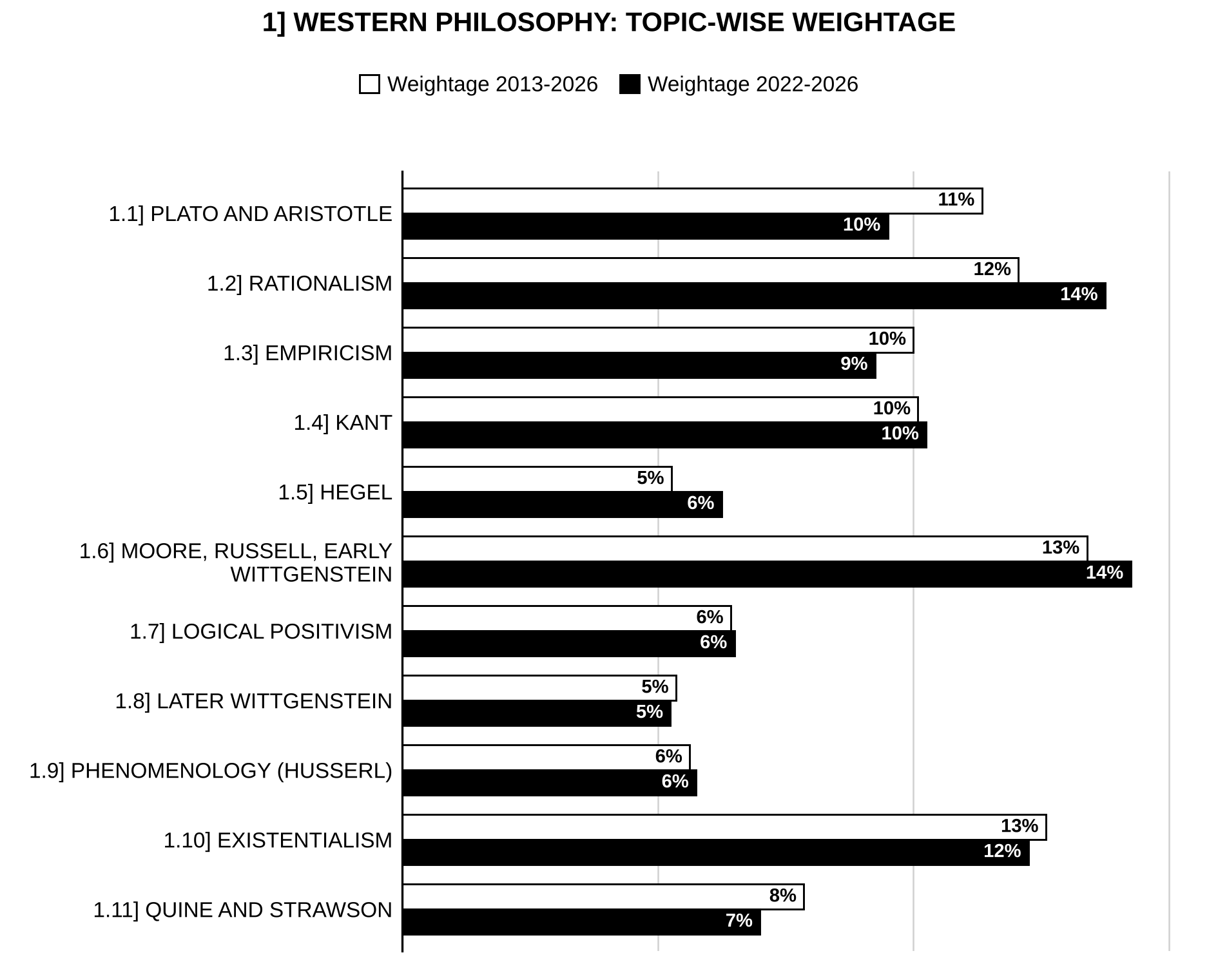
1.1] Plato and Aristotle
39 questions
Compare and contrast the notion of entelechy as presented in Aristotle’s and Leibniz’s philosophy. [2026/10m/150w/1d]
What, according to Aristotle, is the fundamental problem of metaphysics? Discuss this in relation with Aristotle’s account of the essence of the world, where he rejects the views of both the Atomists and Plato. [2026/20m/2a]
“Ideas are timeless and spaceless.” Elucidate this statement with reference to Plato. [2025/10m/150w/1a]
“In the empirical world, everything is a compound of Matter and Form.” Evaluate this statement with reference to Aristotle. [2025/10m/150w/1b]
Differentiate between Plato’s and Aristotle’s conceptions of form. [2024/10m/150w/1a]
Present an exposition of Aristotle’s distinction between actuality and potentiality. Does it provide a solution to the problem of being and becoming as presented in ancient Greek philosophy? Discuss with suitable examples. [2023/15m/2b]
How does Plato use the theory of forms to establish the relation between epistemology and metaphysics? Discuss. [2022/10m/1a]
Is Aristotle’s view of nature of identity in consonance with his metaphysical view of causes as processes? Discuss giving suitable examples. [2022/15m/2b]
“There is a red chair.” How would Plato explain this statement with the use of his theory of forms? Examine. [2021/10m/150w/1a]
“Potentiality is indefinable” according to Aristotle. Explain the relationship between potentiality and actuality with reference to the above philosophical position by taking the example of a “wooden table”. [2021/10m/150w/1b]
How does Aristotle argue for the priority of Form over Matter and Actuality over Potentiality? Critically discuss. [2020/10m/150w/1a]
What does Plato want to prove by his ‘Allegory of Cave’? [2019/10m/150w/1a]
What are the reasons for developmental changes in substance according to Aristotle? Discuss. [2019/15m/2b]
Is the relation between the Idea and the World as discussed by Plato logically consistent? Discuss Aristotle’s views regarding this and also give arguments in favour of your answer. [2018/15m/4b]
In what sense can ideas be both immanent and transcendent? Discuss in this context Plato’s theory of universals and particulars. [2017/10m/150w/1d]
Explain Aristotle’s theory of form and matter. How does it help him resolve the problem of change and permanence? [2017/15m/2c]
Does Aristotle treat matter as a ‘Substance’? Give reasons for your answer. [2016/20m/2a]
Does Plato’s ‘Theory of Form’ explain the ‘change’ and ‘sensibility’ of matter? Give reasons for your answer. [2016/20m/3a]
Aristotle’s distinction between ‘actually’ and ‘potentiality’. [2015/10m/150w/1a]
Explain Plato’s theory of forms. Does it entail a kind of essentialism? Discuss. [2015/20m/4a]
Distinguish between knowledge and belief according to Plato. How is it based on his metaphysics? Explain. [2014/20m/2a]
Explain the significance of Aristotle’s doctrine of form and matter in his theory of causation. [2014/15m/4c]
Discuss how by refuting the different concepts of substances Aristotle establishes his own theory of substance. [2013/10m/150w/1d]
Explain Plato’s ontological theory of Forms. Is ‘knowledge’ one of the Forms? Give reasons. [2013/12.5m/200w/2a]
Discuss Aristotle’s metaphysical theory as a polemic against Plato’s theory of Ideas. [2012/15m/200w/3b]
How does Plato relate the world of ideas to the empirical world? Discuss. [2011/15m/1a]
How does Aristotle’s notion of causation differ from the modern notion of causation? [2010/15m/150w/1a]
Plato’s analogy of the cave and its significance in his theory of knowledge. [2009/20m/200w/4a]
Compare Aristotle’s view regarding causation with that of the Samkhya school’s view of causation. [2009/60m/6]
Aristotle’s teleological conception of causation. [2008/20m/200w/1a]
Plato’s recollection theory of knowledge. [2007/20m/200w/1a]
Discuss the ‘theory of matter’ according to Aristotle. [2006/20m/200w/1a]
Distinction between opinion and knowledge. [2005/20m/200w/1a]
State and discuss Plato’s theory of forms. [2004/60m/2]
‘A universal exists only in the particular.’ Discuss in this connection. Aristotle’s notion of universal and the idea of substance that follows it. [2003/60m/2]
‘While Plato’s metaphysics is a visionary one, Aristotle’s metaphysics is a descriptive one.’ Explain fully giving the essential differences between the views of the two thinkers regarding the nature of reality. [2002/60m/2]
Plato’s theory of ideas. [2000/20m/200w/1a]
Aristotle’s arguments for his theory of substance. [1999/20m/200w/1a]
Explain and examine Plato’s theory of ideas. [1998/60m/2]
1.2] Rationalism (Descartes, Spinoza, Leibniz)
56 questions
How does Spinoza explain the relationship between states of mind and bodily processes? [2026/10m/150w/1a]
Compare and contrast the notion of entelechy as presented in Aristotle’s and Leibniz’s philosophy. [2026/10m/150w/1d]
What are the basic tenets of Rationalism? How does Descartes build a system of Philosophy in consonance with them? Discuss. [2025/20m/2a]
“All determination is negation.” Comment with reference to Spinoza. [2025/15m/2b]
How is Husserl’s account of “I think” different from that of Descartes? Critically discuss. [2025/20m/4a]
How does Spinoza establish that God alone is absolutely real with his statement – “Whatever is, is in God”? Critically discuss. [2024/15m/2b]
Among the rationalists, whose account of mind-body problem is compatible with the notion of human freedom and free will? Critically discuss. [2024/15m/3c]
“That thing is said to be free which exists solely from the necessity of its own nature, and is determined to action by itself alone.” Discuss Spinoza’s views on freedom and determinism in the light of the above statement. [2023/10m/150w/1c]
Discuss Descartes’ theory of innate ideas and the grounds on which Locke refutes it. [2023/15m/2c]
Discuss the concept of substance according to Spinoza. Does his discussion on substance lead to pantheism? Substantiate your view. [2022/15m/2c]
How does Rene Descartes explain the notion of certainty with reference to knowledge of the self? Critically discuss the way it differs from the knowledge of the world. [2022/15m/4b]
How does Leibniz’s conception of monads bear upon his views on determinism and freedom? Discuss with your own comments. [2020/10m/150w/1b]
“From the necessity of the divine nature there must follow infinitely many things in infinitely many ways.” Explain this statement by Spinoza along with some possible criticisms. [2020/15m/4b]
How does Descartes prove the existence of things other than himself and God? Discuss. [2019/10m/150w/1d]
What do you understand by Spinoza’s statement that what is, cannot be other than what it is? Explain. [2019/15m/2c]
Is there any place for freedom in Leibniz’s philosophy, when he speaks of ‘pre-established harmony’? Discuss. [2018/10m/150w/1b]
What is the reason for the difference in the definitions and classifications of substances made by Descartes, Spinoza and Leibniz in spite of the fact that they all belonged to the rationalist school of thought? Discuss. [2018/20m/2a]
What, according to Descartes, is a ‘clear and distinct idea’? What is the epistemological status of clear and distinct ideas? Does this account help Descartes prove that material objects exist? Explain. [2017/15m/3b]
Examine Kant’s criticism on Descartes’ view of Self. [2016/10m/150w/1b]
Discuss the various stances on God taken by Rationalists and Empiricists. [2016/15m/4c]
Explain Leibnitz’s principle of ‘identity of indiscernibles’. [2015/15m/3b]
Does Descartes Cogito principle entail that he is an essentialist? Discuss. [2015/15m/4b]
Does Leibniz’s theory of pre-established harmony necessarily lead to determinism? Discuss. [2014/10m/150w/1d]
Explain the doctrine of Cartesian dualism and examine critically arguments in favour of it. [2014/15m/2b]
Write a short critical essay on Spinoza’s conception of freedom of the individual. [2013/12.5m/200w/2d]
Explain Descartes’ method of doubt. Can this method be used to justify his belief in the existence of God? Argue your case. [2013/12.5m/200w/3a]
Give a critical account of Leibnitz’s principle of the identity of indiscernibles. [2013/12.5m/200w/4c]
How does Descartes’ ‘Cogito Ergo Sum’ affect Hume and Kant’s transcendental philosophy? Explain. [2012/12m/150w/1d]
If ‘every determination is negation’ then how can substance have attributes? Explain. [2012/15m/200w/2a]
Does Leibnitz succeed in combining the mechanical with the teleological view of the world? Explain his theory of Pre-established Harmony. [2012/15m/200w/2c]
Does monadology sufficiently explain the nature of substance? Are monads independent of each other? Explain. [2012/15m/200w/4a]
Why does Descartes not doubt the existence of God? Explain. [2011/15m/1b]
Is the concept of freedom consistent with the theory of determinism of Spinoza? Support your answer with arguments. [2011/30m/4b]
Why does Spinoza think that God alone is absolutely real? Explain. [2010/20m/200w/2b]
What is the basic difference between Leibniz and Kant on the concepts of space and time? [2010/30m/300w/3b]
Interactionism in the philosophical context. [2009/20m/200w/1a]
Compare the views of Leibniz and Hume on the concept of substance. [2009/30m/2a]
Compare the views of Spinoza and Sartre on Freedom. [2009/30m/3b]
Descartes’ mind-body dualism and Strawson’s response to it. [2009/20m/200w/4c]
Explain Leibniz’s notion of monad. Can monad be regarded as a basic particular in the Strawsonian sense? [2008/60m/2]
Discuss Descartes’ Dualism. [2006/60m/3]
Explain Spinoza’s theory of Substance. [2006/60m/4]
Mind and Body as two interacting substances. [2005/20m/200w/1b]
Spinoza’s conception of the Ultimate Substance. [2005/20m/200w/1c]
“I think therefore I am” [2004/20m/200w/1a]
State and critically examine Spinoza’s doctrine of the identity of substance, God and Nature. [2002/60m/3]
Descartes’ method of philosophy. [2001/20m/200w/1d]
Monadology of Leibnitz. [2000/20m/200w/1b]
Interactionism. [1998/20m/200w/1a]
The idea of an all-perfect, omnipotent being implies also that it or He exists. [1997/20m/200w/1a]
I think therefore I am. [1997/20m/200w/1d]
State, explain and discuss the various theories in traditional European philosophy regarding the relationship of body and mind. [1997/60m/2]
Discuss the following view with reference to the philosophers whom you have studied. ‘Philosophy takes the conceptual systems developed by scientists, mathematicians, art critics, moralists, theologians et al, as its subject-matter and seeks to explain and clarify what has to be explained and clarified about such systems in order to render them fully comprehensible.’ Or: Explain the nature of substance and its relation to attributes according to Spinoza. [1997/60m/4]
The dogma of the ghost in a machine. [1996/20m/200w/1b]
“I think; therefore I am”. [1996/20m/200w/1c]
Category mistake. [1995/20m/200w/1b]
1.3] Empiricism (Locke, Berkeley, Hume)
47 questions
Explain the distinction between Intuitive knowledge and Demonstrative knowledge as propounded by Locke. [2026/10m/150w/1b]
How does Hume account for ideas of reason? How does Kant respond to Hume’s views in this regard? Critically discuss. [2026/15m/2b]
Examine Hume’s refutation of Causal relation and Kant’s response to it. [2025/15m/2c]
Explain Berkeley’s doctrine of nominalism and his refutation of Abstract ideas. [2025/15m/4c]
Is rejection of Locke’s notion of primary qualities instrumental in Berkeley’s leaning towards idealism? In this context, also discuss how Berkeley’s subjective idealism is different from the absolute idealism proposed by Hegel. [2024/20m/2a]
Critically analyse Hume’s argument that causality is a matter of habit/custom involving psychological principle of association. [2023/20m/2a]
Discuss Descartes’ theory of innate ideas and the grounds on which Locke refutes it. [2023/15m/2c]
Why and how does John Locke refute the innate ideas? Elucidate the nature and source of knowledge in Locke’s epistemology. [2022/15m/4c]
“Sensible things are those only which are immediately perceived by sense.” Explain Berkeley’s theory of knowledge with reference to the above statement. [2021/10m/150w/1c]
Examine the concept of personal identity by Locke. [2021/10m/150w/1d]
“The relation between cause and effect is one of constant conjunction”. Examine Hume’s criticism of causation in the light of the above statement. [2021/10m/150w/1e]
“I never can catch myself at any time without perception, and never can observe anything but the perception.” How does this statement by Hume problematize the philosophical notion of personal identity? How does Kant deal with this problem in his Critique of Pure Reason? [2020/20m/2a]
Is there any element of necessity in causal relations according to Hume? Discuss. [2019/15m/4b]
Are the two truths–‘The Sun will rise tomorrow’ and ‘2+2=4’ of the same necessity for Hume? Give reasons in favour of your answer. [2018/10m/150w/1a]
How does Berkeley establish that Mind and its ideas alone are real? How do Moore and Russell react to Berkeley’s view in this regard? Do you find any difference between Moore’s reaction and Russell’s one? Discuss. [2018/20m/3a]
Show how Hume’s analysis of experience leaves no ground for belief in any permanent reality either physical or mental. [2017/10m/150w/1e]
How does Locke draw a distinction between primary and secondary qualities? Does he also draw a distinction between the idea of primary qualities and primary qualities as well as the idea of secondary qualities and secondary qualities? Discuss. [2017/20m/4a]
What is the logical necessity for Locke to introduce the concept of secondary qualities? Give reasons for your answer. [2016/10m/150w/1a]
Critically examine Hume’s views on the relation of cause and effect. [2016/15m/2b]
Discuss the various stances on God taken by Rationalists and Empiricists. [2016/15m/4c]
esse est percipi. [2015/10m/150w/1b]
Evaluate critically Hume’s criticism of theory of causation. [2014/15m/2c]
Examine John Locke’s theory of substance. [2013/12.5m/200w/3c]
Give a critical account of Hume’s theory of the Self. [2013/12.5m/200w/4d]
John Locke said that ‘No man’s knowledge can go beyond his experience’. Discuss critically the implication of this statement. [2012/12m/150w/1b]
Was Hume a Sceptic? If not then what is his contribution to Philosophy? [2012/15m/200w/2d]
If ‘To be is to be perceived’ then how does Berkeley explain the permanence of things? Explain. [2012/15m/200w/3c]
Critically examine John Locke’s categorisation of primary and secondary qualities and explain the problem it posed to Later Empiricists. [2012/15m/200w/4b]
What, according to Empiricists is the concept of Substance? Discuss. [2011/20m/2c]
Does Hume deny the possibility of knowledge? Discuss. [2010/15m/150w/1b]
What metaphysical implications can be derived from Berkeley’s statement ‘esse est percipi’? [2010/30m/300w/3a]
Is Strawson’s concept of a person a refutation of Hume’s concept of Self? Discuss. [2010/30m/300w/4b]
“To be is to be perceived.” – Discuss. [2009/20m/200w/1c]
Compare the views of Leibniz and Hume on the concept of substance. [2009/30m/2a]
Hume and Kant on metaphysics. [2008/20m/200w/1c]
State and discuss Locke’s views on Substance. [2007/60m/2]
Explain the theory of knowledge according to Locke. [2006/20m/200w/1b]
Discuss Hume’s Scepticism. [2006/60m/2]
Hume’s views on Induction. [2004/20m/200w/1b]
To be is to be perceived. [2003/20m/200w/1b]
Hume’s Phenomenalism. [2002/20m/200w/1a]
Hume’s analysis of personal identity. [2001/20m/200w/1c]
“Esse est percipi” [2000/20m/200w/1c]
Evaluate Hume’s theory of personal identity. [1999/60m/2]
Esse est percipi. [1998/20m/200w/1b]
Distinction between Solipsism and Scepticism. [1996/20m/200w/1d]
Hume’s arguments against induction. [1995/20m/200w/1d]
1.4] Kant
42 questions
How does Hume account for ideas of reason? How does Kant respond to Hume’s views in this regard? Critically discuss. [2026/15m/2b]
Analyze and discuss the different ways in which Kant and Hegel conceived the relationship between reality and our thinking about reality. [2026/15m/4b]
How does Hegel challenge Kant’s distinction between Phenomena and Noumena? Discuss. [2025/10m/150w/1e]
Examine Hume’s refutation of Causal relation and Kant’s response to it. [2025/15m/2c]
How does Kant respond to Hume’s scepticism with regard to a priori judgments? Discuss. [2024/10m/150w/1b]
Critically examine Kant’s objections against the ontological argument for the existence of God. [2024/15m/2c]
“Precepts without concepts are blind and concepts without precepts are empty.” In the light of this statement discuss how Kant reconciles rationalism with empiricism. [2023/10m/150w/1a]
What are the main arguments offered by Kant to prove that apriori synthetic judgements are possible? Discuss with examples. [2023/10m/150w/1e]
What is apperception, according to Immanuel Kant? Discuss with reference to his transcendental exposition of space and time. [2022/10m/1e]
How does Kant construct antinomies to illustrate the illusory tendencies of pure reason? Explain and examine the antinomies presented by Kant. [2022/20m/3a]
Explain how Cartesian formulation of ontological argument is criticised by Kant. [2021/15m/2c]
“I never can catch myself at any time without perception, and never can observe anything but the perception.” How does this statement by Hume problematize the philosophical notion of personal identity? How does Kant deal with this problem in his Critique of Pure Reason? [2020/20m/2a]
When does Pure Reason enter into the realm of Antinomies according to Kant? Is Kant’s notion of Antinomies of Pure Reason a natural culmination of his distinction between Phenomena and Noumena? Give reasons in favour of your answer. [2020/15m/3c]
How does Kant argue for the transcendence of Space and Time? Discuss. [2019/20m/4a]
Explain the significance of the Kantian dictum, ‘Understanding makes Nature’. How far do you agree that Hegel’s Absolutism is the culmination of the Kantian Dualism? Discuss. Give reasons in favour of your answer. [2018/15m/2b]
How is ‘all bodies are extended’ an analytic judgement but ‘all bodies are heavy’ a synthetic judgement? Is ‘every event has a cause’ an analytic or a synthetic judgement? Explain. [2017/20m/2a]
Elaborate Kant’s theory of space and time. How does this theory enable him to explain how mathematical propositions can be both synthetic and a priori? [2017/20m/3a]
Examine Kant’s criticism on Descartes’ view of Self. [2016/10m/150w/1b]
What, according to Kant, are ‘pure concepts’? Examine their role in the process of knowing. [2016/15m/3b]
Explain Kant’s division of categories. [2015/20m/2a]
How are the synthetic a priori judgements justifiable according to Kant? Explain. [2014/10m/150w/1a]
What is an antinomy? Describe the major antinomies discussed by Kant. [2013/10m/150w/1e]
State Kant’s view of causality. How far is Kant able to answer Hume’s objection that causal relation lacks logical necessity? [2013/12.5m/200w/2b]
How does Descartes’ ‘Cogito Ergo Sum’ affect Hume and Kant’s transcendental philosophy? Explain. [2012/12m/150w/1d]
Why is Kant’s philosophy known as a Copernican revolution in metaphysics? What was revolutionary about Kantian philosophy? Give reasons for your answer. [2012/15m/200w/2b]
“Hume aroused me from my dogmatic slumber”. In what context Kant has made this statement? Explain. [2011/20m/2a]
Why does Kant say that existence is not a predicate? [2010/15m/150w/1c]
What is the basic difference between Leibniz and Kant on the concepts of space and time? [2010/30m/300w/3b]
Kant’s objections against the ontological argument for the existence of God. [2009/20m/200w/4b]
Hume and Kant on metaphysics. [2008/20m/200w/1c]
Nature of synthetic a-priori judgment according to Kant. [2007/20m/200w/1d]
Explain Kant’s criticism of the proofs for the existence of God. [2006/20m/200w/1d]
How does Kant respond to Hume’s scepticism? [2005/60m/2]
The significance of Kant’s distinction between phenomena and noumena. [2004/20m/200w/1c]
How is synthetic apriority judgment possible? [2003/20m/200w/1a]
“Kant’s ‘Critical Philosophy’ is reconciliation between Rationalism and Empiricism.” Elucidate the remark fully and bring out the consequence of such reconciliation for the possibility of traditional metaphysics. [2002/60m/4]
Kant’s conception of space and time. [2001/20m/200w/1a]
State and examine Kant’s criticism of the proofs for the existence of God. [2000/60m/2]
Kant’s Ideas of Reason. [1999/20m/200w/1d]
Kant reconciles rationalism with empiricism by superseding them. [1997/20m/200w/1c]
What do you understand by Kant’s claim that space and time are forms of pure intuition? Explain the arguments he gives in support of his position in this regard. [1996/60m/3]
Kant’s doctrine of transcendental deduction. [1995/20m/200w/1c]
1.5] Hegel
22 questions
Explain Hegel’s idea that the concept of the Absolute as being is the concept of the Absolute as becoming as a process of self-development. [2026/10m/150w/1c]
Analyze and discuss the different ways in which Kant and Hegel conceived the relationship between reality and our thinking about reality. [2026/15m/4b]
How does Hegel challenge Kant’s distinction between Phenomena and Noumena? Discuss. [2025/10m/150w/1e]
Is rejection of Locke’s notion of primary qualities instrumental in Berkeley’s leaning towards idealism? In this context, also discuss how Berkeley’s subjective idealism is different from the absolute idealism proposed by Hegel. [2024/20m/2a]
“History is a process of dialectical change.” In the light of this statement discuss Hegel’s approach in understanding history. [2023/10m/150w/1b]
How does Kierkegaard argue against Hegel’s idea of universal spirit in favour of the individual as the essence of spirit? Critically discuss. [2023/10m/150w/1d]
What is the dialectical method in the philosophy of Georg Wilhelm Hegel? How does this method help in realizing the Absolute? Discuss. [2022/15m/3b]
Discuss Hegel’s Dialectical method. Explain how his dialectical method leads him to the Absolute Idealism. [2021/20m/2a]
Examine the reality of the phenomenal world in the light of Hegel’s Absolute Idealism. [2020/10m/150w/1d]
What is the role of dialectics in realizing the truth in Hegel’s philosophy? [2019/10m/150w/1c]
Explain the significance of the Kantian dictum, ‘Understanding makes Nature’. How far do you agree that Hegel’s Absolutism is the culmination of the Kantian Dualism? Discuss. Give reasons in favour of your answer. [2018/15m/2b]
Elaborate Hegel’s dictum: “All identity is identity and difference.” [2017/10m/150w/1a]
What is Hegel’s view on God? Do you think that his interpretation of God was contributive to the colonial and imperial expansionist designs? Explain. [2016/15m/4b]
Comment: ‘Movement is contradiction itself.’ Examine, in this context, Hegel’s dialectical method. [2013/12.5m/200w/3b]
Explain Hegelian dialectical method and show how it is useful in explaning the historical development process? [2012/15m/200w/4c]
“The rational is real and the real is rational.” – Comment. [2009/20m/200w/1b]
Hegel’s Dialectical method. [2007/20m/200w/1b]
Critically discuss the Hegel’s Dialectical method. [2006/20m/200w/1c]
Hegel’s Dialectical Method. [2002/20m/200w/1b]
The dialectical method simply consists in challenging every typical attitude or belief by rendering its partisan claims logically ridiculous. [1997/20m/200w/1b]
What argument does mctaggard give to establish that context the role of his principle of determining correspondences? [?]. Or: Give a critical evaluation of Wittgenstein’s ideas of ‘language game’ and family resemblance. [1996/60m/4]
What according to Bradley is the relation between thought and reality? How does he establish his view that “a relational way of thought must give appearance and not truth”? Discuss. [1995/60m/2]

Preparing for Prelims too?
Our UPSC Prelims Topic-wise PYQ eBook covers every Prelims question with detailed explanations, so you can see exactly where UPSC asks from.
View the BookDownload Free Sample1.6] Moore, Russell and early Wittgenstein
46 questions
“I can prove now, for instance, that two human hands exist.” How does Moore use this illustration to prove the existence of an external world? Critically discuss. [2026/10m/150w/1e]
“Wittgenstein’s difficulty about not being able to say anything within a given language about the structure of that language can be met by the idea of a hierarchy of languages.” Do you agree with this statement? Give reasons and justifications for your answer. [2026/20m/4a]
“The golden mountain is very high.” Discuss this statement in the context of Russell’s theory of descriptions. [2025/10m/150w/1d]
“We should look not to an ideal language which derives its meaning from facts and has a precise logical structure but empirically, to the ways in which languages are actually used.” Explain the transition from early views of Wittgenstein to his later views on language and meaning with reference to this statement. [2025/20m/3a]
“Blue is one object of sensation and green is another, and consciousness, which both sensations have in common, is different from either.” Present an account of Moore’s refutation of idealism with reference to this statement. [2025/15m/3c]
What arguments are offered by Moore to prove that there are certain truisms, knowledge of which is a matter of common sense? Critically discuss. [2024/10m/150w/1c]
Explain Russell’s notion of incomplete symbols. Also explain how this notion leads to the doctrine of logical atomism. [2024/20m/3a]
Why according to Russell is the proposition – “The present king of France is bald” problematic? Critically discuss. [2023/15m/4b]
What were the main reasons that led Wittgenstein to shift from picture-theory of meaning to use-theory of meaning? Critically discuss. [2023/15m/4c]
What is Bertrand Russell’s method of logical analysis? How does it ultimately end in establishing atomic theory of meaning? Discuss. [2022/10m/1b]
Is there any difference between pictorial form and logical form in Ludwig Wittgenstein’s picture theory of language? How does the logical form define the relation between language and reality? Explain. [2022/15m/3c]
What are the main arguments put forward by Moore in his paper “A Defence of Common Sense” to prove that there are possible propositions about the world that are known to be true with certainty? Do you think Moore’s arguments provide a sufficient response to objections presented by the sceptic against the possibility of knowledge? Give reasons in support of your answer. [2021/20m/3a]
What does Wittgenstein mean by the statement – “Whereof one cannot speak, thereof one must be silent?” Critically discuss. [2021/15m/4c]
Critically discuss the following statement by Moore: “If anyone tells us that to say ‘Blue exists’ is the same thing as to say that ‘Both blue and consciousness exist’, he makes a mistake and a self-contradictory mistake.” [2020/15m/2b]
“The reason that I call my doctrine logical atomism is because the atoms that I wish to arrive at as the sort of last residue in analysis are logical atoms and not physical atoms.” Write a note on the nature of atomic facts according to Russell in the light of the above statement. [2020/15m/2c]
Why is Moore’s philosophy called common-sense realism? [2019/15m/3c]
How does Berkeley establish that Mind and its ideas alone are real? How do Moore and Russell react to Berkeley’s view in this regard? Do you find any difference between Moore’s reaction and Russell’s one? Discuss. [2018/20m/3a]
How does Wittgenstein apply the distinction between ‘saying’ and ‘showing’ to point to a single way of apprehending the most decisive problems of philosophy? Is he justified? Give reasons for your answer. [2018/15m/3c]
How is Russell’s theory of definite description related to his Logical Atomism? Discuss and give reasons for your answer. [2018/15m/4c]
How is the statement, ‘I met a man’, semantically problematic for Russell? How does he account for the meaningfulness of this statement? [2017/10m/150w/1c]
What is Wittgenstein’s picture theory of meaning? What are his reasons for giving up this theory and suggesting the use theory of meaning? [2017/15m/2b]
Explain Russell’s view that “the physical object is a logical construction from sense-data”. Why does he call his metaphysical view ‘neutral monism’? [2016/15m/3c]
G.E. Moore’s refutation of idealism. [2015/10m/150w/1e]
What do we understand by incomplete symbols? What role do they play in Russell’s theory of meaning? Discuss. [2015/15m/3c]
Why does Wittgenstein disagree with Bertrand Russell’s interpretation of atomism in the philosophy of Tractatus? Discuss. [2014/15m/3b]
Are G.E. Moore’s arguments in defence of common sense satisfactory? Give reasons. [2014/15m/3c]
Distinguish between atomic and general propositions. Show how they are justified true. [2013/12.5m/200w/2c]
Comment: ‘Moore’s defence of common sense essentially is defence of ordinary language.’ [2013/12.5m/200w/4a]
Explain the theory of definite descriptions according to Russell. [2012/15m/200w/3d]
What is Russell’s idea of ‘Incomplete symbols’ in his theory of description? Discuss. [2011/15m/1c]
Are the arguments given by G. E. Moore against Idealism, adequate? Give reasons for your answer. [2011/30m/4a]
Are tautologies meaningless according to Wittgenstein? [2010/15m/150w/1d]
What does Moore want to establish when he asserts that propositions like ‘the earth exists’ or ‘we have consciousness’ are truisms? Discuss. [2010/20m/200w/2a]
Explain the theory of logical construction. Does it provide a satisfactory account of language? [2008/60m/4]
State and discuss Russell’s analysis of Definite Descriptions. [2007/60m/3]
Distinction between ‘saying’ and ‘showing’ [2004/20m/200w/1d]
Critically discuss Moore’s Refutation of Idealism. [2004/60m/3]
What is Russell’s logical atomism? Bring out in this connection the conception of metaphysics involved in it. [2003/60m/3]
Moore’s Defense of Common-Sense. [2002/20m/200w/1d]
Russell’s theory of logical construction. [2001/20m/200w/1b]
Give a critical account of Moore’s refutation of idealism. [2000/60m/3]
Russell’s concept of negative facts. [1999/20m/200w/1c]
Clarify Moore’s conception of common sense and examine his arguments in its defense. [1999/60m/3]
Logical atomism. [1998/20m/200w/1d]
How does Moore refute idealism? Critically evaluate. [1998/60m/3]
Elucidate Bertrand Russell’s theory of descriptions, and examine it with special reference to its criticism by P.F. Strawson. Or: Explain the basic concepts of the phenomenology of Edmund Husserl. Is it only a philosophical method or can it be regarded as metaphysics? [1997/60m/3]
1.7] Logical positivism
21 questions
How did the logical positivists try to make philosophy a handmaid to science and establish a unified language of science? Why did their project fail? Discuss. [2026/15m/4c]
Present an exposition of the verification theory of meaning as propounded by the logical positivists. In this context also differentiate between the “strong” and the “weak” sense of the word “verifiable”. [2025/15m/3b]
Is the sentence “All objects are either red or not red” meaningful in the same way as “This page is white” is, according to the logical positivists? Discuss with arguments. [2024/15m/3b]
Does the rejection of metaphysics as proposed by Logical Positivists relate to problem of meaning or problem of knowledge or nature of things or all of them together? Discuss with suitable examples. [2023/20m/3a]
What according to Logical Positivists are “pseudostatements”? How does one identify “pseudostatements”? Critically discuss with examples. [2021/15m/2b]
“The Soul of Superman is Good.” Critically examine the above statement in the light of logical positivism. [2020/10m/150w/1e]
How do the logical positivists account for the meaning of general statements? Can the same account be applied to metaphysical statements? Discuss. [2019/20m/2a]
How do the logical positivists show that metaphysical sentences are meaningless? Can their verification theory of meaning account for the meaningfulness of all scientific sentences? Discuss. [2018/15m/3b]
Does the sentence, ‘Whatever is coloured is extended’, satisfy the criterion of meaningfulness proposed by the logical positivists? Explain. [2017/15m/4b]
Explain verification theory. Does it lead to elimination of metaphysics? [2016/10m/150w/1d]
Are empirical statements conclusively verifiable? Discuss the limitations of ‘verification theory of meaning’. [2014/20m/3a]
Distinguish necessary from empirical propositions. How is a necessary proposition justified? Explain. [2013/10m/150w/1c]
‘Logicial positivism broadly claims that Metaphysics and Theology are meaningless because they are neither matters of logic nor verifiable empirically.’ Critically examine. [2012/12m/150w/1a]
Discuss the limitations of verification theory. [2011/20m/2b]
Are necessary propositions linguistic by nature? Discuss in the light of logical positivism. [2010/20m/200w/2c]
Examine how Ayer eliminates metaphysics. [2009/30m/2b]
Elimination of metaphysics at the hands of Logical Positivists. [2007/20m/200w/1c]
State and discuss the logical positivists’ attempts to eliminate metaphysics. [2005/60m/3]
Evaluate the logical positivists’ arguments for the elimination of metaphysics. [2001/60m/2]
Explain the verification theory and show whether it leads to the elimination of metaphysics. [2000/60m/4]
Critically discuss Ayer’s view on metaphysics. [1998/60m/4]
1.8] Later Wittgenstein
18 questions
Can words be viewed as the ideas in the mind of the person who uses them? Answer with reference to the philosophy of later Wittgenstein. [2026/15m/3c]
“We should look not to an ideal language which derives its meaning from facts and has a precise logical structure but empirically, to the ways in which languages are actually used.” Explain the transition from early views of Wittgenstein to his later views on language and meaning with reference to this statement. [2025/20m/3a]
Why does later Wittgenstein think that there cannot be a language that only one person can speak – a language that is essentially private? Discuss. [2024/10m/150w/1d]
What were the main reasons that led Wittgenstein to shift from picture-theory of meaning to use-theory of meaning? Critically discuss. [2023/15m/4c]
Establish the tenability of later Wittgenstein’s motion of language as form of life. [2022/10m/1c]
“But could we also imagine a language in which a person could write down or give vocal expression to his inner experiences–his feelings, moods and the rest–for his private use?” Critically discuss the answer offered by Wittgenstein to this question. [2020/15m/4c]
Show how Wittgenstein’s critique of solipsism culminates in the critique of private language. [2019/15m/3b]
How does the notion of ‘family resemblance’ help Wittgenstein to uphold that ‘Language is a game’? Discuss. [2018/10m/150w/1c]
What is Wittgenstein’s picture theory of meaning? What are his reasons for giving up this theory and suggesting the use theory of meaning? [2017/15m/2b]
Why does Wittgenstein reject the possibility of private language? [2016/10m/150w/1c]
Bring out the relationship between language games and forms of life. [2015/20m/3a]
Bring out the significance of ‘language games’ in Wittgenstein’s use theory of meaning. [2014/10m/150w/1b]
Explain Wittgenstein’s arguments against the possibility of private language. [2013/10m/150w/1b]
According to Wittgenstein ‘Philosophy is a battle against the bewitchment of our intelligence by means of language’. Explain the function of philosophy in the context of above statement. [2012/12m/150w/1c]
“Meaning of the word lies in its use”. Explain in detail. [2011/30m/3a]
Wittgenstein’s notion of language-game. [2008/20m/200w/1b]
What argument does mctaggard give to establish that context the role of his principle of determining correspondences? [?]. Or: Give a critical evaluation of Wittgenstein’s ideas of ‘language game’ and family resemblance. [1996/60m/4]
Explain and discuss Wittgenstein’s view that “the results of philosophy are the uncovering of one or another piece of plain nonsense and of bumps that understanding has got by running its head up against the limits of language”. [1995/60m/4]
1.9] Phenomenology (Husserl)
22 questions
Describe Sartre’s notion of consciousness as ‘nothing’. How is it different from Husserl’s notion of consciousness? Discuss. [2026/15m/2c]
How is Husserl’s account of “I think” different from that of Descartes? Critically discuss. [2025/20m/4a]
Why does Husserl think that essences exhibit a kind of continuity between consciousness and being? Discuss. [2024/15m/4b]
Elucidate the significance of bracketing and reduction in Husserl’s phenomenological method. [2023/15m/3b]
What is psychologism? Critically discuss the way Edmund Husserl avoids the problem of psychologism in the discourse of transcendental phenomenology. [2022/10m/1d]
Present a critical exposition of Husserl’s criticism of ‘natural attitude’. How does Husserl propose to address the problems involved in natural attitude through his phenomenological method? [2021/20m/4a]
What, according to Husserl, is wrong with psychologism? How does Husserl address the problems with psychologism in his phenomenological method? [2020/10m/150w/1c]
Can hallucination be regarded as an intentional act by Husserl? Explain. [2019/10m/150w/1b]
What is Epoché? How does Heidegger reject this method of phenomenological reduction? Explain Heidegger’s concept of ‘being in the world’ as opposed to the concept of a transcendental ego. [2018/20m/4a]
Explain Husserl’s reasons for advocating phenomenological reductionism. [2017/10m/150w/1b]
What, according to Husserl, is the task of a philosopher? Do you think his methods are relevant to philosophy? Discuss. [2016/20m/4a]
Husserl’s notion of ‘bracketing’. [2015/10m/150w/1c]
Explain the significance of ‘bracketing’ in Husserl phenomenology. [2014/10m/150w/1c]
What, according to Husserl is Intentionality? Discuss its role in arriving at the meaning of object. [2011/30m/3b]
How is the empirical ego in Sartre and Heidegger different from the transcendental ego in Husserl? [2010/30m/300w/4a]
What is the notion of transcendental ego according to Husserl? How is it different from Sartre’s notion of the ego? [2008/60m/3]
What is ‘epoche’? Bring out its significance for Husserl’s conception of rigorous science. [2005/60m/4]
Discuss Husserl’s conception of philosophy as rigorous science. [2003/60m/4]
Bring out the philosophical significance of Husserl’s method of bracketing. [2001/60m/3]
Husserl’s project of presuppositionless inquiry. [1999/20m/200w/1b]
Elucidate Bertrand Russell’s theory of descriptions, and examine it with special reference to its criticism by P.F. Strawson. Or: Explain the basic concepts of the phenomenology of Edmund Husserl. Is it only a philosophical method or can it be regarded as metaphysics? [1997/60m/3]
Method of phenomenological reduction. [1996/20m/200w/1e]
1.10] Existentialism (Kierkegaard, Sartre, Heidegger)
37 questions
Describe Sartre’s notion of consciousness as ‘nothing’. How is it different from Husserl’s notion of consciousness? Discuss. [2026/15m/2c]
Explain Heidegger’s conception of authenticity and inauthenticity as modes of Dasein’s being. [2026/15m/3b]
Explain the difference between being-for-itself and being-in-itself as presented by Sartre. [2025/10m/150w/1c]
How does Kierkegaard define truth in terms of subjectivity? Critically discuss. [2024/10m/150w/1e]
What do the existentialist thinkers mean by the slogan “existence precedes essence”? How is human existence related to human freedom according to them? Discuss. [2024/20m/4a]
How does Kierkegaard argue against Hegel’s idea of universal spirit in favour of the individual as the essence of spirit? Critically discuss. [2023/10m/150w/1d]
“Consciousness is what it is not and is not what it is.” In the light of this statement bring out the chief features of Sartre’s conception of consciousness. [2023/15m/3c]
Provide a critical account of Heidegger’s Being-in-the-world and discuss the problem of ‘authenticity’ in the context of Dasein. [2022/20m/2a]
How does Soren Kierkegaard define the notion of ‘subjectivity’? Explain it with reference to three stages of existence as propounded by him. [2022/20m/4a]
“I can always choose, but I ought to know that if I do not choose, I am still choosing”. Critically discuss Sartre’s conception of choice and responsibility in the light of above statement. [2021/15m/4b]
What does Kierkegaard mean by saying “Subjectivity is the truth” in the context of the problem of ‘the single individual’? [2020/20m/3a]
“You can always make something out of what you have been made into.” Critically discuss this statement by Sartre with reference to his views on existentialism. [2020/20m/4a]
Is Dasein authentic existence for Heidegger? How does he relate temporality with Dasein? Discuss. [2019/20m/3a]
How does Sartre look at the problem of freedom of choice and determinism? Explain. [2019/15m/4c]
How does Sartre connect inauthenticity with bad faith? Why does Sartre show that inauthenticity and bad faith lead to alienation? Discuss. [2018/10m/150w/1d]
What is Epoché? How does Heidegger reject this method of phenomenological reduction? Explain Heidegger’s concept of ‘being in the world’ as opposed to the concept of a transcendental ego. [2018/20m/4a]
Discuss Heidegger’s concept of authenticity and explain how an inauthentic Dasein regains the lost self? [2017/15m/4c]
Discuss Sartre’s notion of ‘Nothingness’. [2016/15m/2c]
Discuss why Heidegger introduces the concept of Dasein in his metaphysics. [2015/15m/2b]
Bring out the relationship between existence and essence in the case of human being. Explain the issues it gives rise to for human beings according to Sartre. [2015/15m/4c]
Explain Kierkegaard’s concept of choice. How does the concept of choice in metaethics differ from normative ethics? Explain. [2014/20m/4a]
State and evaluate Heidegger’s claim that temporality is the horizon against which the being of any entity is understood. [2014/15m/4b]
Examine Sartre’s distinction between Being-for-itself and Being-in-itself. [2013/12.5m/200w/3d]
Analyse Kierkegaard’s concept of choice. Can there be, in his view, correct or incorrect choice? Discuss. [2013/12.5m/200w/4b]
Sören Kierkegaard clarified that “The function of prayer is not to influence God but rather to change the nature of the one who prays”. Comment on this statement. [2012/12m/150w/1e]
Elucidate Existentialism and indicate its strong and weak points in your own words. [2012/15m/200w/3a]
“I am responsible for myself and for everyone else”. Discuss this statement in the light of Sartre’s existentialism. [2011/15m/1d]
How is the empirical ego in Sartre and Heidegger different from the transcendental ego in Husserl? [2010/30m/300w/4a]
“Existence precedes essence.” – Comment. [2009/20m/200w/1d]
Compare the views of Spinoza and Sartre on Freedom. [2009/30m/3b]
Heidegger’s contention that essence of “Dasein is its existence”. [2008/20m/200w/1d]
What is the notion of transcendental ego according to Husserl? How is it different from Sartre’s notion of the ego? [2008/60m/3]
Discuss Sartre’s conception of freedom. [2004/60m/4]
‘Existence precedes essence’. [2003/20m/200w/1d]
Sartre’s phenomenological ontology. [2000/20m/200w/1d]
Human being is always “ahead of himself”. (Heidegger) [1996/20m/200w/1a]
What especial import does the word existence have in the philosophy of existentialism? Explain. [1996/60m/2]
1.11] Quine and Strawson
28 questions
Why are states of consciousness ascribed to anything at all and why are they ascribed to the same things to which we also ascribe physical properties? How does Strawson answer these questions in his work Individuals? [2026/20m/3a]
“We can affirm the truth of any sentence in our total system, in the face of whatever experience, just so long as we are prepared to make adjustments elsewhere.” Discuss this statement in the light of Quine’s ‘Two Dogmas of Empiricism’. [2025/15m/4b]
Explain the nature of the two dogmas that Quine refers to in his paper ‘Two Dogmas of Empiricism’. [2024/15m/4c]
Why does Strawson consider person to be a primitive concept? What implication does it have for the mind-body dualism? Discuss. [2023/20m/4a]
What according to Strawson are basic particulars? What reasons does Strawson offer to believe that ‘material bodies’ and ‘persons’ are basic particulars? Critically discuss. [2021/15m/3b]
Critically examine Quine’s postulate of empiricism without the dogmas with reference to his ‘Two Dogmas of Empiricism’. [2021/15m/3c]
Evaluate the role of spatio-temporal thinking in objective thinking with reference to Strawson’s theory of basic particulars. [2020/15m/3b]
Explain Quine’s arguments against synthetic-analytic distinction. [2019/10m/150w/1e]
How does Strawson explain the concept of person in his philosophy? Discuss. [2018/10m/150w/1e]
How does Quine show that the notion of a priori knowledge as discussed by Kant is ‘a metaphysical article of faith’? Give reasons for your answer. [2018/15m/2c]
What are the two dogmas of empiricism that Quine attacks? What are his arguments against what he calls the second dogma? [2017/15m/3c]
Discuss Quine’s attack on the analytic-synthetic distinction. [2016/10m/150w/1e]
Strawson’s distinction between ‘M’ and ‘P’ predicates. [2015/10m/150w/1d]
Elucidate Quine’s arguments to show that analyticity is not synonymity. [2015/15m/2c]
How far are Quine’s arguments in “Two Dogmas of Empiricism” justified? Discuss. [2014/10m/150w/1e]
Explain and evaluate Strawson’s arguments for his conception of the nature of a person. [2013/10m/150w/1a]
Explain critically Quine’s rejection of the analytic synthetic distinction and his subsequent philosophical arguments. [2012/15m/200w/4d]
Is Strawson’s concept of a person a refutation of Hume’s concept of Self? Discuss. [2010/30m/300w/4b]
What are Quine’s objections with regard to the verification theory of meaning? [2009/30m/3a]
Descartes’ mind-body dualism and Strawson’s response to it. [2009/20m/200w/4c]
Explain Leibniz’s notion of monad. Can monad be regarded as a basic particular in the Strawsonian sense? [2008/60m/2]
State and discuss Strawson’s theory of Person. [2007/60m/4]
Quine’s criticism of analytic-synthetic distinction. [2005/20m/200w/1d]
Strawson’s notion of person as primitive. [2003/20m/200w/1c]
Quine’s attack on Analytic-Synthetic Distinction. [2002/20m/200w/1c]
Examine Quine’s critique of the linguistic theory of a priori propositions. [2001/60m/4]
Examine Quine’s critique of the linguistic theory of necessary propositions. [1999/60m/4]
Theory of person. [1998/20m/200w/1c]

Strengthen your GS papers
Our UPSC Mains Topic-wise & Year-wise PYQ eBook (2013–2026) maps every GS question to the syllabus, so you know what UPSC asks and how often.
View the BookDownload Free SampleNext: Indian Philosophy »
Back to: Philosophy Optional PYQs – Topic-wise
Last updated: 30 October 2026