
Here are all 69 Civil Services questions asked in UPSC Public Administration Optional Paper II from 1995 to 2026, arranged under the 7 topics of the official syllabus. Within each topic the latest questions come first.
Each question ends with a code such as [2024/15m/3b] – the year, the marks, the word limit (where UPSC set one) and the question number in the paper.
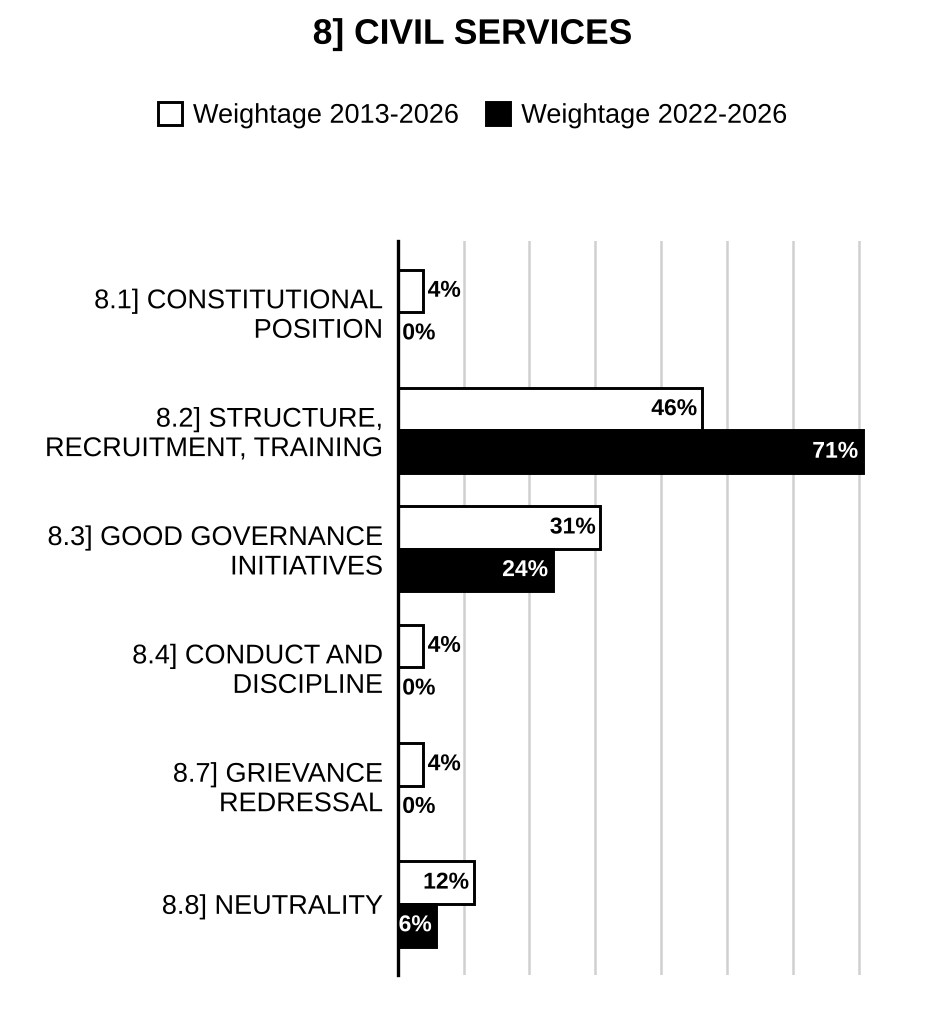
8.1] Constitutional position
8 questions
Emerging developmental aspirations of the society necessitate the constitutional amendment to change the present safeguards available to the civil servants. Evaluate the pros and cons of such amendment. [2019/10m/2c]
Supreme Court ruling on 31st October, 2013 in respect of bureaucracy’s functioning would help achieve good governance. Analyse this ruling and add your comments on it. [2014/20m/8b]
“One of the greatest weakness inherent in a Federal polity is the possibility of conflict of loyalty and responsibility on the part of public servants as between Central and State Governments.” Elaborate and comment. [2004/60m/8]
Comment on: “All India Services as an institution is the result of history.” [2002/20m/200w/5a]
Comment on: “The need and significance of all-India services has been well recognized in political as well as administrative circles.” [2001/20m/200w/5a]
“All India Services play a crucial unifying role in the whole administrative system of the country.” Explain. [2000/30m/3b]
Comment on: “The public services in India have been given Constitutional status.” [1996/20m/200w/1d]
“Independence of the Public Service Commissions has been ensured under specific provisions of the Constitution.” Examine. [1996/30m/3b]
8.2] Structure, recruitment, training and capacity building
31 questions
Lateral Entry in Government of India has not moved in the intended direction. Explain the reasons. [2026/10m/150w/5a]
Civil services is grappling with severe capacity issues and which is a major bottleneck in implementing ambitious programmes across sectors. Mission Karmayogi can only supplement but not solve the entire capacity constraint. Give your opinion. [2026/20m/6a]
Low cyber awareness among officials is causing cyber security issues in the administration. Comment. [2025/10m/150w/5a]
Training and capacity building represent different scope and objectives. Explain the key differences. [2025/20m/8b]
The constitutional stature provided to the Public Service Commissions accord them the autonomy to work towards fair recruitments. Comment. [2024/10m/150w/5a]
With what aims and objectives was the Capacity Building Commission established? Evaluate how far it has come in realising the goals. [2024/10m/6c]
The district training component of Induction Training of IAS officers requires to be revisited. Examine. [2023/10m/150w/5a]
Examine the lateral entry recruitment in government in the context of Part XIV of the Indian Constitution. [2022/10m/150w/5a]
“The objective of Mission Karmyogi is to enhance capacity building of Indian Civil Servants and improve governance.” Discuss. [2022/20m/6b]
Recruitment is the cornerstone of the whole public personnel structure and it revolves around the problem of attracting the best. Discuss the essential elements of a good recruitment system. [2021/20m/3a]
Well planned and goal oriented training programmes are the backbone of the civil service system in India. Examine the statement. [2021/10m/150w/5e]
Civil servants are trained to follow rules and procedures so much that they become bureaucrazy. Do you agree? Justify. [2020/10m/7c]
Capacity issues relating to employees have hampered the implementation of several government programmes. Trace the reasons in the context of the provisions of the National Training Policy, 2012. [2019/20m/3b]
It is apprehended that lateral entry will lead to politicisation of bureaucracy. Do you agree? Justify. [2018/10m/150w/1d]
“Competency mapping is important for effective allocation of responsibilities to administrators.” Do you think that a generalist administrator can handle all issues as effectively as a specialist? Discuss. [2018/20m/6a]
“The idea of lateral entry into the Civil Services would energise Indian administration.” What are its possible advantages and limitations? [2017/20m/2b]
“There is a need for greater inclusion of technocrats in bureaucracy to ensure effective governance in India.” Do you agree? Elucidate. [2017/10m/150w/5b]
Do State Services suffer in comparison with the All-India and Central Services? Suggest measures for enhancing the role, competence and impact of State Services. [2009/30m/4b]
‘Training of civil servants for capacity building should be in consonance with the needs of the socio-economic and technological development of the country.’ Explain. [2008/30m/6a]
“A well-designed module-based training for Civil Servants is the best way to achieve the goals of good governance.” Analyse. [2007/20m/200w/5d]
“The generalist character of I.A.S. is its chief characteristic as well as its chief criticism.” Comment. [2006/20m/200w/5a]
Comment on: “One of the most distinctive characteristics of Indian Administrative Service is its multipurpose character.” [2005/20m/200w/5a]
“In-service training of officers belonging to higher civil services has been perhaps the most conspicuous development in Indian administration.” Discuss with reference to training designed for the Indian Administrative Service officers. [2003/60m/6]
Comment on: “A middle way should be worked out to utilize the services of both generalists and specialists for the national development.” [2000/20m/200w/5d]
“Reservation policy and its implementation has had some positive impact in relative terms on the socio-economic development of the SCs and STs but it is very meagre in absolute terms.” Comment. [2000/30m/7a]
Comment on: “Article 320 states that the Government shall consult the U.P.S.C. on certain specific matters.” [1999/20m/200w/1b]
Comment on: “The All-India Services have, naturally, to be remunerated on a higher level than services recruited purely on a local basis.” [1999/20m/200w/5b]
Comment on: “Central Services are more ‘All-India’ in character than are the All-India Services.” [1998/20m/200w/1c]
It is argued that the recruitment and training of All India and Central Services have not kept pace with the changing needs and time. Give suggestions for improving these processes in order to make administrators more effective, committed and honest. [1998/60m/2]
“Independence of the Public Service Commissions has been ensured under specific provisions of the Constitution.” Examine. [1996/30m/3b]
“The Satish Chandra Committee made a valiant attempt to correct the imbalances unnecessarily introduced in the selection process for civil servants during the late 1970s.” Comment. [1995/30m/3b]
8.3] Good governance initiatives
17 questions
Identify the implementation challenges and issues of the Government e-Marketplace (GeM). [2025/10m/150w/5e]
Assess the role of Government Process Reengineering (GPR) in promoting good governance. [2025/10m/7c]
“Civil Service Reforms along with a transparent transfer policy will go a long way in insulating civil servants from undesired political pulls and pressures.” Discuss. [2023/20m/6a]
Red-tapism is a major obstacle to the implementation of ‘good governance’. Comment. [2021/10m/150w/1c]
Responsibility and accountability are two major goals of Good Governance. Discuss the statement in the context of Indian administration. [2021/10m/150w/5c]
“The ‘enablers’ and ‘facilitators’ are yet to replace the ‘inspectors’ and ‘controllers’ in the civil service in India.” Do you agree? Justify. [2018/10m/150w/5a]
“Pro-Active Governance and Timely Implementation (PRAGATI) is an innovative project of the Union Government.” Discuss its features and modalities. [2017/10m/2c]
“The Prime Minister’s Awards for Excellence in Public Administration encourage good governance initiatives.” Discuss some such initiatives by the Civil Servants in this context. [2017/20m/6a]
Comment on: “Autonomy granted to higher civil servants tends to increase their creativity and productivity.” Argue the case to make the civil service more accountable as well as innovative. [2016/10m/150w/5a]
Do you agree that the Seventh Pay Commission’s recommendations do not reflect and correlate the need for civil service reforms and accountability with pay increase? Justify your answer. [2016/20m/8a]
“‘Minimum government, maximum governance’ is not just a slogan but a philosophy of administration with enormous potentialities.” Do you agree? Give reasons for your answer. [2015/10m/150w/1e]
“Most Civil Servants in India are competent administrators, but they pay little attention to encourage people’s participation in decision-making.” Comment on the statement. [2015/10m/150w/5c]
Supreme Court ruling on 31st October, 2013 in respect of bureaucracy’s functioning would help achieve good governance. Analyse this ruling and add your comments on it. [2014/20m/8b]
‘Good governance is closely aligned with effective democratic governance.’ Elaborate. [2012/12m/150w/5b]
Comment on: “A fixed tenure in Civil Service postings can increase productivity, accountability, and probity in Government.” [2009/20m/200w/5b]
Describe the changing character and new orientations of Public Services in India since Independence. [2008/60m/7]
National Commission to review the working of the Constitution has suggested revolutionary changes in administrative culture. Analyse its major recommendations on Civil Services and Administration. [2007/60m/7]

Preparing for Prelims too?
Our UPSC Prelims Topic-wise PYQ eBook covers every Prelims question with detailed explanations, so you can see exactly where UPSC asks from.
View the BookDownload Free Sample8.4] Code of conduct and discipline
2 questions
Immediate post-retirement appointments of high officers of government have become a new trend. Discuss its pros and cons. [2020/10m/6c]
Discuss the major highlights of the reforms introduced from time-to-time in Central Civil Services Conduct Rules and add your own comments. [2015/10m/7c]
8.7] Grievance redressal mechanism
3 questions
Comment on: “Civil Servants should avoid airing grievances in the media.” In this context, discuss the grievance redressal mechanism available to the Civil Servants in India. [2017/10m/150w/5c]
Elaborate the features of the grievance redressal mechanism of the civil services in India. Does this mechanism satisfy the objectives of its creation? [2014/10m/7a]
(i) “One Lok Pal, howsoever strong it may be, cannot eliminate corruption in the politico-administrative system in India.” Comment. (15) (ii) “Grievance redressal system is perhaps the weakest link in India’s civil service management.” Comment. (15) [2011/30m/6a]
8.8] Civil service neutrality
7 questions
“The neutrality of civil service has become a myth.” Comment. [2024/10m/150w/5b]
Do you agree with the view that the civil service in India is losing its neutral and anonymous character? Argue your case. [2021/10m/8c]
Political neutrality of civil servants has been regarded as one of the cardinal principles in democratic governments. Is its sanctity being maintained in practice in India? Elucidate. [2020/10m/150w/5a]
Discuss the need for civil service neutrality in development administration. Suggest some measures for achieving and strengthening it in practice. [2014/20m/8a]
“Civil service neutrality is founded on the application of the principles of Rule of Law.” Comment. [2013/10m/150w/1b]
“Civil service neutrality is a fiction. How any thinking person can be neutral?” [2010/20m/200w/5b]
“There is no basic contradiction between Civil Service neutrality and Civil Service activism.” Comment. [2009/20m/200w/1d]
8.9] Civil service activism
1 question
“There is no basic contradiction between Civil Service neutrality and Civil Service activism.” Comment. [2009/20m/200w/1d]

Strengthen your GS papers
Our UPSC Mains Topic-wise & Year-wise PYQ eBook (2013–2026) maps every GS question to the syllabus, so you know what UPSC asks and how often.
View the BookDownload Free Sample« Previous: District Administration Since Independence | Next: Financial Management »
Back to: Public Administration Optional PYQs – Topic-wise | Also see: Public Administration Optional year-wise question papers
Last updated: 30 October 2026