
Here are all 78 State Government and Administration questions asked in UPSC Public Administration Optional Paper II from 1995 to 2026, arranged under the 7 topics of the official syllabus. Within each topic the latest questions come first.
Each question ends with a code such as [2024/15m/3b] – the year, the marks, the word limit (where UPSC set one) and the question number in the paper.
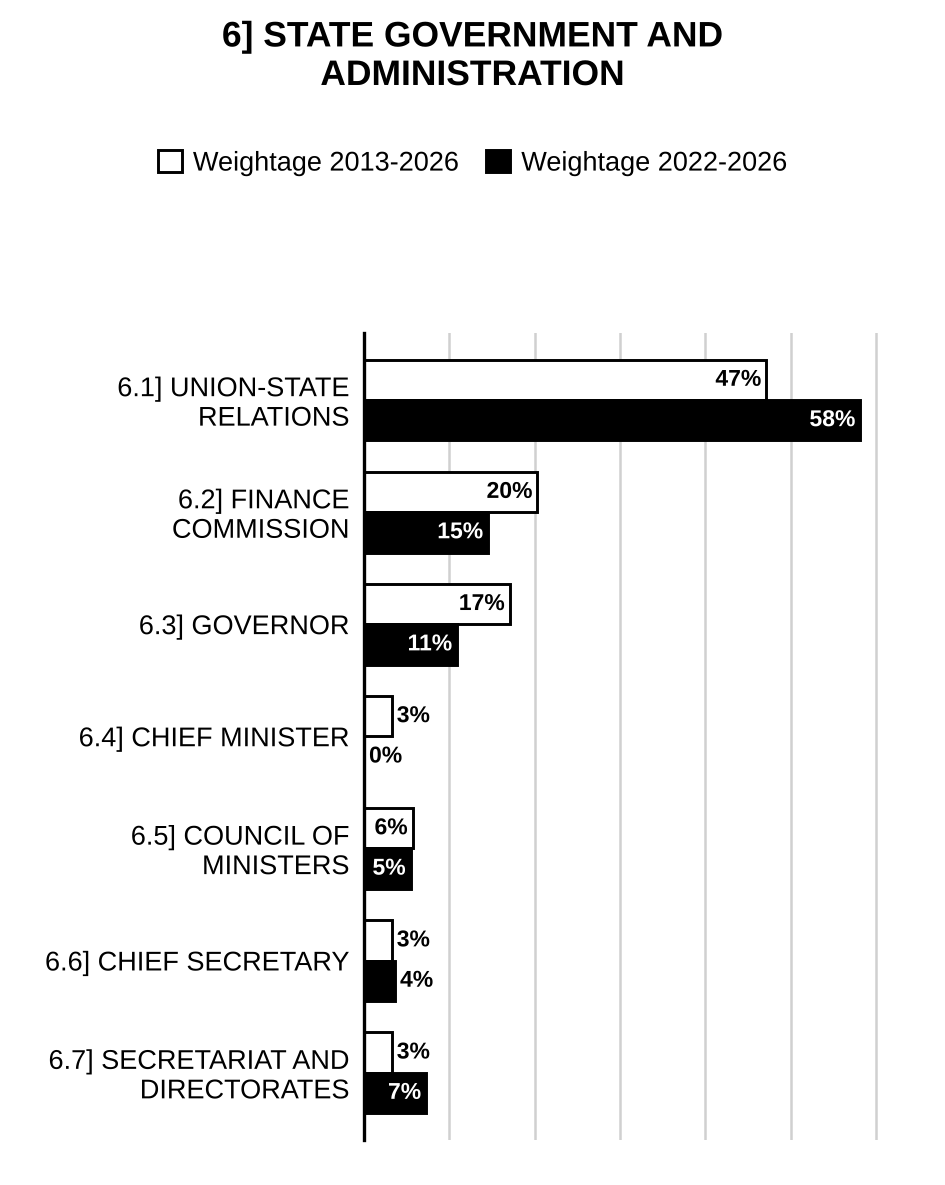
6.1] Union-State administrative, legislative and financial relations
33 questions
Competitive federalism in India while intended to have healthy competition among states has shown tendencies towards parochialism. Comment. [2026/10m/3c]
Doctrine of Pith and Substance, and the Doctrine of severability in the legislative relations between the Indian Union and states are supplementary in nature but distinct in application. Discuss. [2026/20m/4a]
Public debt of states in India has increased significantly in the last one decade. In this context discuss the constraints of the states in planning prudent fiscal management. [2026/20m/6b]
Despite the division of subjects, the Union Government contributes towards subjects in the State and Concurrent Lists. Discuss its pros and cons in the light of fiscal federalism. [2025/20m/2b]
Divergent political interests and financial constraints hinder the spirit of ‘cooperative federalism’. Comment. [2025/10m/2c]
Centre-State administrative relations are a matter of debate as constitutional provisions created a strong Centre. Discuss. [2025/10m/3c]
“Implementation of Goods and Services Tax (GST) has led to a Paradigm shift in the centre-state relations, both financially and politically.” Analyse. [2024/10m/150w/1e]
“Centre-state relations are undergoing a drastic change.” Elaborate. [2024/20m/3b]
“The Indian federal structure is largely symmetric albeit with some asymmetric features.” Examine the status of States and Union Territories through the principle of weighted and differentiated equality in India. [2022/20m/2a]
Analyse the specific areas of controversies with regard to Union-State financial relations, particularly in the context of one nation – one tax policy. [2022/20m/4b]
Examine the role of central government in adjudication of disputes relating to water of interstate rivers. [2022/10m/4c]
Even if all the States combine together, they cannot have their way in the decision-making in the GST Council, unless the Union agrees to it. Analyze this in the perspective of federalism in India. [2020/10m/150w/1e]
Article 356 acts “very much like the proverbial bolt from the blue … without giving an opportunity or notice to the State Government to correct its alleged shortcomings.” This phenomenon not only undermines the autonomy of the State Government, but also demeans the status of the President of India. Critically analyze. [2019/20m/2a]
“Implementation of Goods and Services Tax (GST) has led to a paradigm shift in the Centre-State relations, both financially and politically.” Analyse with examples. [2017/20m/6b]
Examine the efficacy of the measures taken to redefine and execute cooperative federalism in India. [2016/10m/150w/1c]
“Introduction of G.S.T. (Goods and Services Tax) no doubt has economic benefits, but tends to compromise the States’ inherent right to impose taxes.” In this context, comment on the changing nature of Union-State financial relations. [2016/20m/3b]
Briefly discuss the main recommendations of the Punchhi Commission (2010) on Centre-State relations for transforming Indian Federal System. [2015/20m/2b]
Comment on the recent changes in the approach and methodology of devolution of responsibilities and transfer of funds from the Union to the States. [2015/10m/4c]
“The Centre-State relations have acquired new dimensions in recent times due to several political parties being in power at the Centre and the States.” (Second Administrative Reforms Commission) Do you agree? Give reasons to support your arguments. [2014/10m/150w/1e]
“There is a tendency of centralism in Indian federalism, but it is not because of its institutional framework but because of its socialist goals and centrally devised plan development.” Explain the statement in the context of Union-State relationship. (In about 250 words) [2013/20m/250w/4a]
“Indian federalism is passing through a state of potential maturity.” Discuss this statement in the context of the views of the Commission on Centre-State Relations (Justice M. M. Punchhi). [2011/30m/3b]
The prevalence of multiple channels for transfer of resources from the Centre to the States is stated to have compounded the problems of federal fiscal arrangements. Discuss. [2010/30m/3b]
“Many of the programmes of development being implemented at the State and the Local level have been initiated or financed by the Union Government. This has transformed the nature of Indian federalism.” Critically examine this assessment. [2009/30m/8b]
What are the tension areas in Union-State relations in Planning? [2008/30m/3a]
There is a separate Central Ministry or Department on each subject allocated to State List. Does it mean supremacy of the Union Government or an emphasis on development administration? Analyse. [2007/60m/2]
“The main problem of Centre-State relations in India is bottlenecks in fiscal federalism.” Comment. [2006/60m/6]
“One of the greatest weakness inherent in a Federal polity is the possibility of conflict of loyalty and responsibility on the part of public servants as between Central and State Governments.” Elaborate and comment. [2004/60m/8]
“Looking back to our past experience, the fear that the emergency provisions can be misused have at times proved right and wrong at other times.” Discuss with examples. [2003/60m/2]
“Among several other problems, the problem of financial relationship is perhaps the most complex one.” Explain in the context of recent developments in Union-State relations in India. [2000/60m/2]
“The legislative and executive powers of the States are comprehensive, but the exercise of these powers are subject to regulation, abridgement and even suspension by the Union.” Comment. [1999/30m/3a]
Comment on: “The legislative relations between Union and State governments are more biased towards Union government.” [1997/20m/200w/1d]
“The States are constitutionally obliged to ensure that the laws passed by Parliament are implemented.” Explain the constitutional position fully. [1997/60m/4]
“The Union-State financial relations, as provided in the Constitution, are biased towards Union Government in the context of borrowing.” Comment. [1996/20m/200w/1c]
6.2] Role of the Finance Commission
13 questions
“The role of State Finance Commission in distribution of finances between state and local governments is vital.” Discuss. [2024/20m/3a]
Is it true that the Finance Commission has been lending financial strength to the local bodies in India? Argue in favour of your response. [2023/10m/150w/1d]
The recommendations of National Finance Commissions are more norms based than the need based. In the light of this statement analyse the terms of references of 15th National Finance Commission. [2022/20m/6a]
As a constitutionally mandated body the Finance Commission stands at the centre of fiscal federalism. Evaluate the role of Finance Commission in ensuring just and equitable resource sharing among the states and the union. [2021/20m/4a]
Efforts to strengthen State Finance Commissions have faced apathy of State Governments over the years, which has also affected the successive Central Finance Commissions in recommending appropriate fiscal transfers to local bodies. Substantiate the answer with examples. [2019/20m/7b]
Performance grants devolved by Finance Commission of India have increased the financial accountability of the local bodies. Elaborate. [2019/10m/8c]
Critically examine the criteria adopted by the 15th Finance Commission for allocation of resources to States. What have been the major issues of contention since the 10th Finance Commission? [2018/20m/3a]
Comment on the recent changes in the approach and methodology of devolution of responsibilities and transfer of funds from the Union to the States. [2015/10m/4c]
The 13th Finance Commission highlighted an indispensable need to improve the finance of rural and urban level bodies. Does this make local bodies more accountable in the discharge of their functions? [2014/20m/7b]
“Finance Commission in India performs the job of statistics aggregation.” Comment. [2013/10m/150w/1d]
Comment on: States with a record of good governance, it is argued by spokespersons of some states, lost their earlier share from the Finance Commission’s award. [2010/20m/200w/5c]
“The State Finance Commission under Panchayat Raj Law is designed to ensure regional balance in the distribution of State and Central Funds.” Comment. [1998/60m/8]
“After the creation of the Planning Commission, the role of the Finance Commission has started diminishing.” Review the statement. [1996/60m/4]
6.3] Governor
15 questions
Trace the reasons for growing incidences of disagreements between the Governors and state governments. [2026/10m/4c]
“There has been a strain in relations between Governor and State governments in the recent past.” Examine. [2024/10m/3c]
“There shall be Council of Ministers with the Chief Minister at the head to aid and advise the Governor in the exercise of his functions, except ….” This constitutional provision is being intensively debated nowadays. Elucidate. [2023/20m/4a]
The role of the Governor is of a sagacious counsellor, mediator and arbitrator rather than that of an active politician. In this context, examine the role of the Governor in state politics in India. [2021/10m/2c]
Various commissions have reiterated the crucial role of the Governor in Indian system of governance, but the successive governments have not heeded to make the Governor’s office apolitical. Examine with examples. [2019/10m/150w/1e]
“In the coalition era with elusive majority of a single party in the State Legislature, the role of the Governor becomes even more challenging.” Discuss. [2018/20m/3b]
“In very recent time, the role of the State Governor is found to be more of diplomatic than administrative nature.” Comment on the statement with suitable examples. [2015/20m/4b]
“The gubernatorial position of the Governor is comfortably placed in the fuzzy area between ‘Withdrawal of pleasure of the President’ and ‘Compelling reasons for removal’.” Discuss with some recent examples. [2014/20m/3b]
Is there a need to dispense with the Office of the Governor? Examine in the context of coalition governments. (In about 150 words) [2013/10m/150w/3c]
‘The authority of the Governor in the discretionary field is not unrestrained. If it is misused … the President can check him/her and if necessary, he may even remove the Governor.’ Examine this statement critically in the context of the Office of the Governor. [2012/25m/4a]
“Because of several judicial pronouncements, Governors in States are no longer viewed as agents of the ‘Party in Power’ at the Central level.” Evaluate. [2007/20m/200w/1b]
“The position of Governors towards exercising their discretion and powers has considerably changed after 1967.” Discuss. [2004/60m/2]
“Article 163 makes the Governor the sole judge in matters in which he is required to act in his discretion.” Explain. [2003/30m/3a]
Comment on: “It would be a gross fallacy to regard the institution of the Governor as a faint presence like a full moon at midday.” [1999/20m/200w/1c]
Comment on: “The Governor of a State wears two hats, and therefore, dilemmas have arisen in practice.” [1996/20m/200w/5b]

Preparing for Prelims too?
Our UPSC Prelims Topic-wise PYQ eBook covers every Prelims question with detailed explanations, so you can see exactly where UPSC asks from.
View the BookDownload Free Sample6.4] Chief Minister
4 questions
“The position of the Council of Ministers in a State is reduced to that of a body of secretaries in the presence of a domineering Chief Minister.” Critically analyse with examples. [2017/20m/3a]
“The Chief Secretary is often termed as the alter ego of the Chief Minister.” Discuss, with examples, the dynamics of their relationships in State administration. [2017/20m/4b]
‘The Chief Minister is the real executive of the State, whose effectiveness is largely related to his personality traits and equation with central leadership.’ Explain and illustrate with relevant examples. [2008/60m/4]
“The Chief Minister symbolizes ruling power structure and is the real executive head of the State Government.” Discuss the above statement in the light of his position in a Coalition Government. [2005/60m/2]
6.5] Council of Ministers
4 questions
The Ninety-First Constitutional Amendment Act successfully right-sized the Council of Ministers both at Union and State levels. Comment. [2023/10m/150w/1c]
“There shall be Council of Ministers with the Chief Minister at the head to aid and advise the Governor in the exercise of his functions, except ….” This constitutional provision is being intensively debated nowadays. Elucidate. [2023/20m/4a]
“The position of the Council of Ministers in a State is reduced to that of a body of secretaries in the presence of a domineering Chief Minister.” Critically analyse with examples. [2017/20m/3a]
“Legislatures have become a place for infighting rather than for proper policy making.” Comment in the context of the working of State Governments. [2016/10m/4c]
6.6] Chief Secretary
6 questions
“The Chief Secretary is the chief communication link between the state and central government.” Explain. [2022/10m/150w/1e]
“The Chief Secretary is often termed as the alter ego of the Chief Minister.” Discuss, with examples, the dynamics of their relationships in State administration. [2017/20m/4b]
“The success and prestige enjoyed by a Chief Secretary depend, to a large extent, upon his equations with the varied sets of people and institutions that form the work environment.” Critically evaluate the statement and its relevance to the role of the Chief Secretary in the discharge of his functions. [2012/30m/2a]
“The respective roles of the Cabinet Secretary of the Government of India and of the Chief Secretary of a State are similar in certain respects, and dissimilar in other.” Explain. [2009/30m/6a]
Comment on: “The highly significant and elevated position of Chief Secretary is significantly undermined in practice to-day.” [2004/20m/200w/1d]
“In the Chief Secretary, the State Government has an officer whose counterpart does not obtain in the Union Government.” Elucidate. [2000/30m/7b]
6.7] State Secretariat and Directorates
3 questions
Lack of clear demarcation of roles between the State Secretariat and the Directorate has serious implications for policy making and policy implementation. Do you agree? [2025/20m/4b]
“The dispute between Secretariat and Directorate is the result of Generalist vs Specialist controversy.” Analyse. [2007/60m/4]
“State Directorates are administrative and implementation units assisting the Departments functioning from the Secretariat.” Explain. [2001/30m/3a]

Strengthen your GS papers
Our UPSC Mains Topic-wise & Year-wise PYQ eBook (2013–2026) maps every GS question to the syllabus, so you know what UPSC asks and how often.
View the BookDownload Free Sample« Previous: Plans and Priorities | Next: District Administration Since Independence »
Back to: Public Administration Optional PYQs – Topic-wise | Also see: Public Administration Optional year-wise question papers
Last updated: 30 October 2026