
Here are all 52 Application of Psychology to Environment and Related Fields questions asked in UPSC Psychology Optional Paper II from 1995 to 2026, arranged under the 4 topics of the official syllabus. Within each topic the latest questions come first.
Each question ends with a code such as [2024/15m/3b] – the year, the marks, the word limit (where UPSC set one) and the question number in the paper.
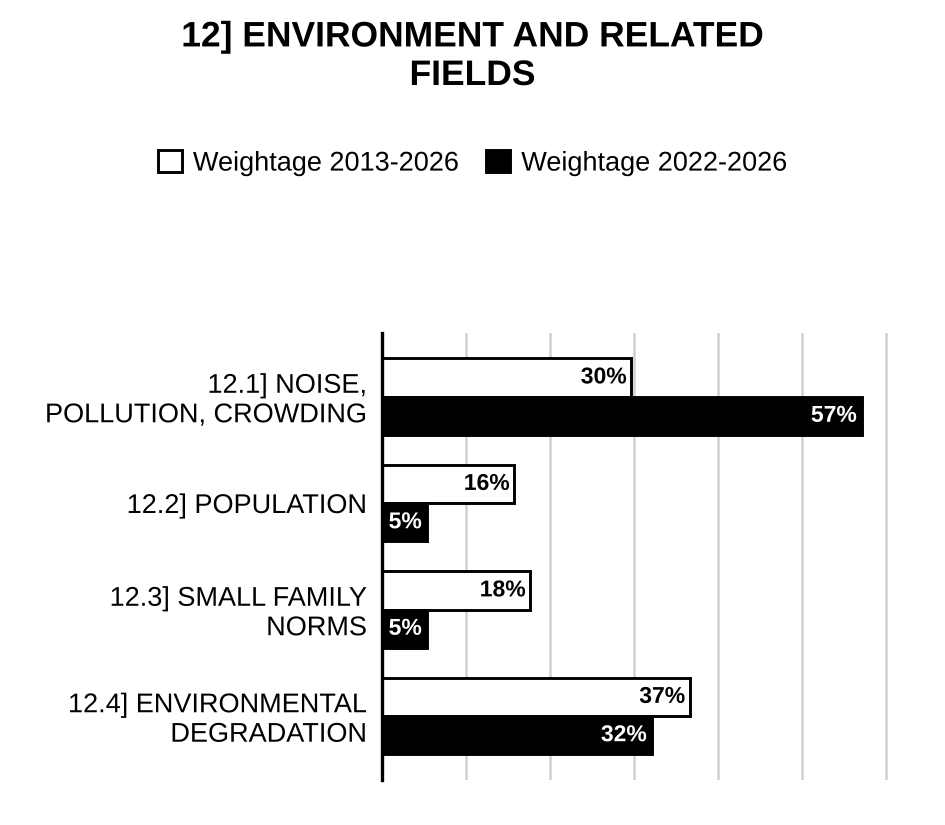
12.1] Environmental psychology: effects of noise, pollution and crowding
15 questions
Evaluate the psychological impact of chronic exposure to noise and crowding on cognition, emotional regulation and behaviour of people. [2026/20m/6c]
Discuss the behavioural strategies for managing pollution. [2025/10m/150w/5d]
Discuss the concept of ‘crowding’, its determinants and impact on psychological health and well-being. [2025/15m/8b]
Discuss the psychosocial consequences of short-term and long-term exposure to noise. [2024/20m/7c]
Discuss pollution and crowding as agents of psycho-social and physical problems. Cite few problems and recommend remedial strategies. [2022/20m/8b]
Explain the psychosocial consequences of crowding and high population density. Suggest appropriate policies to deal with the related problems in Indian context. [2018/15m/7b]
Explain the effects of short-term and chronic exposure to noise on the performance on cognitive tasks. [2017/10m/150w/5b]
Analyze the impact of crowding on mental health. Discuss the psychological measures that can be adopted to reduce the stress resulting from crowding. [2016/20m/7c]
Explain the consequences of short-term and long-term exposure to noise. How does noise affect our social behavior? Cite the impact of crowding in this context. [2012/30m/6b]
State the salient features of the Man-Environment relationship. Discuss their implications for architects in designing built-environment. [2010/30m/8b]
What are the psychological consequence of crowding? [2009/20m/200w/5a]
Discuss the psychological effects of noise pollution. Support your answer with recent research finding. [2008/20m/200w/5b]
Write a short note on: Importance of Environmental Psychology. [2005/20m/200w/5c]
Environmental psychology is limited as far as its application is concerned. Do you agree with this statement? Cite examples to support your arguments. [2003/20m/200w/5d]
Differentiate the environmental features of single and multiple dwellings. Describe how residential environment affects social behaviour of people. [2001/60m/7]
12.2] Population psychology: consequences of population explosion and high population density
9 questions
Discuss the psychological consequences of population explosion. Suggest some techniques to enhance awareness among people for population control. [2023/15m/8b]
Highlight the psychological consequences of living in high population density area. [2021/15m/7a]
How has population growth impacted human and social lives? Discuss this in the light of COVID-19 pandemic crisis. [2020/10m/150w/5c]
“Population explosion and high population density have negative psychological consequences.” Explain this statement especially stressing light on negative psychological consequences. [2019/15m/8b]
Explain the psychosocial consequences of crowding and high population density. Suggest appropriate policies to deal with the related problems in Indian context. [2018/15m/7b]
How is population growth in India affected by psychological processes of attribution, beliefs and values? Discuss possible implications of these processes for population education in India. [2015/15m/7b]
Explain the psychological consequences of population explosion and high population density. How can we motivate people towards small family norms? [2007/60m/7]
Write a short note on: Psychological consequences of population explosion and density. [2006/20m/200w/5d]
What are the consequences of population explosions? How can psychologists help in motivating the public to adopt small family norm? [2002/60m/8]

Preparing for Prelims too?
Our UPSC Prelims Topic-wise PYQ eBook covers every Prelims question with detailed explanations, so you can see exactly where UPSC asks from.
View the BookDownload Free Sample12.3] Motivating for small family norms
11 questions
Discuss the psychological consequences of population explosion. Suggest some techniques to enhance awareness among people for population control. [2023/15m/8b]
Explain the psychosocial factors demotivating people from small family norms. [2018/10m/150w/5d]
What role can media play in the promotion of small family norm in the Indian culture? [2016/10m/150w/5e]
How is population growth in India affected by psychological processes of attribution, beliefs and values? Discuss possible implications of these processes for population education in India. [2015/15m/7b]
What social and psychological factors come in the way of population control in India? [2014/10m/150w/1e]
Comment on: As a psychologist, develop a programme to bring about attitudinal change in favour of small family norm. [2014/10m/150w/5d]
What psychological approach/approaches can be used to persuade those who oppose family planning on religious grounds? [2013/15m/200w/4a]
Explain the psychosocial factors and myths that demotivate people from following small family norms. Suggest relevant motivational strategies in this context. [2012/20m/250w/8b]
What psychological explanation would you offer for India’s failure in reducing its growth rate significantly? [2009/60m/7]
Explain the psychological consequences of population explosion and high population density. How can we motivate people towards small family norms? [2007/60m/7]
What are the consequences of population explosions? How can psychologists help in motivating the public to adopt small family norm? [2002/60m/8]
12.4] Impact of rapid scientific and technological growth on degradation of environment
17 questions
Discuss the behavioural strategies for managing pollution. [2025/10m/150w/5d]
Discuss the impact of rapid technological growth on degradation of environment in Indian context. [2024/10m/150w/5d]
What is pro-environmental behaviour? Design an intervention plan for developing pro-environmental behaviour among schoolchildren. [2023/20m/7c]
Throw light on negative impact of technological growth in our real life. [2022/10m/150w/5d]
Elaborate upon the strategies for inducing pro-environmental behaviour. [2021/10m/150w/5d]
Environmental degradation is a major issue. Explain what has led to this and how it has impacted the life of people and society in India. [2020/15m/3b]
“Rapid scientific and technological growth are responsible for degradation of environment, although, scientific and technological developments are necessary for National development.” Discuss the above assertion and point out the mechanisms for controlling the environmental degradation. [2019/20m/8c]
With some examples show how can indigenous knowledge systems be used in management of biodiversity and cultural diversity? [2018/10m/150w/5e]
Explain the effects of rapid scientific and technological growth on environmental degradation. Discuss the role of psychologists in reducing environmental degradation. [2017/15m/8a]
How are indigenous knowledge systems related to environmental degradation? Mention some psychological processes underlying environmental attitudes and values. [2015/10m/150w/1b]
India rates very high on carbon emission. What use can be made of psychological knowledge to reduce the level of carbon emission in India? [2013/10m/150w/1e]
How can psychological principles be used to conserve water? Develop a plan. [2013/10m/150w/5d]
Define the notion of environmental pollution. How would you explain the impact of scientific and technological innovation on environmental degradation from a psychological perspective? [2012/20m/250w/3c]
What psychological principles can be used to protect our environment? [2009/20m/200w/5d]
Write a short note on: Impact of rapid scientific and technological growth on degradation of environment. [2006/20m/200w/5b]
Write a short note on: Impact of rapid scientific and technological growth on degradation of environment. [2004/20m/200w/5d]
What are the important indicators of environmental degradation? What measures would you suggest to prevent and arrest this degradation? [2002/20m/200w/5d]

Strengthen your GS papers
Our UPSC Mains Topic-wise & Year-wise PYQ eBook (2013–2026) maps every GS question to the syllabus, so you know what UPSC asks and how often.
View the BookDownload Free Sample« Previous: Psychology and Economic Development | Next: Application of Psychology in Other Fields »
Back to: Psychology Optional PYQs – Topic-wise | Also see: Psychology Optional year-wise question papers
Last updated: 30 October 2026