
Here are all 45 Research Methods questions asked in UPSC Psychology Optional Paper I from 1995 to 2026, arranged under the 6 topics of the official syllabus. Within each topic the latest questions come first.
Each question ends with a code such as [2024/15m/3b] – the year, the marks, the word limit (where UPSC set one) and the question number in the paper.
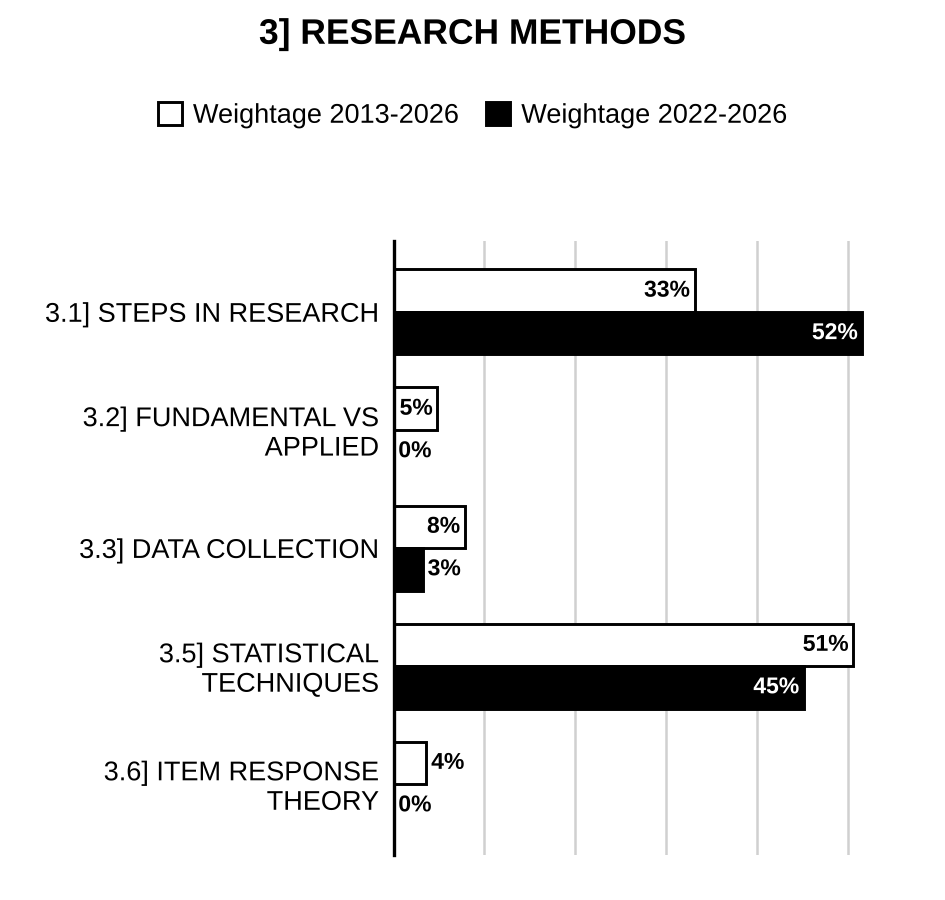
3.1] Major steps in psychological research
14 questions
In what ways can sampling bias affect the accuracy of research outcomes? Discuss the role of data analysis and interpretation in generating meaningful research findings. [2026/15m/2c]
In what ways is probability sampling appropriate in the conduct of psychological research? Illustrate your answer with different techniques of probability sampling. [2025/15m/2c]
Why is research method considered to be the back-bone of any research? Discuss various steps to be undertaken in Psychological research for sound and reliable results. [2023/15m/2c]
Differentiate among a theory, a hypothesis and an operational definition. [2023/15m/4c]
Should the researcher always formulate a hypothesis before collecting data? Justify your answer with appropriate example. [2023/10m/150w/5a]
Illustrate the role of hypothesis in psychological research. [2022/10m/150w/1e]
“Some psychological measures can be reliable but not valid.” Elaborate it with examples. [2021/10m/150w/5a]
Explain the role of hypothesis in psychological researches with suitable examples. [2019/10m/150w/1c]
How can different methods of sampling and data collection be useful in impact evaluation of government social schemes? Describe with a suitable example. [2018/15m/4c]
With suitable examples, discuss the logic behind following the systematic steps in conducting psychological research. [2015/15m/4b]
What are the requirements to be met by psychological assessment tools for offering accurate and useful measure of psychological constructs? [2013/15m/250w/8a]
Bring out the difference between ‘sampling error’ and ‘error in sampling’. How ‘sampling error’ is reduced? [2012/12m/150w/1c]
Differentiate between applied and fundamental research. Discuss major steps in psychological researches. [2005/60m/4]
How is psychological measurement different from measurement in physical sciences? Giving appropriate illustrations, distinguish clearly between psycho-physical and psychometric measures. [1996/60m/2]
3.2] Fundamental versus applied research
2 questions
How do basic and applied research differ? Explain how knowledge from basic research helps solve practical problems. [2021/20m/2a]
Differentiate between applied and fundamental research. Discuss major steps in psychological researches. [2005/60m/4]
3.3] Methods of data collection: interview, observation, questionnaire and case study
6 questions
Describe data collection methods in psychology with special reference to observation and survey methods. [2024/10m/150w/1c]
How can different methods of sampling and data collection be useful in impact evaluation of government social schemes? Describe with a suitable example. [2018/15m/4c]
Evaluate “interview” as a method of data collection. [2017/20m/4a]
Discuss the criteria of question-writing in a survey research. [2012/12m/150w/1b]
Explain the usefulness of ‘interview’ as a method of data collection. State the precautions that you would take for its effective use. [2004/20m/200w/1d]
Evaluate questionnaire as a tool for collecting data for psychological research. Offer suggestions for increasing its utility as a research tool. [2002/20m/200w/1d]

Preparing for Prelims too?
Our UPSC Prelims Topic-wise PYQ eBook covers every Prelims question with detailed explanations, so you can see exactly where UPSC asks from.
View the BookDownload Free Sample3.4] Research designs: ex-post facto and experimental
1 question
What are the drawbacks of Ex-Post-Facto design of research? [1997/20m/200w/1a]
3.5] Statistical techniques: t-test, two-way ANOVA, correlation and regression, factor analysis
19 questions
Under what research conditions would you choose multiple regression over simple linear regression? Explain the assumptions of multiple regression with the help of examples. [2026/15m/3c]
How would you justify the use of factor analysis in psychological research? Answer with appropriate concepts and examples. [2025/20m/6a]
Explain the assumptions of two-way ANOVA. With the help of an example, illustrate main and interaction effects. [2024/15m/2c]
State the assumptions and merits of two-way ANOVA. Explain the applications of the same in psychological research with an appropriate example. [2022/20m/2a]
Differentiate between exploratory and confirmatory factor analysis. What is their significance in test construction? Elaborate your answer with suitable examples. [2020/20m/3a]
Explain the various assumptions and ways of performing regression analysis. Also compare standardized and unstandardized beta coefficients with suitable examples. [2020/15m/6b]
Two-way ANOVA is not merely an addition of two one-way ANOVAs. Describe and evaluate with examples. [2019/15m/7c]
What are the assumptions underlying ANOVA? Discuss the conditions when two-way ANOVA is applied and how the results are interpreted with a hypothetical example. [2018/20m/4a]
In a study, the number of students intake in a college correlated very highly with violence. Explain the research finding. [2017/10m/150w/1c]
Under what kind of research conditions does the use of factor analysis become necessary? Discuss. [2015/20m/3a]
Describe the uses of factor analysis in psychological research and indicate different types of rotations used in it. [2014/10m/150w/1d]
What are the multivariate techniques used in psychological research? Indicate their uses. [2014/15m/2c]
What do you understand by ‘effect size’ and ‘statistical power’? Explain their significance. [2013/15m/250w/2a]
Discuss the three basic conditions for using ‘t’-test of significance. Describe at least five different uses of ‘t’-test with examples. [2012/20m/250w/2a]
Compare LISREL programme with that of SPSS in the analysis of multivariate data. [2012/12m/150w/5d]
With suitable examples distinguish between exploratory type and confirmatory type factor analysis. How do you examine the significance level of factor loadings? [2009/20m/200w/1c]
Define the scales used in psychological measurement and distinguish between parametric and nonparametric statistics. Illustrate the relative significance of these statistics by citing relevant research problems. [2007/60m/2]
Amongst the two statistical techniques ANOVA and regression, which statistical method is superior? Discuss the advantages of regression statistical technique. [2005/20m/200w/1b]
Describe the basic assumptions of regression analysis and explain what happens when these assumptions are violated. [2001/20m/200w/1a]
3.6] Item response theory
3 questions
Define the precursors of the development of item response theory. In what ways will it help in the advancement of the area of aptitude testing? [2020/15m/2c]
In which way IRT is an improvement over classical test theory? Compare the two approaches and critically evaluate Rasch’s model of IRT. [2012/30m/400w/3a]
Can Item Response theory be called a latent trait theory? Describe the mathematical functions that are used in this theory and explain the various models related to the theory. [2008/60m/3]

Strengthen your GS papers
Our UPSC Mains Topic-wise & Year-wise PYQ eBook (2013–2026) maps every GS question to the syllabus, so you know what UPSC asks and how often.
View the BookDownload Free Sample« Previous: Methods of Psychology | Next: Development of Human Behaviour »
Back to: Psychology Optional PYQs – Topic-wise | Also see: Psychology Optional year-wise question papers
Last updated: 30 October 2026