
Here are all 308 Indian Economy after Independence: B. The Post Liberalization Era questions asked in UPSC Economics Optional Paper II from 2004 to 2026, arranged under the 8 topics of the official syllabus. Within each topic the latest questions come first.
Each question ends with a code such as [2024/15m/3b] – the year, the marks, the word limit (where UPSC set one) and the question number in the paper.
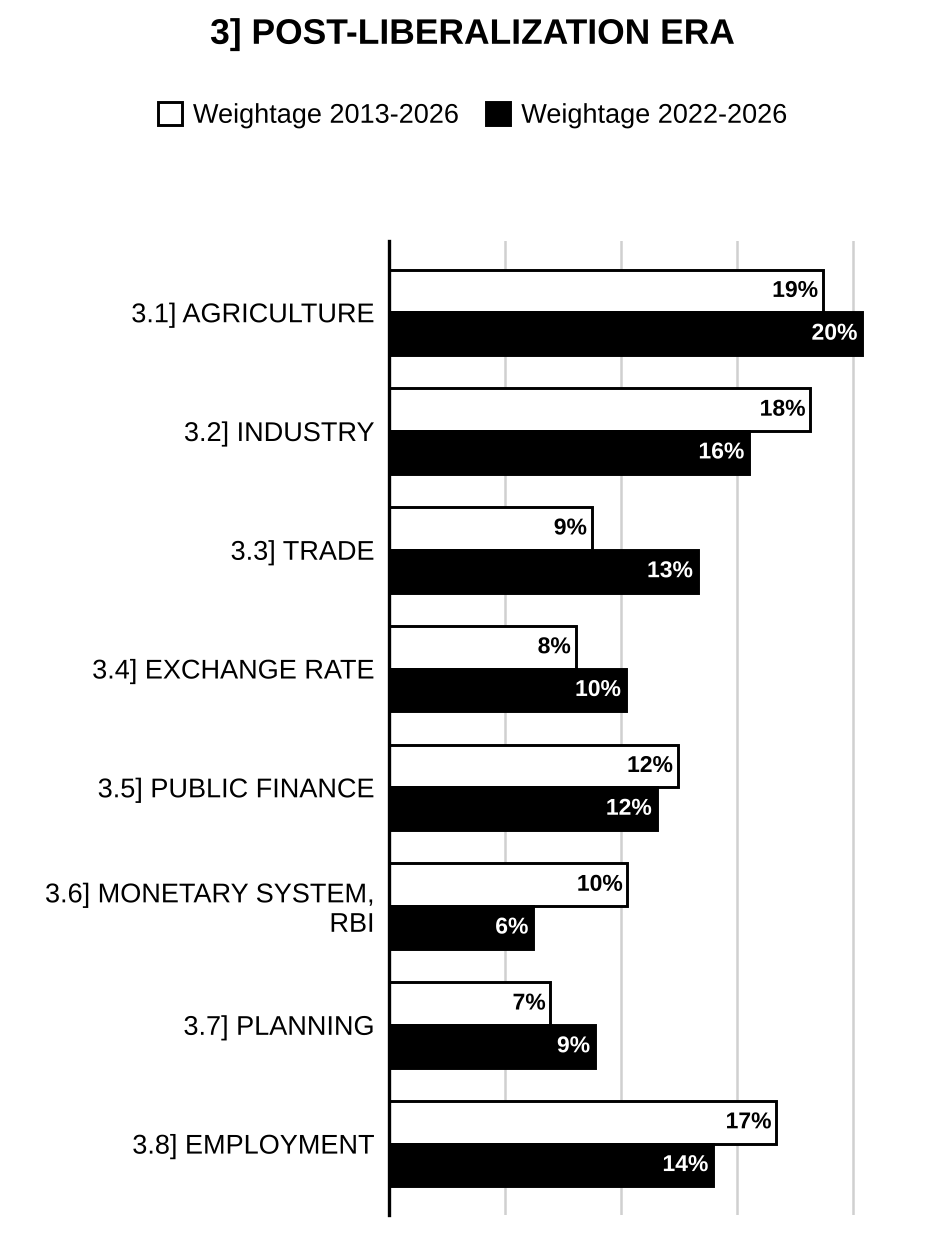
3.1] New economic reform and agriculture
56 questions
Examine the implications of the WTO agreements on Indian agriculture with special reference to food security, subsidies and market access. [2026/15m/6b]
Discuss the components of food processing schemes introduced by the Government of India. [2025/10m/150w/5a]
What are the structural shortcomings of the ‘Public Distribution System (PDS)’ in India? Explain. [2025/10m/150w/5c]
Examine the implications for India due to agreements on agriculture that are signed under the World Trade Organisation (WTO) in 1995. [2025/15m/6b]
What are the implications of “PM-Kisan Samman Nidhi” scheme? [2024/10m/150w/1e]
For faster increase in farmers’ income, is it necessary to link them with corporate-sector in India? Discuss. [2024/15m/4b]
Why second green revolution was advocated for India? Mention the recommendation of the National Commission for Farmers in this regard. [2024/15m/6c]
Whether the role of women in agriculture has changed after liberalisation in India? Comment. [2024/15m/7b]
Why in spite of massive expansion of institutional finance, contribution of non-institutional sources in providing agricultural credit is still predominant? [2024/15m/8b]
What are the various forms of subsidies that go into agriculture sector in India? What is the justification for these? [2024/15m/8c]
Explain the main reasons for deceleration in agricultural growth in India during the post-economic reform period. [2023/15m/2c]
Distinguish between explicit and implicit subsidies. Explain the trends in explicit subsidies on irrigation and fertilizer in India during post-economic reform period. [2023/10m/150w/5a]
Discuss the characteristic features of Agreement on Agriculture (AOA) under Uruguay Round of GATT and examine its impact on Indian agriculture. [2023/20m/6a]
State the key features of the Targeted Public Distribution System (TPDS) in India. Do you believe that TPDS has been successful in achieving its objectives? Justify your answer. [2023/15m/6b]
Discuss the features of targeted Public Distribution System in India and point out the obstacles in its implementation. [2022/10m/150w/1b]
Discuss the rationale for continuance of power and irrigation subsidy in the agriculture sector in India. [2022/15m/4c]
Discuss the prospects and challenges faced by Indian Agriculture due to World Trade Organisation (WTO) provisions. [2022/10m/150w/5b]
Analyse the effectiveness of the major commitments of Agreement on Agriculture (AoA) of the Uruguay Round of WTO on Indian agriculture. [2021/10m/150w/5b]
Analyse the new initiatives taken by the Government of India to boost food processing sector. [2021/10m/150w/5c]
What are the major components of public expenditure on agriculture in India? Would you recommend any changes in the pattern of public expenditure on agriculture to stimulate agricultural growth? [2021/20m/6a]
Examine the procurement policy of the Government of India in the post-liberalisation period and its impact on agricultural prices. [2021/15m/6c]
Analyse the impact of fertilizer subsidy on agricultural productivity growth during the post reform period. [2020/10m/1e]
Do you think the food processing sector as the sunrise sector in India during the post-reform period? Justify your answer. [2020/10m/5b]
Explain the trend in gross capital formation in agriculture in India during the post liberalisation period. Do you think that private investment has been crowded out by the public investment during this period? [2020/20m/6a]
Examine the efficacy and resilience of the Public Distribution System in India for providing food security. [2020/15m/6b]
How has the movement of agricultural prices during the post-liberalisation period been responsible for farmers’ distress in India? [2019/10m/150w/1d]
Do you think that the fall in public investment in agriculture adversely affects the productivity growth of this sector in India? Give reasons. [2019/15m/3c]
What reforms would you advocate to make the public distribution system (PDS) in India more effective? [2019/10m/150w/5a]
Critically examine the role of WTO on agricultural exports in India. [2019/15m/6c]
Analyse the salient features of ‘interest subvention scheme’ and its implications on the farm sector. [2018/15m/3c]
Horticulture is now the growth driver of Indian Agriculture. Discuss the issue in the broad context of rural diversification. [2018/10m/150w/5b]
Explain why the use of organic farming should be encouraged in India. [2018/10m/150w/5d]
What are the merits and demerits of the case of farmers’ loan waiver in India? Explain. [2017/15m/6b]
Even though India is self-sufficient in the production of foodgrains, Indian agriculture is faced with some major challenges. Elucidate. [2017/15m/6c]
Examine the basic features of the National Food Security Act 2013. [2016/10m/150w/5c]
“Agriculture Subsidy is both an Economic as well as Social issue, hence the Government finds it difficult to take a decisive decision”. Comment on the above statement. [2016/15m/8b]
What are the different types of agricultural subsidies that are given to the farmers in India? How can these be rationalised? [2015/15m/3b]
High Minimum Support Prices (MSP) induce distortions, some of which ultimately hurt the poor. Examine its merits and demerits. [2015/15m/4b]
Highlight the basic features of National Food Security Act (NFSA), 2013. Can it solve the problem of malnutrition in the country? Discuss. [2015/10m/150w/5a]
What is your opinion on the view that the economic reform process has largely bypassed agriculture? [2015/15m/6a]
Agro-based industries, especially food-processing units, can alter the fate of rural India. Discuss. [2015/15m/7c]
Why Green Revolution lost its steam and India needs yet another Green Revolution or Evergreen Revolution? Discuss. [2014/20m/3a]
What are the factors responsible for large number of farmers’ suicides in relatively richer Indian States? Examine. [2014/15m/4b]
Subsidy is a contentious issue and roadblock in the WTO. Examine India’s stand for protecting its farmers’ interests. [2014/20m/8a]
Do you agree that focussed and target-oriented technological interventions under National Food Security Mission (NFSM) have made significant impact since its inception? Justify. [2013/10m/150w/5a]
During the British rule, commercialisation of agriculture was forced on the farmers, while now it is the need of the hour. Discuss. [2012/12m/150w/1b]
Distinguish between cooperative, contractual and corporate farming. Which of these is best suited for India and why? [2012/20m/250w/2b]
Discuss the factors responsible for slow growth in agriculture in recent years. What steps ought to be taken for sustained growth in this sector? [2012/12m/150w/5c]
“India urgently needs yet another Green Revolution by infusing modern technologies like ICT and Space technologies and Strategic Management techniques to come up with demand side pressures resulting in persistent food inflation in the economy.” Do you agree? [2011/30m/3a]
Analyse the recent trend of gross capital formation in agriculture. Has it, do you think, been responsible for the sluggish growth rate in agriculture? [2011/30m/4b]
“Declining Public Expenditure in agriculture is largely responsible for deceleration of growth in this sector in India.” Critically examine the validity of this statement. [2010/20m/6a]
Assess the degree of success of the targeted Public Distribution System in the country in meeting its objectives. [2010/30m/7b]
What do you think has been the impact of the targeted public distribution system in India on food security for the rural poor? Justify your answer. [2009/20m/200w/5c]
Discuss the impact of World Trade Organization (WTO) on Indian Agriculture. [2007/60m/2]
Critically evaluate the reasons for fluctuation in agricultural price in India. What would be the components of an optimum agricultural price policy regime for India? [2007/60m/8]
What would be the constituents of an optimal agricultural exports strategy for India? [2005/60m/4]
3.2] New economic policy and industry
51 questions
Trace the trajectory of India’s industrial policy from the Nehruvian model of ‘Mahalanobis Strategy’ to the liberalization era. How has the focus shifted regarding the role of the State and heavy industries? [2026/20m/3a]
Critically examine the impact of the New Economic Policy on the Indian corporate sector. Discuss its effects on privatization, the surge in FDI, and the domestic industry with the entry of multinational corporations. [2026/20m/6a]
The economic reforms marked a paradigm shift in India’s industrial strategy. In this context, discuss deregulation, delicensing, and their impact on industrial efficiency. [2026/15m/7c]
Justify the importance of ‘Disinvestment Policy’ of India. [2025/10m/150w/5d]
What are the causes of industrial backwardness in India? Critically evaluate the role of the New Industrial Policy, announced in July 1991, towards correcting such backwardness. [2025/20m/6a]
Highlight the role of MSMEs in Indian Economy. What steps have been taken by the Government to enhance its contribution? [2024/20m/3a]
Comment on FDI in Multi-brand Retail sector in India. [2024/10m/150w/5d]
Evaluate the policy of Government of India with regard to foreign investment in the country. Do you feel that there is a need for control of their activities? [2024/20m/6a]
Examine the salient features of the Action Plan for Disinvestment, 2009. [2023/10m/150w/5b]
Do you subscribe to the view that private sector is a key driver to economic development of India? Give reasons in support of your answer. [2022/20m/4a]
Do you think that flow of Foreign Direct Investment (FDI) would always be good for the growth of Indian economy? Critically analyse. [2022/10m/150w/5d]
What are the various methods of privatisation? Point out the methods adopted by the government for disinvestment in India. Comment on the proceeds from disinvestment in India. [2022/20m/8a]
Examine how the domestic companies are competing with the MNCs in the post-liberalisation era. [2021/15m/3b]
Analyse the sectoral inflows of FDI in India during the post-liberalisation period. [2021/20m/7a]
Critically discuss the strategies formulated by the Government of India to increase private sector participation in public enterprises. [2021/15m/7b]
What are the major problems faced by the Small Scale Industries (SSIs)? Examine the role of the MSMED Act, 2006, in enhancing productivity of Small Scale Industries in India. [2020/20m/3a]
Critically examine the new manufacturing policy, 2011 for fostering industrial growth in India. [2020/15m/3b]
Evaluate the role of FDI in contributing economic growth of India. [2020/10m/5a]
Critically examine the strategy of disinvestment in improving the growth of the manufacturing sector. [2020/15m/8b]
Evaluate the Competition Act, 2002, relative to the Monopolies and Restrictive Trade Practices Act. [2019/10m/150w/1e]
Explain the principal causes of deceleration in industrial growth during the mid 1960’s to mid 1970’s in India. Do you think that the reasons for the slowdown in industrial growth since the late 1990s are basically different from those of the earlier deceleration? Answer with proper arguments. [2019/20m/4a]
Has India been able to exploit the potential of foreign direct investment (FDI) for export oriented production? Give reasons for your answer. [2019/10m/150w/5b]
Discuss the disinvestment policy adopted by the Government of India as a part of structural adjustment programme of the IMF and the World Bank. Examine the impact of such a policy on industrial growth in India. [2019/20m/6a]
How does the strategy of industrialisation under the New Economic Policy promote productivity growth in manufacturing industries in India? Explain. [2019/15m/8b]
Elaborate on the phenomenon of ‘missing middle’ in Indian manufacturing sector. [2018/10m/150w/1e]
Comment on the new initiatives taken by the government to facilitate investment and ease of doing business. [2018/20m/4a]
How can the organised manufacturing sector be revived as an engine of inclusive growth? [2018/10m/150w/5e]
Why should FDI be preferred over FPI? Comment on government’s initiatives in this respect. [2018/15m/8c]
What is the broad trend of the manufacturing sector’s relative share in GDP in India over the last four decades? How do you view its performance and what actions does the government contemplate in this matter? [2017/20m/3c]
Critically examine the Disinvestment Policy of the Government of India. [2017/15m/4c]
What role are MSMEs playing in India’s economic growth? [2017/10m/150w/5c]
What developmental role can FDI play in a backward economy? What policy has India been following to attract FDI and what safeguards should the country adopt? [2017/20m/7a]
Write short notes on “Skill India” and “Make in India”. [2016/10m/150w/5e]
Critically examine the major changes in FDI policies of the Government of India since 1991. [2016/15m/7c]
Discuss the recent initiatives for augmenting power generation in India. [2015/10m/150w/5b]
There is a need for an ‘apex agency’ to monitor and to regulate the entry and functioning of transnational corporations in the context of India’s broader national interest. Give arguments in support of your answer. [2015/15m/7b]
Explain the recent policy initiatives for enhancing crude oil and natural gas production in India. [2015/15m/8a]
What are the main components of the National Manufacturing Policy, 2014? Discuss. [2015/15m/8b]
Second generation economic reforms are crucial for raising the growth rate of economy. Throw light on these dimensions. [2014/10m/150w/5e]
Write for and against FDI in retail trade of India. [2014/15m/8c]
What is the present policy of disinvestment of the Government of India? What modifications can be introduced in order to make it fruit-bearing? [2013/25m/6a]
Can disinvestment in public sector units be a sustainable alternative for raising resources for government expenditure? [2012/12m/150w/5d]
Why is capital inflow through multinational corporations preferred over foreign debt? [2012/30m/300w/6b]
Write on second-generation economic reforms in India. [2011/15m/150w/5b]
Compare the role of Foreign Direct Investment (FDI) and Foreign Institutional Investment (FII’s) in India’s economic development. Are FDI’s preferable to Portfolio Investments? Evaluate. [2011/30m/6b]
Critically examine the arguments usually put forward in favour of disinvestment of public sector enterprises. [2009/20m/200w/1c]
Examine the role of Foreign Direct Investment in the Indian economy empirically. [2009/20m/200w/5d]
Comment on the recent moves towards liberalization and their effects on Indian industry. [2007/20m/200w/5b]
Is privatization a boon or a bane in India. [2007/20m/200w/5d]
What has been the impact of import liberalisation on Indian Manufacturing Industries since July 1991? [2005/20m/200w/5c]
Examine the need for foreign capital in the Indian economy and discuss critically the Government policy on foreign direct investment. [2004/20m/200w/5d]
3.3] New economic policy and trade
32 questions
Analyze the impact of the TRIPS Agreement on the pricing and availability of generic drugs in the Indian pharmaceutical sector. [2026/10m/150w/5a]
Explain the Intellectual Property Rights (IPR) regime under the WTO. Discuss the specific implications of TRIPS and GATS on India’s trade policy and domestic regulations. [2026/20m/8a]
Do you agree with the view that India’s Foreign Trade Policy, 2023–2028 will boost country’s trade surplus and generate employment? Give reasons. [2025/10m/150w/5b]
What are the main features of ‘TRIMS’? How does it act against India’s interest? [2024/15m/4c]
What steps have been taken by the Government of India to increase exports during the last 10 years? Have these yielded the desired result? Examine. [2024/15m/6b]
Briefly explain the growth and structure of India’s foreign trade in the post-liberalization period. [2023/20m/7a]
Critically examine the contribution of Special Economic Zones (SEZs) in promoting foreign trade in India. [2023/15m/7b]
Discuss the salient features of India’s New Foreign Trade Policy, 2023. [2023/15m/7c]
What is the main purpose of General Agreement on Trade in Services (GATS)? What are the services covered under it? State the modes under which the services are supplied. [2022/15m/6c]
What are the expectations from Foreign Trade Policy 2021–26? Elucidate your answer. [2022/15m/8b]
Analyse the effects of TRIPS Agreement on Indian agriculture. [2021/15m/8b]
What is intellectual property? Why does intellectual property need to be promoted and protected? [2020/15m/6c]
Describe the salient features of New Foreign Trade Policy (2015-20) in India. Examine its role in improving the current account balance. [2020/15m/8c]
Narrate the implications of the TRIPS Agreement with special reference to the pharmaceutical sector in India. [2019/15m/6b]
Describe the salient features of TRIMS. How has it impacted the textile and clothing sector in India? [2018/15m/8b]
Write a note on the broad trend of India’s foreign trade and current account balance during roughly the last one decade. [2017/15m/4b]
Examine the implications of Trade Related Intellectual Property Rights (TRIPS) on Indian Economy. [2016/15m/3c]
Bring out the salient features of New EXIM policy of Government of India. [2016/10m/150w/5d]
Write on the Look East Policy of India. [2014/15m/8b]
What are the key initiatives proposed in Foreign Trade Policy, 2009–2014 for market diversification and technological upgradation to give a boost to exports? [2013/10m/150w/5c]
Discuss the salient features of TRIPS and Indian position on (i) geographical indications and (ii) plant breeders’ rights. [2012/30m/300w/6a]
Examine the new EXIM policy. Given the tough competition in international trade, what corrective measures would you suggest to make it more successful in boosting Indian exports? [2012/30m/300w/8a]
Write on the unfinished agenda of Doha Round of negotiations of the WTO. [2011/15m/150w/5c]
Write on Indo-ASEAN trade relations. [2011/15m/150w/5d]
Examine the challenges to export diversification and increase in export competitiveness of India. [2011/20m/7c]
In view of fresh fears of global financial crisis arising out of decelerating credit rating of the U.S. economy and sovereign debt crisis in peripheral Euro-Zone economies analyse its likely impact on India’s trade and growth performance. Suggest measures to contain it. [2011/40m/8a]
Write in brief on Special Economic Zones (SEZ) and their socio-economic repercussions. [2011/20m/8b]
What are the four modes of GATS? What mode has been preferred by India and why? [2010/15m/150w/5d]
Bring out the broad changes in the level, composition and direction of Indian exports and imports since liberalisation in India. [2010/40m/8a]
“The TRIPS agreement runs counter to the neoliberal argument in favour of competition.” Is this a fair assessment? Discuss. [2009/20m/200w/1d]
Write a detailed note on the import-Substitution and export promotion strategy of India. [2007/60m/6]
Has WTO helped the developing countries as was professed at the time of its establishment? Give reasons for your answer with reference to the Indian economy. [2004/20m/200w/5a]
3.4] New exchange rate regime
25 questions
Distinguish between current account and capital account convertibility. Why has India been cautious regarding full capital account convertibility? [2026/10m/150w/5b]
Analyze India’s exchange rate regime post-1991. Discuss the move towards market-determined exchange rates, and the management of volatile capital flows. [2026/15m/8b]
What are the advantages and disadvantages of full convertibility of Indian rupee? Do you believe that capital account convertibility is feasible under the present circumstances in India? Discuss. [2025/15m/7b]
What is the strategy of the Reserve Bank of India (RBI) for exchange rate management? Discuss the recent changes in India’s Exchange Rate Policy. [2025/15m/7c]
What are the implications of depreciating Rupee on Indian Economy? [2024/10m/150w/5c]
State the salient features of the Foreign Exchange Management Act (FEMA), 1999 in India. To what extent it deviates from the Foreign Exchange Regulation Act (FERA), 1979? [2023/15m/6c]
What is the objective of exchange rate management? Do you think that the present regime of exchange rate management has been satisfactory in terms of building adequate foreign exchange reserves in India? Discuss. [2022/20m/6a]
Differentiate between Current Account convertibility and Capital Account convertibility. What were the pre-conditions recommended by Tarapore Committee-I for adopting Capital Account convertibility. [2022/15m/7b]
Define capital account convertibility. Examine Tarapore Committee (I and II) recommendations on capital account convertibility of rupee. [2021/20m/8a]
Do you think that Indian currency is fully convertible? Explain. [2020/10m/5d]
Examine the role of capital account convertibility in controlling deficit in the current account of India’s Balance of Payments (BOPs). [2019/15m/4b]
Do you believe that capital account convertibility is feasible under the present circumstances in India? Explain. [2018/20m/8a]
Why should FDI be preferred over FPI? Comment on government’s initiatives in this respect. [2018/15m/8c]
Write a note on the broad trend of India’s foreign trade and current account balance during roughly the last one decade. [2017/15m/4b]
Do you think the recent appreciation of Indian currency is harming India’s exports? Can it have a beneficial side too? Explain in brief. [2017/10m/150w/5e]
“Partial Capital Account Convertibility cannot serve the purpose of integrating Indian Economy with World Economy”. Critically examine. [2016/10m/150w/5a]
Do you think that full convertibility of rupee on capital account will help in accelerating India’s economic growth? Give reasons. [2015/10m/150w/1d]
It is often said that the prime generator of economic growth in India in the post-liberalisation period has been the service sector. Do you agree with this view? What has been its implication on the balance of payments in India? [2015/20m/4a]
Discuss the issues involved in Capital Account Convertibility. In the light of this, explain India’s important Capital Account Liberalization measures. [2014/15m/6b]
“Partial capital account convertibility cannot serve the purpose of integrating Indian economy with global economy.” Analyse critically. [2013/10m/150w/5b]
Would a flexible exchange rate regime serve India better than a fixed exchange rate regime in the current international scenario? [2012/12m/150w/5e]
Is India ready for full capital account convertibility? Assess. [2011/30m/6a]
Compare the role of Foreign Direct Investment (FDI) and Foreign Institutional Investment (FII’s) in India’s economic development. Are FDI’s preferable to Portfolio Investments? Evaluate. [2011/30m/6b]
In view of fresh fears of global financial crisis arising out of decelerating credit rating of the U.S. economy and sovereign debt crisis in peripheral Euro-Zone economies analyse its likely impact on India’s trade and growth performance. Suggest measures to contain it. [2011/40m/8a]
Examine critically the Economic Reforms underway since 1991 with reference to their effect on inequality, poverty reduction and vulnerability to external shocks. [2009/60m/6]

Preparing for Prelims too?
Our UPSC Prelims Topic-wise PYQ eBook covers every Prelims question with detailed explanations, so you can see exactly where UPSC asks from.
View the BookDownload Free Sample3.5] New economic policy and public finance
41 questions
Explain the core objectives of the Fiscal Responsibility and Budget Management (FRBM) Act, 2003. Has it been successful? [2026/10m/150w/5c]
Discuss the structure of fiscal federalism in India. How have successive Finance Commissions tried to address the vertical and horizontal fiscal imbalances? [2026/15m/7b]
What are the implications of the Goods and Services Tax (GST) reforms for Indian federalism? Discuss. [2025/10m/150w/5e]
How do the current Finance Commission’s recommendations align with the Government’s Fiscal Consolidation goals? Elucidate. [2025/20m/8a]
Discuss the changes made by the Government of India in the fiscal policy since liberalisation. How far these changes proved to be conducive to growth with social justice in the country? Discuss. [2024/20m/4a]
Distinguish between fiscal federalism, fiscal consolidation and cooperative federalism. Comment on the outcome of cooperative federalism in India. [2024/20m/7a]
What do you mean by horizontal fiscal disequilibrium in a federal setup and how did the XIIth Finance Commission correct such imbalance in India? [2023/10m/150w/5c]
Discuss the desirability of increased public expenditure in India in recent years. [2022/10m/150w/5e]
Point out the main features of Fiscal Responsibility and Budget Management (FRBM) Act. To what extent, it has been successful in achieving the targets? [2022/15m/8c]
Analyse the relevance of Gadgil formula in reducing horizontal imbalance of fiscal health. [2021/10m/150w/1c]
Critically analyse the recommendations of the Twelfth Finance Commission on fiscal federalism. [2021/15m/7c]
Discuss the role of the Fiscal Responsibility and Budget Management Act, 2003, in improving the fiscal health of the State finances in India. [2020/15m/7b]
Distinguish between Fiscal Federalism and Fiscal Consolidation. Discuss the fundamental changes in Indian fiscal federalism after introducing GST. [2020/20m/8a]
Differentiate between plan and non-plan expenditure as used in the government budget. Is this distinction relevant for government finances in India today? [2019/10m/150w/5e]
What is fiscal federalism? Examine the role of the various Finance Commissions since 2001 in reducing horizontal and vertical fiscal imbalances. [2019/15m/7b]
The chequered fiscal history of India of the last fifteen years has been a saga of fiscal prudence on the part of the States and fiscal profligacy by the Centre. Do you agree? Give reasons. [2018/15m/4b]
Do you agree that fiscal slippage in the recent past is structural in nature? Also suggest road map for fiscal consolidation in the next few years. [2018/20m/6a]
Would you advocate that the income of rich farmers should be taxed in India? Give reasons. [2017/10m/150w/1a]
“Subsidies are a source of inefficiency and corruption.” Do you agree with the statement in the Indian context? Justify your answer. [2017/10m/150w/1b]
Explain GST. Analyse how it is going to impact Indian business. [2017/15m/7c]
Give a short analysis of the state of devolution of resources from the Centre to the States in India in the light of the idea of fiscal federalism. [2017/15m/8b]
Examine the process of introducing and passing GST Bill in Parliament. How it helps in Fiscal Consolidation in the country? [2016/15m/4b]
Critically examine the salient features of Fiscal Responsibility Act. [2016/10m/150w/5b]
What are the broad features of the proposed GST Model? [2015/10m/150w/5c]
What are the major recommendations of the Fourteenth Finance Commission? [2015/20m/8c]
What are the salient features of FRBM Act? Examine the criticisms labelled against it. [2014/20m/6a]
How global financial crisis and sovereign debt crisis of European nations exposed the disturbing role of speculative motive and fiscal imprudence? What lesson could India derive from it? [2014/15m/6c]
What are the major objectives of the Direct Taxes Code Bill, 2010? Will it be effective in generating enhanced tax revenues? [2013/25m/6b]
Discuss the major recommendations of the Thirteenth Finance Commission with regard to augmentation of resources of local governments. [2012/20m/250w/7a]
Distinguish between fiscal federalism and political federalism. How has fiscal federalism been evolving in relation to special category States in particular and other States in general? [2012/20m/250w/7b]
How is GST different from VAT? What is the grand bargain suggested by the Thirteenth Finance Commission for implementation of GST? [2012/20m/250w/7c]
Explain the salient features of the Fiscal Responsibility Act. Explain to what extent has the Government of India been able to adhere to the provisions of this Act? [2012/30m/300w/8b]
Critically examine the fiscal federal system as it operates in India presently. What improvements would you suggest? [2010/30m/7a]
Critically assess the key recommendations of the Twelfth Finance Commission. [2009/20m/200w/5b]
Explore the nature of tax reforms India needs to ensure “inclusive growth”, spelling out their basic components as you see them. [2009/60m/7]
Examine the role of indirect taxes in India’s Economic Development. [2007/20m/200w/1c]
Examine the Progress of Tax Reform in India. [2007/20m/200w/5a]
What are the major characteristics of Value Added Tax (VAT) in India? [2005/20m/200w/5d]
Discuss the rationale of government subsidies to various categories of goods in India. Is granting subsidies to non-merit goods justified? [2004/20m/200w/1c]
Discuss the Kelkar Task Force recommendations on indirect taxes. Has the Government implemented them? [2004/20m/200w/5b]
What are the recommendations of the Eleventh Finance Commission to reduce budget deficits? Enumerate the actions taken by the Government of India on them. [2004/60m/8]
3.6] New economic policy and monetary system
34 questions
How has the role of the Reserve Bank of India (RBI) shifted from stabilization policy to inflation targeting as a monetary authority? Explain. [2026/10m/150w/5d]
Discuss the initiatives launched by the Reserve Bank of India (RBI) to promote financial inclusion. [2025/15m/8c]
What are the main objectives of monetary policy adopted by the R.B.I. during last 5 years? Discuss the steps taken by the R.B.I. to encourage investment and maintain price-stability during this period. [2024/20m/8a]
Show how Liquidity Adjustment Facility (LAF) in India emerged as an effective monetary policy instrument to control market fluctuations in the short run. [2023/10m/150w/5d]
Describe the main features of Monetary Policy, 2022. How far the objectives of this policy differ from the previous monetary policy? [2022/15m/7c]
Discuss the strategies adopted by the RBI to promote financial inclusion in India. [2021/10m/150w/5d]
Critically examine the role of the RBI in maintaining financial stability under the new regime of monetary system. [2020/20m/7a]
Why is monetary transmission not effective in India? In the context of the recent announcement by the RBI, compare the efficacy of external benchmarks in bank loans with internal benchmarks for improving monetary transmissions through the banking channel. [2019/20m/7a]
The state-controlled section of India’s banking sector continues to be a major problem for policy makers. Do you agree? Give reasons in support of your answer. [2018/15m/6b]
Demonetisation has been a radical and unprecedented step with short-run costs and long-term benefits. Give reasons in support of this statement. [2018/20m/7a]
What caused the problem of non-performing assets of Indian commercial banks and what cures are being suggested to solve the problem? [2017/10m/150w/1c]
What is your assessment of the principal impact of the recent demonetization in India in the immediate and medium terms? [2017/15m/3a]
Monetary Policy in India is often criticised as ineffective because large part of the country is not yet monetised. Do you agree with the view? Give reasons. [2016/20m/6a]
Trace the development of Non Banking Financial Companies in India since the liberalisation era and comment on their impact on the effectiveness of the interest rate policies of the RBI. [2016/15m/6b]
What are the major factors behind accumulation of non-performing assets in the Indian banking sector in recent years? Discuss. [2015/10m/150w/5d]
‘Financial inclusion is one of the most essential components of inclusive growth.’ Comment. [2015/10m/150w/5e]
Non-banking financial institutions need to be effectively regulated and monitored in India. Can you suggest some measures in this direction? [2015/15m/6b]
How global financial crisis and sovereign debt crisis of European nations exposed the disturbing role of speculative motive and fiscal imprudence? What lesson could India derive from it? [2014/15m/6c]
“An underdeveloped money and capital market has been a major cause of slow economic growth in India.” In the light of this statement, give relative importance of financial sector vis-à-vis real sector in Indian economy. [2013/25m/2a]
Inflation is not a purely monetary phenomenon in India and hence the scope of monetary policy of the RBI to contain it is limited. Discuss. [2013/25m/4b]
“Speculators may do no harm as bubbles on a steady stream of enterprise, but the position is serious when enterprise becomes the bubble on whirlpool of speculation. When capital development of a country becomes a by-product of the activities of a casino, the job is likely to be undone.” Explain in the context of global financial crisis and its impact on Indian economy. [2013/25m/8a]
Characterise the inflationary process in the last three years. What steps were taken by the RBI and the Government to control it? [2012/12m/150w/5a]
Critically examine the point of view that RBI’s recent measures at containing inflation have compromised growth. [2011/30m/3b]
What are the implications in the replacement of the Prime Lending Rate System by the Base Rate System recently? [2010/15m/150w/5c]
Explain the main aspects of the role of the Reserve Bank of India under the present liberalised financial regime as compared to the regime prior to 1991. [2009/20m/200w/1b]
Explain the nature and the cause of inflation of India. Critically appraise the measure adopted the authorities to control it. [2007/60m/3]
Critically examine the functioning of Indian Money Market. [2007/20m/200w/5c]
Discuss the need for and justification of Banking Reforms in India. [2007/60m/7]
Write a detailed note on endogenous money and India. [2005/20m/200w/5a]
Comment on the proposition that inflation in India is a monetary phenomenon. [2005/20m/200w/5b]
Justify the relevance of Banking liberalisation in India. [2005/60m/6]
Weigh the pros and cons of inflation targeting as the objective of the Reserve Bank of India (RBI). [2005/60m/7]
Enumerate the recommendations of the Committee on Banking Sector Reforms (1998) in India. What follow-up actions have been undertaken by the Government for implementing these recommendations? [2004/60m/4]
In what ways have banks in India diversified their functions and adopted new technologies since their nationalisation? [2004/20m/200w/5c]
3.7] Planning
24 questions
Elaborate on the indicative planning in India with its objectives. What role does the NITI Aayog play in this new framework? [2026/15m/6c]
Discuss how decentralized planning may lead to inclusive growth in India. In this context, explain the role of 73rd and 74th constitutional amendments. [2026/15m/8c]
What were the thrust areas of economic planning during the pre-liberalisation era? Discuss. [2025/15m/2c]
What are the guidelines of the Decentralized Planning process in India? Describe. [2025/15m/4c]
State the main provisions of the 73rd and 74th Constitutional Amendment Act, 1992. Do you agree that this Act has been successful in promoting the democratic decentralization in India? Justify your answer. [2023/20m/8a]
Describe the direct and indirect effects on women empowerment through 73rd and 74th Constitutional amendments. [2022/10m/150w/1d]
Do you think that Indian development planning is a transition from centralised planning to indicative planning and subsequently to market based development? Explain. [2022/10m/150w/5a]
Analyse the significance of planning in the context of market-based development in India. [2021/15m/6b]
Discuss the relevance of decentralised planning after the implementation of the 74th Constitutional Amendment Act, 1992. [2020/10m/5c]
Do you think that planning has a role in the context of market based development of India? Answer with arguments. [2019/15m/7c]
How the setting-up of NITI Aayog has changed the planning perspective in India? Explain. [2018/15m/7c]
Give a brief account of the evolution of the concept of economic planning in India after Independence. [2017/15m/7b]
Explain the salient features of 73rd and 74th Constitutional Amendments in India and elaborate the impact of its implementation. [2016/10m/150w/1a]
Discuss the basic features of the IInd five year plan in India. [2016/10m/150w/1d]
Why did the socialist order fail and the country had to resort to the market economy system? Give reasons. [2015/10m/150w/1e]
“Indian planning structure and system still remains largely in favour of a centralised nature of planning. The 73rd and 74th Constitutional Amendments have hardly brought about any change in reality in the nature of Indian planning process.” Critically evaluate this statement. [2013/25m/7a]
Discuss the major recommendations of the Thirteenth Finance Commission with regard to augmentation of resources of local governments. [2012/20m/250w/7a]
Discuss salient economic features of 73rd and 74th Constitutional amendments. [2011/20m/7b]
Bring out the role of State Finance Commissions in India, with particular reference to the rural economy. [2010/20m/200w/1b]
Delineate the role of the District Planning Committee. [2010/15m/150w/5b]
Is Economic planning relevant in the context of the Globlised Economy of India? Elucidate. [2007/20m/200w/1d]
Make a critical appraisal of the Common Minimum Programme. [2004/20m/200w/1b]
What is the role of the State in economic development in India in the context of globalisation and privatisation? [2004/20m/200w/1d]
Account for the transition from central planning, to indicative planning in India. Do you think that adoption of PURA (Providing Urban Amenities in Rural Areas) attempts a reconciliation between employment and GDP growth objectives? [2004/60m/7]
3.8] New economic policy and employment
45 questions
How far is the Direct Benefit Transfer (DBT) scheme in India successful in achieving its objectives? [2026/10m/150w/5e]
“Economic development without employment generation is meaningless.” Give your views. Critically analyze the phenomenon of ‘jobless growth’ in India in post-reform period, and its impact on poverty and social sector outcomes. [2026/20m/7a]
Why is a National Employment Policy necessary for India? What are the initiatives taken by the Government to facilitate employment generation? Explain. [2025/15m/6c]
What schemes are launched by the Government to deal with the problem of unemployment in India? Why the problem still persists? [2024/20m/2a]
Explain the various estimates of rural poverty in India. What measures have been adopted by the Government to reduce it? [2024/15m/7c]
Examine the effectiveness of universal basic income as an approach to poverty alleviation in India. [2023/10m/150w/5e]
Explain the reasons for sluggish growth in employment in India during the post-economic reform period. [2023/15m/8b]
Explain the changes in wage structure in India in the post-economic reform period. [2023/15m/8c]
Analyse the challenges for economic recovery in India posed by sluggish growth in rural wage rates during the pandemic period. [2022/10m/150w/5c]
Highlight the main features of National Policy for Skill Development and Entrepreneurship 2015. [2022/15m/6b]
Critically examine the various poverty alleviation programmes in India since 1970’s. [2022/20m/7a]
Evaluate the role of MGNREGA in asset creation and poverty alleviation. [2021/10m/150w/5e]
How does the New Economic Policy change the structure of employment in India? Evaluate. [2021/15m/8c]
Discuss the changes in sectoral composition of GDP with the changes in the sectoral components of employment in India since Independence. [2020/15m/4b]
Comment on poverty alleviation schemes undertaken by the Government of India for urban poor. [2020/10m/5e]
Examine the recent trend in rural wages in India. Discuss the role of MGNREGA in determining this trend. [2020/15m/7c]
Would you advocate a programme of Universal Basic Income (UBI) to reduce extreme poverty in India? Discuss in detail. [2019/15m/4c]
What are the core objectives of the Mahatma Gandhi National Rural Employment Guarantee Scheme (MGNREGS)? In what ways has a paradigm shift taken place with the implementation of MGNREGA? [2019/20m/8a]
Examine the relation between casualisation of employment and poverty in India. [2019/15m/8c]
Do you agree that MGNREGA has been plagued with rampant malpractices, leakage of funds and diversion of resources? Give reasons. [2018/10m/150w/5a]
India has a vast potential to reap a demographic dividend. Explain the point and discuss the necessary measures to realise it. [2017/15m/3b]
Explain the concept and the underlying rationale of ‘Universal Basic Income’. [2017/10m/150w/5b]
The various anti-poverty programmes have not achieved the desired socio-economic progress in India. Write down the major programmes and your broad based assessment of their weaknesses. [2017/20m/6a]
The quality of employment, in general, in India is perceived to be alarming. How would you analyse the situation? [2017/20m/8a]
Write short notes on “Skill India” and “Make in India”. [2016/10m/150w/5e]
What are the basic features of new national rural employment guarantee scheme? What are the impediments in their implementation? [2016/20m/8a]
Market economy excludes poor from the consumer as well as employment market. Discuss how one can safeguard the interests of population below poverty line. [2015/15m/4c]
Rural poverty continues to be a chronic problem in India, which cannot be taken care of by anti-poverty programmes but by creation of permanent productive assets. Discuss. [2015/20m/7a]
Elaborate growth-mediated security and support-led security strategies of poverty alleviation given by Jean Dreze and Amartya Sen. [2014/20m/2a]
Examine the Labour Policy of India and its impact on employment (labour) market in Indian economy. [2014/15m/3c]
National Rural Employment Guarantee Scheme should be reoriented to create productive permanent assets to promote employment and generate income in the rural sector. Critically evaluate. [2014/20m/4a]
Employment pattern in India in post-reform period has moved in favour of contractual, casual and self-employment. How public sector employment deceleration would impact the future of labour (employment) market in India? Elaborate. [2014/10m/150w/5c]
Skill development and thereby raising labour productivity like that in China would be the only panacea for long-term growth in Indian economy. Discuss. [2014/10m/150w/5d]
Vitalization of rural economy is key to ‘inclusive growth’ which is possible through ‘strategic management’ and technological upgradation. Explain. [2014/15m/7b]
Transformation of rural sector is key to economic development as it sustains two-thirds of Indian population. How physical connectivity, electronic connectivity and knowledge connectivity may be helpful in this transformation? Explain the linkages. [2013/25m/4a]
Account for the changes in the employment pattern in India after liberalization. What are your suggestions for employment security in the ‘informal’ sector of the economy? Discuss. [2013/25m/8b]
Explain why in spite of poverty alleviation schemes number of the poor has not fallen very much. [2012/12m/150w/5b]
Poverty alleviation strategy of the day is moving ahead of Redistribution with Growth (RWG) of Chenery and the World Bank and Dreze and Sen’s Growth-mediated security and Support-led security strategies to Empowerment, Opportunities and Security lines. Elaborate. [2011/30m/2a]
Throw light on the PURA model of rural development. [2011/15m/150w/5a]
Analyse the impact of MNREGA on rural and urban wages and rural migration. [2011/20m/7a]
Examine the key elements of the Swarnajayanti Gram Swarozgar Yojana (SGSY). What are the major problems in its implementation? [2010/20m/8b]
Make a critical assessment of National Rural Employment Guarantee scheme in India. [2007/60m/4]
Critically appraise the National Rural Employment Guarantee Scheme that has recently been proposed by the Government of India. [2005/20m/200w/1c]
Suggest appropriate strategies for self-sustained employment generation in the rural economy of India. Do you think that the proposed National Employment Guarantee Act is a model safety net for those without work? [2004/60m/2]
Make an appraisal of economic reforms in India. What has been their impact on GDP growth, employment and poverty? [2004/60m/6]

Strengthen your GS papers
Our UPSC Mains Topic-wise & Year-wise PYQ eBook (2013–2026) maps every GS question to the syllabus, so you know what UPSC asks and how often.
View the BookDownload Free Sample« Previous: Indian Economy after Independence: A. The Pre-Liberalization Era | Next: Other Questions »
Back to: Economics Optional PYQs – Topic-wise | Also see: Economics Optional year-wise question papers
Last updated: 30 October 2026