
Here are all 93 Money-Banking and Finance questions asked in UPSC Economics Optional Paper I from 2004 to 2026, arranged under the 5 topics of the official syllabus. Within each topic the latest questions come first.
Each question ends with a code such as [2024/15m/3b] – the year, the marks, the word limit (where UPSC set one) and the question number in the paper.
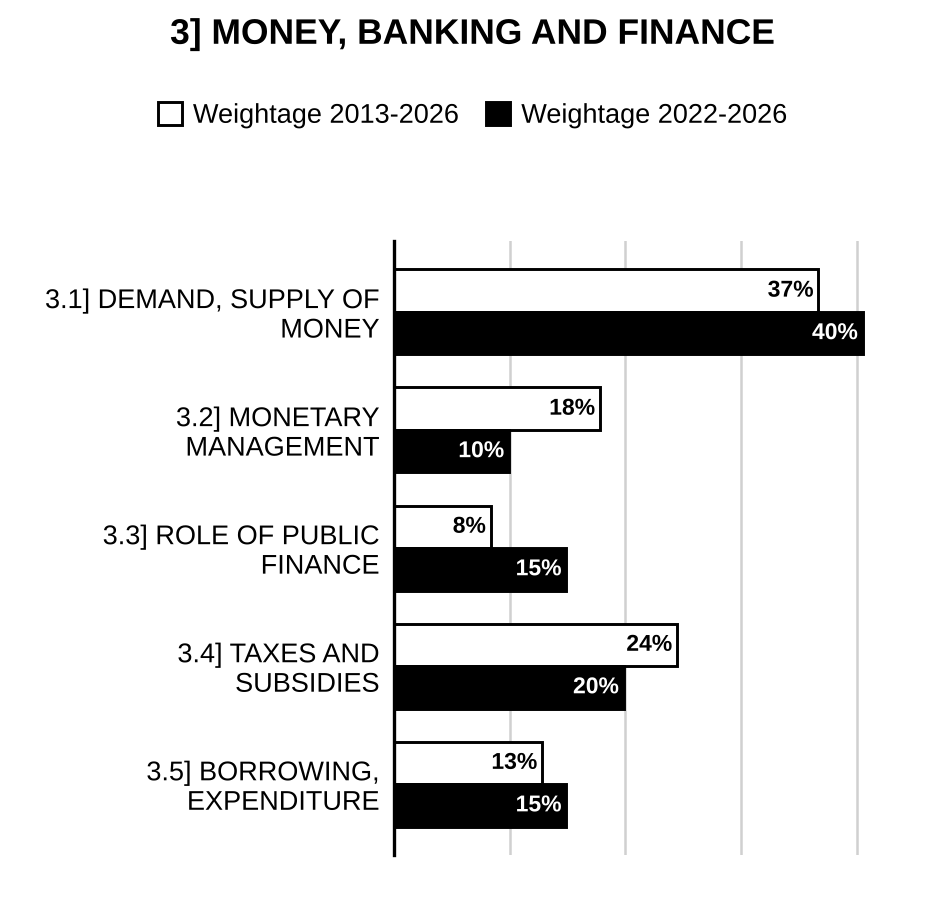
3.1] Demand for and supply of money
35 questions
Discuss the major difference of Friedman’s restatement of quantity theory of money from the Keynesian demand for money. [2026/15m/4c]
What are the determinants of velocity of money in Fisher’s equation? How does it differ from the Cambridge version of velocity of money? [2025/10m/150w/1e]
Define money multiplier and discuss its determinants. Explain in terms of money multiplier, how the banking system of an economy can control money supply. [2025/15m/4c]
Describe the mechanism of credit creation by commercial banks and its implications on multiplier effect. Analyse some of the limitations that can jeopardise the implications on multiplier effect. [2024/20m/4a]
What is the difference between Fisher’s theory and Cambridge cash balance approach to quantity theory of money? What is the criticism of each? Which one is more relevant in present context? Justify. [2024/15m/4c]
How important is speculative demand for money in achieving unemployment equilibrium in the Keynesian model? Discuss. [2023/15m/3c]
Discuss Friedman’s restatement of Quantity Theory of Money. Under what conditions, it reduces to classical Quantity Theory of Money? Explain. [2023/15m/4c]
In demand for money, what are the major differences between ‘transaction approach’ and ‘cash balance approach’? [2022/10m/150w/1c]
Compare the deposit multiplier with the money multiplier. Is there any impact on the money multiplier arising out of massive use of credit and debit cards? Justify your answer. [2022/15m/3b]
Explain how the weaknesses of Keynesian speculative demand for money have been identified in Regressive Expectations model. [2021/20m/3c]
Describe high powered theory of money supply in brief. State the assumptions made in its construction. [2021/15m/4b]
Distinguish between post-Keynesian approaches to horizontalist and structuralist theory of endogenous money supply. [2020/10m/150w/1b]
Explain how Keynesian speculative demand for money is restated in regressive expectation model. Point out its limitations. [2020/20m/6c]
Explain how money multiplier will be affected if there happens to be partial hoarding by public in each round as well as excess cash reserve holding by banks over the minimum required. [2019/10m/150w/5a]
In what sense is Friedman’s quantity theory said to be a ‘restatement’ of Fisher’s theory? Explain. [2019/10m/150w/5b]
Keynesian demand for money is one of the key concepts of Keynesian theory of unemployment. Illustrate. [2019/15m/7b]
What is high-powered money? Explain how changes in short-term monetary policy affect high-powered money and money multiplier. [2018/10m/150w/1e]
Demonetisation is expected to result in a fall in the ratio of currency to deposit. Using the money multiplier theory explain its possible impact on supply of money. [2017/15m/3b]
“Transaction demand for money is not always interest rate inelastic.” Discuss. [2017/15m/4b]
Discuss in brief Friedman’s restatement of the quantity theory of money and find its similarity/difference with the classical quantity theory. [2016/15m/2c]
Show that liquidity preference is neither necessary nor sufficient for the existence of involuntary unemployment in Keynesian system. [2015/20m/3b]
Derive money multiplier when a part of money supply is exogenous and the other part is endogenous. [2015/10m/3c]
Explain H-theory of money supply. [2014/10m/150w/1b]
Compare the deposit multiplier with money multiplier. Is there any impact on money multiplier arising out of massive use of credit and debit cards? [2014/20m/4a]
An individual finds that all his receipts (including income) and payment transactions are in the form of money that bears no interest. However, he can convert money into bonds and earn interest income but that involves a fixed cost of each conversion transaction. What are the determinants of the individual’s demand for holding money? [2013/10m/150w/1d]
Mention the different components of supply of money as specified by the Reserve Bank of India. In what sense is the narrow money ‘narrow’? [2012/20m/2a]
What do you mean by money multiplier? What are the factors that determine the value of the multiplier? [2012/20m/6a]
“Transaction demand for money is interest rate elastic.” Explain in reference to the post Keynesian theories of demand for money. [2012/20m/7b]
Is Friedman’s quantity theory of money close to Classical or Keynesian approach to the aggregate demand for money? Give justifications for your arguments. [2011/20m/200w/1c]
Would the introduction of automatic teller machines, which allows people to withdraw cash from banks as needed, make deposits more inconvenient and affect the money supply? Elucidate. [2011/20m/3c]
What are the different measures of money supply? Explain the concept of money multiplier and state the factors that determine its volume. [2010/30m/3a]
Is the speculative demand for money responsible for the existence of involuntary unemployment in Keynesian system? Give reasons. [2010/20m/200w/5b]
What is high-powered or base money ()? Is it an autonomous policy-determined variable? Explain. [2009/20m/200w/1c]
Explain Milton Friedman’s reformulation of the Quantity Theory of Money. [2009/20m/200w/8b]
Trace out the relationship between increasing foreign exchange reserves and money supply. [2004/20m/200w/1d]
3.2] Monetary management
14 questions
Examine the role of treasury bills in controlling money supply. [2024/10m/150w/1d]
Explain why it is considered difficult for open market operations to affect both the availability and cost of credit at the same time. [2023/10m/150w/1e]
Explain the quantitative methods of credit control adopted by the central bank. [2022/10m/150w/5b]
Mention the classification of assets held by a commercial bank. Discuss the problems faced by commercial bank due to rise in NPAs. [2020/10m/150w/1d]
What is interest rate targeting? Explain using the concept of Taylor rule. [2018/15m/4a]
What is financial repression? Mention some of its consequences. [2017/15m/4a]
Should inflation targeting be main plank of monetary policy of a central bank in emerging market economies like India? Show its implications on investment and growth. [2016/15m/3b]
Explain repo rate and reverse repo rate. How do changes in the repo rate affect EMIs of borrowers? [2015/10m/150w/1e]
In the event of persistent inflation in an economy, what changes the Central Bank will bring about in (i) reserve ratios, (ii) bank rate and (iii) open market operations? [2015/20m/4a]
Compare the various instruments of monetary policy with respect to influencing the cost and availability of credit. [2014/20m/4b]
What are the main goals of a central bank? What are the instruments by which the central bank manages the liquidity in the financial system and how does it use these instruments to achieve its goals? [2013/25m/3b]
“For most developing nations fighting persistent balance of payments crisis and inflationary crisis, monetary contraction is a better option.” Do you agree? [2012/12m/150w/1b]
Describe the fiscal and monetary policies of economic stabilization. Make a comparative analysis of their effectiveness in developed and developing economy. [2005/60m/2]
Do you agree with the view that in competitive banking environment, the Bank Rate has lost its effectiveness to control credit? Give reasons for your answer. [2004/20m/200w/1b]

Preparing for Prelims too?
Our UPSC Prelims Topic-wise PYQ eBook covers every Prelims question with detailed explanations, so you can see exactly where UPSC asks from.
View the BookDownload Free Sample3.3] Public finance and its role in a market economy
11 questions
Differentiate between public goods and private goods. What is a ‘Free Rider’ problem? [2026/10m/150w/1d]
Explain the instruments through which the government of any country tries to successfully carry out its three major roles namely, Allocation, Distribution and Stabilization. [2026/20m/4a]
Give economic rationale for public expenditure on elementary education – a merit good. [2022/15m/4b]
Show that in a simple Keynesian model, equal expansion in tax and government expenditure does not always lead to balanced budget theorem. [2019/10m/150w/1e]
Automatic stabilizers are supposed to mitigate cyclical fluctuations, but there exist limitations which dampen the effect of these stabilizers. Analyze. [2019/10m/150w/5d]
What are the three basic goals of public finance? Can these goals be coordinated into an overall pattern of policy or are they always in conflict? [2013/10m/150w/5a]
What is the difference between private and social cost-benefit? Which one of the two is more relevant to government investment decision and why? [2012/20m/3a]
The ‘non-rival nature’ of social goods consumption has important bearing on efficient resource allocation. Explore the problem with the examples and diagrams. [2011/20m/2a]
Bring out the differences in the definitions of deficit financing given by different authorities in India and examine the role of deficit financing as an instrument of monetary control. [2009/20m/200w/5b]
Describe the fiscal and monetary policies of economic stabilization. Make a comparative analysis of their effectiveness in developed and developing economy. [2005/60m/2]
Lately, too much concern has been shown regarding the size of the fiscal deficit; what matters more is the reason for the deficit rather than the size. Comment. [2004/20m/200w/1c]
3.4] Government revenue, taxes and subsidies
21 questions
(i) Suppose that the market demand and supply functions are given by: and Find out the effects of imposition of specific sales tax of 18% on equilibrium price and quantity. (ii) In a monopoly market, the demand and cost curves are given by: and Suppose that the government imposes a tax of ₹ 10 per unit. How will equilibrium price and quantity be affected? [2025/15m/4b]
Show that ad valorem tax is preferable to specific sales tax from a firm’s point of view in generating the same level of tax revenue. [2024/10m/150w/1c]
Tax burden is distributed between buyers and sellers in the ratio of elasticities of demand and supply. Explain. [2023/15m/4b]
State the canons of taxation. Do you think that direct taxes are less burdensome than indirect taxes in generating equal amount of tax revenue? Justify your answer. [2022/20m/4a]
If the government raises taxes on labour income and interest income, explain how potential GDP and economic growth are affected. [2021/15m/8a]
Discuss different forms of subsidies. Explain how perverse subsidies are detrimental to the economy and environment in the long run. [2020/20m/8c]
The role of income and substitution effect is crucial in producing backward bending labour supply curve when a tax is imposed on wages. Do you agree? [2019/15m/3a]
The burden of tax depends upon the elasticity of demand and supply of a commodity or service. Explain with suitable examples. [2018/20m/4c]
Distinguish between effective and differential tax incidence. [2017/10m/150w/5a]
“Subsidies have both positive and negative impacts on the economy.” Explain this statement and illustrate your answer with Indian experience. [2015/20m/4b]
What do you understand by shifting of a tax? How does a monopolist succeed in shifting the burden of a tax under increasing marginal cost? [2014/10m/2c]
Suppose a given yield of tax is to be obtained from an excise on a particular product in a perfectly competitive industry. If the objective is economic efficiency the government would prefer that tax which obtains the desired yield with a lesser increase in the price. Should the government impose a unit tax or an ad valorem tax if the objective is that they should both impose the same burden at the initial price before the imposition of the tax? Demonstrate your answer with a diagram. [2013/25m/6a]
What is rent seeking? Consider a proposal by a government to levy a proportional tax on income so as to subsidize the consumption of a good. The proportional tax at a rate reduces the wage received to which with a standard upward sloping supply of labour curve will reduce the hours of labour worked from say to . The net income of the person falls and tax revenue will be . This is transferred as a subsidy which reduces the price of the subsidized good from to and increases the quantity demanded from to . What is the valuation of the subsidy by the recipient? Is it equal to the value of taxes paid to finance the subsidy? If the tax payer decides to devote resources to rent seeking to forestall the policy to subsidize the good and the subsidy recipient is also willing to devote resources to encourage the adoption of the policy, who will have the advantage in the rent seeking context? [2013/25m/6b]
Is there any significant difference between Value added tax and Sales tax? If so, what is that? [2012/20m/3c]
How does the burden of tax distribution between buyers and sellers in the ratio of elasticity of demand and that of supply take place? [2011/20m/2b]
What is the difference between horizontal equity and vertical equity while considering ability to pay? How should the problem be resolved? Illustrate graphically. [2011/20m/3a]
“Subjective approach to taxation leads to least aggregate sacrifice principle.” Elucidate. Also give the limitations of this principle. [2009/20m/200w/1b]
“The direct money burden of the tax imposed on any object is divided between the buyers and the sellers in the proportion of the elasticity of supply of the object taxed to the elasticity of demand for it.” Discuss. [2009/20m/200w/3b]
“The adjustment to a tax imposition not only affects the distribution of tax burden but also bears upon the efficiency of resource use in the private sector”. Substantiate the statement highlighting the role of taxation policy in improving allocation efficiency in economy. [2007/60m/4]
Distinguish between the effect and incidence of direct taxation. How do direct taxes affect the production and savings in the economy. [2004/60m/4]
What do you understand by tax buoyancy and elasticity of tax revenue? [2004/20m/200w/5d]
3.5] Public borrowing and public expenditure
12 questions
What is the crowding-out effect in Fiscal Policy? How can foreign capital mitigate the crowding-out effect? [2026/10m/150w/1e]
Discuss the relative effectiveness of capital expenditure versus revenue expenditure in stimulating economic activity. [2026/15m/4b]
(i) Explain the effects of public spending on national income, if it is financed through government borrowings. (ii) Why do some believe that it is important to restrict the growth of public expenditure? Suggest how public expenditure might be controlled. [2025/20m/4a]
Does government borrowing always crowd out the private investment? Illustrate. [2021/10m/150w/1d]
Discuss briefly the circumstances where fiscal expansion leads to full crowding out. [2017/15m/2b]
Discuss the problem of intergenerational inequity arising out of internal public debt. [2017/20m/8c]
Examine the effects of public expenditure on the development process of an economy. [2016/15m/4c]
Differentiate between the complete, partial and zero crowding out effect of a given increase in government expenditure in an economy. [2014/10m/150w/1c]
Explain why money supply remains unaffected if budget deficit is met by borrowing from the public. [2012/20m/3b]
If public expenditure is financed by money creation, show diagrammatically the short run and long run crowding out effect. [2010/20m/200w/5c]
Discuss the factors responsible for increasing government expenditure. In this context evaluate the Wagnar’s law and Peacock-Wisemen hypothesis as explanations of growing public expenditure. [2005/60m/8]
Is Wagner hypothesis an adequate explanation of increase in public expenditure in recent times? Explain. [2004/20m/200w/5c]

Strengthen your GS papers
Our UPSC Mains Topic-wise & Year-wise PYQ eBook (2013–2026) maps every GS question to the syllabus, so you know what UPSC asks and how often.
View the BookDownload Free Sample« Previous: Advanced Macro Economics | Next: International Economics »
Back to: Economics Optional PYQs – Topic-wise | Also see: Economics Optional year-wise question papers
Last updated: 30 October 2026