
Here are all 253 Financial Management questions asked in UPSC Commerce & Accountancy Optional Paper I from 1995 to 2026, arranged under the 8 topics of the official syllabus. Within each topic the latest questions come first.
Each question ends with a code such as [2024/15m/3b] – the year, the marks, the word limit (where UPSC set one) and the question number in the paper.
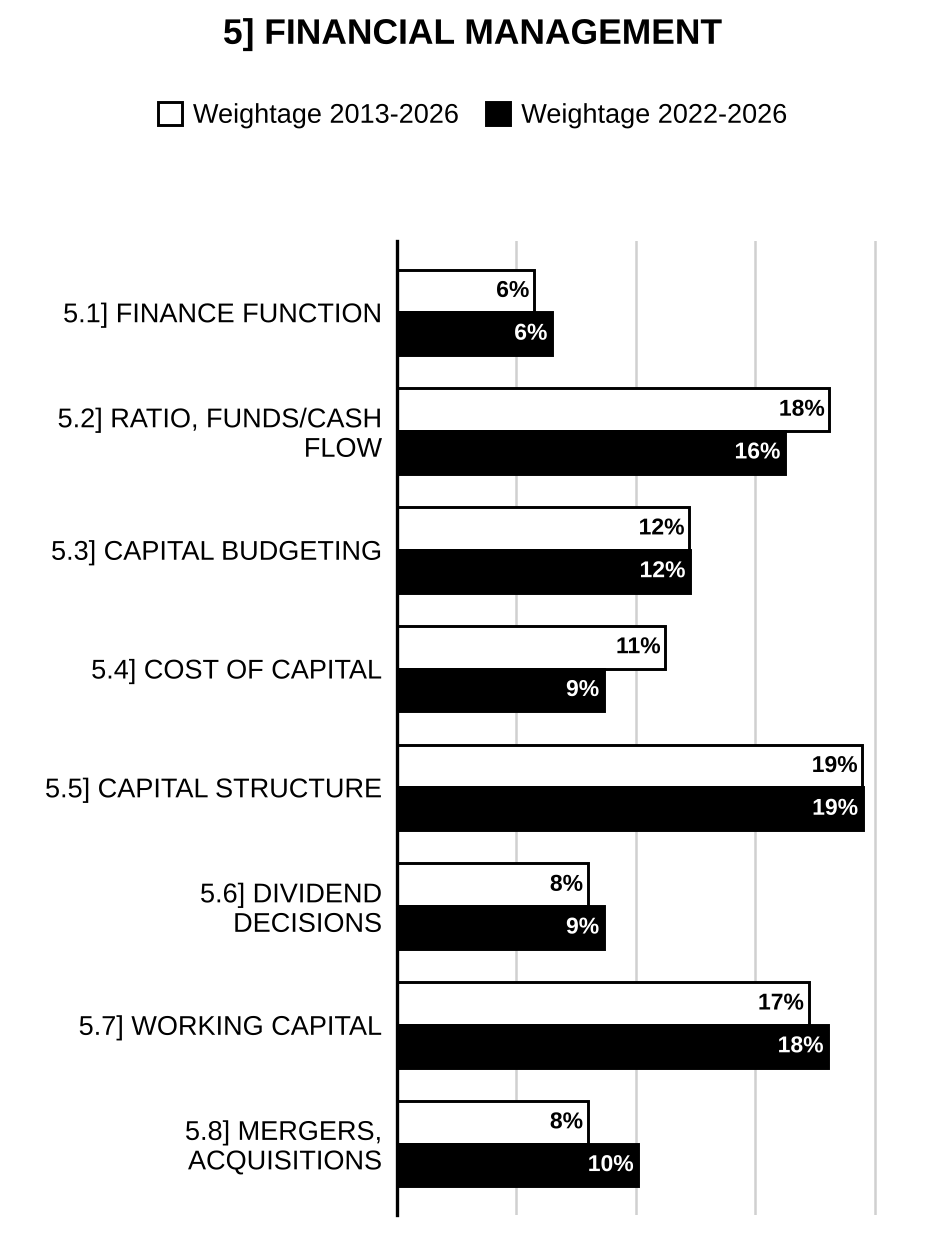
5.1] Finance function
25 questions
Discuss the objectives of financial management. Why is wealth-maximization the preferred objective? [2024/10m/150w/5c]
“Investment decisions are more important than financing and distribution decisions in financial management.” Discuss this statement. [2024/10m/150w/5e]
Discuss the risk-return trade-off in financial decisions. Give examples. [2024/15m/6b]
Explain the objective of maximising the wealth of shareholders. [2022/10m/150w/5e]
What is risk-return trade-off? Explain its significance in financial decision making. [2021/10m/150w/5a]
“Maximization of profits is regarded as the proper objective of investment decision, but it is not as exclusive as maximizing shareholders’ wealth” – Comment. [2019/10m/150w/5a]
Critically examine the relationship between the key financial decisions, return, risk and market value. [2018/10m/150w/5a]
“Profit maximisation is the goal of Financial Management.” Critically examine. [2017/10m/150w/5a]
Discuss the Risk-Return Trade-off in financial decisions. [2017/10m/150w/5b]
Explain the relevance of time value of money in financial decisions. [2016/10m/150w/5a]
What is the justification for the goal of maximising the wealth of shareholders? [2014/10m/150w/5e]
“Shareholders’ wealth maximisation is a theoretically logical and operationally feasible normative goal for guiding financial decision-making, while profit maximisation is not.” Critically evaluate this statement. [2010/15m/150w/5a]
“Maximising the value of the company to its shareholders is consistent with the company exercising considerable social responsibilities.” Discuss. [2009/20m/200w/1c]
Explain objectives of Financial Management. [2007/20m/200w/5a]
“Finance is the lifeblood of business.” Discuss. [2006/20m/200w/5a]
What is Financial Management? Explain its nature, scope and objectives. [2006/30m/6a]
Critically examine the functions of a Financial Manager in a large scale industrial establishment. [2005/30m/6a]
Wealth maximization is the main function of financial management. Comment. [2003/20m/200w/5a]
What should, in your opinion, be the objective of financial management? Briefly state the broad areas of financial management. [2002/30m/6a]
Factors that determine the nature of the organisation of financial management function. [2001/20m/200w/5a]
Explain the nature and scope of finance function in a liberalised economy. Give suitable illustration and indicate the impact of globalisation on finance function. [1999/60m/6]
What is meant by financial planning? How does it differ from financial forecasting? [1998/20m/200w/5a]
Explain the scope of financial management. What role should the financial manager play in a modern business enterprise? [1998/30m/6a]
Discuss the functions of financial management. [1997/20m/200w/5a]
Optimum capital structure aims at profit maximisation rather than wealth maximisation, but it is a mythical proposition. Discuss. [1996/60m/7]
5.2] Tools of financial analysis
34 questions
The financial position of a firm as on 31st March 2024 and 2025 was as under:
| Particulars | 31.3.2024 | 31.3.2025 |
| ₹ | ₹ | |
| I. EQUITY & LIABILITIES | ||
| Shareholders funds: | ||
| Share capital | 2,96,000 | 2,98,000 |
| Non-Current Liabilities: | ||
| Loan from subsidiary company | – | 40,000 |
| Loan from Bank | 60,000 | 50,000 |
| Current Liabilities | 72,000 | 82,000 |
| 4,28,000 | 4,70,000 | |
| II. ASSETS | ||
| Non-Current Assets: | ||
| Machinery | 2,14,000 | 2,44,000 |
| Less: Depreciation up to date | 54,000 | 72,000 |
| 1,60,000 | 1,72,000 | |
| Building | 1,00,000 | 1,10,000 |
| Land | 40,000 | 60,000 |
| Current Assets: | ||
| Inventories | 50,000 | 44,000 |
| Trade receivables | 70,000 | 76,800 |
| Cash & Cash equivalents | 8,000 | 7,200 |
| 4,28,000 | 4,70,000 |
During the year ₹52,000 was paid as dividend. Prepare cash flow statement as per Indirect Method. [2026/20m/4a]
What is a Funds Flow Statement? Discuss its managerial uses. [2026/10m/150w/5c]
Using the following information, complete the Balance Sheet given below: Total Debt to Net worth – 0.5 : 1; Turnover of total assets (based on year end sales figure) – 2; Gross profit ratio – 20 percent; Average collection period (based on 360 days) – 30 days; Inventory turnover (based on cost of goods sold and year-end inventory) – 3; Acid-Test Ratio – 0.8 : 1. All sales are assumed to be on credit basis.
| Balance Sheet | |||
| Liabilities and Equity | (₹) | Assets | (₹) |
| Notes and Accounts Payable | – | Cash | – |
| Common Stock | 9,00,000 | Accounts Receivable | – |
| Retained Earnings | 13,50,000 | Inventory | – |
| Equipment | – | ||
| Total | Total |
[2026/20m/7a]
The following Balance Sheet is given as on 31st March, 2022:
| Particulars | Amount ₹ |
| I. Equity and Liabilities | |
| 1. Shareholders’ Funds: | |
| Equity Share Capital | 5,00,000 |
| 10% Preference Share Capital | 1,00,000 |
| Reserves and Surplus | 92,000 |
| 2. Non-Current Liabilities: | |
| 12% Debentures | 4,00,000 |
| 3. Current Liabilities: | |
| Sundry Creditors | 1,00,000 |
| Bills Payable | 40,000 |
| Provision for Income Tax | 1,00,000 |
| Total | 13,32,000 |
| II. Assets | |
| 1. Non-Current Assets: | |
| Fixed Assets: | |
| (a) Tangible Assets: | |
| Plant & Machinery | 2,80,000 |
| Land & Building | 2,00,000 |
| Furniture & Fittings | 1,56,000 |
| 6,36,000 | |
| Less: Provision for Depreciation | 1,48,000 |
| 4,88,000 | |
| (b) Intangible Assets: | |
| Goodwill | 80,000 |
| Investments | 3,00,000 |
| 2. Current Assets: | |
| Current Assets | 4,40,000 |
| Prepaid Rent | 4,000 |
| Unamortized Preliminary Expenses | 20,000 |
| Total | 13,32,000 |
From the given Balance Sheet, calculate the following:
(i) Debt-equity Ratio
(ii) Proprietary Ratio
(iii) Solvency Ratio
(iv) Fixed Capital Ratio from Proprietary Capital
(v) Capital Gearing Ratio [2023/20m/7a]
What is the importance of Funds Flow Statement to the management? How is it different from a Cash Flow Statement? [2023/15m/7b]
From the following data, you are required to prepare a Balance Sheet and a Statement of Profit and Loss:
| ₹ | ||
| (a) | Share Capital | 9,60,000 |
| (b) | Working Capital | 3,64,000 |
| (c) | Bank Overdraft | 60,000 |
Additional information:
| (i) | Current Ratio | 2 |
| (ii) | Quick Ratio | 1.5 |
| (iii) | Proprietary Ratio (Fixed Assets/Proprietary Fund) | 0.80 |
| (iv) | Gross Profit Ratio | 0.20 |
| (v) | Inventory Turnover Ratio | 4 |
| (vi) | Trade Receivables Turnover | 36 days |
| (vii) | Net Profit to Paid-up Capital | 10% |
Assume there are no fictitious assets. In the case of current assets, there are no assets other than inventories, trade receivables and cash. Closing inventory is 20% higher than the opening inventory. Also assume 360 days in a year. [2022/20m/6a]
From the following Summary Cash Account of Z Ltd., you are required to prepare Cash Flow Statement for the year ended March 31, 2022 in accordance with AS-3 using the Direct method.
Summary Cash Account (for the year ended March 31, 2022) (₹ in ’000)
| ₹ | ₹ | ||
| Balance on 01/04/2021 | 100 | Payment to suppliers | 4,000 |
| Issue of Equity Shares | 600 | Purchase of fixed assets | 400 |
| Receipts from customers | 5,600 | Overhead expenses | 400 |
| Sale of fixed assets | 200 | Wages & Salaries | 200 |
| Taxation | 500 | ||
| Dividend | 100 | ||
| Repayment of bank loan | 600 | ||
| Balance on 31/03/2022 | 300 | ||
| 6,500 | 6,500 |
Note: The company does not have any cash equivalance. [2022/15m/7b]
Distinguish between Net Profit and Cash from Operating Activities. [2020/10m/150w/1a]
Define and compare the following ratios: (i) Return on Assets (ROA) (ii) Return on Capital Employed (ROCE) (iii) Return on Equity (ROE) [2020/15m/6c]
From the following information of a firm, calculate the cashflow from operating activities by applying Direct Method: (For the year ended March 31, 2019)
| Cost of Goods sold | ₹ 1,00,000 |
| Sales | ₹ 1,50,000 |
| Salaries | ₹ 12,000 |
| Insurance Premium | ₹ 3,000 |
| Depreciation | ₹ 10,000 |
Additional Information:
| Particulars | 01.04.2018 | 01.04.2019 |
| Debtors | ₹ 18,000 | ₹ 25,000 |
| Bills Receivables | ₹ 7,000 | ₹ 4,000 |
| Creditors | ₹ 8,000 | ₹ 6,000 |
| Stock | ₹ 20,000 | ₹ 25,000 |
| Salaries Outstanding | ₹ 2,000 | ₹ 3,000 |
| Prepaid Insurance Premium | ₹ 1,000 | ₹ 1,000 |
[2019/15m/6b]
From the following information, you are required to prepare the balance sheet of A Ltd as on March 31, 2019:
| Current Ratio | 1.60 : 1 |
| Liquid Ratio | 1.10 : 1 |
| Inventory Turnover | 6 times |
| Gross Profit Ratio | 20% |
| Debt Collection Period | 1.92 months |
| Fixed Assets Turnover | 1.25 times |
| Reserves and Surplus to Capital | 0.25 : 1 |
| Long Term Loan to Net worth | 0.5 : 1 |
| Fixed Assets to Net worth | 1.20 : 1 |
| Sales for the year | ₹ 7,50,000 |
[2019/15m/7b]
Define and evaluate the following ratios used for analysis of financial statements: (i) Acid-test ratio (ii) Interest coverage ratio (iii) Average collection period (iv) Return on capital employed (v) Price – earning ratio. [2018/15m/7c]
The Balance Sheets of S.K. Ltd. as at 31.3.2014 and 31.3.2015 are as under:
| Liabilities | 31.3.2014 ₹ | 31.3.2015 ₹ |
| Equity Share Capital | 75,00,000 | 1,02,50,000 |
| General Reserve | 42,50,000 | 50,00,000 |
| Profit and Loss Account | 15,00,000 | 18,75,000 |
| 13% Debentures of ₹ 100 each | 58,00,000 | 43,50,000 |
| Current Liabilities | 30,00,000 | 32,50,000 |
| Proposed Dividend | 7,50,000 | 9,10,000 |
| Provision for Income Tax | 22,50,000 | 24,75,000 |
| Total | 2,50,50,000 | 2,81,10,000 |
| Assets | 31.3.2014 ₹ | 31.3.2015 ₹ |
| Goodwill | 10,00,000 | 7,75,000 |
| Land and Building | 68,00,000 | 61,20,000 |
| Plant and Machinery | 75,12,000 | 1,07,95,000 |
| Investment | 25,00,000 | 21,25,000 |
| Stock | 33,00,000 | 27,50,000 |
| Debtors | 24,45,000 | 36,20,000 |
| Cash and Bank | 14,93,000 | 19,25,000 |
| Total | 2,50,50,000 | 2,81,10,000 |
The following additional information is available:
(i) During the financial year 2014 – 15, the company issued equity shares at par.
(ii) Debentures were redeemed on 1.4.2014 at a premium of 10%.
(iii) Some investments were sold at a profit of ₹ 75,000 and the profit was credited to General Reserve Account.
(iv) During the year, an old machine costing ₹ 23,50,000 was sold for ₹ 6,25,000. Its written down value was ₹ 8,00,000.
(v) Depreciation is to be provided on plant and machinery at 20% on the opening balance.
(vi) There was no purchase or sale of land and building.
(vii) Provision for tax made during the year was ₹ 4,50,000.
You are required to prepare a Cash Flow Statement for the year ended 31.3.2015. [2017/20m/8a]
Explain the significance of the following Accounting Ratios: (i) Debt-Equity Ratio (ii) Acid Test Ratio (iii) Inventory Turnover Ratio (iv) Operating Profit Ratio (v) Current Ratio. [2017/15m/8c]
Diagrammatically present the Du Pont chart to calculate return on equity. [2016/10m/150w/5b]
Using the following information, prepare the Balance Sheet:
| (i) | Total debt to net worth | 1 : 2 |
| (ii) | Total assets turnover | 2 |
| (iii) | Gross profit on sales | 30% |
| (iv) | Average collection period (Assume 360 days year) | 40 days |
| (v) | Inventory turnover ratio based on cost of goods sold and year-end inventory | 3 |
| (vi) | Acid test ratio | 0.75 |
| (vii) | Equity share capital | ₹ 4,00,000 |
| (viii) | Reserves and Surplus | ₹ 6,00,000 |
[2016/20m/6a]
Explain the important ratios that will be used in each of the following situations: (i) A bank is approached by a company for a working capital facility of ₹ 50 lacs. (ii) A long-term creditor who is interested in knowing whether his claim is adequately secured. (iii) A shareholder who is examining his portfolio to decide whether to hold or sell his holdings in the company. (iv) A finance manager who is interested to know the effectiveness with which the available resources are utilised. [2015/15m/6b]
The Balance Sheets of S Ltd. at 31st March, 2012 and 31st March, 2013 are as under:
| Particulars | 31-3-2012 ₹ | 31-3-2013 ₹ |
| I. Equity and Liabilities: | ||
| Shareholder’s Funds: | ||
| Share Capital | 50,000 | 70,000 |
| General Reserve | 5,000 | 8,000 |
| Profit and Loss A/c | 10,000 | 15,000 |
| Current Liabilities: | ||
| Creditors | 15,000 | 19,000 |
| Bills Payable | 4,000 | 5,000 |
| Outstanding Expenses | 1,000 | 500 |
| 85,000 | 1,17,500 | |
| II. Assets: | ||
| Non-Current Assets: | ||
| Building | 50,000 | 80,000 |
| Machinery | 8,000 | 12,000 |
| Current Assets: | ||
| Stock in Trade | 5,000 | 7,500 |
| Debtors | 20,000 | 15,000 |
| Cash and Bank Balance | 2,000 | 3,000 |
| 85,000 | 1,17,500 |
Following further information is available:
(i) Depreciation of ₹ 5,000 on building and ₹ 2,000 on machinery has been charged for the year 2012 – 2013.
(ii) A machine costing ₹ 1,200 was sold on 1st April, 2012 for ₹ 800. Depreciation of ₹ 700 was provided on the same upto 31st March, 2012.
Prepare classified cash flow statement for the year ended on 31st March, 2013. [2015/20m/7a]
From the following Balance Sheets as on December, 2012 and 2013, you are required to prepare a Statement of Funds Flow and Schedule of Changes in Working Capital:
| Liabilities | 2012 ₹ | 2013 ₹ |
| Share Capital | 2,00,000 | 2,50,000 |
| General Reserve | 50,000 | 60,000 |
| Profit and Loss | 30,500 | 30,600 |
| Long Term Loan | 70,000 | – |
| Sundry Creditors | 1,50,000 | 1,35,200 |
| Provision for Tax | 30,000 | 35,000 |
| 5,30,500 | 5,10,800 | |
| Assets | 2012 ₹ | 2013 ₹ |
| Land and Building | 2,00,000 | 1,90,000 |
| Machinery | 1,50,000 | 1,69,000 |
| Stock | 1,00,000 | 74,000 |
| Sundry Debtors | 80,000 | 64,200 |
| Cash | 500 | 600 |
| Bank | – | 8,000 |
| Goodwill | – | 5,000 |
| 5,30,500 | 5,10,800 |
Additional information during the year ended 2013 is as under:
(i) Dividend of ₹ 23,000 was paid.
(ii) Assets of other company were purchased for ₹ 50,000 payable in shares. Assets purchased were Stock of ₹ 20,000, Machinery ₹ 25,000 and Goodwill ₹ 5,000.
(iii) Machinery was further purchased for ₹ 8,000.
(iv) Depreciation written off on machinery ₹ 12,000.
(v) Income Tax provided during the year ₹ 33,000.
(vi) Loss on sale of machine ₹ 200 was written off to General Reserve. [2014/20m/6a]
Using the following information, complete the Balance Sheet given below:
| Balance Sheet | |||
| Capital and Liabilities | ₹ | Assets | ₹ |
| Equity Capital | 2,00,000 | Plant and Equipments | ? |
| Retained Earnings | 3,00,000 | Inventory | ? |
| Creditors and Bills Payable | ? | Debtors | ? |
| Cash | ? | ||
| Total | Total |
Other Information:
(i) Total debt to Net worth Ratio is: 0.5 : 1.0
(ii) Turnover on Total Assets: 2
(iii) Gross Profit margin: 30%
(iv) Average Collection Period (based on 360 days year): 40 Days
(v) Inventory Turnover (based on cost of goods sold and year end inventory): 3 times
(vi) Acid Test Ratio: 0.75 : 1.0 [2014/20m/7c]
KKC (P) Limited is engaged in manufacturing and selling components of television sets. After drawing up Trial Balance and making necessary adjustments the following account heads are finalised for drawing up Profit and Loss Account for the year ended 31.03.2012:
| Account Heads | Amount (₹ in thousands) |
| Sales | 26681 |
| Cost of materials | 14872 |
| Salaries and Wages (factory) | 480 |
| Contribution to PF and Welfare Expenses | |
| For workers | 96 |
| For office staff | 218 |
| Repairs and Maintenance | |
| Office premises | 5 |
| Plant and Machinery | 90 |
| Provision for gratuities | 26 |
| Interest | 6 |
| Consumables | 77 |
| Printing and Stationeries | 26 |
| Travelling expenses | 47 |
| Import and Transportation Costs | 1027 |
| Power, Electricity and Oil | 1361 |
| Opening Stock | 883 |
| Closing Stock | 2054 |
| Depreciation | |
| Plant and Machinery | 901 |
| Building and other office assets | 60 |
| Wastages | 281 |
| Packing materials | 3868 |
| Salaries and allowances | 1125 |
| Rent, Rates, Taxes and Insurance | |
| For factory | 100 |
| For office | 94 |
| Advertisement and Publicity | 39 |
| Postage and Telephones | 10 |
| Bank charges | 9 |
| Miscellaneous expenses | 92 |
| Scrap sales | 8 |
| Rent received | 12 |
| Interest earned on investments | 60 |
| Profit on sale of assets | 20 |
| Miscellaneous receipts | 39 |
Calculate the following with your comments:
(i) Gross profit ratio
(ii) Operating profit ratio
(iii) Interest coverage ratio [2013/30m/4a]
Define and distinguish between ROA and ROI. Decompose these two ratios into other ratios and interpret each of them. [2013/10m/6d]
Using appropriate Accounting Ratios, comment on (i) Liquidity, (ii) Current period solvency and (iii) Long-period financial risk of a company. Its Balance Sheet as on 31st March, 2011 is as follows: Balance Sheet as on 31/3/2011.
| Liabilities | Amount ₹ | Assets | Amount ₹ |
| Share Capital | 75,00,000 | Land & Buildings | 85,00,000 |
| General Reserve | 15,00,000 | Plant & Machinery | 60,50,000 |
| 14% Debentures | 50,00,000 | Furniture | 5,50,000 |
| Borrowings from IFCI | 55,00,000 | Investment (Market value ₹ 28,00,000) | 30,50,000 |
| Share Premium A/c | 15,00,000 | Stock-in-trade | 20,90,000 |
| Debenture Redemption Reserve | 12,50,000 | Debtors | 20,00,000 |
| Creditors | 28,50,000 | Bills | 1,90,000 |
| Bills Payable | 1,50,000 | Cash Balance | 25,00,000 |
| Outstanding liability | 1,00,000 | Profit & Loss (Dr.) | 16,00,000 |
| Tax Payable | 11,80,000 | ||
| 2,65,30,000 | 2,65,30,000 |
Notes:
(i) Stock worth ₹ 50,000 is not saleable.
(ii) Debtors to the tune of ₹ 1,50,000 are likely to become bad.
(iii) Debts not acknowledged as debts, ₹ 2,50,000.
(iv) A liability of ₹ 50,000 left to be recorded. [2011/40m/7a]
How would you deal with the following items in relation to Cash Flow Statement? State in respect of each item (transaction) whether it leads to inflow or outflow of cash: 1. Depreciation 2. Payment of interim dividend 3. Revaluation of assets 4. Issue of bonus shares 5. Transfer of certain sum of money out of profits to General Reserves. [2010/15m/2a(ii)]
From the following Profit & Loss Account of an organization for the year ended 31st March, 2010, find out ‘Cash from operations’: Profit & Loss Account for the year ended 31st March, 2010.
| Rs | Rs | ||
| Purchases | 5,00,000 | Sales | 8,00,000 |
| Wages & Salaries | 85,000 | ||
| Miscellaneous Expenses | 61,200 | ||
| Loss on Sale of Old Computers | 10,900 | ||
| Depreciation | 21,200 | ||
| Goodwill (written off) | 6,000 | ||
| Transfer to General Reserves | 10,000 | ||
| Net Profit | 1,05,700 | ||
| 8,00,000 | 8,00,000 |
[2010/15m/4a(ii)]
The Summarised Balance Sheet of ABC Ltd. as on 31st March, 2009 is as follows with other relevant details: Balance Sheet as on 31st March, 2009.
| Liabilities | Rs (in lakh) | Assets | Rs (in lakh) |
| Equity Capital | 40.00 | Fixed Assets (Net) | 28.00 |
| Reserve and Surplus | Cash | 2.40 | |
| 6.00 | Debtors | 18.60 | |
| Sundry Creditors | 14.00 | Inventories | 11.00 |
| 60.00 | 60.00 |
(i) Other information:
| Sales | Rs 52.00 lakhs |
| (–) Cost of production of goods sold | Rs 36.00 lakhs |
| Rs 16.00 lakhs | |
| (–) Selling and administration expenses | Rs 12.50 lakhs |
| Net Profit | Rs 3.50 lakhs |
(ii) The Current Industry Average of the following Ratios of ABC Ltd. is– 1. Current ratio = 2.1 2. Sales to Debtors ratio = 8.0 3. Inventory turnover = 10.2 4. Net profit to Sales = 9% 5. Sales to Total assets = 2
You are required to calculate Current ratio, Sales to Debtors ratio, Inventory turnover ratio, Net Profit margin and Sales to Total assets of ABC Ltd. and compare the same with the industry average. Also give brief comments. [2010/30m/6a]
Below are given some figures relating to three companies carrying on the same type of business, for the year 2008-09. State which company, in your opinion, has put in the best performance and has followed the best financial policies:
| A Ltd. | B Ltd. | C Ltd. | |
| Net Block to Net Worth | 1.70 | 0.83 | 0.90 |
| Current Ratio | 0.94 | 1.32 | 1.03 |
| Liquid Ratio | 0.75 | 0.68 | 0.22 |
| Gross Profit Ratio (in %) | 20 | 15 | 12 |
| Capital Turnover Ratio | 1.50 | 2.50 | 3.50 |
| Dividend Pay-out Ratio (in %) | 40 | 25 | 50 |
| Net Profit Rate (in %) | 8 | 6 | 3 |
[2009/30m/6a]
Information:
| I Year | II Year | III Year | |
| Return on Capital (ROC) | 15% | 12% | 9% |
| Margin on Sale (MOS) | 3% | 3% | 3% |
From the above information, you are asked to find out the reason(s) for decline of ROC. What should be your recommendation to improve ROC? [2006/30m/6b]
“Ratio-analysis is a tool to examine the health of a firm.” Elucidate. [2005/30m/7a]
Discuss the role of financial analysis as a diagnostic tool. [2004/20m/200w/5a]
The capital structure of the two companies is given below:
| A | B | |
| Capital sources | Rs. | Rs. |
| Paid up Capital | 5,00,000 | 1,00,000 |
| Reserve Fund | 3,00,000 | 1,00,000 |
| Preference Shares 9% | 1,00,000 | 1,00,000 |
| Debentures 8% | 1,00,000 | 7,00,000 |
Calculate Capital Gearing Ratio. [2004/30m/7b]
Point out the limitations of a Balance Sheet, and of a Profit and Loss Account. How are these limitations overcome by a Statement of Changes in Financial Position? [2001/30m/6a]
Calculate the (i) Current Ratio (ii) Acid-test Ratio from the following figures:
| Rs. | Rs. | ||
| Cash | 500 | Creditors | 2,000 |
| Bank | 1,000 | Bills Payable | 2,000 |
| Debtors | 2,000 | Bank Credit | 1,000 |
| Finished Goods | 5,000 | Outstanding Expenses | 2,000 |
| Inventory of Raw Material | 2,000 |
[2001/30m/6b]
Precautions to be taken in the interpretation of accounting ratios. [2000/20m/200w/5a]
5.3] Capital budgeting decisions
30 questions
A company is considering the proposal of installing a new equipment which requires an investment of ₹400 lakhs. The expected life of the equipment is 5 years without any salvage value. The project is expected to generate the following earnings before depreciation and taxes over the next 5 years:
| Years | 1 | 2 | 3 | 4 | 5 |
| Earnings (₹ in lakh) | 185 | 190 | 190 | 195 | 175 |
The cost of raising additional capital for the project is 14 percent. Assume that the company is allowed to charge depreciation on straight-line basis for tax purposes and that the tax rate is 40 percent.
You are required to calculate the net present value of the project and advise the management to take appropriate decision.
Present value of ₹1 at the discounting rate of 14 percent is given below for 5 years:
| Year | 1 | 2 | 3 | 4 | 5 |
| PV at 14% | 0.877 | 0.769 | 0.675 | 0.592 | 0.519 |
[2026/15m/7b]
A plant with a life of 3 years has the following projected cash flows:
| Year | Cash Flows (₹) |
| 0 | (–) 20,00,000 |
| 1 | 8,00,000 |
| 2 | 8,00,000 |
| 3 | 9,00,000 |
There is no residual value at the end of the life of the plant. Calculate the– (i) Internal Rate of Return (IRR); (ii) discounted payback period.
Applicable discounting rate is 10% p.a. Present values of ₹ 1 at the discounting rate of 10% and 12% are given below for 3 years:
| Year | 0 | 1 | 2 | 3 |
| PV at 10% | 1 | 0.909 | 0.826 | 0.751 |
| PV at 12% | 1 | 0.892 | 0.797 | 0.712 |
[2025/20m/8b]
Six years ago, a machine was purchased for ₹ 3,00,000. It has been depreciated to a book value of ₹ 1,80,000. Its economic life was 15 years with no salvage value. If this machine is replaced by a new machine costing ₹ 4,50,000, the operating cost would be reduced by ₹ 60,000 for the next 10 years. The old machine could also be sold for ₹ 10,000. The cost of capital is 10%. The new machine will be depreciated on straight line basis over eight years life with ₹ 50,000 as salvage value. Assuming the company’s tax rate to be 55% and using the NPV method, state whether the old machine should be replaced or not. The present value factor at 10% is as follows:
| Year | 1 | 2 | 3 | 4 | 5 | 6 | 7 | 8 |
| PVF | 0.909 | 0.826 | 0.751 | 0.683 | 0.621 | 0.564 | 0.513 | 0.467 |
[2024/20m/6a]
Moon Ltd. wants to replace its labour-intensive manufacturing facility. The company is evaluating a project to install a machining system. It is estimated that the system will result in annual savings of ₹ 13,50,000 in wages, ₹ 4,50,000 in supervisory cost, ₹ 1,50,000 in material losses during production, ₹ 1,20,000 in inventory cost and ₹ 90,000 in other operating costs. The machining system is likely to cost ₹ 22,50,000 and will require an installation cost of ₹ 1,50,000. Its useful life is estimated at 5 years. To operate the system, the company requires the services of two trained operators at an annual salary of ₹ 4,50,000 each. Its annual repairs and maintenance cost is likely to be ₹ 1,20,000. Assuming that the corporate tax rate is 30% and the required rate of return is 12%, suggest Moon Ltd. whether it should accept the project or not. The PVF of an annuity @ 12% for 5 years is 3.605. [2023/20m/6a]
Discuss the problem of multiple internal rates of return in relation to capital budgeting decision. [2022/10m/150w/5d]
What is capital rationing? Explain the principles of capital rationing. [2021/10m/150w/5c]
The Zenith Enterprises Ltd. has two investment proposals–project X and project Y. These are mutually exclusive. Project X requires an initial outlay of ₹3.4 crores and project Y requires an initial outlay of ₹3.3 crores. The risk-free rate is 8% for both the projects. The risk premium rate for project X is 2% and project Y is 4%. The expected cash inflow and certainty equivalent coefficient for projects are given below:
| Year | Project X | Project X | Project Y | Project Y |
| Year | Expected Cash Inflow | CE | Expected Cash Inflow | CE |
| 1 | ₹1.8 crores | .85 | ₹1.8 crores | .90 |
| 2 | ₹2.0 crores | .75 | ₹1.8 crores | .85 |
| 3 | ₹2.0 crores | .60 | ₹2.0 crores | .75 |
The PVF for 3 years:
| Year 1 | Year 2 | Year 3 | |
| PVF @ 8% | .926 | .857 | .794 |
| PVF @ 10% | .909 | .826 | .751 |
| PVF @ 12% | .893 | .797 | .712 |
From these details, determine which of the two projects should be accepted by using–
(i) risk-adjusted discount rate method;
(ii) certainty equivalent approach method. [2021/20m/6a]
Discuss the Decision-Tree approach for evaluating risky investments. [2020/10m/150w/5b]
The expected cash flows of a project are as follows:
| Year | Cash flows (₹) |
| 0 | (–) 1,00,000 |
| 1 | 40,000 |
| 2 | 50,000 |
| 3 | 40,000 |
The cost of capital is 10 per cent.
Calculate: (i) Payback period (ii) Net present value (iii) Discounted payback period (iv) Profitability Index [2020/20m/6a]
Discuss the following ways of incorporating risk in the investment decision making process: The Risk-Adjusted Discount Method and The Certainty Equivalent Method. [2018/10m/150w/5c]
Namya Ltd. wants to prepare the feasibility of manufacturing one of the components needed for its finished product. It has two options of purchasing from its present supplier or to manufacture it in-house.
Its present supplier has shown the willingness to provide at ₹125 per unit for the company’s requirement of 6000 units per year.
If the component is manufactured in-house, it requires equipments costing ₹10 lakh and is expected to have salvage value of ₹2 lakh after the expiry of five years. Additional fixed cost (excluding depreciation) are estimated to increase by ₹1 lakh per year. The variable cost of manufacturing each component will be ₹30 per unit. The company is subject to a 35 per cent tax rate. Its cost of capital is 15 per cent for this project. The company’s projected annual needs is at 7500 units per year for 5 years. The tax relevant rate of depreciation is 25 per cent based on WDV method.
Advise the company, whether it should continue buying from outside supplier or start its own manufacturing. Will your answer be different if the requirement of the company is only 6000 units per year?
| Year | 1 | 2 | 3 | 4 | 5 |
| The present value of ₹1 at 15% | 0.870 | 0.756 | 0.658 | 0.572 | 0.497 |
| The present value of an Annuity of ₹1 at 15% | 0.870 | 1.626 | 2.283 | 2.855 | 3.352 |
[2018/20m/7a]
Define Capital Rationing. Explain the factors leading to Capital Rationing and also state the situations of Capital Rationing. [2017/15m/6c]
XY Ltd. wants to install a new machine in place of an existing old one which has become obsolete. The company made extensive enquiries and from the proposals received, short-listed two offers. The two models differ in cost, output and anticipated net revenue. The estimated life of both the machines is five years. There will be only negligible salvage value at the end of the fifth year. Further details are as follows:
| Anticipated after-tax cash flow | Anticipated after-tax cash flow | Anticipated after-tax cash flow | Anticipated after-tax cash flow | Anticipated after-tax cash flow | ||
| Machine | Cost | Year 1 | Year 2 | Year 3 | Year 4 | Year 5 |
| A | 25 | – | 5 | 20 | 14 | 6 |
| B | 40 | 10 | 14 | 16 | 17 | 8 |
The company’s cost of capital is 16%. You are required to make an appraisal of the two offers and advise the firm by using the following:
(i) Payback Period
(ii) Net Present Value
(iii) Profitability Index
(iv) Internal Rate of Return [2016/20m/7a]
A Ltd. is considering the replacement of one of its machines. The existing machine is in good operating condition, but the company is looking for a bigger machine. The existing machine is 5 years old, and has remaining depreciable life of 10 years. The machine was purchased for ₹ 1,50,000 and is being depreciated at ₹ 10,000 per year for tax purposes. The new machine will cost ₹ 2,20,000 or ₹ 1,70,000 if exchanged with the existing machine. It will be depreciated on a straight line basis for 10 years with no salvage value. The management anticipates that, with the increased operations, there will be a need for an additional net working capital of ₹ 30,000. The new machine will allow the company to expand current operations thereby increasing annual revenue by ₹ 60,000 and variable operating costs from ₹ 2,00,000 to ₹ 2,20,000. The company’s tax rate is 35% and its cost of capital is 10%. Should the company replace its existing machine? Assume that the loss on exchange of existing machine can be claimed as short-term capital loss in the current year itself. [2015/20m/2a]
Discuss the utility and limitations of Internal Rate of Return (IRR) method of appraising a capital investment decision. [2015/15m/7c]
“Internal Rate of Return Method of Capital budgeting is considered to be superior to Payback Period Method.” – Critically evaluate. [2014/10m/150w/5a]
How will you handle risk and uncertainty in Capital Budgeting? Explain. [2011/20m/7b]
What are the decision rules of the Discounted Cash Flow (DCF) techniques of capital budgeting? [2010/7m/150w/5b(i)]
“NPV (Net Present Value) technique of capital budgeting decision is superior to the IRR (Internal Rate of Return) technique.” Do you agree? [2010/8m/150w/5b(ii)]
R Ltd. is considering a new automatic blender. The new blender would last for 10 years and would be depreciated to zero over the 10 year period. The old blender would also last for 10 more years and would be depreciated to zero over the same 10 year period. The old blender has a book value of Rs. 10,000 but could be sold for Rs. 15,000 (the original cost was Rs. 20,000). The new blender would cost Rs. 50,000. It would reduce labour expense by Rs. 8,000 a year. The company is subject to a 50% tax rate on regular income and a 30% tax rate on capital gains. Their cost of capital is 8%. There is no investment tax credit in effect. (i) Identify all the relevant cash flows for this replacement decision. (ii) Compute the present value, net present value and profitability index. (iii) Is this an attractive project? [2009/30m/4b]
Discuss Capital Budgeting. [2007/20m/200w/5b]
Explain the nature and scope of Capital Budgeting. [2006/20m/200w/5c]
Each of the three projects A, B, C requires an investment of Rs. 20,000. Their life is 5 years and cash inflows are as under:
| Year | Cash Inflows A | Cash Inflows B | Cash Inflows C |
| Rs. | Rs. | Rs. | |
| 1 | 4,000 | 5,000 | 6,500 |
| 2 | 4,000 | 5,000 | 5,000 |
| 3 | 5,000 | 5,000 | 4,500 |
| 4 | 6,500 | 5,000 | 4,000 |
| 5 | 5,000 | 5,000 | 5,000 |
Using the Pay Back and Net Present Value methods, determine the ranking of the projects. The discount rate is 10%.
Note: The present value of Re. 1 at the discount rate of 10% is as follows:
| Year | 1 | 2 | 3 | 4 | 5 |
| Present value | .909 | .826 | .751 | .683 | .621 |
[2005/30m/6b]
A company is considering installing a new machine. Machine X costs Rs. 4,00,000 and its life is 8 years. Machine Y costs Rs. 10,00,000 and its life is 10 years. After deducting the operating expenses, the estimated annual return from Machine X is Rs. 80,000 and from Machine Y is Rs. 1,50,000. On the basis of average rate of return on investment, which machine will be most profitable? [2004/30m/6b]
How will you handle risk and uncertainties in capital budgeting decisions? Explain clearly. [2002/30m/7a]
Projects A, B and C are mutually exclusive projects which cost ₹ 11,600, ₹ 13,750 and ₹ 15,000 respectively. The cash inflows over their lives have been estimated as shown below. You are required to select one project as finance is a limiting factor assuming that the project should yield atleast 28% return.
| Project A | Project B | Project C | |
| Cash Outflow | 11,600 | 11,600 [?] | 15,000 |
| Cash Inflows: | |||
| 1st year | 6,000 | 7,000 | 8,000 |
| 2nd year | 5,000 | 6,000 | 7,000 |
| 3rd year | 5,000 | 6,000 | 5,000 |
| 4th year | 4,000 | 6,000 | 5,000 |
The present value of Re. 1 for different years at 28% is:
| Years | Discount factor |
| 1 | 0.7813 |
| 2 | 0.6104 |
| 3 | 0.4768 |
| 4 | 0.3725 |
[2002/30m/7b]
Discounted cash flow technique for appraisal of capital expenditure proposals. [2000/20m/200w/5c]
Limitations of pay-back period method of capital budgeting. [1999/20m/200w/5a]
Examine the various techniques of capital budgeting in the light of current economic scenario. [1997/20m/200w/5c]
Should the following be included in the total amount of investment to be made in a new machine? (i) Rs. 5,00,000 paid as the price of the machine and Rs. 5,000 as carriage inwards. (ii) Rs. 2,000 paid to a consultant for his advice on whether the new machine should be purchased. (iii) Cash salvage value of the old machine is Rs. 5,000. (iv) Loss on the sale of the old machine is Rs. 6,000. (v) The cost of removing the old machine is Rs. 1,000. (vi) Installation charges of the new machine are Rs. 2,000. (vii) The cost of training workers to handle the new machine is Rs. 2,000. (viii) Additional working capital required for the new machine is Rs. 20,000. (ix) Interest at the rate 10% is to be paid on the loan taken to buy the new machine. (x) The new machine would save floor space the rental value of which is Rs. 500 per month. [1995/30m/8b]
5.4] Cost of capital
22 questions
Explain the CAPM approach for computing the cost of equity. Discuss the merits and demerits of the approach. [2026/10m/150w/5a]
As a Financial Manager of an engineering company, you are required to compute the weighted average cost of capital of the company using (1) Book-value weights and (2) Market-value weights. The company’s present capital structure is:
| ₹ | |
| Equity Shares (₹ 10 per share) | 30,00,000 |
| 10% Preference Shares (₹ 100 per share) | 4,00,000 |
| 12% Debentures (₹ 100 per debenture) | 14,00,000 |
| 48,00,000 |
All these securities are traded in the securities market. Their recent prices are: Debentures–₹ 110 per debenture; Preference Shares–₹ 115 per share; Equity Shares–₹ 40 per share.
Anticipated external financing opportunities are:
(i) New ₹ 100 Debentures can be sold at par at 9% coupon rate, reedeemable at 10% premium after 5 years. Flotation cost would be 2%
(ii) New ₹ 100 Preference Shares carrying 8% dividend can be sold at par, redeemable at premium of 5% after 10 years. Flotation cost would be ₹ 3 per share
(iii) New ₹ 10 Equity Shares can be sold at ₹ 35. Flotation cost would be 2% of issue price. Expected dividend on Equity Shares is 20%. Anticipated growth rate in dividend is 8%. Corporate tax rate is 40% [2025/20m/7a]
Explain ‘Capital Asset Pricing Model’. [2022/10m/150w/5a]
A company wishes to raise additional finance of ₹ 20 lakh for meeting its investment plans. It has ₹ 4,20,000 in the form of retained earnings available for investment purposes. Following are the additional details: (i) Debt/Equity mix – 30%/70% (ii) Cost of debt upto ₹ 3,60,000 is 10% before tax; Beyond ₹ 3,60,000 is 16% before tax; (iii) Earnings per share is ₹ 8 (iv) Dividend payout is 50% of earnings (v) Expected growth rate in dividend is 10% (vi) Current market price per share is ₹ 88 (vii) Tax rate is 50% You are required to determine the pattern for raising the additional finance, the post-tax average cost of additional debt, the cost of retained earnings and the cost of equity. Also compute the overall weighted average after-tax cost of additional finance. [2022/20m/7a]
Shasun Ltd. has the following capital structure:
| Sources of Capital | Book value (₹) | Market value per security (₹) |
| 30000 equity shares of ₹100 each | 30,00,000 | 120 |
| 10000 8% preference shares of ₹100 each | 10,00,000 | 108 |
| 20000 10% debentures of ₹100 each | 20,00,000 | 105 |
The company is expected to declare 20% dividend on its equity share with a growth rate of 5%. The corporate tax rate is 30% and corporate dividend tax is 10%. Calculate Weighted Average Cost of Capital (WACC) of the company using–
(i) book value as weight;
(ii) market value as weight. [2021/15m/7b]
Out of cost of equity and cost of debt, which one is lower and why? [2020/10m/150w/5c]
Akash Limited wishes to raise additional finance of ₹ 10 lakh for meeting its investment plans. It has ₹ 2,10,000 in the form of retained earnings available for investment purposes. The following are the further details:
| (i) Debt – Equity Mix | 30% – 70% |
| (ii) Cost of Debt up to ₹ 1,80,000 | 10% (before tax) |
| (iii) Cost of Debt beyond ₹ 1,80,000 | 16% (before tax) |
| (iv) Earnings per share | ₹ 4 |
| (v) Dividend pay out | 50% of earnings |
| (vi) Expected growth rate in dividend | 10% |
| (vii) Current market price per share | ₹ 44 |
| (viii) Tax Rate | 50% |
You are required to:
(a) Determine the pattern for raising the additional finance.
(b) Determine the post-tax average cost of additional debts.
(c) Determine the cost of retained earnings and cost of equity.
(d) Compute the overall weighted average after tax cost of additional finance. [2019/20m/7a]
What is CAPM? What are the components of CAPM equation? Explain the meaning of each component. What does it tell us about the required return on a risky investment? [2019/15m/7c]
“The Weighted Average Cost of Capital (WACC) of a firm, depends on many factors which are beyond the control on the investment and financing policies of a firm.” Explain in brief. [2018/15m/6c]
X Ltd. and Y Ltd. have the same level of business risk and their market values and earnings are summarised below:
| Particulars | X Ltd. ₹ | Y Ltd. ₹ |
| Equity | 6,00,000 | 3,00,000 |
| Debt | – | 2,50,000 |
| 6,00,000 | 5,50,000 | |
| Earnings | 90,000 | 90,000 |
| Less: Interest | – | 22,000 |
| 90,000 | 68,000 |
Calculate the post-tax cost of equity, cost of debt and weighted average cost of capital of both the companies. Assume that the income-tax rate on the company is 35% and the additional tax on dividend distribution is 20%. [2016/15m/6b]
“Retained earnings have no cost.” Comment. [2015/10m/150w/5e]
Calculate the explicit cost of debenture for each of the following situations, assuming (i) tax rate of 35%, (ii) coupon rate of interest 10%, (iii) face value of debenture ₹ 1,000, (iv) maturity – 20 years: (1) If debentures are sold at a premium of 10% and floatation costs are 2%. (2) If debentures are sold at a discount of 5% and floatation costs are 3%. The present value factor of an annuity of ₹ 1 for 20 years and present value factor of ₹ 1 for the 20th year are as under:
| For ₹ 1 | 9% | 10% | 11% |
| PV factor of Annuity for years 1 – 20 | 9.129 | 8.514 | 7.963 |
| PV factor for the year: 20th | 0.178 | 0.149 | 0.124 |
[2014/20m/6b]
Explain ‘Security Market Line’ with illustration under the assumptions of CAPM. [2013/10m/7c]
Prof. James C. Van Horne, by way of example, used the following data to arrive at a Beta of 0.53.
| Period | Market Return | Risk-free Return | Stock Return |
| 1 | 0.11 | 0.05 | 0.091 |
| 2 | 0.17 | 0.07 | 0.110 |
| 3 | (0.02) | 0.06 | 0.024 |
| 4 | 0.25 | 0.08 | 0.234 |
| 5 | 0.18 | 0.06 | 0.132 |
| 6 | 0.28 | 0.07 | 0.275 |
| 7 | (0.08) | 0.07 | 0.121 |
| 8 | 0.27 | 0.09 | 0.292 |
| 9 | 0.14 | 0.07 | 0.105 |
| 10 | 0.00 | 0.08 | 0.077 |
Show the model and make detailed calculations to arrive at the Beta. [2013/30m/8a]
Interpret the Beta so arrived at. [2013/5m/8b]
Vijay Ltd. is a reputed auto parts manufacturing company. Its equity share is selling for Rs 50. The Company expects its earnings per share of Rs 7.50. The Company has a policy of paying 60% of its earnings as dividends. The company earns a return of 10% on its reinvested profit. The Company has plans for expansion, for which it wants to issue a 10-year, 8%, Rs 1,000 per bond at a premium of Rs 20. The underwriting commission is expected to be Rs 40 per bond. The tax rate applicable to the Company is 35%. After the issue of bonds, the Company wishes to have its debt-equity ratio 30 : 70. You are required to work out cost of equity, after-tax cost of bond and overall cost of capital. [2010/30m/7a]
The capital structure of Microsoft Ltd. is as follows:
| ₹ (lakhs) | |
| Equity Share Capital | 400 |
| 12% Debentures | 400 |
| 18% Term Loan | 1200 |
(i) Determine the weighted average cost of capital of Microsoft Ltd. It has been paying dividend at a consistent rate of 20% p.a.
(ii) What difference will it make in the weighted average cost of capital if the current market price of the ₹ 100 equity share is ₹ 160? [2007/30m/6b]
Discuss the relevance of cost of capital in capital budgeting. [2005/20m/200w/5b]
What is meant by weighted average cost of capital? Illustrate your answer with assumed figures. [2004/30m/6a]
Define cost of capital. Explain its significance in financial decision making. [1998/20m/200w/5b]
Following information of XYZ Co. Ltd. are given for the year 1995-96:
| Particulars | Rs. |
| 2,00,000 Equity Shares | 40,00,000 |
| 10,000 6% Preference Shares | 10,00,000 |
| 6,000 8% Debentures | 30,00,000 |
The share is sold for Rs. 20 each. It is expected that company will pay next year a dividend of Rs. 2 per share which will grow at 7 percent forever. Assume a 50 percent tax rate.
You are required to: (a) Compute a weighted average cost of capital based on existing capital structure using both book value and market value weights. (b) Compute the new weighted average cost of capital if the company raises an additional Rs. 20,00,000 debt by issuing 10 percent debentures. This would result in increasing the expected dividend to Rs. 3 and leave the growth rate unchanged but the price of share will fall to Rs. 15 per share. (c) Compute the cost of capital if in (a) above growth rate increases to 10 percent. [1997/30m/6b]
A company’s current earnings per share are Rs. 4, dividend pay out is 5%[?] of earnings, expected growth rate in dividends is 10%, market price per share is Rs. 44 and tax rate is 50%. The company wishes to raise additional capital of Rs. 10 lakh including debt of Rs. 3 lakh. The cost of debt (before tax) is estimated to be 10% upto Rs. 2 lakh and 16%[?] beyond that. Compute the after tax costs of debt and equity and the weighted average cost of capital. [1995/30m/6b]

Preparing for Prelims too?
Our UPSC Prelims Topic-wise PYQ eBook covers every Prelims question with detailed explanations, so you can see exactly where UPSC asks from.
View the BookDownload Free Sample5.5] Financing decisions: capital structure
47 questions
The following is the data regarding two companies X and Y belonging to the same equivalent risk class:
| Company X | Company Y | |
| Number of Equity Shares | 2,00,000 | 3,00,000 |
| 10% Debentures | 1,00,000 | – |
| Market price per share | ₹1.30 | ₹1.00 |
| Profit before interest | ₹40,000 | ₹40,000 |
All profits after paying interest on debentures are distributed as dividends. Explain how under Modigliani and Miller approach, an investor holding 10% of shares in Company X will be better off in switching his holdings to Company Y. [2026/15m/6b]
Explain the concept of optimal capital structure. How does a company decide on the right mix of debt and equity? [2025/10m/150w/5a]
Rainbow Ltd. provides the following data for the year 2023–24: Sales–₹ 80 lakh; Variable Cost–₹ 56 lakh; Fixed Operating Cost–₹ 8 lakh; Fixed Finance Cost–₹ 4 lakh; Effective Tax Rate–25%; EPS–₹ 9. (i) Compute the Degree of Operating Leverage (DOL), Degree of Financial Leverage (DFL) and Degree of Combined Leverage (DCL) for the company and interpret the results. (ii) If the company can increase its sales by 20%, by what amount will EPS change? Give your answer on the basis of your results obtained in (i). [2025/15m/6b]
A company provides the following information related to the capital structure planning: Leverage is measured as Debt/(Debt + Equity); At 20% leverage, cost of equity () is measured at 18%. (i) What will be the at 40% leverage, if Net Income (NI) model is followed? (ii) If Net Operating Income (NOI) model is followed while overall cost of capital () is 16%, what will be the at 40% leverage? Assume cost of debt capital () to remain constant. [2025/15m/6c]
How will you measure the degree of combined leverage? Also describe the effects of combined leverage along with suitable examples. [2024/15m/6c]
A company has earnings of ₹ 1,00,000. The capital structure of the company contains debt as well as equity in which debt is of ₹ 4,00,000 borrowed at the rate of 10%. Presently, the cost of equity capital of the company is 12.50%. Find out the total value of the company and the overall cost of capital using Net Income approach. If debt is increased or reduced by ₹ 1,00,000, what will be the effect on the value of the company and on overall cost of capital as per the Net Income approach? [2024/15m/7b]
Explain the ‘Financial Indifference Point’ in the context of EBIT-EPS analysis by giving suitable example. [2023/10m/150w/5a]
What is meant by capital structure? Discuss the major determinants of capital structure. [2023/10m/150w/5b]
Capital structure of a company consists of the following:
| ₹ | |
| Equity Share Capital: (Shares of ₹ 100 each) | 40,00,000 |
| Retained Earning | 20,00,000 |
| 8% Preference Shares | 20,00,000 |
| 7% Debentures | 4,00,000 |
| Total | 84,00,000 |
The company requires ₹ 50,00,000 to finance the expansion programme for which the following alternatives are available:
(i) Issue of 40,000 equity shares at a premium of ₹ 25 per share
(ii) Issue of 10% Preference Shares
(iii) Issue of 8% Debentures
It is estimated that in the case of equity shares, preference shares and debentures financing, the PE ratios would be 21.4, 17 and 15.7 respectively.
Assume the company earns 12% on its capital with the income tax rate of 50%.
You are required to evaluate the three financing alternatives and recommend the best alternative suitable for the company. [2022/15m/6b]
Explain the Arbritrage process as per the M&M Model. [2022/15m/8c]
Define optimum capital structure. Discuss its determinants. [2021/10m/150w/5b]
Calculate degree of (i) operating leverage (ii) financial leverage (iii) combined leverage from the following data under situations I and II and financial plans A and B.
| ₹ | |
| Sales | 90,000 |
| Variable cost | 45,000 |
| Fixed operating costs: | |
| Situation I | 15,000 |
| Situation II | 20,000 |
| Fixed financial costs: | |
| Plan A | 20,000 |
| Plan B | 10,000 |
[2020/20m/7a]
Explain NOI (Net Operating Income) model of capital structure. A firm’s cost of equity at zero leverage is 15 per cent. What would be its overall cost of capital at 40 per cent leverage under NOI model? [2020/15m/8b]
Explain ‘Indifference Point’ (IP) in EBIT-EPS analysis. [2019/10m/150w/5c]
Illustrate the Net Income Approach relating to capital structure decision making. [2019/15m/6c]
Mayur Manufacturing Ltd. has equity share capital of ₹5,00,000 (face value ₹10). To meet the requirement of expansion plan, the company wishes to raise ₹3,00,000. The company is considering the following four alternative sources to raise the funds:
Plan A: To have full money from the equity shares.
Plan B: To raise ₹1 lakh from equity and ₹2 lakhs by borrowing from financial institution @ 10% rate of interest per annum.
Plan C: To raise full money of ₹3 lakhs from bank at 10% rate of interest per annum.
Plan D: ₹1 lakh in equity and ₹2 lakhs issue of preference shares at 8% per annum dividend.
The company is expected to have earnings of ₹1,50,000 after the expansion programme. The tax rate applicable to company is 35%. Suggest the suitable plan. [2018/15m/7b]
State the assumptions made in Modigliani and Miller Proposition-I that the capital structure is independent of capital mix. Explain with an example that how arbitrage process justifies the theory, using the following data.
Shyam Ltd. and Ram Ltd. belong to same risk class. Ram Ltd. has no debt capital. Shyam Ltd. has both debt and equity capital. Other details are as under:
| Particulars | Ram Ltd. | Shyam Ltd. |
| Net Operating Income (₹) | 10,00,000 | 10,00,000 |
| Debt Interest (₹) | – | 3,00,000 |
| Debt Capitalisation Rate | – | 10% |
| Equity Capitalisation Rate | 14% | 18% |
| Average Cost of Capital | 14% | 14.52% |
One investor is holding ₹1,00,000 worth of equity shares of Ram Limited. What arbitrage will he resort to? [2018/15m/8c]
The following information is related to ‘Alpha Co. Ltd.’ for the year ended 31.3.2016:
| ₹ | ||
| Equity Share Capital (₹ 10 each) | 50 lakhs | |
| 12% Bonds of ₹ 1,000 each | 37 lakhs | |
| Sales | 84 lakhs | |
| Fixed Cost (excluding interest) | 6.96 lakhs | |
| Financial Leverage | 1.49 | |
| Profit Volume Ratio | 27.55% | |
| Income Tax Applicable | 40% |
You are required to calculate (i) Operating Leverage (ii) Combined Leverage (iii) Earning Per Share [2017/20m/7a]
Define ‘Optimum Capital Structure’. Discuss the major considerations in the Optimum Capital Structure planning of a firm. [2017/15m/8b]
Explain briefly the propositions made in Modigliani and Miller approach on cost of capital. [2016/10m/150w/5c]
The share capital of a company is ₹ 10,00,000 with shares of face value of ₹ 10. The company has debt capital of ₹ 6,00,000 @ 10% rate of interest. The sales of the firm are 3,00,000 units per annum at a selling price of ₹ 5 per unit and variable cost is ₹ 3 per unit. The fixed cost amounts to ₹ 2,00,000. The company pays tax at 35%. If the sales increase by 10%, calculate: (i) Percentage increase in EPS (ii) Degree of financial leverage at the two levels. [2016/20m/8a]
Examine with an example the relationship between leverage and profitability. [2015/10m/150w/5a]
Calculate the degree of operating leverage, degree of financial leverage and degree of combined leverage for the following firms:
| N | S | D | |
| Production (in units) | 17,500 | 6,700 | 31,800 |
| Fixed costs (₹) | 4,00,000 | 3,50,000 | 2,50,000 |
| Interest on long-term loan (₹) | 1,25,000 | 75,000 | NIL |
| Selling price per unit (₹) | 85 | 130 | 37 |
| Variable cost per unit (₹) | 38 | 42.50 | 12 |
You are also required to interpret the results of your calculation. [2015/20m/6a]
Give a critical appraisal of the Modigliani-Miller (MM) approach to the theory of capital structure. [2015/20m/8b]
What is the relationship between leverage and cost of capital as per the (i) net income approach and (ii) net operating income approach of theories of capital structure? [2014/10m/150w/5b]
Rudra Ltd.’s Balance Sheet as on 31-12-2013 is as under:
| Balance Sheet (As on 31-12-2013) | |||
| Liabilities | ₹ | Assets | ₹ |
| Equity Capital (₹ 10 per share) | 60,000 | Net Fixed Assets | 1,50,000 |
| 10% Long-term Loan | 80,000 | Current Assets | 50,000 |
| Retained Earnings | 20,000 | ||
| Current Liabilities | 40,000 | ||
| 2,00,000 | 2,00,000 |
The company’s total assets turnover ratio is 3.0. Its fixed operating costs are ₹ 1,00,000. Its variable operating costs to sales ratio is 40%. The income tax rate is 35%.
(i) Calculate the Degree of operating leverage, financial leverage and combined leverage.
(ii) Determine the likely level of EBIT if EPS is (a) ₹ 3 and (b) ₹ 0 (zero). [2014/20m/7a]
Trade-off theory in capital structure decisions. [2013/10m/150w/5e]
Illustrate Operating Leverage and Financial Leverage. What insights you get from these two leverages? What are their limitations? [2012/30m/7a]
A company is contemplating to expand its business for which it will need a capital expenditure of ₹ 1.50 crores and working capital of ₹ 0.50 crore. The existing capital of the company consists of 30,00,000 shares of ₹ 10 each. The additional investment may be financed by issue of fresh share capital or borrowings @ 15% interest per annum from financial institutions or a combination of share capital and loan. The earnings before interest and taxes are likely to go up to ₹ 1,10,00,000 after the implementation of expansion plan. The company pays tax @ 35 per cent on earnings after paying interest. Which source of financing should the company use for raising additional capital? Advise the company keeping in mind the EPS and financial risk. [2011/35m/6a]
“Between two extremes of Net Income (NI) and Net Operating Income (NOI) approaches to Capital Structure, there is also a middle view which is perhaps nearer the truth.” Examine this statement in detail. [2010/30m/6b]
If the use of financial leverage magnifies the earnings per share under favourable economic conditions, why do companies not employ very large amounts of debt in their capital structures? [2010/15m/8b(i)]
What do you mean by financial leverage? Write the importance and limitations of it. [2007/30m/6a]
The Progressive Corporation Ltd. currently has an equity share capital of ₹ 40 lakh consisting of 40,000 equity shares of ₹ 100 each. The management of the company is planning to raise further ₹ 30 lakh to finance a major expansion project through one of the four possible financial plans. The options are: (i) Entirely through issue of equity shares. (ii) ₹ 15 lakh from the issue of equity shares of ₹ 100 each and the balance from the issue of 8% Debentures. (iii) ₹ 10 lakh from the issue of equity shares of ₹ 100 each and the balance through long term borrowings at 9% interest p.a. (iv) ₹ 15 lakh from the issue of equity shares of ₹ 100 each and the balance through issue of preference shares with 5% dividend per annum. The corporation’s expected earning before interest and taxes will be ₹ 15 lakh. Assuming tax rate of 50%, you are required to determine the earning per share. Comment on the financial leverage that will be authorised under each of the above schemes of financing. [2007/30m/7b]
Define capital structure. Discuss the factors which influence the planning of capital structure. [2007/30m/8a]
What is under Capitalization? [2005/20m/200w/5a]
What are the sources for raising long term capital? [2004/20m/200w/5c]
What are the basic considerations influencing debt-equity mix in a corporate capital structure? Examine the merits and demerits of debt financing. [2004/30m/7a]
Write a note on trading on equity. [2003/20m/200w/5d]
Explain the term Capital Structure. What should generally be the features of an appropriate capital structure for a company? [2003/30m/6a]
Debt is a cheaper but burdensome source of financing. Do you agree? Explain with example. [2002/20m/200w/5c]
XYZ Ltd. required an amount of ₹ 2,50,000 to execute its expansion plan for which three alternative financing plans have emerged:
| Equity | Debt | Preference shares | |
| Plan I | 100% | – | – |
| Plan II | 50% | 50% | – |
| Plan III | 50% | – | 50% |
The cost of debt and preference shares is estimated to be 12%. The company is in a position to raise desired funds by issuing shares at a premium of ₹ 10 per share.
The expected Earnings before Interest and Taxes (EBIT) of the company is ₹ 80,000 and the applicable tax rate is 35%. You are required to find out for each plan the EPS and the financial break-even level. Which plan should the company select? [2002/30m/8b]
What are the approaches of the determination of a firm’s capital structure? Suggest the best means of financing in the following case:– A company is presently working with all-equity. To finance the expansion plan of the company, three alternative means of financing are available as under (i) All equity (ii) 9% preference shares (iii) 10% debentures. The present capital of the company consists of 1,50,000 equity shares of Rs. 10 each. Additional funds to the tune of Rs. 4,50,000 is to be raised to meet the expansion programme. The earnings of the company after expansion are likely to be upto Rs. 5,25,000. Corporate tax is 45%. [2000/30m/8b]
Write a note on theories of capital structure. In what manner are the traditional theories fast getting eroded and new explanations of capital structure being developed? [1999/60m/7]
Describe the traditional view on the capital structure. Compare and contrast this view with NOI and NI approach. [1998/30m/7a]
ABC Ltd. has an average selling price of Rs. 20 per unit. Its variable units cost are Rs. 14 and fixed costs amount to Rs. 3,40,000. It finances all its assets by equity funds. It pays 50% tax on its income. XYZ Ltd. is identical to ABC Ltd., except in respect of the pattern of financing. The latter finances its assets 50% by equity and 50% by debt, the interest on which amounts to Rs. 40,000. Determine the degree of operating, financial and combined leverages at Rs. 14,00,000 sales for both the firms, and interpret the results. [1998/30m/7b]
Optimum capital structure aims at profit maximisation rather than wealth maximisation, but it is a mythical proposition. Discuss. [1996/60m/7]
Discuss briefly the Net Income, Net Operating Income and Traditional approaches to capital structure. [1995/30m/6a]
5.6] Dividend decisions and valuation of firm
32 questions
Discuss Gordon’s model of dividend decision. [2026/10m/150w/5b]
The earning per share of a company is ₹9 and the rate of capitalisation applicable is 12 percent. The company has before it, an option of adopting (i) 50, (ii) 60 and (iii) 100 percent dividend payout ratio. Compute the market price of the company’s quoted shares as per Walter’s Model if it can earn a return of (A) 15, (B) 12 and (C) 5 percent of its retained earnings. [2026/15m/8b]
Explain the concept of dividend policy. Discuss the various types of dividend policies followed by the companies. [2025/10m/150w/5d]
Details regarding three companies are given below:
| A Limited | B Limited | C Limited |
| r = 15% | r = 10% | r = 8% |
| k = 10% | k = 10% | k = 10% |
| E = ₹ 10 | E = ₹ 10 | E = ₹ 10 |
Using Walter’s model, you are required to calculate the value of an Equity Share of each of these companies when dividend payout ratio is (i) 20%, (ii) 50% and (iii) 0%. [2023/15m/8b]
Discuss Walter’s model of dividend decision. [2022/10m/150w/5c]
A company has a capital of ₹100 crores with shares of ₹100 each. The shares are currently quoted at par in the market. The company is planning to declare a dividend of ₹6 per share at the end of current financial year which has just started. The rate of capitalisation for the risk class to which the company belongs is 10%. Using Modigliani-Miller (MM) model, answer the following: (i) Calculate the price of the shares at the end of the year, if (1) dividend is declared and (2) dividend is not declared. (ii) Calculate the number of shares to be issued assuming the company pays dividend, has net income of ₹10 crores and make new investment of ₹20 crores during the year. (iii) Find out the value of the firm, if (1) dividend is declared and (2) dividend is not declared. [2021/20m/8a]
Explain Gordon’s share valuation model and state in which case dividend policy is irrelevant under this model. [2020/10m/150w/5a]
“A firm should follow a policy of very high dividend pay-out”. Do you agree? Why or why not? [2019/10m/150w/5b]
The following information is available for KRISHIV Corporation:
– Earning per share: ₹4.00
– Rate of return on investments: 18 per cent
– Rate of return required by shareholders: 15 per cent
What will be the price per share as per the Walter Model if the payout ratio is 40 per cent? 50 per cent? 60 per cent? [2018/15m/6b]
State the valuation formula put forward by James Walter. Also explain the logic behind it. [2017/10m/150w/5e]
Explain the Modigliani and Miller approach for corporate dividend policy. [2016/15m/8b]
Explain briefly the factors that determine the dividend policy of a company. [2015/10m/150w/5d]
Earnings per share of Shree Laxmi Textile Ltd. is ₹ 20 per share. The company has an internal rate of return of 12 percent and the capitalisation rate is 10 percent. Determine the following using Walter’s Dividend Model: (i) Optimum payout ratio of the firm. (ii) The price of the share at this payout. [2014/10m/7b]
From the information given below you are required to value the business under Residual Operating Income method: (Rupees in lakh)
| Particulars | Actual | Forecasts | |||
| 2012 | 2013 | 2014 | 2015 | 2016 | |
| Net Operating assets | 2724 | 2915 | 3119 | 3337 | 3570 |
| Operating income | 410 | 449 | 480 | 514 | 550 |
Required return of the business is 10.10%. Net operating assets are expected to grow at 7% p.a.
As on date the business has net outside liabilities of Rs. 1728 lakh. [2012/40m/8a]
Critically examine MM-Thesis. [2011/15m/150w/5d]
How is Gordon’s model an improvement over other dividend models? Discuss its limitations. [2011/25m/8b]
Examine the impact of issue of stock dividend on the market price of equity shares of a company with a suitable illustration. [2010/15m/150w/5c]
What do you understand by dividend policy? Explain the various factors which influence the dividend decision of a company. [2007/30m/7a]
Explain the concept of valuation. How are firm’s Fixed Income Securities and Common Stocks valued? [2006/30m/7a]
Explain in detail the Theories of Dividend. [2006/30m/8b]
In what ways dividend policy and retention of earnings related to financing of firms business? [2005/20m/200w/5d]
Explain with the help of a suitable example Walter’s approach to dividend policy. [2005/30m/8a]
Why should companies pay dividend to shareholders when it does not affect their valuation? Give your views on this issue. [2002/30m/8a]
Are dividends irrelevant to the valuation of a firm? Give reasons for your answer. [2001/30m/7a]
A Co. Ltd. had 50,000 equity shares of Rs. 10 each as on January 1. Currently the shares are being quoted at par in the market. In the current calendar year the company is going to declare a dividend of Rs. 3 per share. The company belongs to a risk class with an appropriate capitalisation rate of 20 p.c. Use the Modiliani-Miller model to determine the price of the shares of the company when (i) dividend is declared (ii) no divident is declared. No taxes are to be paid. [2001/30m/7b]
What do you mean by an appropriate dividend policy? What factors govern the formulation of a dividend policy? Explain. [2000/30m/7a]
Do you perceive any relationship between book value and market value of a share? What can be the possible reasons for the difference between the two? [2000/30m/7b]
Dividend and retention policy in a company. [1999/20m/200w/5d]
Mr. Ram, an investor, purchases an equity share of a growing company X Ltd. for Rs. 450. He expect the company to pay dividends of Rs. 21, Rs. 22.05 and Rs. 23.15 in years 1, 2 and 3 respectively. Mr. Ram proposes to sell the share at a price of Rs. 520 at the end of 3 years. (i) Determine the growth rate in dividends. (ii) Calculate the current dividend yield. (iii) What is the required rate of return of Mr. Ram on his equity investment? [1998/30m/6b]
What is stock dividend? Discuss its advantages and limitations. [1997/30m/7a]
The following is the Capital structure of Bharat Ltd as on 31st March 1997:
| Particulars | Rs. |
| Equity Capital (1,00,000 shares) | 10,00,000 |
| Share Premium | 15,00,000 |
| Reserve and Surplus | 5,00,000 |
On 1 April, 1997, the company made a bonus issue of two shares for every five held when the market price of the share was Rs. 40 per share.
Mr. Chaudhary had 100 shares of the company purchased on April 1, 1994 at a market price of Rs. 30. He sold these shares on December 31, 1996 at Rs. 50 per share. The income tax rate was 20 percent and capital gains tax rate was 15 percent for him. If the company pays a regular dividend of 10 percent on par before transferring earnings to reserves and surplus, state whether Mr. Chaudhary was able to earn his required rate of return of 10 percent on his investment. [1997/30m/7b]
Critically examine Walter’s approach to dividend policy. [1995/20m/200w/5b]
5.7] Working capital management
44 questions
Describe the costs of maintaining receivables. Explain the factors which influence the size of receivables. [2026/15m/6c]
Write about Miller and Orr model of cash management. [2025/10m/150w/5b]
How is Economic Order Quantity (EOQ) determined? How does quantity discount affect the EOQ? [2025/10m/7c]
The Board of Directors of a company asks to prepare a statement showing working capital estimates for a level of activity of 15,600 units of production. The following information is available for calculation: (A) Per Unit Cost and Selling Price:
| Raw materials | ₹ 90 |
| Labour | ₹ 40 |
| Overheads | ₹ 75 |
| ₹ 205 | |
| Profit | ₹ 60 |
| Selling Price | ₹ 265 |
(B) (i) Raw materials are in stock on an average for one month.
(ii) Raw materials are in process on an average for two weeks.
(iii) Finished goods are in stock on an average for one month.
(iv) Credit allowed by suppliers – one month.
(v) Credit allowed to debtors – two months.
(vi) Lag in payment of wages – weeks.
(vii) Lag in payment of overheads is one month.
20% of the production is sold against cash. Cash in hand is expected to be ₹ 60,000. It is to be assumed that production is carried on evenly, throughout the year, wages and overheads accrue similarly and the time period of 4 weeks is equivalent to one month. [2024/20m/7a]
Define working capital management in a manufacturing firm. What are the key components of working capital? How does inventory management hold importance over cash management in modern business organisations? [2024/15m/8c]
The following information has been extracted from the records of X Ltd. engaged in large-scale customer retailing. You are required to forecast its working capital requirements for the year 2022–23. One year constitutes 52 weeks:
| Projected annual sales–₹ 87,81,500 |
| Percentage of net profit on cost of sales–30% |
| Average credit allowed to debtors–14 weeks |
| Average credit allowed by creditors–7 weeks |
| Average inventory carrying (in terms of sales requirements)–12 weeks |
| Add 15% of the computed figures to allow for contingencies |
[2023/15m/6b]
X Limited has its present annual sales amounting to ₹ 60 lakhs at ₹ 24 per unit. Variable costs are ₹ 16 per unit and fixed costs amount to ₹ 5 lakhs per annum. Its present credit period of one month is proposed to be extended to either two or three months whichever appears to be more profitable. The following estimates are made for the purpose:
| Credit Policy | 1 month | 2 months | 3 months |
| Increase in sales (%) | – | 8 | 30 |
| Percent of bad debt to sales | 1 | 2 | 6 |
Fixed costs will increase by ₹ 1,00,000 annually after an increase in sales above 25% over the present level.
The company requires a pre-tax return on investment of at least 20% for the level of risk involved.
What will be the most rewarding credit policy in case of X Limited under the above circumstances? [2023/20m/8a]
From the following information as contained in the Trading and Profit & Loss Account and Balance Sheet of X Ltd., you are required to calculate the operating cycle period.
Trading and Profit & Loss Account (for the year ended March 31, 2022) (₹ in lakh)
| ₹ | ₹ | ||
| To Opening Stock: | By Sales | 640 | |
| Raw Materials | 28 | By Closing Stock: | |
| Work-in-Process | 60 | Raw Materials | 32 |
| Finished Goods | 40 | Work-in-Process | 80 |
| To Purchases | 480 | Finished Goods | 60 |
| To Wages | 50 | ||
| To Manufacturing Expenses | 30 | ||
| To Gross Profit | 124 | ||
| 812 | 812 | ||
| To Office & Administrative Expenses | 32 | By Gross Profit | 124 |
| To Selling & Distribution Expenses | 16 | ||
| To Net Profit | 76 | ||
| 124 | 124 |
Balance Sheet (as on March 31, 2022) (₹ in lakh)
| Liabilities | ₹ | Assets | ₹ |
| Share Capital | 600 | Land & Buildings | 300 |
| Loans | 320 | Plant & Machinery | 480 |
| Profit & Loss Account | 76 | Stocks: | |
| Creditors | 84 | Raw Materials | 32 |
| Work-in-Process | 80 | ||
| Finished Goods | 60 | ||
| Debtors | 104 | ||
| Cash | 24 | ||
| 1080 | 1080 |
Additional Information:
(i) Closing balance of debtors is ₹ 8 lakh more than the opening balance of debtors.
(ii) Opening balance of creditors is ₹ 24 lakh.
(iii) Purchases and sales are made on credit basis only. [2022/20m/8a]
What is credit policy? Explain the criteria involved in assessing the credit-worthiness of a customer. [2021/15m/6b]
XYZ Co. is operating on 60% capacity, producing 48000 units per annum at the following cost price structure:
| Raw material | ₹5 per unit |
| Wages | ₹3 per unit |
| Overhead (variable) | ₹2 per unit |
| Overhead (fixed) | ₹1 per unit |
| Profit | ₹2 per unit |
| Selling Price | ₹13 per unit |
The current assets and liabilities were as follows:
| (₹) | |
| Raw material 4000 units at cost | 20,000 |
| Work-in-progress 1000 units at cost | 8,000 |
| Finished goods 3000 units at cost | 33,000 |
| Sundry debtors | 78,000 |
| Creditors for goods | 30,000 |
| Liability for wages | 3,000 |
| Liability for expenses | 6,000 |
In view of the increased demand for the product, it has been decided that from 1.1.2021 the unit should operate at 80% capacity. You are required to ascertain the additional working capital as would be necessary in view of additional production. The price of materials, rates of wages and expenses and selling price per unit will not be changed. The period of credit allowed to customers, credit allowed by suppliers and also time lag in payment of wages and expenses shall remain the same as before. [2021/20m/7a]
Briefly explain the different techniques of inventory management in a manufacturing unit. [2021/15m/8b]
Explain how with managerial intervention cash balance is maintained within limits using Miller and Orr model. [2020/15m/6b]
Zenith Corporation provides 30 days credit to its customers. Its present level of sales is ₹50 lakhs. The firm’s cost of capital is 10 per cent and the ratio of variable costs to sales is 0.85. Zenith is considering extension of credit period to 60 days. Such an extension is likely to push sales up by ₹5 lakhs. The bad debt proportion to sales would rise from 1 per cent to 2 per cent. Evaluate impact of extension of credit period on profits. Ignore tax and assume 360 days a year. [2020/20m/8a]
A proforma cost sheet of a company provides the following particulars:
| Raw Material Cost per Unit | ₹ 70 |
| Direct Labour Cost per Unit | ₹ 35 |
| Overhead Cost per Unit | ₹ 55 |
| Total Cost per Unit | ₹ 160 |
| Profit per Unit | ₹ 25 |
| Selling price per Unit | ₹ 185 |
Additional Information:
(i) Raw Materials are in stock on an average for 1 month.
(ii) Materials are in process on an average for month.
(iii) Finished goods are in stock on an average for 1 month.
(iv) Credit allowed by Suppliers is 1 month.
(v) Credit allowed to Debtors is 2 months.
(vi) Lag in payment of wages is weeks.
(vii) Lag in payment of Overhead expenses is 1 month.
(viii) th of the output is sold against cash.
(ix) Cash in hand and at bank is expected to be ₹ 2,50,000.
You are required to prepare a statement showing the working capital needed to finance a level of activity of 1,04,000 Units of production. You may assume that production is carried on evenly throughout the year, wages and overheads accrue similarly and a time period of 52 weeks is equivalent to a year and 4 weeks is equivalent to a month. [2019/20m/6a]
“ABC Analysis, FSN Analysis and Inventory Turnover Ratio are the most commonly used tools of inventory management.” Explain each tool in brief and state the reasons for their popularity. [2018/10m/150w/5b]
ABC Ltd. is considering the following credit policy alternatives:
| Particulars | Existing Policy | Option – A | Option – B |
| (A) Credit Sales (₹ in lakhs) | 10.00 | 9.60 | 12.00 |
| (B) Credit Period (days) | 30 | 45 | 60 |
| (C) Bad Debt (% of sales) | 5 | 4 | 6 |
| (D) Cost of Credit Administration (₹ in lakhs) | 0.40 | 0.25 | 0.50 |
| (E) Average Collection Period (days) | 45 | 50 | 70 |
The company expects to achieve a contribution of 40% on sales. It has the required rate of return on investment of 20% p.a. Assume 365 days in a year. You are required to suggest which credit period option is more suitable to the company. [2018/20m/6a]
A company sells 2600 units of ‘Mixer’ at ₹ 2,000 each, annually. The details of cost per unit are as follows:
| ₹ | |
| Raw and Packing Materials | 800 |
| Direct Wages | 400 |
| Overhead Expenses | 400 |
Overhead expenses include ₹ 2.60 lakhs on depreciation. Production is evenly maintained over the year, on a weekly basis. All sales are on credit. Materials are introduced at the beginning of the process.
The following additional information is also available:
| Average Period | |
| Raw Material and Packing Materials in stock | 4 weeks |
| Work-in-Progress (Material 100%, Labour and Overheads 50%) | 1 week |
| Finished Goods | 1 week |
| Credit Allowed to Debtors | 6 weeks |
| Credit Allowed by Suppliers | 4 weeks |
Cash balance to be maintained is ₹ 60,000.
Calculate the Net Working Capital Requirements of the company. [2017/20m/6a]
Explain the techniques used by the Credit Manager in monitoring the status and the composition of Accounts Receivables. [2017/15m/7b]
Shree Ltd. has current sales of ₹ 20,00,000. The company is planning to introduce a cash discount policy of 2/10, net 30. As a result, the company expects the average collection period to go down by 10 days and 80% of the sales to opt for the cash discount facility. If the company’s required return on investment in receivables is 20%, should it introduce the new discount policy? [2016/15m/7b]
Explain briefly the factors influencing the working capital requirement. [2015/15m/7b]
Write a note on two important issues of (i) the ratio of current assets to sale (relative asset liquidity) and (ii) the ratio of short-term financing to long-term financing (relative financing liquidity) in formulating working capital policy. [2014/10m/150w/5d]
Distinction between Baumol’s Cash-EOQ Model, Miller & Orr Model and Stone Model pertaining to cash management of firms. [2013/10m/150w/5b]
Define and distinguish between gross working capital and net working capital. Can a firm survive with zero net working capital? [2012/12m/150w/5b]
A company’s annual demand of materials is 10,000 units. Presently, the company is procuring these materials at Rs. 10 per unit. A group of suppliers are now willing to offer the following quantity discounts:
| Order size | Discount |
| 1–999 units | No discount |
| 1,000 units and above | 10% |
Ordering cost of the company is Rs. 50 per order and the holding cost is 20% p.a.
Find out the particular order size where the total cost is at its lowest. [2012/30m/6a]
The financial record of a manufacturing company has provided the following cost data:
| Material cost per unit | ₹ 45 |
| Labour cost | ₹ 12 |
| Overheads | ₹ 20 |
| ₹ 77 per unit | |
| Profit | ₹ 23 |
| Selling Price | ₹ 100 per unit |
Additional Information:
(i) The average storage period for raw material is one month.
(ii) Production cycle lasts for month.
(iii) Average storage period for finished goods is one month.
(iv) Company sells goods on 2 month’s credit whereas it avails only one month’s credit facility. 80% of the stock is sold for credit.
(v) Time lag for payment of wages is month and for payment of overheads the time lag is one month.
(vi) Cash is expected to remain at ₹ 20,000.
The company proposes to manufacture 2000 units for the next year and asks you to determine working capital needs for this level of output. Calculate it. [2011/35m/8a]
Unique Storage Private Ltd. Co. is leader in selling small-size storage tanks in Central Gujarat. At present, the Company is selling 100000 tanks at Rs 500 each. At the current level of production, the variable cost per tank is Rs 400 and the total cost per tank is Rs 450. The Company wants to enter in the Northern Gujarat with an aggressive marketing plan. For the purpose, it is thinking of extending credit period from one month to two months, so that entering into new market will be easy in addition to attracting existing distributors. If the credit period is extended, it is estimated that sales will increase by 25 percent. If the required rate of return (before tax) on the investment of the Company is 25 percent, comment on the desirability of the proposed policy. [2010/30m/7b]
Comment on any likely conflict of interest between the sales manager and the finance manager of a company, with regard to the company’s credit policy. [2009/20m/200w/1d]
The Birla Manufacturing buys and uses a component for its production at ₹ 10 per unit. Annual requirement is 2000 units. Carrying cost of inventory is 10% p.a. and ordering cost is ₹ 40 per order. The purchase manager proposes that as the ordering cost is very high, it is advantageous to place a single order for the entire annual requirement. He also says that if we order 2000 units at a time, we can get 2% discount from the supplier. Evaluate the proposal and make your recommendations. [2007/30m/8b]
What is Credit Management? [2006/20m/200w/5d]
X and Co. is desirous to purchase a business and has consulted you, and one point on which you are asked to advise them is the average amount of working capital, which will be required in the first year’s working. You are given the following estimates and instructed to add 10% to your computed figure to allow for contingencies:
| Particulars | Figures for the year ₹ | |
| (i) Average amount locked up for stocks: | ||
| Stock of Finished Product | 5,000 | |
| Stock of Stores, Materials | 8,000 | |
| (ii) Average credit given: | ||
| Inland Sales | 6 weeks’ credit | 3,12,000 |
| Export Sales | 1½ weeks’ credit | 78,000 |
| (iii) Lag in payment of wages and other outgoings: | ||
| Wages | 1½ weeks | 2,60,000 |
| Stores, Materials, etc. | 1½ months | 48,000 |
| Rent, Royalties, etc. | 6 months | 10,000 |
| Clerical Staff | ½ month | 62,000 [?] |
| Manager | ½ month | 4,800 |
| Miscellaneous Expenses | 1½ months | 48,000 |
| (iv) Payment in advance: Sundry Expenses (paid quarterly in advance) | 8,000 | |
| (v) Undrawn Profits on the average throughout the year | 11,000 |
Set up your calculations for the average amount of working capital required. [2006/30m/7b]
A proforma cost sheet of a company provides the following particulars: Elements of cost: Material 40%, Direct Labour 20%, Overheads 20%. The following further particulars are available: (a) It is proposed to maintain a level of activity of 2,00,000 units. (b) Selling price is Rs. 12 per unit. (c) Raw materials are expected to remain in stores for an average period of one month. (d) Materials will be in process on averages half a month. (e) Finished goods are required to be in stock for an average period of one month. (f) Credit allowed to debtors is two months. (g) Credit allowed by suppliers is one month. You may assume that sales and production follow a consistent pattern. You are required to prepare a statement of working capital requirements, a forecast profit and loss account and a balance sheet of the company, assuming that:
| Share Capital | Rs. 15,00,000 |
| 8% Debentures | Rs. 2,00,000 |
| Fixed Assets | Rs. 13,00,000 |
[2005/30m/7b]
Discuss the components of working capital. [2004/20m/200w/5b]
The cost of a product in a manufacturing company consists of the following components:
| Material | ₹ 4 per unit |
| Labour | ₹ 2 per unit |
| Overheads | ₹ 2 per unit |
| ₹ 8 per unit | |
| Profit | ₹ 2 per unit |
| Total | ₹ 10 |
Other Information:
(i) The company proposes to produce and sell an output of 1,50,000 units.
(ii) The material is expected to be held for an average period of one month.
(iii) Raw material will remain in processing, on an average for 15 days (½ month).
(iv) Finished goods remain in stock for an average period of one month.
(v) Credit allowed to customers is two months.
(vi) Credit allowed by suppliers is one month.
(vii) Production and sales are regular throughout the year.
On the basis of the above information, forecast the working capital requirements of the company. [2002/30m/6b]
The concept of working capital. [2001/20m/200w/5b]
What are the various forms of credit available to industries from banks? Point out their merits and limitations. [2001/30m/8b]
Optimum credit policy for a trading firm. [2000/20m/200w/5b]
A manufacturing company provides you the following data and other information and asks you to estimate working capital requirements based on operating cycle method. • Raw material cost per unit, Rs. 15 • Labour cost per unit, Rs. 8 • Overheads, Rs. 1,20,000 • Annual production and sales = 20,000 units. Other Information: (i) Raw material remains in store on an average for 15 days. (ii) Finished goods holding period is 10 days. (iii) Suppliers provide 30 days credit. (iv) Firm supplies goods to its customers for 15 days credit only. (v) Raw material remains in production process for 8 days. Working capital based on above calculations may be raised by 10% to meet contingencies. [2000/30m/6a]
The annual consumption of raw material of a firm is 48,000 units. The firm buys raw material every month. The usage rate has been fairly uniform. The lead time is usually 15 days. The firm wishes to hold inventory equal to 5 days consumption as safety stock as it perceives some unexpected changes in usage rate and lead time. You are required to calculate Re-Order Point and state as to when should the firm place the order to ensure smooth production schedule. [2000/30m/6b]
What is the concept of operating cycle? Give an example to describe the concept. [1998/20m/200w/5c]
A firm has credit sales amounting to Rs. 64,00,000. The sale price per unit is Rs. 40, the variable cost is Rs. 25 while the average cost per unit is Rs. 32. The average age of accounts receivable of the firm is 72 days. The firm is considering to tighten the credit standards. It will result in a fall in the sales volume to Rs. 56,00,000 and the average age of accounts receivable to 45 days. Assuming 20% rate or return, is the proposal under consideration feasible? [1998/30m/8b]
What is ‘Accounts Receivable’? Explain the costs of Accounts Receivable. [1997/20m/200w/5b]
A company’s credit sale is Rs. 20,00,000. The company is considering lowering its credit standards which will result in a slowing in the average collection period from one to two months. This relaxation is expected to increase sale by 20 percent. The company’s required return on investment is 20 percent. At the existing level of sales the production and selling cost is 80 percent of sales. The variable production and selling cost of increased volume of sales will be 70 percent of the sales. Should the credit standards be relaxed? [1997/30m/8b]
Write a note on working capital problems of Indian industries. [1996/20m/8a]
The central decision in the evaluation of credit management involves balancing of bad debt losses against sales losses. Amplify this statement and discuss the criteria that you would adopt to evaluate credit management. [1995/20m/200w/5a]
5.8] Corporate restructuring: mergers and acquisitions
19 questions
Discuss the types of mergers. Explain the financial objectives of mergers. [2026/15m/8c]
Define and explain the concept of merger, takeover and amalgamation. What leads to the failure of a merger or an acquisition? How should a company ensure that merger or acquisition is successful? [2025/20m/6a]
Define corporate restructuring. Differentiate between mergers and acquisitions. Also give suitable examples. [2024/10m/150w/5a]
What is merger? Explain various types of merger. [2023/10m/150w/5e]
What is corporate restructuring? Explain the techniques of corporate restructuring. [2022/15m/7c]
X Ltd is contemplating taking over Y Ltd by issue of shares based on market price of shares. The following data are available:
| (₹’00000) | X Ltd | Y Ltd |
| PAT | 40 | 20 |
| No. of equity shares (in lakhs) | 5 | 4 |
| P/E ratio | 10 | 8 |
Find:
(i) Market price of shares of X Ltd and Y Ltd
(ii) Number of shares to be issued by X Ltd for taking over Y Ltd
(iii) Number of equity shares of X Ltd after merger. [2020/15m/7b]
What do you mean by corporate restructuring? Outline its objectives. Explain the various techniques used for corporate restructuring. [2019/20m/8a]
What are the different bases for establishing the exchange ratio in case of a merger? How the boundaries for exchange rate is determined from the view point of acquiring, acquired and combined firm? [2018/20m/8a]
Discuss the various methods of deciding exchange ratio in merger of companies. [2017/10m/150w/5d]
What is corporate restructuring? State the major forms in which it can be carried out. [2015/15m/8c]
What is Corporate Restructuring with special reference to Mergers and Acquisitions? [2014/10m/6c]
Explain the financial parameters to be used to evaluate post-merger performance. [2012/12m/150w/1e]
What leads to the failure of a merger or acquisition? How should a company ensure that the merger or acquisition is successful? Elaborate. [2010/30m/8a]
What are the causes of industrial sickness? [2007/20m/200w/5d]
What is the logic behind the mergers and acquisitions which are increasingly taking place in Indian corporate sector in recent years? [2002/20m/200w/1b]
How do you identify a sick industrial unit? Examine the role of BIFR in dealing with the cases under the relevant Act. [2002/20m/200w/5b]
What is meant by financial distress? State the provisions of Sick Industrial Companies (Special Provisions) Act, 1985 designed to help sick industries in India. [2001/30m/8a]
Functioning of the BIFR. [1999/30m/8b]
Appraise the functions of BIFR. Illustrate how far has it been successful in achieving its objectives. [1997/20m/200w/5d]

Strengthen your GS papers
Our UPSC Mains Topic-wise & Year-wise PYQ eBook (2013–2026) maps every GS question to the syllabus, so you know what UPSC asks and how often.
View the BookDownload Free Sample« Previous: Auditing | Next: Financial Markets and Institutions »
Back to: Commerce & Accountancy Optional PYQs – Topic-wise | Also see: Commerce & Accountancy Optional year-wise question papers
Last updated: 30 October 2026