
Here are all 96 Taxation questions asked in UPSC Commerce & Accountancy Optional Paper I from 1995 to 2026, arranged under the 5 topics of the official syllabus. Within each topic the latest questions come first.
Each question ends with a code such as [2024/15m/3b] – the year, the marks, the word limit (where UPSC set one) and the question number in the paper.
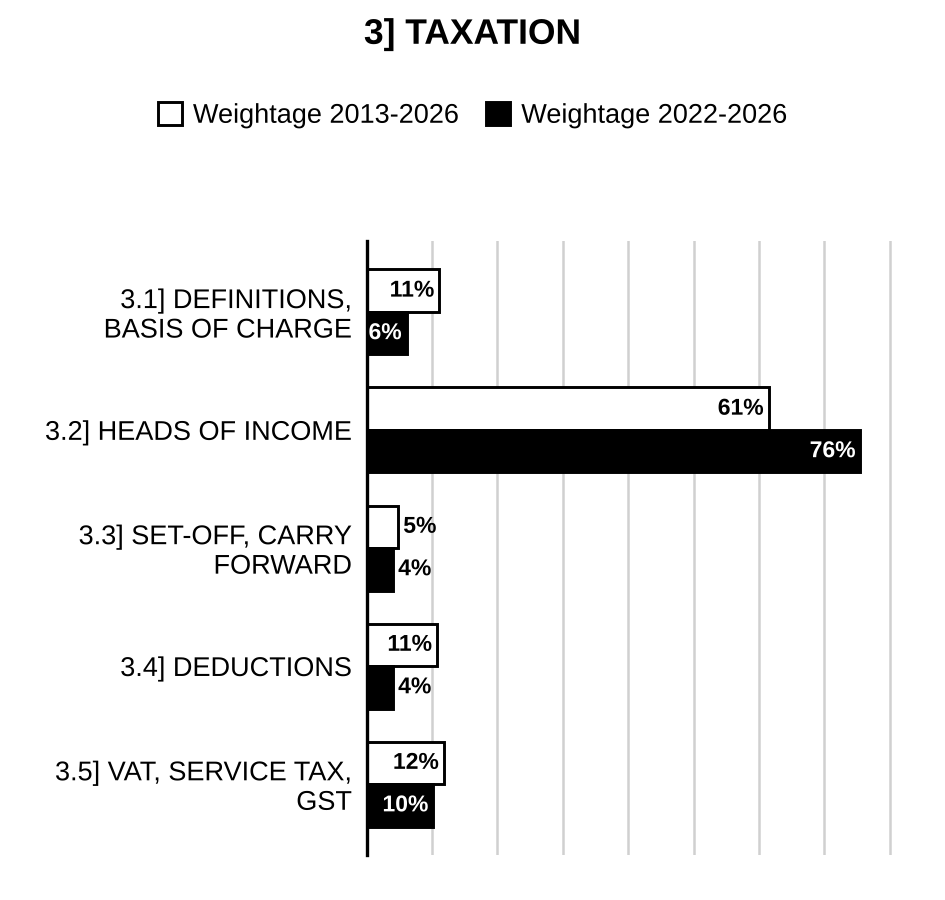
3.1] Income tax: definitions, basis of charge and exempt incomes
12 questions
What is the relevance of residential status as per the Indian Income-tax Act, 1961? Discuss in detail how the residential status of an individual is determined for income tax purposes. [2023/15m/2c]
What is the relationship between residential status and incidence of tax? [2021/10m/150w/1d]
Discuss how the residential status of an assessee is determined for income tax purposes? [2019/15m/2c]
In what way does the liability of tax of a “not ordinarily resident” person differ from that of a “resident” person under the Income Tax Act? [2018/10m/150w/1c]
“Residential status has its effect on computation of taxable income under the Income Tax Act, 1961.” Discuss. [2017/15m/2c]
State the basic conditions of Income-Tax Act to determine the residential status of an individual, a company and all other persons. [2014/15m/4b]
Discuss Agricultural Income. [2007/20m/200w/1c]
Discuss the powers of Income Tax officers. [2003/20m/200w/1c]
Define residential status. Examine the incidence of taxes based on residential status. [1997/20m/200w/1c]
Explain the provisions of the Income Tax Act relating to taxation of agricultural income. [1996/30m/2a]
What is agricultural income? How is the income treated for income tax purposes? [1995/20m/200w/1d]
Discuss briefly the powers of the Income-Tax Officer. [1995/30m/3a]
3.2] Computation of income under various heads (individuals)
55 questions
Discuss the perquisites which are taxable for all employees. [2026/10m/150w/1d]
Mr. A of Agra submits the following particulars of his let out residential house:
| Particulars | Amount (₹) |
| (A) Rent received for house as well as for various amenities provided to the tenant. | |
| (i) For House | 16,000 per month |
| (ii) For lift maintenance | 1,600 per month |
| (iii) For security charges | 1,400 per month |
| (iv) For electricity and water | 1,600 per month |
| (B) Municipal valuation | 1,70,000 per annum |
| (C) Fair Rental value | 1,52,000 per annum |
| (D) Standard Rent | 1,40,000 per annum |
| (E) Municipal Taxes 10% of Municipal valuation (50% to be paid by tenant) | |
| (F) Repair expenses met by tenant | 10,000 |
| (G) Insurance premium | 2,000 |
| (H) Interest on loan taken in 2014 for Renovation of the house | 50,000 per annum |
| (I) Unrealized rent recovered (Actual ₹48,000 but deduction allowed ₹36,000 only) | 24,000 |
Compute Mr. A’s income from house property and any other income for the Assessment year 2025-26, assuming that Mr. A spent ₹22,000 on providing facilities to the tenant. [2026/20m/3a]
Explain in brief the deductions that are expressly allowed in computing the income from business under the Income-tax Act, 1961. [2025/15m/3a]
Harish sold jewellery on 15th June, 2023 for ₹ 10,10,000 (cost of jewellery to Harish on 25th May, 2002 was ₹ 94,500 and brokerage paid on the sale of jewellery was ₹ 10,000). On 15th December, 2023, he purchased a residential house for ₹ 5,00,000. On 15th June, 2023, he did not own any residential house. The cost inflation index for 2002–03 was 105 and for 2023–24, it was 348. Compute the amount of capital gains chargeable to tax for the Assessment Year 2024–25. (i) Assuming that Harish sells the new residential house before 15th December, 2026, what will be the taxable capital gains and for which year? (ii) Assuming that Harish purchases any other residential house before 15th June, 2025 or constructs any other residential house before 15th June, 2026, what will be the taxable capital gains and for which year? [2025/15m/3b]
Define fair rent and annual rent under income from house property as per Indian Income Tax Act, 1961. Explain it with an example. [2024/10m/150w/1d]
(i) State the methods of computation of Short-term and Long-term capital gains under Indian Income Tax Act, 1961. (ii) State the rules of capital gains in case of transfer of depreciable assets under Section 50 of the Indian Income Tax Act, 1961. [2024/15m/2c]
Mrs. Y (59 years) receives ₹ 7,90,000 as basic pay and ₹ 1,18,000 as bonus during the previous year 2023 – 24. Besides, she gets ₹ 52,000 as Dearness Allowance (forming part of salary) and 4 percent commission on turnover achieved by her. During the year, turnover achieved by her is ₹ 90 lakh. The employer contributes ₹ 2,24,240 towards recognised provident fund. The amount of interest credited to provident fund on 30 November, 2023 at the rate of 10 percent comes to ₹ 40,000. She also gets child education allowance of ₹ 450 per month (for daughter) and ₹ 80 per month (for son). Cost of education is approximately ₹ 1,80,000 for two children (out of which ₹ 1,10,000 is tuition fees paid by Mrs. Y). The employer company provides 1800 cc car to her for official and private purpose and incurs the entire expenditure on running and maintenance of the car. Personal use of the car as per log book is approximately 65 percent. With effect from 1 November, 2023, she gets a driver to whom the company pays ₹ 6,000 per month. Her income from house property is ₹ 1,65,000. During the year she makes the following contributions and investments: (i) Own contribution towards provident fund ₹ 3,36,360. (ii) Insurance premium on own life ₹ 9,000 (sum assured ₹ 80,000, policy taken in December 2018). (iii) Contribution towards NSC VIII issue ₹ 11,000. (iv) Insurance premium on the life of major son (not dependent on her) ₹ 4,000 (sum assured ₹ 1,00,000). (v) Insurance premium on the life of her mother (age 80 years) dependent on her ₹ 2,000. (vi) Repayment of loan taken to purchase house property ₹ 21,000. Determine the taxable income of Mrs. Y for the assessment year 2024 – 25 under regular tax regime. Also calculate Gross Qualifying amount under Section 80 C. [2024/20m/4a]
What are the conditions required for availing of additional depreciation as per the Indian Income Tax Act, 1961? Explain with a detailed example. [2024/15m/4b]
“An assessee is not only liable in respect of his own incomes for tax purposes but his liability may extend to some other incomes also.” Explain. [2023/10m/150w/1e]
Mr. A, resident of Chennai, owns two houses, the particulars of which are as under:
| Particulars | House–I | House–II |
| Standard Rent (under the Rent Control Act) (in ₹) | 38,000 | 36,000 |
| Municipal Valuation (in ₹) | 40,000 | 45,000 |
| Fair Rent (in ₹) | 50,000 | 60,000 |
| De facto Rent (in ₹) | – | 45,000 |
| Municipal Taxes paid during previous year (in ₹) | 6,000 | 7,250 |
| Fire Insurance Premium (in ₹) | 500 | 4,500 |
| Water Benefit Tax (due but outstanding) (in ₹) | 600 | 750 |
| Interest on Loan taken to construct the house (in ₹) | 22,500 | 5,750 |
| Rent of Lease (due but outstanding) (in ₹) | 750 | 750 |
| Use of Assets | Self-occupied | Rented for Residence |
Compute the Taxable Income of Mr. A for the Assessment Year, 2022–23. House–I is constructed in February 2022, whereas House–II in 2012. How will the outcome of this situation be treated as per the provisions of the Income-tax Act? [2023/15m/3b]
Explain the following as per the Indian Income-tax Act, 1961: (i) Gratuity (ii) Leave encashment at the time of retirement. [2023/15m/4c]
What is Annual Value? Illustrate the procedure of computing the annual value of a house property which is let out throughout the previous year. [2022/15m/2c]
X, an employee of a firm, furnished the following particulars of his income for the year ended March 31, 2021:
| ₹ | |
| Basic Salary | 2,88,000 |
| Dearness Allowance | 57,600 |
| Own contribution to recognized Provident Fund | 40,320 |
| Employer’s contribution to the above fund | 40,320 |
| Interest on balance in recognized Provident Fund | 28,000 |
| Bonus | 24,000 |
Additional Information:
(i) X was provided with a small car for which the employer paid all the running and maintenance costs. The car was used for official as well as personal purposes.
(ii) He was also provided with rent-free accommodation at Kolkata for which the employer paid a rent of ₹ 2,500 pm. He was allowed to use one refrigerator and an air-conditioner costing ₹ 16,000 and ₹ 24,000 respectively, while their written-down values as on 01.04.2020 were ₹ 9,000 and ₹ 14,000 respectively.
(iii) Life insurance premium of ₹ 24,000 was paid by his employer on an Insurance Policy for ₹ 4,80,000 on the life of X.
Compute the taxable salary of X for the Assessment Year 2021 – 22. [2022/20m/3a]
(i) Define short-term capital assets and long-term capital assets. (ii) How to compute tax on short- and long-term capital gains? [2021/15m/2c]
Mr. B (49 years), a resident individual, furnishes the following particulars pertaining to the year ending 31st March, 2021: Analysis of his bank account in his ledger reveals the under-mentioned data–.
| Particulars | (₹) |
| Rent received for a vacant plot of land | 4,00,000 |
| Amount received from X (P) Ltd. for a house at Pune for which he had been in negotiation for rent enhancement since last 4 years (this has not been taxed in any earlier year. However, this house is transferred during March, 2020) | 3,00,000 |
| Gift received from Alekhyo, his best friend | 1,20,000 |
| Gift received from mother’s father | 1,60,000 |
| Winning from a TV game show (net) | 1,40,000 |
| Amount forfeited (initially paid by a buyer of his vacant plot, since the buyer could not finalise the deal as per agreement) | 6,20,000 |
| Amount received under Keyman Insurance Policy | 4,40,000 |
| Other information: | |
| (i) Donation given in cash to a charitable trust registered under Section 12AA | 24,000 |
| (ii) Interest credited in the Public Provident Fund (PPF) account during the year | 17,800 |
| (iii) Public Provident Fund paid in the name of his minor daughter | 1,50,000 |
| (iv) He owns agricultural lands at Malaysia. He has derived agricultural income therefrom | 3,60,000 |
Compute the taxable income of Mr. B for the assessment year 2021–22. [2021/20m/3a]
Define perquisite. How are rent free accommodation and medical facility valued under income tax rules? [2020/15m/2c]
Y has two houses in Chennai. He has self-occupied both the houses. The particulars of the houses are as follows:
| House (I) ₹ | House (II) ₹ | |
| Municipal value per year | 1,20,000 | 1,15,000 |
| Fair rent per annum | 1,50,000 | 1,75,000 |
| Standard rent per year | 1,00,000 | 1,65,000 |
| Date of completion of construction | 31.3.2009 | 31.3.2009 |
| Municipal taxes payable during the year | 12% | 8% |
| Interest on amount borrowed for repair of both the houses during the current year | Nil | 55,000 |
Y has paid the municipal taxes for House II only. It is due for House I. Compute the house property income of Y for the assessment year.
Advice:
(i) Which house should be opted by Y to be assessed as self-occupied? and
(ii) State the reasons for it. [2020/20m/3a]
What do you understand by the term Annual Value of house property? How would you determine the annual value of let out house property which remained vacant for part of previous year? [2019/10m/150w/1c]
Mr. X is a Government employee at Ludhiana and is getting following emoluments:
(i) Salary – ₹ 30,000 per month
(ii) Dearness Allowance (enters) – 60% of salary
(iii) Contribution in Notified Pension Scheme – ₹ 3,000 per month
(iv) Employer’s contribution to Pension Scheme – ₹ 3,000 per month
(v) Transport Allowance for commuting between home and office – ₹ 2,800 p.m.
(vi) Deputation Allowance (for 2 months) – ₹ 3,000 per month
(vii) Entertainment Allowance – ₹ 2,000 per month (During the year, he spent ₹ 12,000 on entertainment of official guests)
(viii) He has been provided with a rent-free accommodation. The licence fee for the accommodation has been fixed at ₹ 2,000 per month. The government has also provided him with furniture items costing ₹ 1,00,000 (WDV – ₹ 75,000) for his personal use.
(ix) He has been provided with the facility of a servant and watchman w.e.f. 01.10.2018 and the government is paying ₹ 3,000 per month to each of these servants.
(x) A laptop costing ₹ 50,000 has been given to him for his official as well as personal purposes.
(xi) On 01.10.2018 he took a loan of ₹ 2,00,000 from his employer to buy a car at a concessional rate of interest of 6.25%. The repayment of loan started w.e.f. 01.01.2019 @ ₹ 10,000 per month. SBI rate of interest as on 01.04.2018 was 9.25%.
(xii) During the year savings made by Mr. X were:
(a) LIC Premium: For Self ₹ 10,500 (sum assured ₹ 2,00,000); For Spouse ₹ 12,000 (sum assured ₹ 1,00,000); For Mother ₹ 8,000 (sum assured ₹ 1,00,000); For Major Son ₹ 8,000 (not dependent on him but is suffering from disability) (sum assured ₹ 50,000). All life insurance policies were taken in the previous year 2014-15.
(b) PPF Deposits: ₹ 5000
(c) Tuition Fees of Second Son studying in a College ₹ 6,000
(d) Repayment of Housing Loan from LIC (Principal Portion) – ₹ 36,000
Calculate:
(i) Salary Income
(ii) Qualifying amount for deduction U/S 80 C. [2019/20m/3a]
What are the provisions of inclusion of the income of a minor child and the wife of an assessee in his total income? [2018/15m/2c]
Compute the taxable income of X (40 years) for the assessment year 2018-19.
| Particulars | ₹ |
| Net income from trading business | 8,00,000 |
| Long-term capital gain on transfer of debentures (if computed without indexation) | 6,00,000 |
| Long-term capital gain on transfer of listed debentures (computed after indexation) (X wants to pay tax at the rate of 20% of ₹2,50,000 and not at the rate of 10% of ₹6,00,000) | 2,50,000 |
| Share of income from HUF in which he is a member | 82,000 |
| Winning from horse races (net of TDS of 30 per cent) | 70,000 |
| Interest on bank fixed deposits: | |
| – Deposit in his own name | 1,17,000 |
| – In the name of minor son | 1,450 |
| – In the name of minor daughter | 8,000 |
| – In the name of major unmarried daughter | 70,000 |
| Expenditure incurred for medical treatment of his 67 years old elder brother (dependent of X, being a person with disability) | 8,000 |
| Repayment of loan taken for part-time studies of major daughter for graduate course in management (loan is taken from a notified charitable institute) | 6,90,000 |
| Payment of interest from the aforesaid loan | 76,000 |
| Donation to the aforesaid notified charitable institute | 5,000 |
| Brought forward loss of a discontinued business pertaining to the assessment year 2014-15 | 26,000 |
| Purchase of a work of art on November 10, 2017 from a friend for ₹1,15,000 (market value is, however, ₹1,70,000) | 1,15,000 |
| Deposit in Public Provident Fund account and purchase of NSC IX issue | 1,63,000 |
[2018/25m/3a]
Mr. ‘X’ owns two house properties, ‘A’ and ‘B’. Property ‘A’ is used by him for his own residential purpose, whereas property ‘B’ is let out to a tenant for a monthly rent of ₹ 15,000 throughout the financial year 2016 – 17. The other particulars in respect of the properties are as under:
| Particulars | Property ‘A’ | Property ‘B’ |
| Municipal Valuation | ₹ 30,000 | ₹ 50,000 |
| Standard Rent under Rent Control Act | ₹ 40,000 | ₹ 1,00,000 |
| Municipal Taxes paid by Mr. ‘X’ | ₹ 8,000 | ₹ 24,000 |
| Maintenance Charges paid | ₹ 6,000 | ₹ 18,000 |
| Date of completion of construction | 31.3.2010 | 31.8.2013 |
| Interest on home loans for construction of properties from Nationalised Bank | ₹ 70,000 | ₹ 1,20,000 |
| Fire Insurance Premium Payable | ₹ 1,500 | ₹ 3,000 |
The following further information is available:
(i) Out of interest of ₹ 1,20,000 on home loan taken for construction of property ‘B’, an amount of ₹ 30,000 was outstanding payable as at 31.3.2017.
(ii) Mr. ‘X’ was employed by ABC Ltd. on a monthly salary of ₹ 50,000 plus monthly travelling allowance of ₹ 10,000.
(iii) He donated during the year ₹ 1,50,000 to a charitable trust approved under Section 80G of the Income Tax Act, 1961.
(iv) He spent ₹ 7,500 for his health check-up during the year.
You are required to compute Total Taxable Income of Mr. ‘X’ for the Assessment Year 2017 – 18. [2017/20m/3c]
Mr. ‘A’ inherited a residential house from his father in January 2015. His father had bought the said house in the year 1979 at a cost of ₹ 70,000. Mr. ‘A’ sold the house in June 2016 for a sale consideration of ₹ 17,00,000 and the registered valuer has valued the said house at ₹ 1,00,000 as at 1.4.1981. The Cost Inflation Index (CII) is as under:
| Financial Year | CII |
| 1981 – 82 | 100 |
| 2015 – 16 | 1000 |
| 2016 – 17 | 1200 |
You are required to compute the income from capital gains for the Assessment Year 2017 – 18. Also suggest the actions, if any, that may be taken by Mr. ‘A’ to avoid tax on capital gains. [2017/20m/4c]
“An assessee not only pays tax on his own incomes but also on others’ incomes.” Explain this statement. [2016/15m/2c]
Dr. Sharma is a Chief Medical Officer. He receives a salary of ₹ 15,000 per month and Dearness Allowance @ 25%. He contributes 15% of his salary to a Recognised Provident Fund. The employer also contributes an equal amount. He is provided with a Rent Free House in a city with a population of 5 lakhs. Fair rental value of the house is ₹ 6,000 per month. He receives Hostel Allowance of ₹ 500 per month for his child. He has let out his own house at ₹ 500 per month and paid ₹ 2,000 for Municipal tax of the house. He has the following incomes too:
| Dividend from a domestic company | ₹ 5,000 |
| Interest on debentures of a cooperative society | ₹ 3,000 |
| Dividend from a foreign company | ₹ 1,000 |
| Share in the profits of A.O.P. | ₹ 2,000 |
He paid ₹ 12,000 for his own medical health insurance by cheque. He donated ₹ 1,500 to a national fund and ₹ 1,500 for promoting family planning programmes.
Compute the total income for the Assessment Year 2016 – 17. [2016/20m/4a]
Mr. S is employed by A Ltd. at Delhi throughout the financial year ended on 31st March, 2015. He furnishes the following particulars for computation of his income for the assessment year 2015 – 16: (i) Basic Salary @ ₹ 50,000 per month (ii) Personal Pay @ ₹ 30,000 per month (iii) Conveyance Allowance @ ₹ 3,000 per month (iv) Uniform Allowance @ ₹ 2,000 per month (v) Knowledge Update Allowance @ ₹ 2,500 per month (vi) Medical Allowance @ ₹ 5,000 per month (vii) Entertainment Allowance @ ₹ 1,000 per month (viii) He is provided with gift vouchers of ₹ 15,000 per year. (ix) His employer contributes 15% of the basic salary to his recognised provident fund account. Similar amount is deducted from his salary as his contribution to the fund. (x) He gets house rent allowance @ ₹ 20,000 per month against a rent of ₹ 25,000 per month paid by him for his residential accommodation. (xi) His employer paid electricity and telephone bills of his residential house amounting to ₹ 70,000 and ₹ 20,000 respectively for the whole year. (xii) During the year he made the following payments: I. Life insurance premium ₹ 1,20,000 (sum assured is ₹ 10 Lacs) II. Life insurance premium on the life of his major son ₹ 25,000 III. Mediclaim policy premium paid in cash ₹ 30,000 IV. Donation of ₹ 2,00,000 to an approved charitable trust. Compute his taxable income for the assessment year 2015 – 16. [2015/25m/3a]
What are the various ‘Heads of Income’? Explain briefly each head of income. [2014/10m/150w/1e]
Mr. Asoke and his wife are partners in a trading firm. Their respective shares of profit for the financial year 2011 – 12 were ₹ 50,000 and ₹ 30,000 respectively.
Their minor son has been admitted to the benefits of another firm manufacturing toys from which he received ₹ 45,000 as share of profit and ₹ 1,20,000 as interest on capital. The capital was invested out of the minor’s own fund gifted to him by his uncle amounting to ₹ 10,00,000.
A house in the name of Mr. Asoke was transferred to his wife on 01.12.2011 for adequate consideration. The property has been let out throughout the financial year 2011 – 12 at a monthly rent of ₹ 50,000.
Non-convertible debentures of a limited company of ₹ 2,00,000 and ₹ 2,64,000 were purchased three years ago in the names of Mr. Asoke and his wife respectively, on which interest is payable at 10% p.a. Mrs. Asoke had in the past transferred ₹ 1,00,000 out of her income to Mr. Asoke for purchase of debentures in Mr. Asoke’s name.
Mr. Asoke had transferred ₹ 1,50,000 to Mrs. Asoke in the year 2008 – 09 without any consideration, which she lent out to one Mr. X. Mrs. Asoke earned ₹ 60,000 as consolidated interest during earlier financial years, which was also given on loan to Mr. X. During the financial year 2011 – 12 Mrs. Asoke received interest @ 10% p.a. on the loan amounting to ₹ 2,10,000.
Mr. Asoke transferred ₹ 1,50,000 to a Trust. The income accruing from its investment amounted to ₹ 15,000, out of which ₹ 10,000 shall be utilised for the benefit of his elder son’s wife and ₹ 5,000 for the benefit of his minor grandchildren.
Calculate Gross Taxable Income of Mr. Asoke and Mrs. Asoke for the financial year 2011 – 12. [2013/35m/3a]
Mention the cases where valuation of house property for purpose of income tax shall be NIL. Also mention the exceptions to such rules. [2013/15m/3b]
A HUF consists of Mr. A (Karta), Mrs. A and a minor child. On 18th December 2011, the Karta sets apart Rs. 5 lakh out of the family fund for maintenance of his wife. Mrs. A deposits the money in her name with a bank at an interest rate of 9% p.a. Discuss whether the interest income will be clubbed with the income of HUF or Mr. A or none. Justify your answer. [2012/15m/4a(i)]
Mrs. X, who is an Arts graduate, holds 2;200 out of 10,000 equity shares of a private limited company in which her husband Mr. Y, who is also an Arts graduate, is working as Chief Accountant at an annual salary of Rs. 12 lakh. The ITO claims that the salary income of Mr. Y shall be clubbed together with the income of Mrs. X. Is the ITO correct? Justify your answer. [2012/15m/4a(ii)]
Mr. Shan is a salaried employee. During the year ended on 31st March, 2011, the details of his income and other information were as follows:
| ₹ | |
| Annual salary ₹ 35,000 × 12 = | 4,20,000 |
| Pay Arrears | 80,000 |
| Leave travel concession provided by employer | 21,000 |
| House Rent Allowance ₹ 10,000 per month | |
| Dividend on Investment in Shares | 1,500 |
| LIC Premium paid on his life by employer | 18,000 |
| Medical Allowance @ ₹ 1,200 p.m. | 14,400 |
| Mr. Shan invested in NSC | 25,000 |
| Investment in Mutual Fund (ELSS) | 10,000 |
| Deposit in Public Provident Fund | 15,000 |
| Admission fees of the child | 6,000 |
| Donation to a local private school | 1,000 |
He owns a house which has been let out on annual rent of ₹ 96,000.
Paid Municipal Charges on House Property, ₹ 6,000.
Determine the Total Income of Mr. Shan and the tax payable by him as per the rates applicable for 2011 – 2012 Assessment year. [2011/35m/4b]
Give a list of items of expenses which are not allowed to be deducted from income in the determination of Profits and Gains from Business or Profession. [2011/15m/150w/5c]
What relief is available to an individual under Section 89(1) of Income-tax Act, 1961 in respect of gratuity received from a public company after rendering services for more than 20 years? How shall the relief be calculated? [2010/15m/150w/1c]
From the following particulars, compute total income and tax payable by Mr. A who is disabled and is of 68 years on 31st March, 2010 for the assessment year 2010–11: (i) Salary received from the employer–Rs 5,80,000 (ii) Annual value of let out house–Rs 30,000 (iii) Interest on loan to purchase another house which is self-occupied–Rs 20,000 (iv) He sold another house on 1.4.2009 for Rs 15 lakhs. Its fair market value on 1.4.1981 was Rs 2,00,000. He invested on 30.7.2009 in the bonds of NHAI (Cost inflation index for 2009–10 is 620) (v) He won Rs 42,000 in racecourse betting (vi) He paid Rs 12,000 by cheque to secure the health insurance of GIC for his wife (vii) He spent on treatment of his mother Rs 20,000, who is suffering from cancer (viii) He got agricultural income of Rs 20,000 (ix) His minor son is disabled on whose special education he spent Rs 15,000 (x) He donated Rs 10,000 to Gujarat State Chief Minister Relief Fund. [2010/28m/3a]
Examine the taxability of capital gain arising on each of the following transactions: (i) On the sale of self-generated goodwill of a profession (ii) On transfer of self-generated tenancy rights (iii) On transfer of own right to manufacture (iv) On sale of old car used for personal purposes. [2010/12m/3c]
Mrs. Ganga received the following amounts during the financial year 2008-09:–.
| Rs. | |
| Gross Salary | 6,00,000 |
| Family pension @ Rs. 1,500 p.m. | 18,000 |
| Income of a minor child | 6,000 |
| Accumulated balance in provident fund of her husband after his death | 1,00,000 |
| Gratuity received after the death of her husband | 80,000 |
Calculate taxable income and tax liability of Mrs. Ganga for the assessment year 2009-10. [2009/30m/4a]
Sandeep submits the following information for the assessment year 2009-10: Income from Business Rs. 20,000.
| Property Income | House A (Rs.) | House B (Rs.) |
| Municipal Valuation | 17,500 | 40,000 |
| Municipal taxes paid by tenant | 1,500 | 2,000 |
| Land Revenue paid | 1,000 | 8,000 |
| Rent Received | 19,000 | 34,000 |
| Insurance premium paid | 250 | 1,000 |
| Repairs paid by tenant | 250 | 9,000 |
| Interest on borrowed capital for payment of Municipal tax of house property | 100 | 200 |
| Nature of occupation | Let out for Residence | Let out for Business |
| Date of completion of construction | 1-4-1993 | 1-4-1991 |
Determine the taxable income of Sandeep for the assessment year 2009-10. [2009/30m/7b]
What do you understand by capital gains? What are the incomes included under the head capital gains? [2007/30m/4a]
Discuss the relevant provisions of Income Tax concerning Salary. [2006/30m/4b]
How will you compute taxable income from house property? Give example. [2005/20m/200w/1d]
X, a regular employee of A Ltd. gets the following emoluments during the previous year 2001-02: Basic Salary: Rs. 6,000 per month (which has been increased to Rs. 7,000 per month from January 1, 2002); dearness allowance Rs. 4,000 p.m. (72% of which is part of salary for computing retirement benefits); education allowance Rs. 550 p.m. per child for 4 children; medical allowance Rs. 400 p.m.; transport allowance Rs. 1,150 p.m. (out of which Rs. 900 p.m. is used for covering the journey between office and residence and Rs. 250 p.m. is used for other purposes). Besides, he gets Rs. 4,500 p.m. as house rent allowance up to November 30, 2001 (Rent paid at Ghaziabad, Rs. 5,500 p.m.). With effect from December 1, 2001, he has been provided a furnished flat by the Employer at Delhi (rent paid by employer Rs. 7,500 p.m.; rent of furniture provided Rs. 500; rent recovered from X Rs. 900 p.m.). Find out the salary chargeable to tax for the assessment year 2002-03 [ignore standard deduction on the assumption that with effect from January 1, 2002 he joins a part-time employment with B Ltd. (Salary Rs. 2,000 p.m.) with the permission of A Ltd. without leaving the job of A Ltd.]. [2005/30m/4b]
How do you calculate annual let out value of house property? [2004/20m/200w/1c]
What is a capital asset as defined in Income Tax Act? Can the following be included under capital asset? Give reasons. (i) Stock-in-trade (ii) Personal effects of the assessee (iii) Goodwill. [2004/30m/4b]
Find out the income from house property chargeable to tax for the assessment year 2002-03 in the following cases:
| Item | X | Y |
| Municipal value | ₹ 1,20,000 | ₹ 1,20,000 |
| Fair rent | ₹ 1,30,000 | ₹ 1,30,000 |
| Standard rent under the Rent Control Act. | ₹ 1,10,000 | ₹ 1,10,000 |
| Actual rent if property is let out throughout the previous year | ₹ 1,26,000 | ₹ 1,26,000 |
| Unrealised rent of the previous year 2001-02 | ₹ 10,500 | Nil |
| Period when the property remained vacant in number of month | 1 month | Nil |
| Loss due to vacancy | ₹ 10,500 | Nil |
| Municipal Taxes – Tax of the year 2001-02 | ₹ 18,000 | ₹ 18,000 |
| Paid by X and Y during 2001-02 | ₹ 17,000 | ₹ 8,000 |
| Paid by X and Y after March 31, 2002 | ₹ 1,000 | ₹ 1,000 |
| Paid by tenants during 2001-02 | ₹ 9,000 | ₹ 9,0000 [?] |
[2003/30m/4b]
Give a list of incomes which are shown under the head Income from other sources. [2002/20m/200w/1d]
What standard deductions and other exemptions are available to a salaried person in the computation of his taxable income? What are the tax rates for the salary income earned during the previous year 2001-2002? [2002/30m/4b]
Mr. X is an executive in a company in Mumbai. He received a monthly salary of Rs. 25,000. He gets Rs. 250 per month as dearness salary and Rs. 500 per month as dearness allowance. His employer paid directly Rs. 45,000 as his medical expenses to an approved hospital. The employer incurred an expenditure of Rs. 30,000 on his treatment by a private medical practitioner. Mr. X incurred medical expenses of Rs. 50,000 in a hospital approved by the Chief Commissioner of Income-Tax, which were reimbursed by the employer. Mr. X travelled abroad with an attendant, which cost him Rs. 1,50,000. The employer also undertook an expenditure of Rs. 2,00,000 on Mr. X’s stay and treatment abroad. On this item half of the amount is to be exempted from tax. Mr. X was paid by his employer a sum of Rs. 8,000 for the eye-surgery of his maternal uncle dependent upon him. Mrs. X suffered from cancer and was treated at the Tata Memorial Hospital, Mumbai which is approved by the Chief Commissioner of Income-Tax. The employer paid a sum of Rs. 1,50,000 for the treatment. Compute Mr. X’s income from salary on the basis of the above details, assuming the transactions having taken place in the assessment year 2001-02. [2001/30m/4b]
Following are the particulars given by Mr. A of Delhi working in some private organization for the previous year ended on 31st March, 2000. Compute the taxable income and tax thereon for the assessment year 2000-2001. (i) Basic salary Rs. 5,000 per month. (ii) D.A. @ Rs. 1,000 p.m. which forms part of salary. (iii) House Rent Allowance @ 30% of basic salary out of which he spent Rs. 1,000 p.m. on account of rental accommodation. (iv) Contribution to recognized provident fund @ 10% of salary. (v) Leave travel allowance received Rs. 12,000 but he spend Rs. 10,000 on travel to his home. (vi) His other incomes are: Interest on deposits Rs. 10,000 (gross), Dividend from UTI Rs. 16,000 Rent received from lot out house property Rs. 9,600 (local tax paid during the year were Rs. 2,000). [2000/30m/4b]
What is meant by “perquisites”? What are tax-free perquisites? [1998/20m/200w/1c]
Sri Manoj submits the following particulars as to his income and expenditure for the previous year 1997-98:
| Particulars | Rs. |
| Basic Salary | 84,000 |
| Special Allowance | 16,000 |
| Helper’s Allowance @ Rs. 500 P.M. (Salary to helper paid by Manoj being Rs. 600 P.M.) | 6,000 |
| Bonus | 40,000 |
| Employer’s contribution to recognised providend fund | 13,200 |
| Interest on accumulated balance in P.F. a/c credited on 31-3-98 @ 14.5% | 17,400 |
| Reimbursement of education expenses of two children | 12,000 |
Sri Manoj owns two residential houses, one at Hyderabad which is occupied by his parents and the other at Delhi which is let out to a foreign embassy on a rental of Rs. 96,000 per annum. The municipal valuation of the houses is Rs. 72,000 and Rs. 80,000 respectively. Municipal taxes in respect of the first house Rs. 7,200 is borne and paid by him and in regard to the second house, Rs. 16,000, only 50% payment has been made by him during the previous year. The embassy has undertaken to bear the cost of repairs which in the previous year amounted to Rs. 48,000.
On June 1, 1997 Sri Manoj borrowed Rs. 1,00,000 from a financier at 24% to acquire 1000 shares of Rs. 100 each of an Indian Company. No dividend was declared during the year though the share was quoted at BSE at Rs. 160 as on 31st March, 1998.
Other investments made during the year by him include: Contribution to RPF Rs. 30,000; Purchase of National Savings Certificates (VIII) Rs. 30,000; Insurance premium in respect of policy on his own life Rs. 10,000; Donations to recognised institutions Rs. 3,000.
Compute the total income of Sri Manoj for the Assessment year 1998-99. [1998/30m/4b]
Following information are given pertaining to a private limited company for the previous year ended on 31st March 1997:
| Particulars | Rs. |
| (i) Profit from business | 20,00,000 |
| (ii) Dividend from Indian companies (Gross) | 1,00,000 |
| (iii) Income from royalty for providing technical know-how to Indian companies | 50,000 |
| (iv) Business profit including the profit of newly established industrial undertaking which installed a new plant on 31st July, 1990 | 2,00,000 |
| (v) Export Promotion Expenses incurred | 50,000 |
| (vi) Accrued gratuity liability for staff | 1,25,000 |
| (vii) Expenses incurred for conducting researches to develop a new product | 1,50,000 |
| (viii) Expenditure incurred by the company relating to registration fee for increasing the share capital | 5,000 |
| (ix) Amount paid by the company to the State Electricity Board for providing service line to its factory | 15,000 |
| (x) Sum received by the company from the Sales Tax authorities towards refund, refund of excess Sales Tax paid which was allowed as an expenditure in the earlier Assessment Year | 2,00,000 |
You are required to compute the taxable income of the company for the assessment year 1997-98. [1997/30m/4b]
Mr. Y is a resident and ordinary resident employed as a Manager in a private sector company working in Patna. The following particulars are furnished by him for the previous year ending 31st March, 1995:
| Particulars | Rs. |
| Salary received | 86,000 |
| Dearness allowance | 88,500 |
| House rent allowance | 22,500 |
Mr. Y owns a house in Delhi consisting of two portions. The fair rental value of the house is Rs. 60,000 per annum. One portion of the house is let out to his friend on a monthly rent of Rs. 4,000 and another portion is kept for his self occupation in which his son studying in IIT Delhi is residing. He paid municipal taxes amounting to Rs. 10,500 and incurred Rs. 8,000 on repairs during the previous year. However he resides in a rented house in Patna by paying a monthly rent of Rs. 3,000. The company advanced him an amount of Rs. 1,00,000 free of interest which he invested in shares. The company had paid Rs. 6,000 as interest on the loan. The dividends received from these shares during the previous year were Rs. 14,500. He paid Rs. 1.5000[?] towards life insurance premium on a life policy of Rs. 1,00,000. During the previous year he received Rs. 16,000 being 1/3 share from a registered firm. Compute the total income of Mr. Y for the assessment year 1995-96. [1996/30m/2b]
Commercial expediency determines the charge of expenses and losses in computing profits and gains of business and profession. Explain. [1996/20m/200w/5b]
The following are the particulars of salary income of Shri Ram Prakash who is employed at Kanpur. (i) Salary Rs. 2000 p.m. (ii) D.A. @ 40% of salary (iii) C.C.A. Rs. 200 p.m. (iv) H.R.A. Rs. 400 p.m. and he pays rent of Rs. 500 p.m. (v) A compensation of Rs. 8000 received from the previous employer for termination of employment. (vi) He contributes Rs. 250 p.m. towards Recognised Provident Fund. His employer also contributed the same amount. (vii) Professional tax paid during the year Rs. 200. (viii) He owns a car which he uses for official as well as personal work. Compute his taxable income and the qualifying amount for rebate of tax u/s 88. [1995/30m/3b]

Preparing for Prelims too?
Our UPSC Prelims Topic-wise PYQ eBook covers every Prelims question with detailed explanations, so you can see exactly where UPSC asks from.
View the BookDownload Free Sample3.3] Set-off and carry forward of loss
6 questions
State the exceptions to the provision under the Income Tax Act regarding set-off of loss from one source against income from another source under the same head. [2022/10m/150w/1e]
State the provision of law relating to carry forward and set off of business loss. [2020/10m/150w/1d]
Explain the provisions of the Income Tax Act, 1961 with regard to set-off and carry forward of loss under the head Income from Business and Profession and Capital Gains. [2015/15m/2c]
In what situations are business losses allowed to be set off and carried forward by persons other than those who actually suffered the losses? [2010/15m/150w/1d]
Discuss the relevant provisions concerning set off and carry forward of losses. [2004/30m/4a]
State the provision of the law relating to set off and carry forward of losses. [2000/20m/200w/1c]
3.4] Deductions from gross total income
10 questions
Mrs. Y (59 years) receives ₹ 7,90,000 as basic pay and ₹ 1,18,000 as bonus during the previous year 2023 – 24. Besides, she gets ₹ 52,000 as Dearness Allowance (forming part of salary) and 4 percent commission on turnover achieved by her. During the year, turnover achieved by her is ₹ 90 lakh. The employer contributes ₹ 2,24,240 towards recognised provident fund. The amount of interest credited to provident fund on 30 November, 2023 at the rate of 10 percent comes to ₹ 40,000. She also gets child education allowance of ₹ 450 per month (for daughter) and ₹ 80 per month (for son). Cost of education is approximately ₹ 1,80,000 for two children (out of which ₹ 1,10,000 is tuition fees paid by Mrs. Y). The employer company provides 1800 cc car to her for official and private purpose and incurs the entire expenditure on running and maintenance of the car. Personal use of the car as per log book is approximately 65 percent. With effect from 1 November, 2023, she gets a driver to whom the company pays ₹ 6,000 per month. Her income from house property is ₹ 1,65,000. During the year she makes the following contributions and investments: (i) Own contribution towards provident fund ₹ 3,36,360. (ii) Insurance premium on own life ₹ 9,000 (sum assured ₹ 80,000, policy taken in December 2018). (iii) Contribution towards NSC VIII issue ₹ 11,000. (iv) Insurance premium on the life of major son (not dependent on her) ₹ 4,000 (sum assured ₹ 1,00,000). (v) Insurance premium on the life of her mother (age 80 years) dependent on her ₹ 2,000. (vi) Repayment of loan taken to purchase house property ₹ 21,000. Determine the taxable income of Mrs. Y for the assessment year 2024 – 25 under regular tax regime. Also calculate Gross Qualifying amount under Section 80 C. [2024/20m/4a]
Mr. X is a Government employee at Ludhiana and is getting following emoluments:
(i) Salary – ₹ 30,000 per month
(ii) Dearness Allowance (enters) – 60% of salary
(iii) Contribution in Notified Pension Scheme – ₹ 3,000 per month
(iv) Employer’s contribution to Pension Scheme – ₹ 3,000 per month
(v) Transport Allowance for commuting between home and office – ₹ 2,800 p.m.
(vi) Deputation Allowance (for 2 months) – ₹ 3,000 per month
(vii) Entertainment Allowance – ₹ 2,000 per month (During the year, he spent ₹ 12,000 on entertainment of official guests)
(viii) He has been provided with a rent-free accommodation. The licence fee for the accommodation has been fixed at ₹ 2,000 per month. The government has also provided him with furniture items costing ₹ 1,00,000 (WDV – ₹ 75,000) for his personal use.
(ix) He has been provided with the facility of a servant and watchman w.e.f. 01.10.2018 and the government is paying ₹ 3,000 per month to each of these servants.
(x) A laptop costing ₹ 50,000 has been given to him for his official as well as personal purposes.
(xi) On 01.10.2018 he took a loan of ₹ 2,00,000 from his employer to buy a car at a concessional rate of interest of 6.25%. The repayment of loan started w.e.f. 01.01.2019 @ ₹ 10,000 per month. SBI rate of interest as on 01.04.2018 was 9.25%.
(xii) During the year savings made by Mr. X were:
(a) LIC Premium: For Self ₹ 10,500 (sum assured ₹ 2,00,000); For Spouse ₹ 12,000 (sum assured ₹ 1,00,000); For Mother ₹ 8,000 (sum assured ₹ 1,00,000); For Major Son ₹ 8,000 (not dependent on him but is suffering from disability) (sum assured ₹ 50,000). All life insurance policies were taken in the previous year 2014-15.
(b) PPF Deposits: ₹ 5000
(c) Tuition Fees of Second Son studying in a College ₹ 6,000
(d) Repayment of Housing Loan from LIC (Principal Portion) – ₹ 36,000
Calculate:
(i) Salary Income
(ii) Qualifying amount for deduction U/S 80 C. [2019/20m/3a]
Mr. ‘X’ owns two house properties, ‘A’ and ‘B’. Property ‘A’ is used by him for his own residential purpose, whereas property ‘B’ is let out to a tenant for a monthly rent of ₹ 15,000 throughout the financial year 2016 – 17. The other particulars in respect of the properties are as under:
| Particulars | Property ‘A’ | Property ‘B’ |
| Municipal Valuation | ₹ 30,000 | ₹ 50,000 |
| Standard Rent under Rent Control Act | ₹ 40,000 | ₹ 1,00,000 |
| Municipal Taxes paid by Mr. ‘X’ | ₹ 8,000 | ₹ 24,000 |
| Maintenance Charges paid | ₹ 6,000 | ₹ 18,000 |
| Date of completion of construction | 31.3.2010 | 31.8.2013 |
| Interest on home loans for construction of properties from Nationalised Bank | ₹ 70,000 | ₹ 1,20,000 |
| Fire Insurance Premium Payable | ₹ 1,500 | ₹ 3,000 |
The following further information is available:
(i) Out of interest of ₹ 1,20,000 on home loan taken for construction of property ‘B’, an amount of ₹ 30,000 was outstanding payable as at 31.3.2017.
(ii) Mr. ‘X’ was employed by ABC Ltd. on a monthly salary of ₹ 50,000 plus monthly travelling allowance of ₹ 10,000.
(iii) He donated during the year ₹ 1,50,000 to a charitable trust approved under Section 80G of the Income Tax Act, 1961.
(iv) He spent ₹ 7,500 for his health check-up during the year.
You are required to compute Total Taxable Income of Mr. ‘X’ for the Assessment Year 2017 – 18. [2017/20m/3c]
What are the various deductions made from Gross Total Income? [2016/10m/150w/1d]
Dr. Sharma is a Chief Medical Officer. He receives a salary of ₹ 15,000 per month and Dearness Allowance @ 25%. He contributes 15% of his salary to a Recognised Provident Fund. The employer also contributes an equal amount. He is provided with a Rent Free House in a city with a population of 5 lakhs. Fair rental value of the house is ₹ 6,000 per month. He receives Hostel Allowance of ₹ 500 per month for his child. He has let out his own house at ₹ 500 per month and paid ₹ 2,000 for Municipal tax of the house. He has the following incomes too:
| Dividend from a domestic company | ₹ 5,000 |
| Interest on debentures of a cooperative society | ₹ 3,000 |
| Dividend from a foreign company | ₹ 1,000 |
| Share in the profits of A.O.P. | ₹ 2,000 |
He paid ₹ 12,000 for his own medical health insurance by cheque. He donated ₹ 1,500 to a national fund and ₹ 1,500 for promoting family planning programmes.
Compute the total income for the Assessment Year 2016 – 17. [2016/20m/4a]
Mr. S is employed by A Ltd. at Delhi throughout the financial year ended on 31st March, 2015. He furnishes the following particulars for computation of his income for the assessment year 2015 – 16: (i) Basic Salary @ ₹ 50,000 per month (ii) Personal Pay @ ₹ 30,000 per month (iii) Conveyance Allowance @ ₹ 3,000 per month (iv) Uniform Allowance @ ₹ 2,000 per month (v) Knowledge Update Allowance @ ₹ 2,500 per month (vi) Medical Allowance @ ₹ 5,000 per month (vii) Entertainment Allowance @ ₹ 1,000 per month (viii) He is provided with gift vouchers of ₹ 15,000 per year. (ix) His employer contributes 15% of the basic salary to his recognised provident fund account. Similar amount is deducted from his salary as his contribution to the fund. (x) He gets house rent allowance @ ₹ 20,000 per month against a rent of ₹ 25,000 per month paid by him for his residential accommodation. (xi) His employer paid electricity and telephone bills of his residential house amounting to ₹ 70,000 and ₹ 20,000 respectively for the whole year. (xii) During the year he made the following payments: I. Life insurance premium ₹ 1,20,000 (sum assured is ₹ 10 Lacs) II. Life insurance premium on the life of his major son ₹ 25,000 III. Mediclaim policy premium paid in cash ₹ 30,000 IV. Donation of ₹ 2,00,000 to an approved charitable trust. Compute his taxable income for the assessment year 2015 – 16. [2015/25m/3a]
Prepare a note on deductions from gross total income in respect of certain incomes and certain payments for individuals. [2014/15m/4c]
From the following particulars, compute total income and tax payable by Mr. A who is disabled and is of 68 years on 31st March, 2010 for the assessment year 2010–11: (i) Salary received from the employer–Rs 5,80,000 (ii) Annual value of let out house–Rs 30,000 (iii) Interest on loan to purchase another house which is self-occupied–Rs 20,000 (iv) He sold another house on 1.4.2009 for Rs 15 lakhs. Its fair market value on 1.4.1981 was Rs 2,00,000. He invested on 30.7.2009 in the bonds of NHAI (Cost inflation index for 2009–10 is 620) (v) He won Rs 42,000 in racecourse betting (vi) He paid Rs 12,000 by cheque to secure the health insurance of GIC for his wife (vii) He spent on treatment of his mother Rs 20,000, who is suffering from cancer (viii) He got agricultural income of Rs 20,000 (ix) His minor son is disabled on whose special education he spent Rs 15,000 (x) He donated Rs 10,000 to Gujarat State Chief Minister Relief Fund. [2010/28m/3a]
What are the deductions that are to be made in computing total income? [2006/20m/200w/1c]
Deduction allowed in computing taxable income. [1999/20m/200w/1c]
3.5] VAT and service tax
13 questions
What is service tax? Discuss its features. Explain the rationale behind changing the GST rates. [2026/15m/2b]
Distinguish between VAT and Service Tax. How do they apply to goods and services, and what are the administrative challenges in these taxes? [2025/10m/150w/1e]
Write a note on ‘Service Tax’. [2017/10m/150w/1d]
Explain the accounting for VAT, with examples. [2015/10m/150w/1d]
Discuss the mechanism of levy of Value Added Tax. [2015/10m/4c]
Describe the salient features relating to ‘Value Added Tax’. [2014/10m/2c]
Conditions for availing of CENVAT credit under various categories of goods and services. [2013/10m/150w/1a]
Explain whether services provided by a Veterinary clinic and Yoga establishment are exempt from service tax. [2013/10m/2c]
Discuss how the money value of non-monetary consideration is determined for purpose of Service Tax. [2012/12m/150w/1a]
M/s Anant Kumar are a registered dealer in West Bengal. During the year ending on 31st March 2012 the firm’s local purchases from registered dealers of West Bengal amounted to Rs. 12 lakh. The firm had also made purchases from local unregistered dealers amounting to Rs. 2 lakh. During the period the firm’s sales within West Bengal amounted to Rs. 8 lakh and outside West Bengal Rs. 1.50 lakh. Applicable rates for VAT (both for purchases and sales) and CST are 13.5% and 2% respectively. Pass necessary journal entries to record the above transactions. [2012/20m/2b]
Examine the concept of VAT scheme. How does VAT system remove the cascading effect of taxes? [2010/15m/4b(i)]
Referring to the provisions relating to Service Tax, examine the validity of the following exemptions: 1. Service provider whose turnover is Rs 6 lakhs 2. Export of services worth Rs 50 lakhs 3. Services to UN Agencies worth Rs 25 lakhs 4. Services provided to Mr. X a developer of SEZ worth Rs 20 lakhs 5. Goods and materials supplied worth Rs 5 lakhs while providing service. [2010/15m/4b(ii)]
(i) Explain how VAT is an improvement over the old sales tax structure. (ii) What do you mean by ‘taxable services’ in the context of service tax? How is the value of taxable services determined? [2009/30m/8b]

Strengthen your GS papers
Our UPSC Mains Topic-wise & Year-wise PYQ eBook (2013–2026) maps every GS question to the syllabus, so you know what UPSC asks and how often.
View the BookDownload Free Sample« Previous: Cost Accounting | Next: Auditing »
Back to: Commerce & Accountancy Optional PYQs – Topic-wise | Also see: Commerce & Accountancy Optional year-wise question papers
Last updated: 30 October 2026