
Here are all 85 Anthropological Theories questions asked in UPSC Anthropology Optional Paper I from 1995 to 2026, arranged under the 10 topics of the official syllabus. Within each topic the latest questions come first.
Each question ends with a code such as [2024/15m/3b] – the year, the marks, the word limit (where UPSC set one) and the question number in the paper.
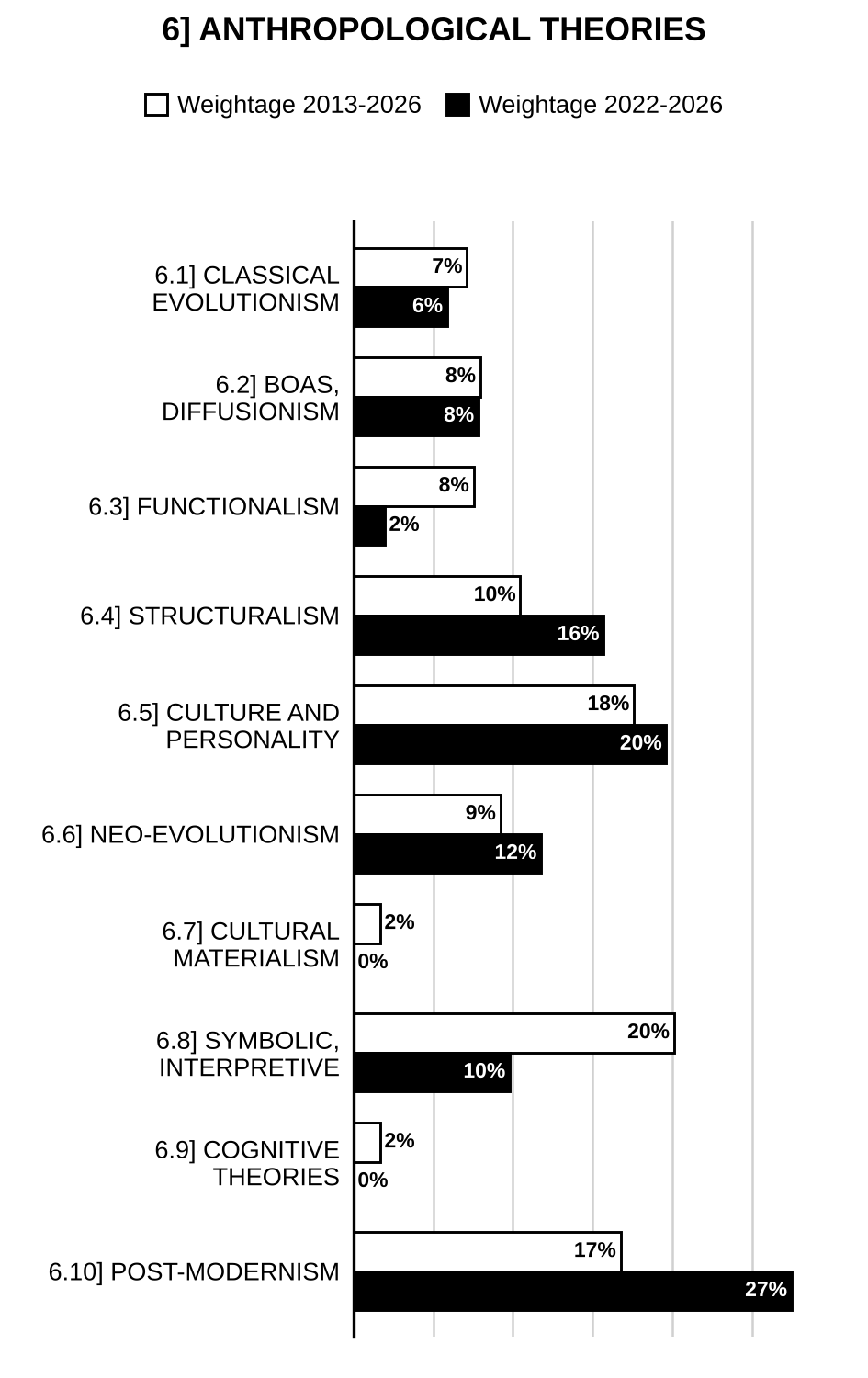
6.1] Classical evolutionism
4 questions
Critically examine James Frazer’s theory of evolutionism. Elucidate the place of religion in modernity. [2025/15m/4c]
How did Morgan explain the evolution of marriage, family and Socio-Political organization, and how did other evolutionists disagree with his explanation? [2015/20m/2b]
How do diffusionism and evolutionism differ as explanations of Culture Change? [2015/15m/2c]
Write a short note on: Classical evolutionism. [1996/25m/R4]
6.2] Historical particularism and diffusionism
11 questions
Discuss historical particularism as a critical development to the classical evolutionism. [2024/20m/2a]
Write a short note on: Historical Particularism and Franz Boas. [2021/10m/150w/1c]
Write a short note on: Historical Particularism. [2015/10m/150w/1e]
How do diffusionism and evolutionism differ as explanations of Culture Change? [2015/15m/2c]
Write a short note on: Culture Area and Age Area. [2000/20m/200w/1a]
Define ‘culture area’. How did it help the American diffusionists to understand diffusion of culture? [1998/50m/13]
Write a short note on: Acculturation and contra-acculturation. [1997/25m/200w/11b]
Critically examine the Historical Particularistic approach of Franz Boas to the study of culture. [1997/50m/13]
What is meant by cultural diffusionism? Give an account of Fritz Graebner’s contributions to the theory of cultural diffusionism. [1996/50m/R15]
What is cultural change? How did the Austro-German school put up the scheme of cultural change? [1995/50m/R11]
What was Boas’ approach of studying primitive cultures? Delineate the role of field work and history in anthropological study. [1995/50m/R13]
6.3] Functionalism and structural-functionalism
12 questions
Write a short note on: Radcliffe-Brown’s ideas on status, role and institution. [2022/10m/150w/1c]
Write a short note on: Basic tenets of structural-functionalism. [2017/10m/150w/1c]
Write a short note on: Functionalism. [2016/10m/150w/1e]
In what ways is Functionalism different from Structural Functionalism? (350 words) [2013/20m/350w/3b]
Write a short note on: Structural functionalism. [2008/20m/200w/1d]
Describe structural features of social life as suggested by Radcliffe-Brown in his theory of social structure. [2003/60m/R11]
Discuss the approaches of Radcliffe-Brown and Evans-Pritchard to Comparative Methods in Anthropological Research. [2001/60m/R10]
Write a short note on: Social structure. [1999/25m/200w/11a]
What is meant by functionalism? Discuss the basic tenets of Malinowski’s functionalism. [1999/50m/12]
“To Radcliffe-Brown ‘function’ was the contribution an institution makes to the maintenance of social structure.” Elucidate in the light of Radcliffe-Brown’s contributions to structural-functionalism theory. [1998/50m/15]
Analyse how Raymond Firth’s concepts of structure, function, organization and process accommodate the study of both static and dynamic aspects of the social structure. [1996/50m/R16]
Give the names of two prominent British functionalists in social anthropology. Describe the functional theory attributed to any one of them. [1995/50m/R14]
6.4] Structuralism
7 questions
How is the theory of structuralism helpful in understanding the concepts of caste and gender? [2026/15m/2c]
Compare Edmund Leach’s structuralism with interpretive anthropology of Clifford Geertz. [2026/20m/8a]
How does Lévi-Strauss look at the Tsimshian myth of Asdiwal? Critically discuss Lévi-Strauss’ theory of structuralism in the light of his study of mythologies. [2024/15m/6c]
Explain the structural analysis of kinship as proposed by Lévi-Strauss. [2021/15m/8c]
How did Radcliffe-Brown and Levi-Strauss study kinship in terms of social structure? [2019/15m/2b]
How do the concepts of binary opposites and exchange figure in Lévi-Strauss’ structural analysis of kinship? [2016/15m/4b]
What are the major criticisms of the theory of ‘Structuralism’ as propounded by Claude Lévi-Strauss? [2009/30m/3a]
6.5] Culture and personality
12 questions
Discuss, with appropriate examples, how basic personality types may lead towards building up of national character. [2026/15m/8c]
Critically discuss the characteristics of the psychological types in the cultures of the American South-West as observed by Ruth Benedict. [2024/20m/4a]
Discuss political and methodological aspects of national character studies. Elucidate the contemporary relevance of such studies. [2023/15m/7c]
Discuss various anthropological approaches to the study of personality and culture. [2020/20m/4a]
What do you understand by the National Character Study? Illustrate the concept. [2018/15m/2c]
Explain Ruth Benedict’s patterns of culture. [2017/20m/4a]
Discuss the relationship between culture and personality. [2008/60m/4]
Critically discuss the contribution of Ruth Benedict to the study of culture. [2004/60m/R10]
Discuss the contributions of Margaret Mead and Ralph Linton to the analysis of the relationship between culture and personality. [2001/60m/R11]
Discuss the contributions of Ralph Linton, Cora Du Bois and Abraham Kardiner in the study of personality. [1999/50m/15]
Write a short note on: Pattern of culture. [1998/25m/200w/11c]
Write a short note on: Culture and personality. [1996/25m/R5]

Preparing for Prelims too?
Our UPSC Prelims Topic-wise PYQ eBook covers every Prelims question with detailed explanations, so you can see exactly where UPSC asks from.
View the BookDownload Free Sample6.6] Neo-evolutionism
12 questions
Critically discuss how culture determines human behaviour in the light of Leslie White’s theory. [2026/15m/6b]
Discuss the approaches of Leslie White, Julian Steward and Marshall Sahlins in the light of cultural evolution. [2022/15m/7c]
Write a short note on: Gordon Childe’s Theory of Cultural Evolution. [2018/10m/150w/5a]
Critically examine the Stewardian view of neo-evolutionism. [2017/15m/4c]
Point out the differences in the concepts of classical evolutionism and neo-evolutionism in socio-cultural anthropology. Which stage of prehistoric culture is known as Cultural Revolution and why? [2010/30m/2b]
Explain the theory of ‘Neo-evolutionism’. [2009/60m/4]
Discuss the contribution of Julian Steward to Cultural Ecology. [2002/60m/R12]
Write a short note on: Universal Cultural Evolution. [2002/20m/R3]
What do you understand by neo-evolutionism? Evaluate how Leslie A. White’s approach is helpful in understanding cultural evolution. [2000/60m/3]
What do you mean by cultural ecology? Evaluate how Julian Steward’s particularistic approach is helpful in understanding multilineal evolution. [1998/50m/14]
Write a short note on: Neo-evolutionism. [1997/25m/200w/11a]
What is cultural ecology? Discuss how man adapts himself to different environments, giving suitable examples. [1995/50m/R18]
6.7] Cultural materialism (Harris)
3 questions
Write a short note on: Cultural Materialism. [2019/10m/150w/1d]
Write a short note on: Cultural materialism. [2011/15m/150w/1d]
Write a short note on: Cultural Materialism. [2003/20m/R2]
6.8] Symbolic and interpretive theories
12 questions
Compare Edmund Leach’s structuralism with interpretive anthropology of Clifford Geertz. [2026/20m/8a]
Compare and contrast the symbolic approaches of Clifford Geertz and Victor Turner to understand culture. [2025/15m/2b]
Elucidate the concept of “thick description” of Clifford Geertz with a suitable example. [2021/15m/2b]
Write a short note on: Victor Turner and Liminality. [2020/10m/150w/1d]
Examine critically the contributions of Victor Turner and Clifford Geertz in anthropology. [2019/20m/6a]
According to Geertz, how does the cock-fight reveal aspects of Balinese culture? [2016/15m/2c]
What made Geertz’s Interpretive Anthropology distinct from Turner’s Symbolic Anthropology? What does each of them mean by the terms ‘Symbol’ and ‘Symbolic’? [2015/20m/4c]
Bring out the contribution of Turner and Geertz in symbolic and interpretive theories in Anthropology. [2013/15m/250w/4b]
Critically examine the contribution of Anthropologists in the interpretation of symbols. [2011/30m/3a]
Write a short note on: Symbolism. [2007/20m/R4]
Write a short note on: Symbolic Anthropology. [2001/20m/R3]
Write a short note on: Symbolism. [1999/25m/200w/11b]
6.9] Cognitive theories
5 questions
Explain the difference between emic and etic, and how does the difference derive from the study of language? [2015/10m/4b]
Write a short note on: Cognitive Anthropology. [2002/20m/R4]
Write a short note on: Etic and Emic approach. [2000/20m/200w/1d]
What is cognitive approach? Critically examine its implications in Socio-cultural Anthropology. [1996/50m/R9]
Write a short note on: New ethnography. [1995/25m/R6]
6.10] Post-modernism in anthropology
7 questions
Write a short note on: Multispecies, Multi-sited and Critical Ethnography. [2025/10m/150w/5a]
How the theories of postmodernism are relevant in promoting social justice and empowerment of marginalised communities? [2025/20m/8a]
Critically explain the notion of ‘deconstruction’ in the light of the postmodern works of Jacques Derrida. [2024/20m/7a]
Critically examine Arjun Appadurai’s conceptualization of global cultural economy. [2023/20m/8a]
Write a short note on: Experiential Ethnography. [2020/10m/150w/5c]
Explain the basic features of ‘postmodernism’ in Anthropology. [2015/20m/3c]
Write a short note on: Post-modernism in Anthropology. [2012/12m/150w/1c]

Strengthen your GS papers
Our UPSC Mains Topic-wise & Year-wise PYQ eBook (2013–2026) maps every GS question to the syllabus, so you know what UPSC asks and how often.
View the BookDownload Free Sample« Previous: Religion | Next: Culture, Language and Communication »
Back to: Anthropology Optional PYQs – Topic-wise | Also see: Anthropology Optional year-wise question papers
Last updated: 30 October 2026