
Here are all 67 Complex Analysis questions asked in UPSC Mathematics Optional Paper II from 2008 to 2026, arranged under the 4 topics of the official syllabus. Within each topic the latest questions come first.
Each question ends with a code such as [2024/10m/1a] – the year, the marks and the question number in the paper.
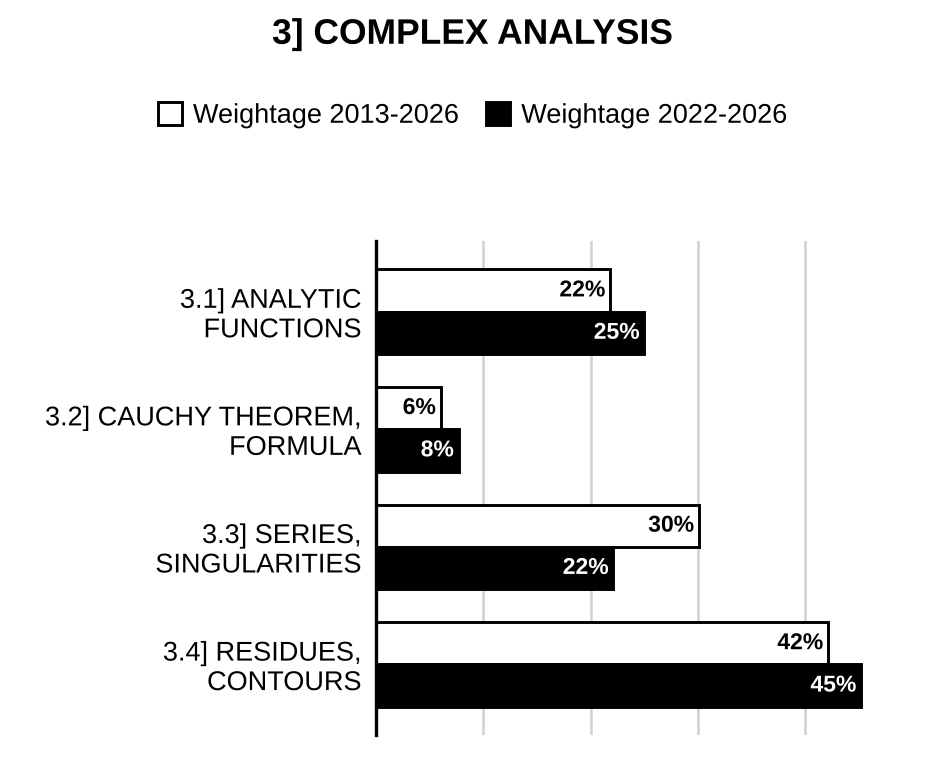
3.1] Analytic functions
17 questions
Show that the function is not analytic at the origin, although Cauchy-Riemann equations are satisfied at that point. [2026/10m/1d]
If is an analytic function of , then show that . [2024/10m/1b]
If and are functions of and satisfying Laplace equation, then show that , is an analytic function, where and . [2024/10m/1d]
State the sufficient conditions for a function to be analytic in its domain. Hence, show that is analytic in its domain and find . [2023/10m/1d]
Prove that is harmonic. Find its conjugate harmonic function and express the corresponding analytic function in terms of . [2023/15m/3b]
If is an analytic function of , and , then find subject to the condition . [2022/10m/1b]
If , , then find an analytic function [2020/15m/4a]
Suppose is analytic function on a domain in and satisfies the equation , . Show that is constant in . [2019/10m/1d]
Prove that the function : is harmonic and find its harmonic conjugate and the corresponding analytic function in terms of . [2018/10m/1c]
Let be an analytic function on the unit disc . Show that at all points of . [2017/15m/3b]
Is a harmonic function ? Prove your claim. If yes, find its conjugate harmonic function and hence obtain the analytic function whose real and imaginary parts are and respectively. [2016/10m/1d]
Show that the function is harmonic. Find its conjugate harmonic function . Also, find the corresponding analytic function in terms of . [2015/10m/1d]
Prove that the function , where satisfies Cauchy-Riemann equations at the origin, but the derivative of at does not exist. [2014/10m/1c]
Show that the function defined by is not analytic at the origin though it satisfies Cauchy-Riemann equations at the origin. [2012/12m/1c]
If is an analytic function of and , find subject to the condition, . [2011/12m/1c]
Show that is a harmonic function. Find a harmonic conjugate of . Hence find the analytic function for which is the real part. [2010/12m/1e]
(i) Evaluate the line integral where , is the boundary of the triangle with vertices , , in that order. (ii) Find the image of the finite vertical strip to , of -plane under exponential function. [2010/15m/4a]
3.2] Cauchy’s theorem and integral formula
8 questions
Find the function which is analytic inside and on the circle , and has the value on the circumference of , where . [2024/20m/2c]
Evaluate the integral counterclockwise from to along the curve , where is the circle . [2020/10m/1d]
Evaluate the integral from 0 to along the curve where is a parabola . [2019/10m/3c]
Use Cauchy integral formula to evaluate where is the circle . [2012/15m/2c]
If the function is analytic and one valued in , prove that for , where is the real part of . [2011/15m/2c]
(i) Evaluate the line integral where , is the boundary of the triangle with vertices , , in that order. (ii) Find the image of the finite vertical strip to , of -plane under exponential function. [2010/15m/4a]
Evaluate where is the circle . State the theorems you use in evaluating above integral. [2008/15m/4a]
Let be an entire function satisfying for some positive constant and all . Show that for some constant . [2008/15m/4b]

Preparing for Prelims too?
Our UPSC Prelims Topic-wise PYQ eBook covers every Prelims question with detailed explanations, so you can see exactly where UPSC asks from.
View the BookDownload Free Sample3.3] Power, Taylor and Laurent series
18 questions
Prove that where [2026/15m/3a]
Expand in a Laurent series valid for . [2025/10m/1d]
Locate the poles and their order for the function Also, find the residue of at these poles. [2024/15m/3a]
Classify the singular point of the function and obtain the principal part of its Laurent series expansion. [2023/15m/4b]
Expand in a Laurent series valid for the regions (i) and (ii) . [2022/10m/1d]
Find the Laurent series expansion of in the powers of in the region . [2021/20m/2c]
Let be an entire function whose Taylor series expansion with centre has infinitely many terms. Show that is an essential singularity of . [2021/15m/3a]
Show that an isolated singular point of a function is a pole of order if and only if can be written in the form where is analytic and non zero at . Moreover if . [2019/15m/2d]
Obtain the first three terms of the Laurent series expansion of the function about the point valid in the region . [2019/10m/4b]
Find the Laurent’s series which represent the function when (i) (ii) (iii) [2018/15m/4b]
Determine all entire functions such that 0 is a removable singularity of . [2017/10m/1d]
For a function and , let denote the derivative of and . Let be an entire function such that for some , for all . Show that is a polynomial. [2017/15m/4a]
Prove that every power series represents an analytic function inside its circle of convergence. [2016/20m/4c]
Find all possible Taylor’s and Laurent’s series expansions of the function about the point . [2015/20m/2c]
Expand in Laurent series the function about and . [2014/10m/1d]
Expand the function in Laurent series valid for (i) (ii) (iii) (iv) [2012/15m/3c]
Find the Laurent series for the function with centre . [2011/15m/3d]
Find the Laurent series of the function where with a given complex number and taking the unit circle given by as contour in this region. [2010/15m/4b]
3.4] Residues and contour integration
24 questions
Use the method of contour integration to prove [2026/20m/2c]
Use the method of contour integration to prove that . [2025/20m/2c]
Evaluate the integral , . [2025/15m/3a]
Locate the poles and their order for the function Also, find the residue of at these poles. [2024/15m/3a]
Evaluate using contour integration. [2023/20m/2c]
Apply the calculus of residues to evaluate , . [2022/20m/2c]
Evaluate , where is . [2022/15m/3a]
Let be the curve, where , . Evaluate the contour integral . [2021/10m/1d]
Using contour integration, evaluate the integral , . [2021/20m/4b]
Using contour integration, evaluate the integral . [2020/20m/2c]
Show that an isolated singular point of a function is a pole of order if and only if can be written in the form where is analytic and non zero at . Moreover if . [2019/15m/2d]
Show by applying the residue theorem that , . [2018/15m/3b]
Using contour integral method, prove that [2017/15m/2b]
Let Find, giving justifications, the value of the contour integral [2016/15m/3c]
State Cauchy’s residue theorem. Using it, evaluate the integral [2015/15m/3a]
Evaluate the integral using residues. [2014/20m/3c]
Prove that if where and are positive and real, then the function has zeroes in the unit circle. [2013/10m/1d]
Using Cauchy’s residue theorem, evaluate the integral [2013/15m/4b]
Evaluate by contour integration [2012/15m/3d]
Evaluate by Contour integration, [2011/15m/3c]
Let , . Assume that the zeroes of the denominator are simple. Show that the sum of the residues of at its poles is equal to . [2009/12m/1e]
If , , are real numbers such that show that : [2009/30m/4a]
Find the residue of [2008/12m/1e]
Evaluate where is the circle . State the theorems you use in evaluating above integral. [2008/15m/4a]

Strengthen your GS papers
Our UPSC Mains Topic-wise & Year-wise PYQ eBook (2013–2026) maps every GS question to the syllabus, so you know what UPSC asks and how often.
View the BookDownload Free Sample« Previous: Real Analysis | Next: Linear Programming »
Back to: Mathematics Optional PYQs – Topic-wise | Also see: Mathematics Optional year-wise question papers
Last updated: 30 October 2026