
Here are all 89 Real Analysis questions asked in UPSC Mathematics Optional Paper II from 2008 to 2026, arranged under the 6 topics of the official syllabus. Within each topic the latest questions come first.
Each question ends with a code such as [2024/10m/1a] – the year, the marks and the question number in the paper.
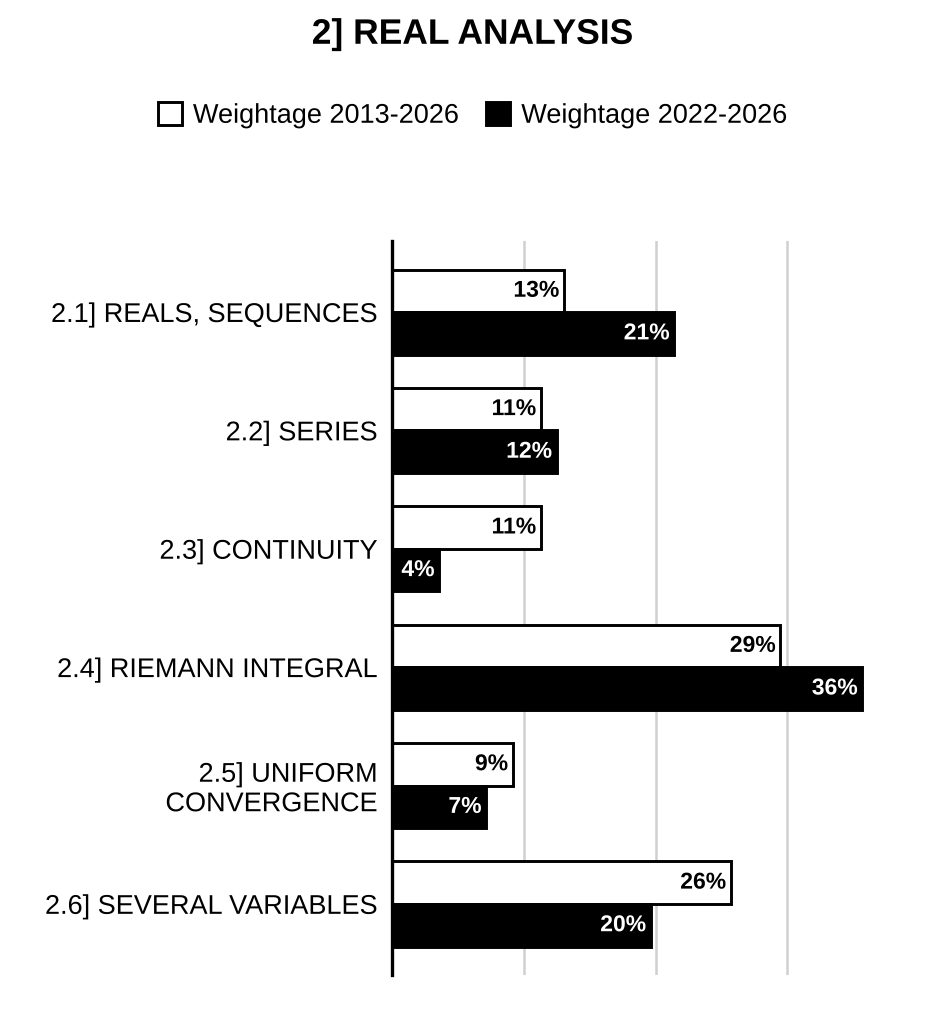
2.1] Real number system and sequences
13 questions
Prove that the sequence defined by the recursion formula , , converges to the positive root of . [2026/15m/2b]
Define Cauchy sequence and prove that every convergent sequence of real numbers is a Cauchy sequence. What is the importance of Cauchy condition? [2025/15m/2a]
Using Cauchy’s general principle of convergence, examine the convergence of the sequence , where . [2024/15m/2a]
Prove that the oscillation of a real-valued bounded function defined on is the supremum of the set . [2023/15m/4a]
Prove that the sequence satisfying the condition , for all natural numbers , is a Cauchy sequence. [2020/10m/1c]
Let and , . Show that the sequence is convergent. [2017/10m/1a]
Two sequences and are defined inductively by the following : Prove that and deduce that both the sequences converge to the same limit , where . [2016/10m/1c]
Show that every open subset of is a countable union of disjoint open intervals. [2013/14m/2d]
Discuss the convergence of the sequence where [2010/12m/1c]
Define by and for . Show that the sequence converges to . [2010/12m/1d]
Show that a bounded infinite subset of must have a limit point. [2009/15m/3d]
Let Find derived set of and find Supremum of and greatest number of . [2008/6m/1c(ii)]
Prove that the sets , are equivalent sets. [2008/6m/3d(i)]
2.2] Series
11 questions
Examine whether the series is absolutely or conditionally convergent. [2025/10m/1c]
Test the convergence of the series [2023/10m/1c]
Test for convergence or divergence of the series [2022/15m/4b]
Find the range of for which the series : is (i) absolutely convergent and (ii) conditionally convergent. [2018/10m/1d]
Let be a conditionally convergent series of real numbers. Show that there is a rearrangement of the series that converges to 100. [2017/20m/4c]
Show that the series is conditionally convergent. (If you use any theorem(s) to show it, then you must give a proof of that theorem(s).) [2016/15m/2a]
Test the convergence and absolute convergence of the series . [2015/10m/1c]
Show that the series is convergent. [2012/12m/1e]
Show that the series : converges. [2009/15m/2c]
Discuss the convergence of the series [2008/15m/2c]
Show that the series is equivalent to [2008/15m/2d]
2.3] Continuity and uniform continuity
15 questions
Find the points of discontinuity of the function defined by [2026/10m/1c]
Find the maximum and minimum values of for . [2021/15m/2a]
Prove that the function is not uniformly continuous on the interval . [2020/15m/2b]
Show that if a function defined on an open interval of is convex, then is continuous. Show, by example, if the condition of open interval is dropped, then the convex function need not be continuous. [2018/15m/2c]
Find the supremum and the infimum of on the interval . [2017/10m/1c]
For the function given by show that there is a differentiable function that extends . [2016/10m/1b]
Let be a continuous function such that and exist and are finite. Prove that is uniformly continuous on . [2016/15m/4b]
Let and be defined by where (in ). Is uniformly continuous on ? Justify your answer. [2011/12m/1b]
Define the function Find . Is continuous at ? Justify your answer. [2010/15m/2c]
State Rolle’s theorem. Use it to prove that between two roots of there will be a root of . [2009/12m/1c]
Let What are the points of discontinuity of , if any ? What are the points where is not differentiable, if any ? Justify yours answers. [2009/12m/1d]
Show that if is a continuous function then for some real numbers and , . [2009/15m/2d]
For , show . [2008/6m/1c(i)]
If is continuous and for all , then show that for all . [2008/12m/1d]
Prove that [2008/9m/3d(ii)]

Preparing for Prelims too?
Our UPSC Prelims Topic-wise PYQ eBook covers every Prelims question with detailed explanations, so you can see exactly where UPSC asks from.
View the BookDownload Free Sample2.4] Riemann integral
21 questions
A function is defined on by Evaluate lower integral and upper integral . Does the integral exist? [2026/20m/3b]
Prove that the improper integral is divergent. [2026/15m/4b]
Prove that every continuous function is Riemann integrable. [2025/15m/4b]
Test the convergence of . [2024/10m/1c]
Find the upper and lower Riemann integrals for the function defined on as follows : Hence, show that is not Riemann integrable on . [2024/15m/4b]
Test the convergence of . [2022/10m/1c]
Let on , . Show that is Riemann integrable on the closed interval and . [2022/15m/2a]
If a function is monotonic in the interval , then prove that is Riemann integrable in . [2021/10m/1c]
Show that [2020/15m/4b]
Evaluate [2019/10m/1c]
Discuss the convergence of . [2019/15m/4c]
Prove the inequality : . [2018/10m/1b]
Let where denotes the largest integer less than or equal to . (i) Determine all the real numbers at which is differentiable. (ii) Determine all the real numbers at which is continuous but not differentiable. [2017/15m/2a]
Is the function Riemann integrable? If yes, obtain the value of . [2015/15m/2b]
Test the convergence of the improper integral . [2014/10m/1b]
Integrate , where [2014/15m/2b]
Let Is Riemann integrable in the interval ? Why ? Does there exist a function such that ? Justify your answer. [2013/10m/1c]
Let denote the integer part of the real number , i.e., if where is an integer, then . Is the function Riemann integrable in ? If not, explain why. If it is integrable, compute . [2013/10m/3d]
Let be differentiable on such that and . Prove that . [2012/15m/3b]
Give an example of a function , that is not Riemann integrable but is Riemann integrable. Justify. [2012/20m/4b]
Let be a continuous function on . Using first mean value theorem on Integration, prove that [2008/15m/3c]
2.5] Sequences and series of functions
12 questions
Consider the series , , the sum of whose first terms is given by , . Show that the given series can be differentiated term-by-term, though , does not converge uniformly on . [2024/20m/3b]
Test the uniform convergence of the series on . [2021/10m/1b]
Discuss the uniform convergence of [2019/15m/3a]
Test the series of functions for uniform convergence. [2015/15m/3b]
Show that the series , is uniformly convergent but not absolutely for all real values of . [2013/13m/2c]
Let Show that converges to a continuous function but not uniformly. [2012/12m/1b]
Let , Examine the uniform convergence of on . [2011/15m/2b]
Show that the series for which the sum of first terms cannot be differentiated term-by-term at . What happens at ? [2011/15m/3b]
Show that if , then its derivative for all . [2011/20m/4b]
Consider the series . Find the values of for which it is convergent and also the sum function. Is the convergence uniform ? Justify your answer. [2010/15m/2d]
Let on for . Find the limit function. Is the convergence uniform ? Justify your answer. [2010/15m/3c]
Show that : Justify all steps of your answer by quoting the theorems you are using. [2009/15m/3c]
2.6] Functions of several variables
17 questions
Show that the volume of the greatest rectangular parallelopiped that can be inscribed in the ellipsoid is . [2025/20m/3b]
Using the method of Lagrange’s multipliers, find the minimum and maximum distances of the point from the sphere . [2023/15m/2b]
Find the maximum and minimum values of , when and . Interpret the result geometrically. [2022/20m/3b]
Find the stationary values of subject to the conditions and . Interpret the result geometrically. [2021/20m/3b]
If , then show that [2020/20m/3c]
Show that the function is continuous and differentiable at . [2019/10m/1b]
Using differentials, find an approximate value of where . [2019/15m/2c]
Find the maximum value of subject to the subsidiary condition , . [2019/15m/4a]
Find the relative maximum and minimum values of the function [2016/15m/3b]
Find the absolute maximum and minimum values of the function over the region . [2015/15m/4b]
Obtain and for the function Also, discuss the continuity of and at . [2014/15m/3b]
Find the minimum value of subject to the condition by the method of Lagrange multipliers. [2014/15m/4b]
Let . At what points will have a maximum or minimum ? [2013/10m/3c]
Let Show that and exist at though is not continuous at . [2012/15m/2b]
Find the minimum distance of the line given by the planes and from the origin, by the method of Lagrange’s multipliers. [2012/15m/2d]
Find the shortest distance from the origin to the hyperbola [2011/15m/2d]
Find the maxima, minima and saddle points of the surface . [2010/15m/3d]

Strengthen your GS papers
Our UPSC Mains Topic-wise & Year-wise PYQ eBook (2013–2026) maps every GS question to the syllabus, so you know what UPSC asks and how often.
View the BookDownload Free Sample« Previous: Algebra | Next: Complex Analysis »
Back to: Mathematics Optional PYQs – Topic-wise | Also see: Mathematics Optional year-wise question papers
Last updated: 30 October 2026