
Here are all 85 Algebra questions asked in UPSC Mathematics Optional Paper II from 2008 to 2026, arranged under the 5 topics of the official syllabus. Within each topic the latest questions come first.
Each question ends with a code such as [2024/10m/1a] – the year, the marks and the question number in the paper.
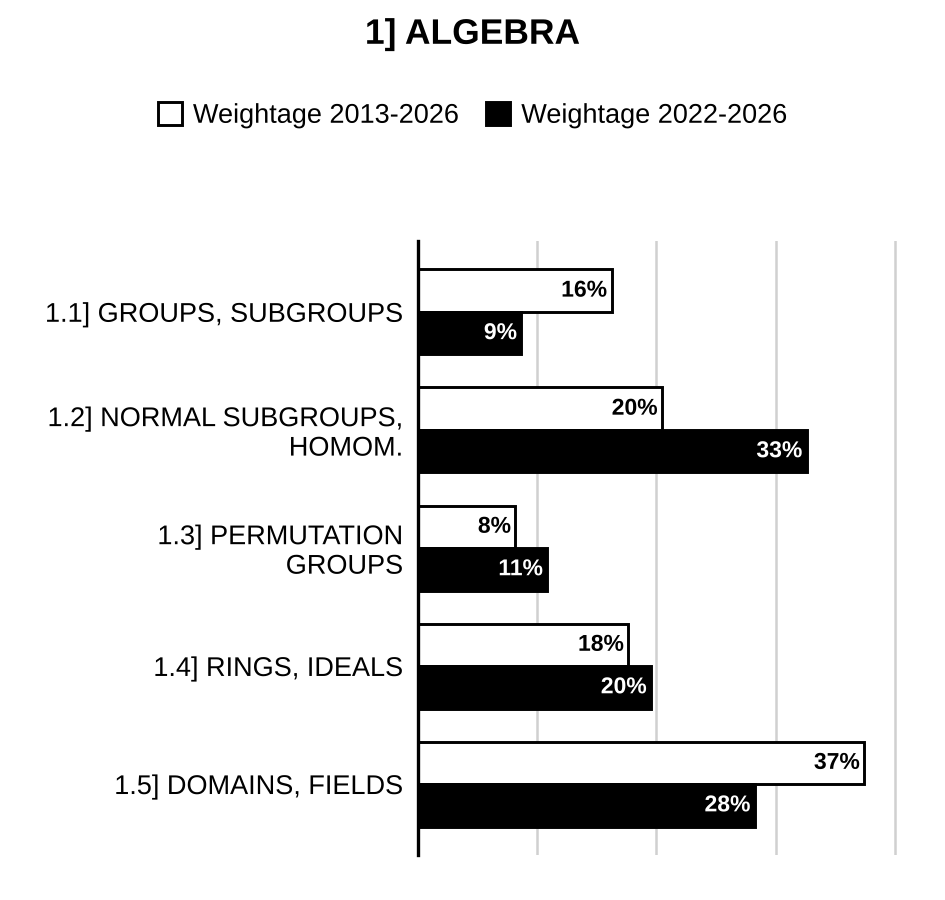
1.1] Groups and subgroups
17 questions
Let and be two subgroups of a group such that and . Show that , where is the identity element. Here , and denote the order of , and respectively. [2025/10m/1a]
Let be a non-Abelian group with and . Show that (where is the identity element of and , denote the order of the elements , respectively). [2025/10m/1b]
Show that there are infinitely many subgroups of the additive group of rational numbers. [2021/15m/4a]
Let be a finite cyclic group of order . Then prove that has generators (where is Euler’s -function). [2020/15m/2a]
Let be a finite group, and subgroups of such that . Show that . [2019/10m/1a]
Find all the proper subgroups of the multiplicative group of the field , where and represent addition modulo 13 and multiplication modulo 13 respectively. [2018/20m/3a]
Let be a prime number and denote the additive group of integers modulo . Show that every non-zero element of generates . [2016/15m/2b]
(i) How many generators are there of the cyclic group of order 8? Explain. (ii) Taking a group of order 4, where is the identity, construct composition tables showing that one is cyclic while the other is not. [2015/10m/1a]
Give an example of an infinite group in which every element has finite order. [2013/10m/1b]
How many elements of order 2 are there in the group of order 16 generated by and such that the order of is 8, the order of is 2 and . [2012/12m/1a]
Show that the set of six transformations on the set of Complex numbers defined by is a non-abelian group of order 6 w.r.t. composition of mappings. [2011/12m/1a]
Prove that a group of Prime order is abelian. [2011/6m/1e(i)]
How many generators are there of the cyclic group of order 8 ? [2011/6m/1e(ii)]
Give an example of a group in which every proper subgroup is cyclic but the group itself is not cyclic. [2011/15m/2a]
Let and be elements of a group, with , and . Find the order of , and express its inverse in each of the forms and . [2011/20m/4a]
Let be the set of all real numbers omitting . Define the binary relation on by . Show is a group and it is abelian. [2010/12m/1a]
Let be the set of all real numbers except zero. Define a binary operation on as : where denotes absolute value of . Does form a group? Examine. [2008/12m/1a]
1.2] Normal subgroups and homomorphisms
17 questions
Let be a group of order , where and are primes. Show that either is an abelian group or no non-identity element commutes with every element of . [2026/10m/1a]
Let be a finite group generated by two elements and of order 2 each. Show that is isomorphic to the dihedral group of order , where . [2026/15m/2a]
Show that every homomorphic image of an abelian group is abelian, but the converse is not necessarily true. [2024/15m/2b]
Let be a group of order 10 and be a group of order 6. Examine whether there exists a homomorphism of onto . [2023/10m/1a]
Show that the multiplicative group , where , is isomorphic to the group . [2022/10m/1a]
Prove that every homomorphic image of a group is isomorphic to some quotient group of . [2022/15m/2b]
Let and be permutation group on 3 symbols and group of residue classes module 3 respectively. Show that there is no homomorphism of in except the trivial homomorphism. [2020/10m/1a]
If and are finite groups whose orders are relatively prime, then prove that there is only one homomorphism from to , the trivial one. [2019/10m/2a]
Write down all quotient groups of the group . [2019/10m/2b]
Show that the quotient group of modulo is isomorphic to the multiplicative group of complex numbers on the unit circle in the complex plane. Here is the set of real numbers and is the set of integers. [2018/15m/2a]
Show that the groups and are isomorphic. [2017/15m/3a]
Let be the set of all real matrices , where . Show that is a group under matrix multiplication. Let denote the subset . Is a normal subgroup of ? Justify your answer. [2014/10m/1a]
Show that a cyclic group of order 6 is isomorphic to the product of a cyclic group of order 2 and a cyclic group of order 3. Can you generalize this ? Justify. [2010/12m/1b]
Let be the multiplicative group of non-zero reals and be the multiplicative group of non-singular real matrices. Show that the quotient group and are isomorphic where . What is the centre of ? [2010/15m/2a]
If is the set of real numbers and is the set of positive real numbers, show that under addition and under multiplication are isomorphic. Similarly if is the set of rational numbers and the set of positive rational numbers, are and isomorphic? Justify your answer. [2009/12m/1a]
Determine the number of homomorphisms from the additive group to the additive group . ( is the cyclic group of order ). [2009/12m/1b]
Let and be two groups and let be a homomorphism. For any element (i) prove that . (ii) is a normal subgroup of . [2008/15m/2a]

Preparing for Prelims too?
Our UPSC Prelims Topic-wise PYQ eBook covers every Prelims question with detailed explanations, so you can see exactly where UPSC asks from.
View the BookDownload Free Sample1.3] Permutation groups
7 questions
Let be a finite group of order , where and are prime numbers with . Show that has at most one subgroup of order . [2024/10m/1a]
Prove that a non-commutative group of order , where is an odd prime, must have a subgroup of order . [2023/15m/2a]
Let be a group of order . Show that is isomorphic to a subgroup of the permutation group . [2017/10m/1b]
What are the orders of the following permutations in ? [2013/10m/2a]
What is the maximal possible order of an element in ? Why ? Give an example of such an element. How many elements will there be in of that order ? [2013/13m/2b]
How many conjugacy classes does the permutation group of permutations 5 numbers have ? Write down one element in each class (preferably in terms of cycles). [2012/15m/2a]
Show that the alternating group on four letters has no subgroup of order 6. [2009/15m/2b]
1.4] Rings and ideals
16 questions
Examine whether the mapping defined by , for , is a homomorphism. Deduce that the ideal is a prime ideal in , but not a maximal ideal in . [2025/15m/4a]
Consider the polynomial ring over the ring of integers. Let be an ideal of generated by . Show that is prime but not a maximal ideal of . [2024/15m/4a]
Let be a field of real numbers and , the field of all those polynomials such that . Prove that is an ideal of . Is the residue class ring an integral domain? Give justification for your answer. [2022/15m/4a]
Suppose be the set of all real numbers and is a function such that the following equations hold for all : (i) (ii) Show that either , or, . [2018/20m/4a]
Let be a field and be the ring of polynomials over in a single variable . For a polynomial , let denote the ideal in generated by . Show that is a maximal ideal in if and only if is an irreducible polynomial over . [2016/10m/1a]
Give an example of a ring having identity but a subring of this having a different identity. [2015/10m/1b]
If is a ring with unit element 1 and is a homomorphism of onto , prove that is the unit element of . [2015/15m/2a]
Prove that the set is a commutative ring with identity. [2014/15m/4a]
Let = ring of all real valued continuous functions on , under the operations Let . Is a maximal ideal of ? Justify your answer. [2013/15m/3b]
Describe the maximal ideals in the ring of Gaussian integers . [2012/20m/4a]
Let be the set of all real valued continuous functions defined on the closed interval . Prove that is a Commutative Ring with unity with respect to addition and multiplication of functions defined pointwise as below : where . [2011/15m/3a]
Show that the quotient ring is isomorphic to the ring where denotes the ring of Gaussian integers. [2010/15m/3b]
How many proper, non-zero ideals does the ring have ? Justify your answer. How many ideals does the ring have ? Why ? [2009/15m/2a]
How many elements does the quotient ring have ? Is it an integral domain ? Justify yours answers. [2009/15m/3b]
Suppose that there is a positive even integer such that for all the elements ‘‘ of some ring . show that for all and for all . [2008/12m/1b]
Show that any maximal ideal in the commutative ring of polynomials over a field is the principal ideal generated by an irreducible polynomial. [2008/15m/3b]
1.5] Integral domains and fields
28 questions
Show that every non-zero prime ideal in a Euclidean Domain is maximal. [2026/10m/1b]
Let be a positive integer. Show that the following statements are equivalent : (i) is an integral domain. (ii) is a field. (iii) is prime. [2026/15m/4a]
Show that 3 is an irreducible element in the integral domain . [2025/15m/2b]
Express the ideal as a principal ideal in the integral domain . [2023/10m/1b]
Prove that is an irreducible polynomial in . Further show that the quotient ring is a field of 9 elements. [2023/15m/3a]
Let be positive integers and the greatest common divisor of . Show that there exist integers such that [2021/10m/1a]
Let be a field and a polynomial of degree over . Show that there is a field and an imbedding s.t. the polynomial has a root in , where is obtained by replacing each coefficient of by . [2021/15m/2b]
Let be a principal ideal domain. Show that every ideal of a quotient ring of is principal ideal and is a principal ideal domain for a prime ideal of . [2020/10m/1b]
Let be a finite field of characteristic . Show that the mapping defined by , is an isomorphism. [2020/15m/3a]
Let be an irreducible element of the Euclidean ring , then prove that is a field. [2019/10m/3d]
Let be an integral domain with unit element. Show that any unit in is a unit in . [2018/10m/1a]
Let be a field and denote the ring of polynomials over in a single variable . For with , show that there exist such that and [2017/20m/2c]
Let be a field and be the ring of polynomials over in a single variable . For a polynomial , let denote the ideal in generated by . Show that is a maximal ideal in if and only if is an irreducible polynomial over . [2016/10m/1a]
Let be an extension of a field . Prove that the elements of , which are algebraic over , form a subfield of . Further, if are fields, is algebraic over and is algebraic over , then prove that is algebraic over . [2016/20m/3a]
Show that every algebraically closed field is infinite. [2016/15m/4a]
Do the following sets form integral domains with respect to ordinary addition and multiplication? If so, state if they are fields : (i) The set of numbers of the form with rational (ii) The set of even integers (iii) The set of positive integers. [2015/15m/4a]
Show that is a field. Then find and in . [2014/15m/2a]
Show that the set , where and are real numbers, is a field with respect to usual addition and multiplication. [2014/15m/3a]
Show that the set of matrices is a field under the usual binary operations of matrix addition and matrix multiplication. What are the additive and multiplicative identities and what is the inverse of ? Consider the map defined by . Show that is an isomorphism. (Here is the set of real numbers and is the set of complex numbers.) [2013/10m/1a]
Let be the ring of Gaussian integers (subring of ). Which of the following is : Euclidean domain, principal ideal domain, unique factorization domain ? Justify your answer. [2013/15m/3a]
Is the ideal generated by 2 and in the polynomial ring of polynomials in a single variable with coefficients in the ring of integers , a principal ideal ? Justify your answer. [2012/15m/3a]
Let . Show is a commutative ring with 1 under pointwise addition and multiplication. Determine whether is an integral domain. Explain. [2010/15m/2b]
Consider the polynomial ring . Show is irreducible over . Let be the ideal in generated by . Then show that is a field and that each element of it is of the form with , , in and . [2010/15m/3a]
Show that is a unique factorization domain that is not a principal ideal domain ( is the ring of integers). Is it possible to give an example of principal ideal domain that is not a unique factorization domain ? ( is the ring of polynomials in the variable with integer.) [2009/15m/3a]
How many elements does the quotient ring have ? Is it an integral domain ? Justify yours answers. [2009/15m/3b]
Let be a ring with unity. If the product of any two non zero elements is non zero prove that . Whether has the above property or not explain. If in integral domain? [2008/15m/2b]
Prove that every Integral Domain can be embedded in a field. [2008/15m/3a]
Show that any maximal ideal in the commutative ring of polynomials over a field is the principal ideal generated by an irreducible polynomial. [2008/15m/3b]

Strengthen your GS papers
Our UPSC Mains Topic-wise & Year-wise PYQ eBook (2013–2026) maps every GS question to the syllabus, so you know what UPSC asks and how often.
View the BookDownload Free Sample« Previous: Vector Analysis | Next: Real Analysis »
Back to: Mathematics Optional PYQs – Topic-wise | Also see: Mathematics Optional year-wise question papers
Last updated: 30 October 2026