
Here are all 45 questions on Topics and movements (1900–1990) asked in UPSC English Literature Optional Paper II (2009–2026), arranged under the 8 topics of this unit. Within each topic the latest questions come first.
Each question ends with a code such as [2024/15m/3b] – the year, the marks, the word limit (where UPSC set one) and the question number in the paper.
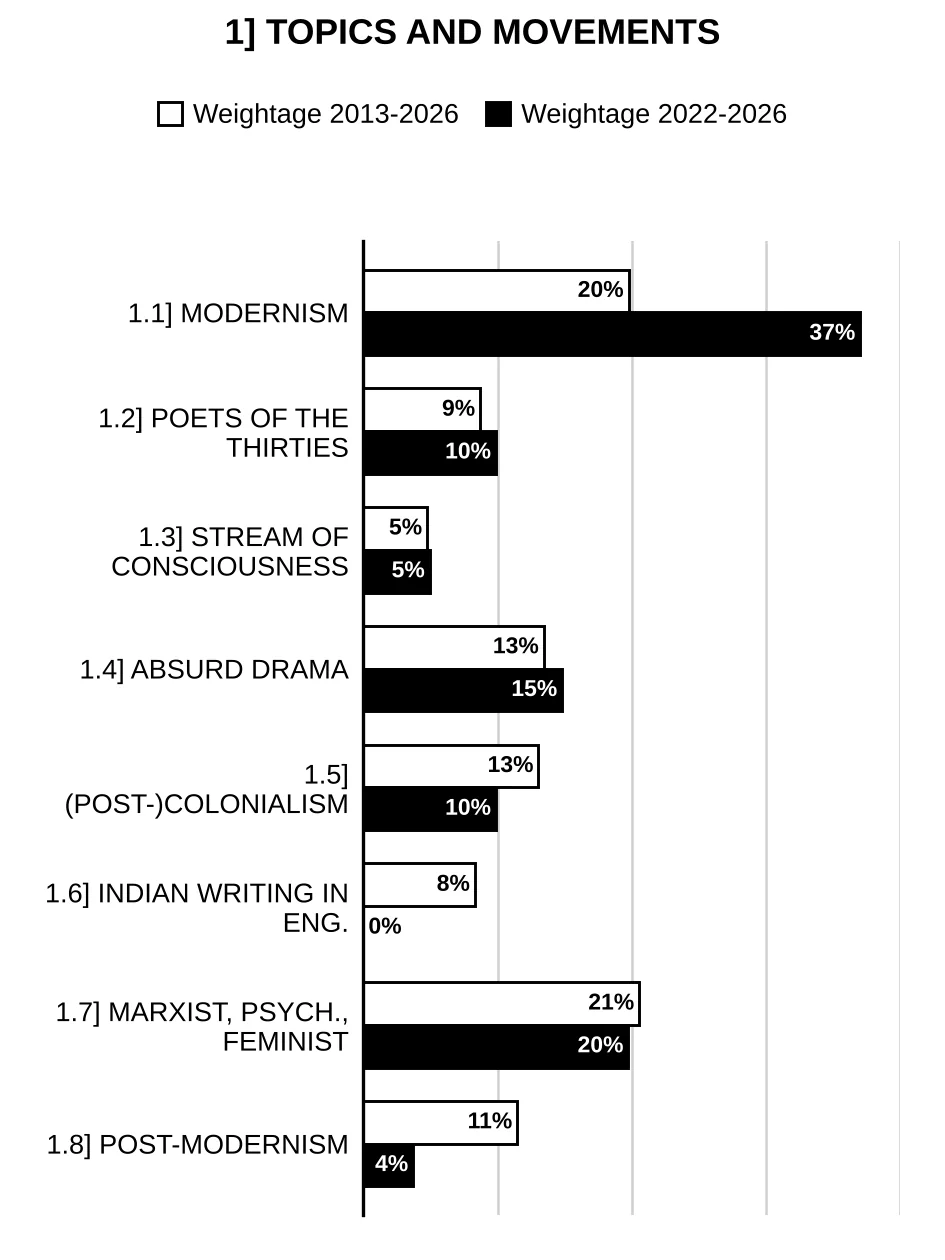
1.1] Modernism
8 questions
What structural and formal innovations characterised modernist poetry? Illustrate with reference to the prescribed poems. [2026/20m/3c]
Discuss how modernism in literature experimented with language, form and style to represent the complexities of the then contemporary human life. Make use of the prescribed texts to substantiate your answer. [2025/20m/3c]
How does modernist poetry employ ‘symbolism’ to give an ironic twist to descriptions in order to create meaning? [2025/15m/4b]
Discuss Modernism as a literary and cultural movement. [2023/20m/2c]
Discuss how “the close connection between modernism and difficulty made it (modernism) appear increasingly isolated, elitist, and apolitical.” [2020/20m/2c]
“The central weakness of Modernism is that in its pursuit of a more complex sense of reality it fails in coherence.” Do you agree? Justify your answer with some illustrations from twentieth century poetry and drama. [2018/20m/3c]
What are the important points of distinction between Modernism and Post-modernism? [2017/20m/3c]
“The most striking feature of twentieth century poetic taste was to explore experiences meticulously and weave rich patterns of meaning rather than render in mellifluous verse imagery drawn from nature.” Elaborate with examples. [2012/30m/7b]

Preparing for Prelims too?
Our UPSC Prelims Topic-wise PYQ Book covers every Prelims question with detailed explanations, so you can see exactly where UPSC asks from. Now available as a hard copy and an eBook.
Buy Hard Copy on AmazonBuy eBook (PDF)1.2] Poets of the Thirties
4 questions
“The poets of the thirties expressed that ‘they had no time to be difficult…; the political situation was too urgent’.” Elaborate the statement with examples from the poets of the period. [2023/20m/3c]
How was the socio-political development of the thirties reflected in the works of the poets of the age? Discuss with textual references. [2021/15m/2b]
The poets of the Thirties are critical of their present and nostalgic for irretrievable pasts. Argue for or against this statement with specific examples from the poets of the period. [2020/20m/3c]
Who are the “Poets of the Thirties” and what is their contribution to English literature? Explain. [2010/40m/2a]
1.3] The Stream-of-consciousness Novel
3 questions
Examine the features and significance of the stream of consciousness technique in modernist literature with reference to Mrs. Dalloway. [2026/20m/6c]
“It is nothing joined; it flows. A ‘river’ or a ‘stream’ is the metaphor by which it is most naturally described.” Elaborate this statement about the Stream of Consciousness Novel. [2016/20m/2c]
It was not until the 1920s that new notions of time and states of mind have been stressed with greater impact in twentieth century novel. Elucidate with examples. [2012/30m/2a]
1.4] Absurd Drama
6 questions
Discuss the use of existential themes, circular dialogues, and illogical situations in absurd drama. [2026/20m/4c]
Illustrate the characteristic features of Absurd Theatre with special reference to the play Waiting for Godot. [2024/20m/4c]
Absurd theatre reflects the existential dilemma and the irrationality of life. Examine this statement with a critical analysis of Beckett’s Waiting for Godot. [2021/20m/4c]
How do the best plays of the Theatre of the Absurd show in telling images the alienation, bewilderment and frustrations of the Modern Man? [2019/20m/2c]
Comment on the deployment of repetitive language and action in the English ‘new theatre’. [2013/25m/8b]
Explain with references, how modern drama with its disjointed and ambiguous deliberations that blur the distinction between reality and illusion, serves to intensify the dreadful angst of the protagonist. [2012/30m/2b]
1.5] Colonialism and Post-Colonialism
9 questions
Illustrate the distinctive features of colonialism and post-colonialism in reference to some literary texts. [2024/20m/2c]
Postcolonial writing conflates history and myth to create new centers. Examine how this is achieved in Raja Rao’s Kanthapura. [2021/15m/8b]
In what way does a post-colonial reading diverge from the earlier approaches to literature? [2017/20m/2c]
Postcolonial melancholia. [2013/10m/1d]
How crucial in your view is the concept of ‘Othering’ in postcolonial literatures? [2013/25m/4b]
Write an essay on the diasporic longings in postcolonial literature. [2011/30m/2a]
What key role does Kanthapura play in the theories of reading postcolonial literatures? [2011/30m/8a]
With examples, highlight the major post-colonial approaches to Indian English literature. [2010/60m/3]
What tense elements in Indian writing in English contributed to the renowned critical dictum that ‘the Empire Writes Back’? [2009/60m/2]
1.6] Indian Writing in English
5 questions
“Indians can write in English, but they ‘cannot write like the English’ – rather, Indian English must become a ‘distinctive and colourful’ dialect of the language, which ‘time alone will justify’.” Analyse Kanthapura as an Indian English novel in the context of Raja Rao’s statement. [2020/15m/8a]
Is there an Indian way of thinking? In the light of this question, examine Indian poetry written in English. [2014/20m/2a]
How sustainable is the argument that Indian writers in English betray an ‘anxiety of Indianness’? [2013/25m/2a]
With examples, highlight the major post-colonial approaches to Indian English literature. [2010/60m/3]
What tense elements in Indian writing in English contributed to the renowned critical dictum that ‘the Empire Writes Back’? [2009/60m/2]
1.7] Marxist, Psychoanalytical and Feminist Approaches to Literature
8 questions
“Marxist analysis can be used as a tool to reveal the oft-hidden structures in literary texts.” Analyse any two novels prescribed in your syllabus in the light of the above statement. [2025/20m/6c]
Explain the meaning of feminism, and discuss its various phases of evolution in the 20th century. [2024/20m/3c]
Psychoanalytic criticism is similar to New criticism in not concerning itself with “what the author intended”, but “what the author never intended”. Elucidate. [2016/20m/3c]
Marxist theories of Literature since 1970. [2014/10m/150w/1a]
Radical feminism. [2014/10m/150w/1b]
Attempt a critique of the writer as worker as enunciated in Marxist critical thought. [2013/25m/7a]
How do Feminist writers engage cultural politics? [2013/25m/7b]
What directions has Freudian Psychoanalytic theory taken after the Second World War? [2011/30m/2b]
1.8] Post-Modernism
5 questions
Samuel Beckett’s Waiting for Godot is often mentioned as a play that falls into both the modern and post-modern genres. Evaluate. [2022/15m/3b]
What are the important points of distinction between Modernism and Post-modernism? [2017/20m/3c]
Deconstruction is not synonymous with destruction, it is in fact closer to the original meaning of the word, “analysis” which originally means to undo. Discuss. [2015/20m/3c]
Postmodern ‘realisms’ [2013/10m/1e]
Discuss some major issues involving language as power in postmodern English writing. [2013/25m/4a]

Strengthen your GS papers
Our UPSC Mains Topic-wise & Year-wise PYQ Book (2013–2026) maps every GS question to the syllabus, so you know what UPSC asks and how often. Now available as a hard copy and an eBook.
Buy Hard Copy on AmazonBuy eBook (PDF)« Previous: Critical analysis of unseen passages · Next: Texts: poetry and drama (section a) »
Back to: English Literature Optional PYQs – Topic-wise
Last updated: 2 November 2026