
Mauryan Empire History Optional PYQs from 1995 to 2026 are compiled here exactly as UPSC set them in the Mains examination, sorted by syllabus topic. It is unit 7 of Paper 1, Section A – Ancient India, with 28 questions, the latest from 2026.
Mauryan Empire – History Optional PYQs (1995–2026)
7.1] Foundation of the Mauryan Empire
1. How far did the Mauryans facilitate the diffusion of the material culture of the Gangetic plains? Explain. [2025/15m/3b]
2. How would you characterize the nature of Mauryan state on the basis of Kautilya’s Arthashastra? [2021/20m/3b]
3. Determine the extent of the Mauryan empire. [2005/60m/2]
4. Analyse the causes of the success of the Magadhan imperialism upto the reign of Ashoka the Great. [2001/60m/2]
7.2] Ashoka: Concept of Dharma; Edicts
1. Analyze the contours of imperial ideology as exhibited during the Mauryan period. [2023/15m/3b]
2. Ashoka’s Dhamma was propagated not just for moral upliftment and social harmony but also for the extension of the state’s authority. Analyse the statement. [2022/15m/3b]
3. Explain how Ashoka used religion as a tool of political aggrandizement. [2019/15m/4a]
4. “The concept of Ashoka’s Dhamma as found through his inscriptions had its roots in Vedic—Upanishadic literature.” Discuss. [2017/15m/3b]
5. Discuss different interpretations of historians about the nature of Asoka’s ‘Dhamma’. Did his principle of ‘Dhamma-vijaya’ render the Mauryan Empire militaristically weak? [2014/20m/3c]
6. How did Ashoka contribute to the moral and administrative welfare of his people? [2000/60m/2]
7. Examine sources of information for Mauryan dynasty. Throw light on historical significance of Ashoka’s inscriptions. [1999/60m/4]
8. Write a short essay on: Inscriptions of Ashoka. [1995/20m/200w/1c]
7.3] Polity, Administration, Economy
1. How far did the Mauryans facilitate the diffusion of the material culture of the Gangetic plains? Explain. [2025/15m/3b]
2. Analyze the contours of imperial ideology as exhibited during the Mauryan period. [2023/15m/3b]
3. How would you characterize the nature of Mauryan state on the basis of Kautilya’s Arthashastra? [2021/20m/3b]
4. Do you agree with the popular view that Mauryas established a unitary and highly centralized if not monolithic state system? [2018/20m/3a]
5. Critically evaluate the theory and practice of land revenue system in ancient India. [2016/20m/4a]
6. Examine the role of adhyaksa in the Mauryan administration. [2012/30m/4a]
7. Examine the nature of the Mauryan State. Bring out the features of their administrative system. [2002/60m/3]
8. Write a short essay on: Mauryan municipal administration. [1996/20m/200w/1c]

Preparing for Prelims too?
Our UPSC Prelims Topic-wise PYQ eBook covers every Prelims question with detailed explanations, so you can see exactly where UPSC asks from.
View the BookDownload Free Sample7.4] Art, architecture and sculpture
1. Explain as to how the early Buddhist Stupa art, while using folk motifs and narratives and common cultural symbols, succeeded in transforming these themes for expounding the Buddhist ideals. [2013/20m/4c]
2. Write a short essay on: The architectural and artistic features of the great stupa at Sanchi. [1997/20m/200w/1b]
7.5] External contacts
1. Delineate the nature and impact of India’s contact with Western Asia and the Mediterranean world during the Mauryan period. [2015/15m/3b]
7.6] Religion, spread of religion and literature
1. Discuss the role of Buddhism in shaping the socio-religious landscape of the Mauryan Empire. [2024/15m/3b]
2. Write what you know of the rise and spread of Buddhism before the first century A.D. [2007/60m/3]
7.7] Disintegration of the empire; Sungas and Kanvas
1. Evaluate the political and socio-cultural changes occurred in North India after the decline of the Mauryan Empire under the Shunga and Kanva Dynasties. [2026/15m/3b]
2. Evaluate the significant political features of the Post Mauryan Northern India. What are the main sources of it? [2020/15m/3a]
3. The development of art and architecture during the Sunga period belies the belief that they were anti-Buddhist. Discuss. [2019/15m/2b]
Summary of Mauryan Empire PYQs (1995–2026)
| Total questions (1995–2026) | 28 (25 unique – a few questions are listed under more than one sub-topic) |
| Total marks asked | 700 (unique questions) |
| Questions in last 5 years (2022–2026) | 7 (5 unique) |
| Most recent year asked | 2026 |
| Sub-topics | 7 (7.1 to 7.7) |
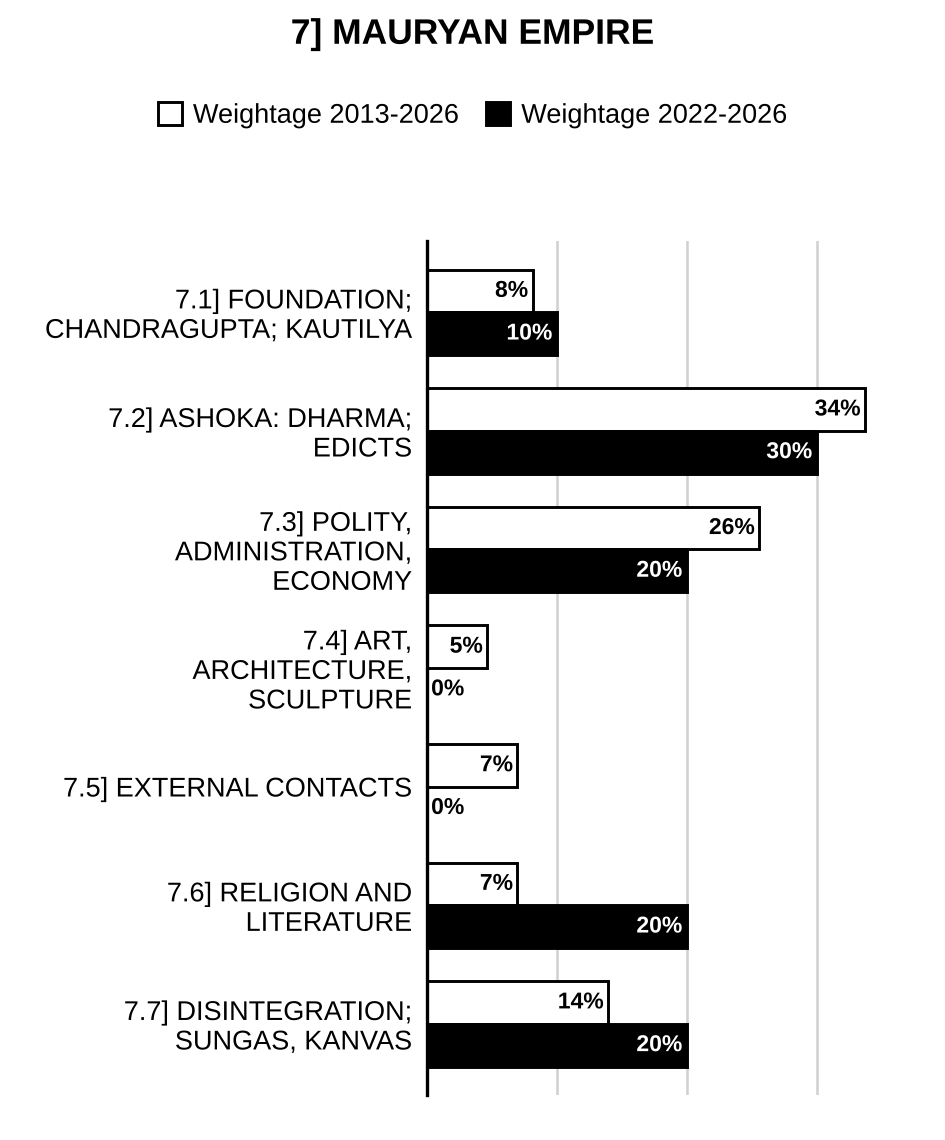
The earliest question here dates from 1995 and the latest from 2026; UPSC has drawn on this unit in 24 of the 32 years. In the last five years (2022–2026), 7 questions were set from it.
Official Syllabus
7. Mauryan Empire: Foundation of the Mauryan Empire, Chandragupta, Kautilya and Arthashastra; Ashoka; Concept of Dharma; Edicts; Polity, Administration, Economy; Art, architecture and sculpture; External contacts; Religion; Spread of religion; Literature. Disintegration of the empire; Sungas and Kanvas.
Source: UPSC Civil Services Examination 2026 notification.
Where this unit stands in Ancient India
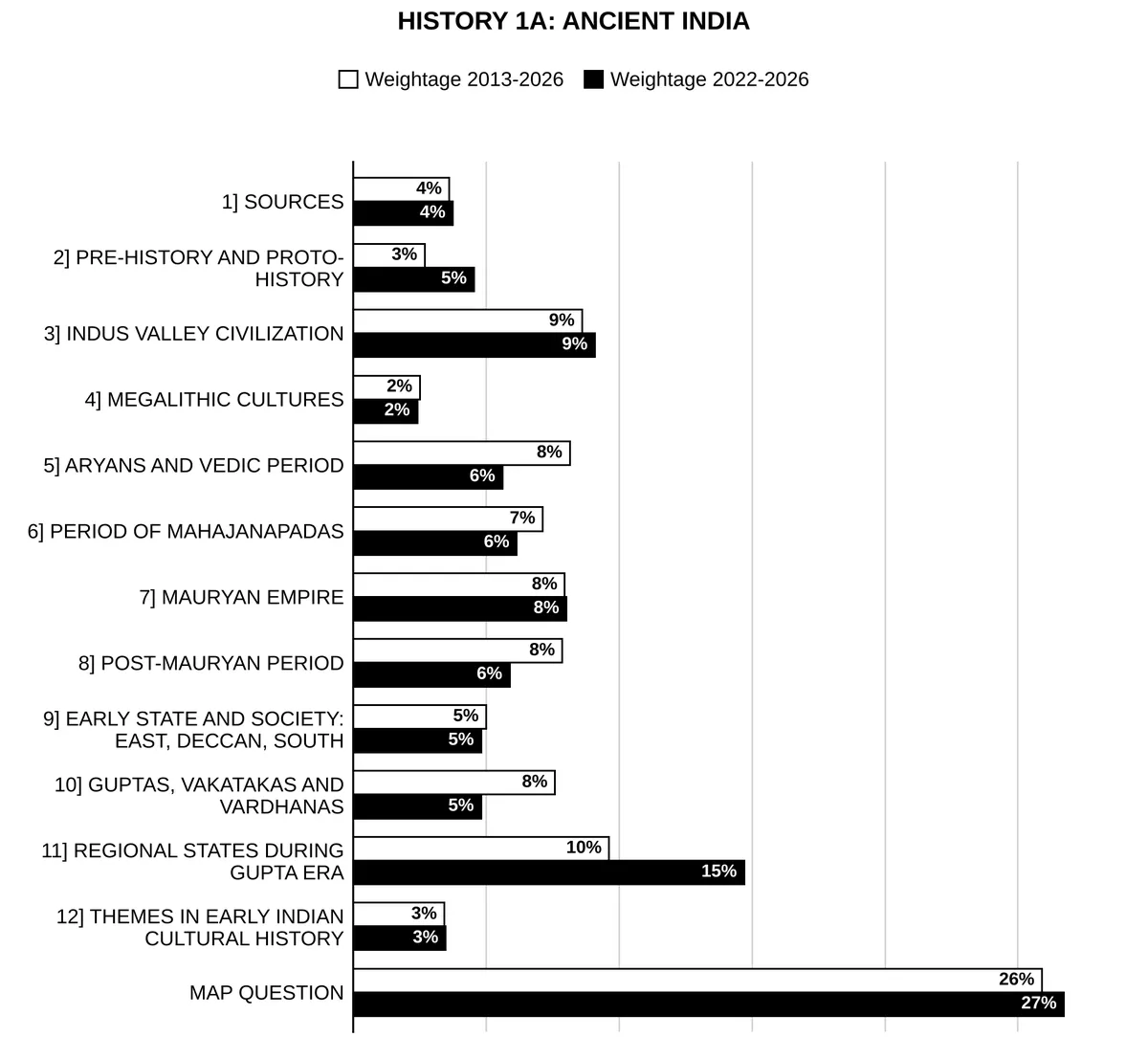
Mauryan Empire accounted for about 8% of the marks asked in Ancient India (the map question included) in 2022–2026, the same as 8% over 2013–2026, ranking 3rd of the 12 units in the section by recent weightage.
How to use these PYQs
- Read the syllabus line in the box above alongside the questions and mark which phrases UPSC keeps returning to; those are the areas to prepare first.
- Questions run from the latest year to the oldest, so read the top of each list first for the current pattern, then use older ones for practice of content.
- Use the question code to set the length of your practice answer – marks and word limit tell you how much depth UPSC expected.
Frequently Asked Questions
How many History Optional questions have been asked from Mauryan Empire?
This collection lists 28 question entries from Mauryan Empire (unit 7 of Paper 1) between 1995 and 2026, of which 25 are unique questions; the rest are listed under more than one sub-topic. They were asked in 24 of the 32 years and 7 came in 2022–2026.
When was Mauryan Empire last asked in History Optional?
Most recently in 2026, with 1 question (2026/15m/3b). Before that, it was asked in 2025.
Where can I find all History Optional PYQs topic-wise?
All units of Paper 1 and Paper 2, the map question and the earlier-syllabus questions are linked from History Optional PYQs Topic-wise (1995–2026).
« Previous: Period of Mahajanapadas – History Optional PYQs (1995–2026)
Next: Post-Mauryan Period – History Optional PYQs (1995–2026) »
Back to: History Optional PYQs Topic-wise (1995–2026) | Also see: History Optional year-wise question papers (1995–2026)