
Here is the complete set of Post-Mauryan Period History Optional PYQs from UPSC Mains 1995–2026, taken from our topic-wise question bank. It is unit 8 of Paper 1, Section A – Ancient India, with 32 questions, the latest from 2025.
Post-Mauryan Period – History Optional PYQs (1995–2026)
8.1] Contact with outside world
1. Examine the nature and impact of India’s contacts with Central Asia during the 1st to 3rd century CE. How did these interactions influence India’s political, cultural and economic spheres? [2025/20m/3c]
2. Western Kshatrapas are known for their socio-economic contribution, particularly in trade, agriculture and urbanization. Examine the statement. [2024/15m/2c]
3. Evaluate the significant political features of the Post Mauryan Northern India. What are the main sources of it? [2020/15m/3a]
4. The flourishing international trade during the Kushana period gave tremendous impetus to the development of art. Discuss. [2019/15m/3a]
5. The discovery of monsoons by Hippalus gave a new direction to Indo-Roman trade during the Satavahana period. Comment. [2019/15m/4c]
6. What was the impact of trans-regional and trans-continental trade in the post Mauryan period on social and cultural life of India? [2018/20m/4a]
7. The period of Indian History from 3rd century B.C.E. to 5th century C.E. was the period of innovation and interaction. How will you react? [2017/20m/3c]
8. Justify Pliny’s statement that Rome was being drained out of its gold by India during the first century of the Christian era. [2012/30m/2b]
8.2] Growth of urban centres, economy and coinage
1. Western Kshatrapas are known for their socio-economic contribution, particularly in trade, agriculture and urbanization. Examine the statement. [2024/15m/2c]
2. The economic achievements of the Guptas were the culmination of a process which began during the Kushanas. Comment. [2022/20m/3a]
3. What was the impact of trans-regional and trans-continental trade in the post Mauryan period on social and cultural life of India? [2018/20m/4a]
4. How does the numismatic evidence of the period reflect the political and economic outlook of the Kushanas and the Satavahanas? [2016/15m/3b]
5. On the basis of contemporary sources assess the nature of banking and usuary in ancient India. [2013/15m/3a]
6. Justify Pliny’s statement that Rome was being drained out of its gold by India during the first century of the Christian era. [2012/30m/2b]
7. Examine the significance of the deities depicted on the coins of the Kushanas. [2010/30m/2b]
8. How justified are we in characterizing the post-Mauryan five centuries as the “Dark Period” of Indian History? Give reasons in support of your answer. [2008/60m/3]

Preparing for Prelims too?
Our UPSC Prelims Topic-wise PYQ eBook covers every Prelims question with detailed explanations, so you can see exactly where UPSC asks from.
View the BookDownload Free Sample8.3] Development of religions; Mahayana
1. Symbiotic relationships between Buddhist establishments, traders, artisan guilds, and royal support led to a close proximity of religion, economy and polity in the Mauryan and post-Mauryan periods. Examine the statement. [2024/20m/3a]
2. “The political and economic needs of rulers, combined with economic and status needs of the merchant class, together provided the receptive cultural milieu in which Buddhism flourished.” Comment. [2021/20m/4a]
3. Examine the significance of the deities depicted on the coins of the Kushanas. [2010/30m/2b]
4. “The centuries between c. 200 B.C. and c. A.D. 300 constitute a landmark in the socio-religious history of India.” Analyse the proposition. [1995/60m/3]
8.4] Social conditions
1. How justified are we in characterizing the post-Mauryan five centuries as the “Dark Period” of Indian History? Give reasons in support of your answer. [2008/60m/3]
2. Assess the status of women in India from c. 4th century BC to AD 6th century. [2005/60m/3]
3. “The centuries between c. 200 B.C. and c. A.D. 300 constitute a landmark in the socio-religious history of India.” Analyse the proposition. [1995/60m/3]
8.5] Art, architecture, culture, literature and science
1. Analyze the significance of external influences and indigenous development on post-Mauryan art. [2021/15m/2c]
2. The development of art and architecture during the Sunga period belies the belief that they were anti-Buddhist. Discuss. [2019/15m/2b]
3. The flourishing international trade during the Kushana period gave tremendous impetus to the development of art. Discuss. [2019/15m/3a]
4. The period of Indian History from 3rd century B.C.E. to 5th century C.E. was the period of innovation and interaction. How will you react? [2017/20m/3c]
5. “The changes in the field of art from the Kushana period to early medieval period are mere reflection of changing outlook.” Comment. [2016/20m/3c]
6. Review critically the evolution of different schools of art in the Indian subcontinent between the second century BCE and the third century CE, and evaluate the socio-religious factors responsible for it. [2014/20m/2c]
7. Explain as to how the early Buddhist Stupa art, while using folk motifs and narratives and common cultural symbols, succeeded in transforming these themes for expounding the Buddhist ideals. [2013/20m/4c]
8. Furnish a critical and comparative account of various schools of art in the Post-Mauryan period (c. 200 B.C. – c. 300 A.D.). [1998/60m/3]
9. Write a short essay on: The architectural and artistic features of the great stupa at Sanchi. [1997/20m/200w/1b]
Summary of Post-Mauryan Period PYQs (1995–2026)
| Total questions (1995–2026) | 32 (24 unique – a few questions are listed under more than one sub-topic) |
| Total marks asked | 620 (unique questions) |
| Questions in last 5 years (2022–2026) | 5 (4 unique) |
| Most recent year asked | 2025 |
| Sub-topics | 5 (8.1 to 8.5) |
The earliest question here dates from 1995 and the latest from 2025; UPSC has drawn on this unit in 18 of the 32 years. In the last five years (2022–2026), 5 questions were set from it.
Official Syllabus
8. Post-Mauryan Period (Indo-Greeks, Sakas, Kushanas, Western Kshatrapas): Contact with outside world; growth of urban centres, economy, coinage, development of religions, Mahayana, social conditions, art, architecture, culture, literature and science.
Source: UPSC Civil Services Examination 2026 notification.
Where this unit stands in Ancient India
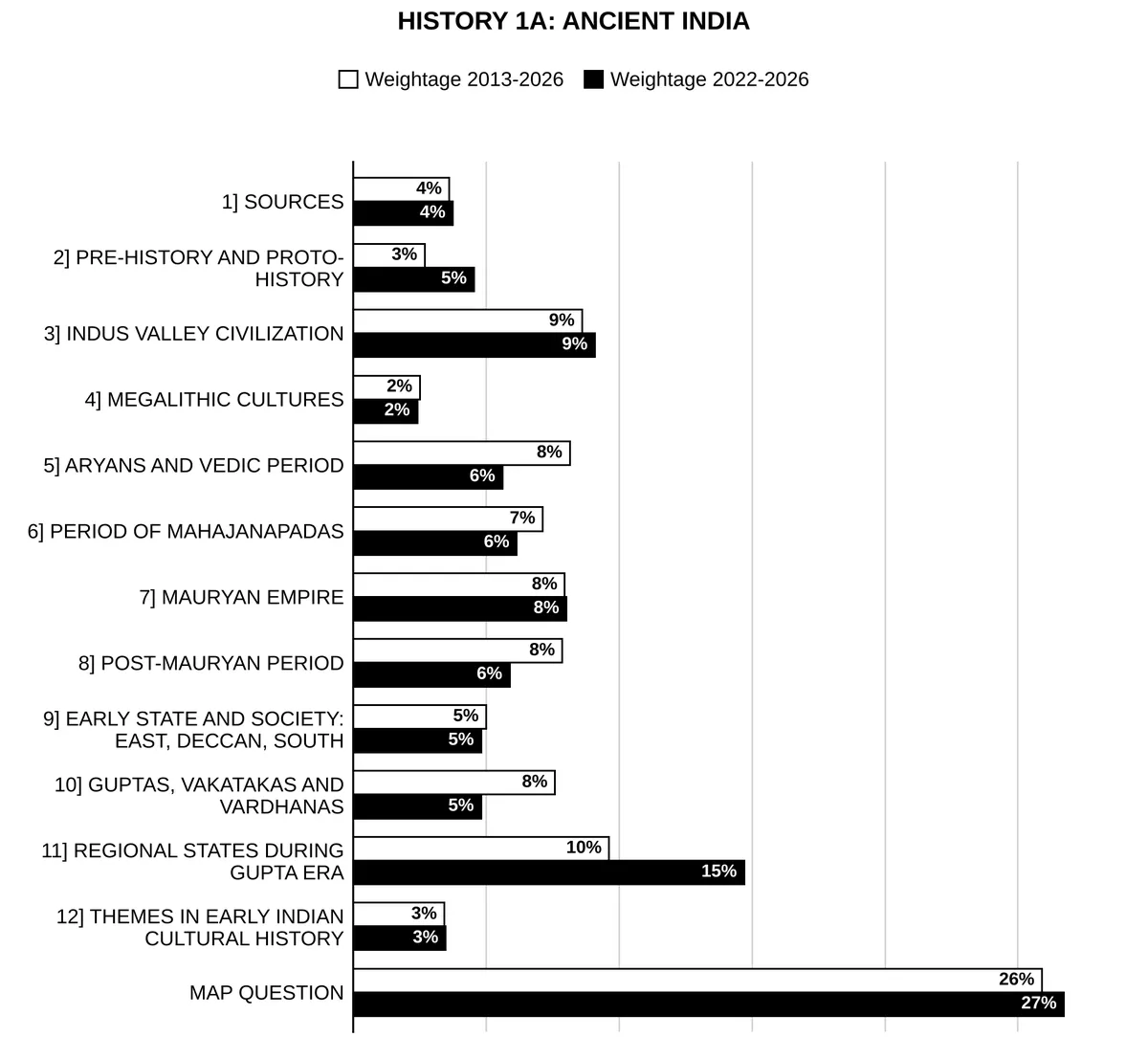
Post-Mauryan Period accounted for about 6% of the marks asked in Ancient India (the map question included) in 2022–2026, down from 8% over 2013–2026, ranking 5th of the 12 units in the section by recent weightage.
How to use these PYQs
- Compare the questions with the official syllabus wording above – themes that recur across years deserve the deepest notes.
- Give priority to the recent questions (2013 onwards follow the present 250-mark paper pattern); use the pre-2013 questions to test your depth of content.
- Practise answers within the word limit shown in the question code (for example 150w or 250w) and under timed conditions, then revise them after a week.
Frequently Asked Questions
How many History Optional questions have been asked from Post-Mauryan Period?
This collection lists 32 question entries from Post-Mauryan Period (unit 8 of Paper 1) between 1995 and 2025, of which 24 are unique questions; the rest are listed under more than one sub-topic. They were asked in 18 of the 32 years and 5 came in 2022–2026.
When was Post-Mauryan Period last asked in History Optional?
Most recently in 2025, with 1 question (2025/20m/3c). Before that, it was asked in 2024.
Where can I find all History Optional PYQs topic-wise?
All units of Paper 1 and Paper 2, the map question and the earlier-syllabus questions are linked from History Optional PYQs Topic-wise (1995–2026).
« Previous: Mauryan Empire – History Optional PYQs (1995–2026)
Next: Early State and Society in Eastern India, Deccan and South India – History Optional PYQs (1995–2026) »
Back to: History Optional PYQs Topic-wise (1995–2026) | Also see: History Optional year-wise question papers (1995–2026)