
Here is the complete set of Gandhian Phase of the National Movement History Optional PYQs from UPSC Mains 1995–2026, taken from our topic-wise question bank. It is unit 9 of Paper 2, Section A – Modern India, with 46 questions, the latest from 2026.
Gandhian Phase of the National Movement – History Optional PYQs (1995–2026)
9.1] Rise of Gandhi; character of Gandhian nationalism; Gandhi’s popular appeal
1. “The emergence of Gandhi signified the Indianization of the national movement.” Analyze with reference to his early movements between 1917–1922. [2025/10m/3c]
2. The same Gandhiji who withdrew the Non-Cooperation Movement on the issue of violence at Chauri-Chaura, refused to condemn people’s violence during the Quit India Movement. Do you think that he was losing faith in the efficacy of non-violence and was willing to deviate from this path? Elucidate. [2021/20m/3b]
3. “In the divided and contestable space of Indian politics, Gandhiji could claim for himself a centrist position because he alienated neither and tactically combined the goal of the moderates with the means of the extremists.” Discuss. [2020/20m/4a]
4. Discuss how the Satyagrahas of Gandhi removed the spell of fear among Indians and thus knocked off an important pillar of imperialism. [2017/20m/4a]
5. Critically examine: “Gandhi’s body is in jail but his soul is with you, India’s prestige is in your hands, you must not use any violence under any circumstances. You will be beaten but you must not resist; you must not raise a hand to ward off blows.” [2013/10m/150w/1e]
6. “Is moral law, the law of conscience, higher than the law of the state which is oppressive?” (Mahatma Gandhi, 1922) [2008/20m/200w/1c]
7. Comment on: “Gandhi restrained mass movements, yet he retained his popularity among the masses.” [2002/20m/200w/1c]
8. “Gandhi’s mystique consisted of a union of original ideas with a remarkable flair for tactics and an uncanny insight into the mass mind.” Elucidate. [1999/60m/4]

Preparing for Prelims too?
Our UPSC Prelims Topic-wise PYQ eBook covers every Prelims question with detailed explanations, so you can see exactly where UPSC asks from.
View the BookDownload Free Sample9.2] Rowlatt Satyagraha; Khilafat Movement; Non-cooperation Movement
1. “The emergence of Gandhi signified the Indianization of the national movement.” Analyze with reference to his early movements between 1917–1922. [2025/10m/3c]
2. Critically examine: “Awakened political consciousness of Indian masses, bound with dishonourable and cowardly insults of the British led to the movement of Non-Cooperation.” [2023/10m/150w/1c]
3. Do you consider the suspension of Non-Cooperation Movement a “national calamity”? [2018/20m/4a]
4. Critically examine: “This retention of Rowlatt legislation in the teeth of universal opposition is an affront to the nation. Its repeal is necessary to appease national honour.” [2015/10m/150w/1e]
5. Critically examine: “M.K. Gandhi made a gross mistake in championing the Khilafat cause, an extra-territorial issue which cut at the very roots of Indian nationality.” [2014/10m/150w/1e]
6. Critically examine: “Many of us who worked for the Congress programme lived in a kind of intoxication during the year 1921. We were full of excitement and optimism …. We had a sense of freedom and a pride in that freedom.” [2013/10m/150w/1d]
7. “Is moral law, the law of conscience, higher than the law of the state which is oppressive?” (Mahatma Gandhi, 1922) [2008/20m/200w/1c]
8. Explain the circumstances leading to the alliance between the Khilafat and Non-Cooperation Movements. Was it a politically wise step on the part of the Congress? [2007/60m/3]
9.3] National politics between Non-cooperation and Civil Disobedience; Simon Commission; Nehru Report
1. Do you agree with the fact that the virtual failure of the Non-Cooperation Movement and the gloom that descended on the nationalist scene, created conditions for revolutionary activities? Discuss. [2020/20m/3b]
9.4] The two phases of the Civil Disobedience Movement; the Round Table Conferences
1. Critically examine: When Gandhiji launched the Civil Disobedience Movement he was “desperately in search of an effective formula.” [2023/10m/150w/1d]
2. Critically examine: “Gandhi’s body is in jail but his soul is with you, India’s prestige is in your hands, you must not use any violence under any circumstances. You will be beaten but you must not resist; you must not raise a hand to ward off blows.” [2013/10m/150w/1e]
3. Comment on: “At Karachi in 1931, the Congress defined what Swaraj would mean for the masses”. [2007/20m/200w/1c]
4. Analyse the factors responsible for the Civil Disobedience movement (1930–31). How far were its aims realised in the Government of India Act of 1935? [2005/60m/4]
5. Economic changes in India from the late 1920s influenced the course of the country’s politics. Elucidate. [1995/60m/3]
9.5] Nationalism and the peasant and working class movements
1. The trade union movement joined forces with the mainstream of nationalist politics to strengthen each other in their struggle against colonial rule. — Comment. [2024/20m/4b]
2. Critically examine: The rise of the Communist Movement in India in the 1920s lent a militant and revolutionary content to the Trade Union Movement. [2021/10m/150w/1d]
3. Critically examine: “The Trade Union Movement in India not only supported the call for national struggle at critical junctures, but also impacted its course and character in several ways.” [2020/10m/150w/1d]
4. Was the Moplah Rebellion in Malabar an expression of anti-landlord and anti-foreign discontent? Discuss. [2018/20m/2a]
5. Discuss the nature of peasant movements under the Kisan Sabhas during 1920–1940. [2017/10m/3c]
6. Analyze the nature of peasant movements during the nationalist phase and bring out their shortcomings. [2015/20m/4a]
7. Comment on: The 1921 Moplah rebellion was “in essence an expression of long-standing agrarian discontent which was intensified by the religious and ethnic identity.” [2000/20m/200w/1d]
8. Economic changes in India from the late 1920s influenced the course of the country’s politics. Elucidate. [1995/60m/3]
9.6] Women and Indian youth and students in Indian politics (1885–1947)
1. Critically examine: “In the early twentieth century, there came into existence a number of women’s organisations, which operated more actively in the public arena and focused more directly on women’s political and legal rights.” [2020/10m/150w/1c]
2. What significant role did women play in the Indian National Movement? [2016/20m/4b]
3. Critically evaluate: “The active participation of Aruna Asaf Ali in 1942 movement symbolized the role of women in India’s freedom struggle.” [2010/20m/200w/1c]
9.7] The election of 1937 and the formation of ministries
1. “The developments during 1937–1939 greatly undermined the ability of the Indian National Congress to push through the agenda of national unity.” Comment. [2010/20m/2c]
2. Trace the course of the people’s movement in Indian States after 1937. How did the Congress leadership react to it? [1996/60m/3]

Strengthen your GS papers
Our UPSC Mains Topic-wise & Year-wise PYQ eBook (2013–2026) maps every GS question to the syllabus, so you know what UPSC asks and how often.
View the BookDownload Free Sample9.8] Cripps Mission; Quit India Movement; Wavell Plan; Cabinet Mission
1. “The Quit India Movement of 1942 was a decisive phase in India’s struggle for independence, rooted in the circumstances of the second world war, colonial policies and the growing strength of Indian Nationalism.” Analyse. [2026/20m/3b]
2. The same Gandhiji who withdrew the Non-Cooperation Movement on the issue of violence at Chauri-Chaura, refused to condemn people’s violence during the Quit India Movement. Do you think that he was losing faith in the efficacy of non-violence and was willing to deviate from this path? Elucidate. [2021/20m/3b]
3. Critically examine: “The Cripps Mission was plagued throughout, and ultimately torpedoed.” [2019/10m/150w/1e]
4. Why is the Quit India Movement characterised as a ‘Spontaneous Revolution’? Did it accelerate the process of Indian independence? [2019/20m/4a]
5. Explain why the efforts at finding solution to India’s constitutional impasse failed during 1942–1946. [2017/20m/3b]
6. “To characterize the Quit India Movement as ‘Spontaneous Revolution’ would be partial interpretation, so also would be to look up at it as the culmination of Gandhian Satyagraha movements.” Elucidate. [2015/20m/2b]
7. “… instead of rejecting the plan (Cabinet Mission Plan), they (the Congress Leadership) resorted to a half-baked legalistic stratagem to reserve their position on its long-term arrangements and accepted its short-term provisions.” Critically examine. [2014/20m/2b]
8. Do you think that the Quit India movement was a Spontaneous Revolution? [2009/30m/4b]
9. Comment on: ‘We are therefore unable to advise the British Government that the power which at present resides in British hands should be handed over to two entirely separate sovereign States.’ [2004/20m/200w/1d]
10. Comment on: ‘In the summer of 1942 Gandhi was in a strange and uniquely militant mood’. [2003/20m/200w/1c]
11. Comment on: The Quit India Movement was a spontaneous revolt of the people against British rule. [2001/20m/200w/1d]
Summary of Gandhian Phase of the National Movement PYQs (1995–2026)
| Total questions (1995–2026) | 46 (41 unique – a few questions are listed under more than one sub-topic) |
| Total marks asked | 910 (unique questions) |
| Questions in last 5 years (2022–2026) | 6 (5 unique) |
| Most recent year asked | 2026 |
| Sub-topics | 8 (9.1 to 9.8) |
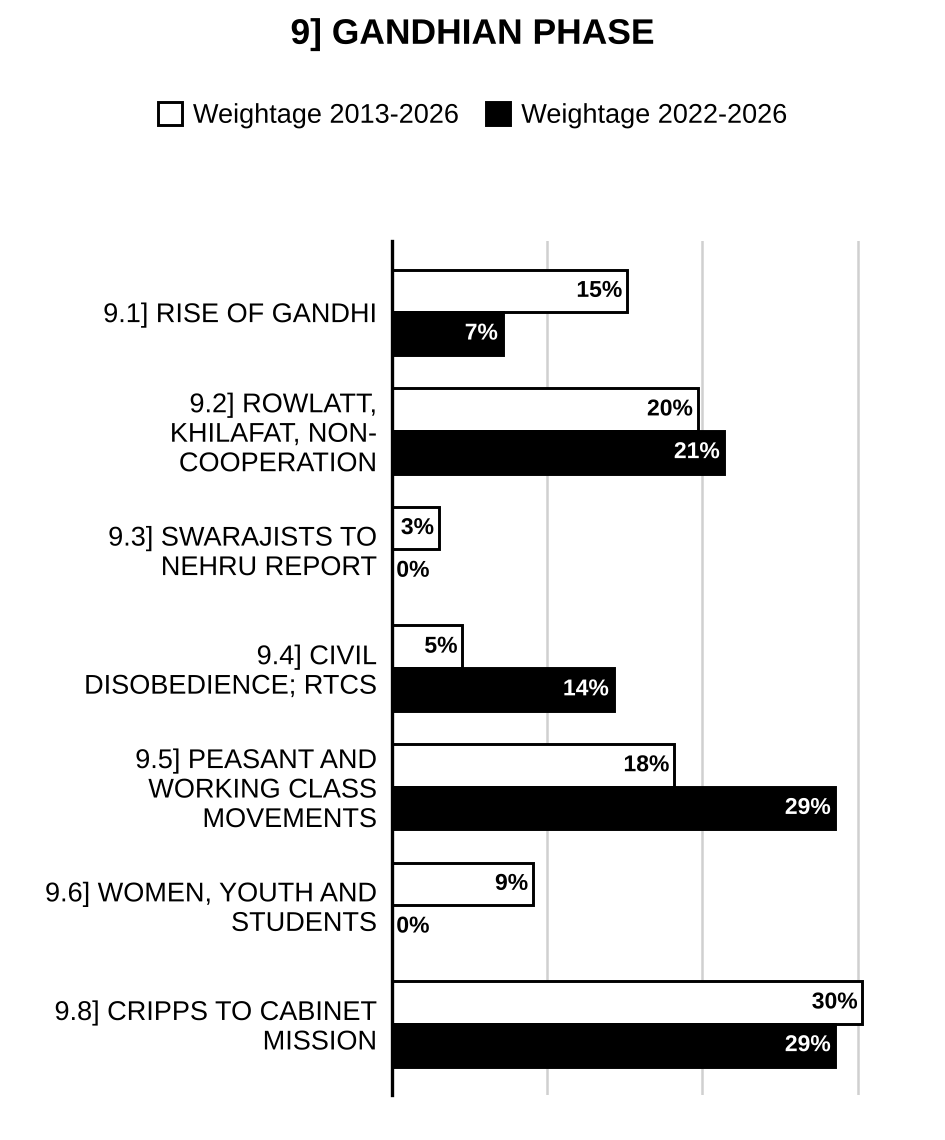
The earliest question here dates from 1995 and the latest from 2026; UPSC has drawn on this unit in 26 of the 32 years. In the last five years (2022–2026), 6 questions were set from it.
Official Syllabus
9. Gandhian Phase of the National Movement: Rise of Gandhi; Character of Gandhian nationalism; Gandhi’s popular appeal; Rowlatt Satyagraha; the Khilafat Movement; the Non-cooperation Movement; National politics from the end of the Non-cooperation movement to the beginning of the Civil Disobedience Movement; the two phases of the Civil Disobedience Movement; Simon Commission; The Nehru Report; the Round Table Conferences; Nationalism and the Peasant Movements; Nationalism and Working class movements; Women and Indian youth and students in Indian politics (1885–1947); the election of 1937 and the formation of ministries; Cripps Mission; the Quit India Movement; the Wavell Plan; The Cabinet Mission.
Source: UPSC Civil Services Examination 2026 notification. The notification gives no title for this unit; the short title used here is editorial.
Where this unit stands in Modern India
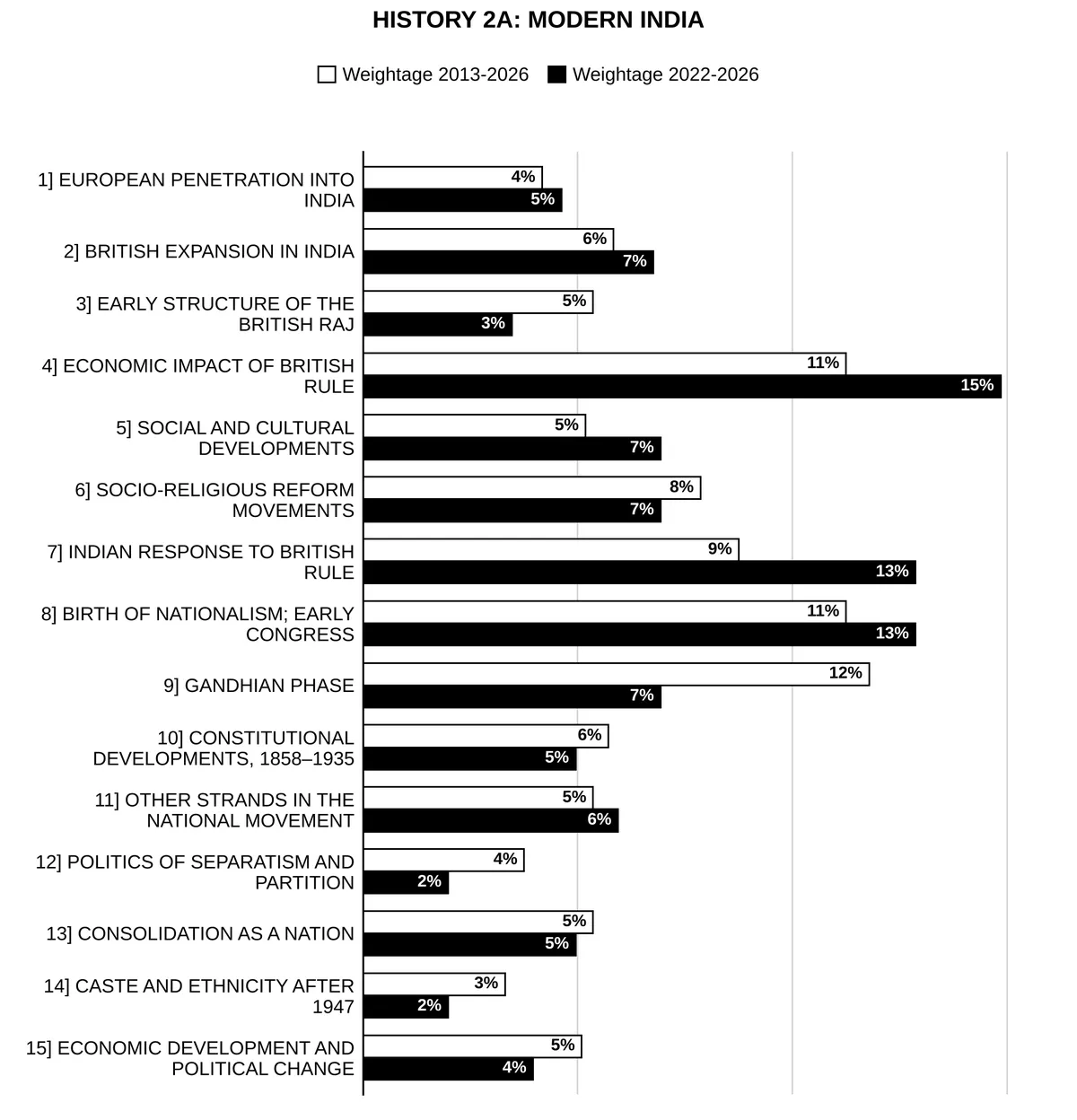
Gandhian Phase of the National Movement accounted for about 7% of the marks asked in Modern India in 2022–2026, down from 12% over 2013–2026, ranking 4th of the 15 units in the section by recent weightage.
How to use these PYQs
- Map every question to a phrase of the official syllabus shown above; recurring phrases show where UPSC’s interest lies.
- Start with the latest questions at the top of each list to see how UPSC frames this unit today; the older 60-mark questions are still useful for depth and content.
- Write timed answers to a few questions every week, keeping to the marks and word limit in each code, and revisit questions you found difficult.
Frequently Asked Questions
How many History Optional questions have been asked from Gandhian Phase of the National Movement?
This collection lists 46 question entries from Gandhian Phase of the National Movement (unit 9 of Paper 2) between 1995 and 2026, of which 41 are unique questions; the rest are listed under more than one sub-topic. They were asked in 26 of the 32 years and 6 came in 2022–2026.
When was Gandhian Phase of the National Movement last asked in History Optional?
Most recently in 2026, with 1 question (2026/20m/3b). Before that, it was asked in 2025.
Where can I find all History Optional PYQs topic-wise?
All units of Paper 1 and Paper 2, the map question and the earlier-syllabus questions are linked from History Optional PYQs Topic-wise (1995–2026).
« Previous: Birth of Indian Nationalism and the Early Congress – History Optional PYQs (1995–2026)
Next: Constitutional Developments – History Optional PYQs (1995–2026) »
Back to: History Optional PYQs Topic-wise (1995–2026) | Also see: History Optional year-wise question papers (1995–2026)