
Industrialization History Optional PYQs from 1995 to 2026 are compiled here exactly as UPSC set them in the Mains examination, sorted by syllabus topic. It is unit 18 of Paper 2, Section B – World History, with 25 questions, the latest from 2026.
Industrialization – History Optional PYQs (1995–2026)
18.1] English Industrial Revolution: causes and impact on society
1. The Industrial Revolution in England accelerated the decline of traditional Indian handicrafts and cottage Industries. Critically examine the factors responsible for this decline and its impact on the Indian economy and society. [2026/20m/7a]
2. The course of the English industrialization was too long drawn to be considered a revolution. Comment. [2024/20m/6a]
3. The impact of industrial revolution on the middle class world view is reflected in the views of Adam Smith, Thomas Malthus and Jeremy Bentham. Comment. [2023/20m/7a]
4. Do you agree that the economic effects of the Industrial Revolution were to add enormously to wealth and capital on the one hand and to degrade the masses to permanent poverty as the other? Elucidate. [2022/20m/6a]
5. Critically examine: There were many reasons why the industrial revolution first happened in England. [2021/10m/150w/5a]
6. Critically examine: “Industrial Revolution had far reaching social and political consequences with the advent of assembly line factories, urbanization and rise of the urban working class.” [2020/10m/150w/5c]
7. Critically examine: “The Industrial Revolution put mobility in the place of stability.” [2018/10m/150w/5c]
8. Explain why England became the harbinger of Industrial Revolution. Also throw light on its social consequences. [2017/20m/6a]
9. “The oppressive exploitation of the working class in the wake of Industrial Revolution had jolted the social conscience of England.” Elucidate. [2015/10m/7c]
10. “Whoever says Industrial Revolution, says cotton.” Comment. [2011/20m/6b]
11. The Industrial Revolution brought about great changes in the social and economic life of Europe. Explain. [1998/60m/6]
12. Comment on: The Industrial Revolution “changed England in character and culture.” [1996/20m/200w/5b]

Preparing for Prelims too?
Our UPSC Prelims Topic-wise PYQ eBook covers every Prelims question with detailed explanations, so you can see exactly where UPSC asks from.
View the BookDownload Free Sample18.2] Industrialization in other countries
1. Critically examine: “The Meiji reign (1868–1912) was an epoch making in the industrial history of Japan.” [2026/10m/150w/5c]
2. Examine the impact of the links between scientific education and industrial expansion on German society in the early 20th century. [2025/10m/8c]
3. Critically examine: The unification of Germany was as much a product of coal and iron as it was of blood and iron. [2024/10m/150w/5c]
4. The state was the most important factor in the industrialization of Russia. Comment. [2024/10m/6c]
5. How did the policies of governments facilitate the process of industrialisation in Europe? [2019/20m/6a]
6. Discuss how Japan industrialized after the Meiji Restoration. What were the consequences for its neighbours? [2018/20m/6b]
7. Critically examine: “The Russo-Japanese War helped in the rise of Japan as a great power.” [2014/10m/150w/5e]
8. Critically examine: “The process of industrialization in some other countries of Europe was different from that in England.” [2012/12m/150w/5d]
9. Was German unification achieved more by ‘coal and iron’ than by ‘blood and iron’? [2012/30m/7b]
10. What was the extent of industrialization in western Europe by the end of the nineteenth century? [2009/30m/6b]
11. The years 1853–1894 witnessed the transformation of Japan. Explain. [1998/60m/7]
18.3] Industrialization and Globalization
1. Critically examine: “Globalization tends to benefit the privileged sections of society and further marginalized those who are already disadvantaged.” [2026/10m/150w/5d]
2. Critically examine the socio-cultural and economic impact of migration in Europe and Asia in the 18th and 19th centuries. [2014/20m/7b]
Summary of Industrialization PYQs (1995–2026)
| Total questions (1995–2026) | 25 |
| Total marks asked | 492 |
| Questions in last 5 years (2022–2026) | 9 |
| Most recent year asked | 2026 |
| Sub-topics | 3 (18.1 to 18.3) |
The earliest question here dates from 1996 and the latest from 2026; UPSC has drawn on this unit in 17 of the 32 years. In the last five years (2022–2026), 9 questions were set from it.
Official Syllabus
18. Industrialization
- (i) English Industrial Revolution: Causes and Impact on Society.
- (ii) Industrialization in other countries: USA, Germany, Russia, Japan.
- (iii) Industrialization and Globalization.
Source: UPSC Civil Services Examination 2026 notification.
Where this unit stands in World History
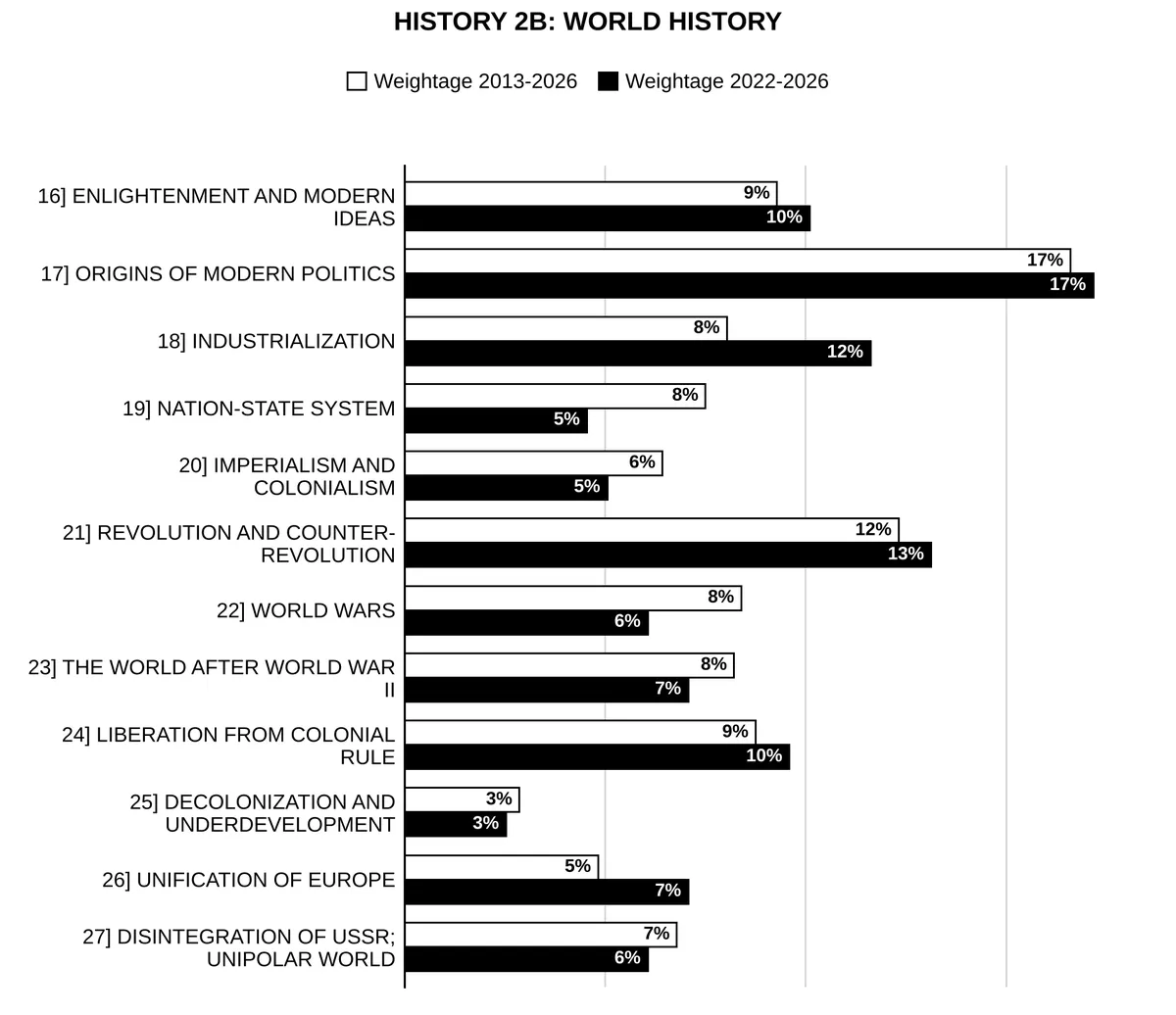
Industrialization accounted for about 12% of the marks asked in World History in 2022–2026, up from 8% over 2013–2026, ranking 3rd of the 12 units in the section by recent weightage.
How to use these PYQs
- Map every question to a phrase of the official syllabus shown above; recurring phrases show where UPSC’s interest lies.
- Start with the latest questions at the top of each list to see how UPSC frames this unit today; the older 60-mark questions are still useful for depth and content.
- Write timed answers to a few questions every week, keeping to the marks and word limit in each code, and revisit questions you found difficult.
Frequently Asked Questions
How many History Optional questions have been asked from Industrialization?
This collection lists 25 question entries from Industrialization (unit 18 of Paper 2) between 1996 and 2026. They were asked in 17 of the 32 years and 9 came in 2022–2026.
When was Industrialization last asked in History Optional?
Most recently in 2026, with 3 questions (2026/20m/7a, 2026/10m/150w/5c, 2026/10m/150w/5d). Before that, it was asked in 2025.
Where can I find all History Optional PYQs topic-wise?
All units of Paper 1 and Paper 2, the map question and the earlier-syllabus questions are linked from History Optional PYQs Topic-wise (1995–2026).
« Previous: Origins of Modern Politics – History Optional PYQs (1995–2026)
Next: Nation-State System – History Optional PYQs (1995–2026) »
Back to: History Optional PYQs Topic-wise (1995–2026) | Also see: History Optional year-wise question papers (1995–2026)