
Here are all 75 Animal Reproduction questions asked in UPSC Animal Husbandry and Veterinary Science Optional Paper I from 1995 to 2026, arranged under the 5 topics of the official syllabus. Within each topic the latest questions come first.
Each question ends with a code such as [2024/15m/3b] – the year, the marks, the word limit (where UPSC set one) and the question number in the paper.
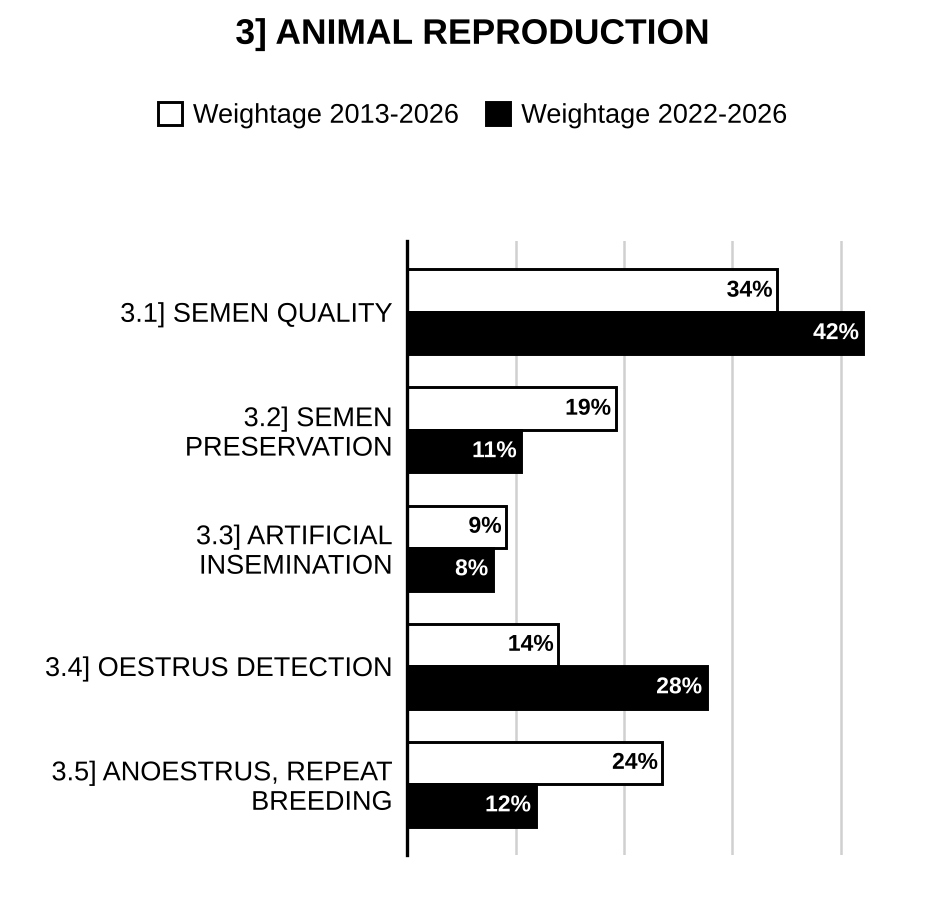
3.1] Semen and its quality
15 questions
How do high temperature and humidity impact spermatogenesis, libido and semen quality parameters like sperm motility and morphology? [2026/10m/4c]
Factors affecting semen quality in vivo and in vitro. [2025/10m/150w/5e]
Explain in detail about the different methods of semen collection in livestock and poultry. [2025/20m/6b]
Write in brief about the stages of spermatogenesis in bulls. [2023/10m/150w/1c]
Describe the electro-ejaculation technique for collection of semen in bulls with its merits and demerits. [2022/10m/150w/1c]
Describe the cellular and fluid constituents of semen in domestic animals. [2022/20m/6a]
What are the endogenous and exogenous factors which influence the sperm motility of a buffalo bull? [2020/10m/150w/1e]
Discuss the significance of semen quality and enlist the associated tests for its evaluation. Write down the ‘cervical mucus penetration test’ in detail. [2019/20m/4a]
Enlist various accessary sex glands of bull and describe the contribution of seminal vesicle to semen. [2019/15m/7a]
Write the physicochemical properties of ejaculated semen in domestic animals. [2018/10m/3c]
Describe the semen collection procedure in sheep and cattle. [2017/10m/150w/1e]
What do you understand by spermatogenesis and spermiogenesis? Discuss the factors affecting the semen quality in buffaloes. [2015/20m/2b]
Discuss the importance and process of capacitation of spermatozoa. [2014/10m/1d]
Describe process of spermatogenesis in bovine. [2013/10m/5e]
Factors affecting semen production and quality preservation. [1999/20m/200w/1d]
3.2] Semen preservation and deep freezing
19 questions
How do different extenders and preservation methods affect fertilization capacity of sperms? Explain. [2026/10m/150w/1e]
Mention the steps involved in cryopreservation of bull semen. [2024/10m/150w/5a]
Write composition of egg yolk citrate dilutor and method of its preparation. [2021/10m/150w/1a]
Enlist the properties of ideal dilutor used for deep-freezing of bull semen with composition of TRIS dilutor used for the same purpose. [2019/15m/6b]
Calculate the dilution factor and volume of dilutor from the given information: (i) Ejaculate volume–5 ml (ii) Progressive sperm motility–80% (iii) Sperm concentration–1000 × 10⁶/ml (iv) Use of mini French straw for semen freezing. [2019/15m/8a]
Discuss the diluents used in cattle semen preservation. What are the precautions that are necessary during semen preservation and thawing? [2016/20m/4c]
Name three diluters along with their properties and composition for cryopreservation of cattle bull semen. [2015/10m/150w/1e]
Enlist the characteristics of a semen diluter. Calculate the dilution rate of semen with following information available: (i) Semen to be frozen in French mini straws. (ii) Semen volume: 5 ml (iii) Sperm concentration in neat semen: 1000 million/ml (iv) Initial motility: 70%. [2013/10m/4b]
In reference to semen preservation, what is ‘cold shock’ and how it is prevented? [2011/15m/4a]
Extension of bovine semen for AI. [2011/12m/150w/5e]
Describe the procedure for deep freezing of bovine semen using polyvinyl chloride straws. [2009/20m/3c]
Buffalo semen diluents. [2007/20m/200w/1b]
Production of Deep Frozen Semen in cattle. [2005/20m/200w/1d]
Discuss the principle of deep freezing of semen. What are the advantages and disadvantages of various packaging systems used for deep freezing of semen? Enumerate the precautions to be taken at the time of thawing of frozen semen for artificial insemination? [2004/60m/2]
What is cryopreservation of semen? Describe its principle and technique. [2002/60m/4]
Factors affecting semen production and quality preservation. [1999/20m/200w/1d]
Explain the steps for preparation of artificial vagina before collection of semen. Describe the deep freezing techniques of semen for artificial insemination in cows, sheep, goats, swine and poultry. [1999/60m/4]
Discuss the collection, dilution, cryopreservation and insemination of semen for artificial insemination in cattle, swine and poultry. [1997/60m/4]
Diluents for buffalo bull semen. [1995/20m/200w/1d]

Preparing for Prelims too?
Our UPSC Prelims Topic-wise PYQ eBook covers every Prelims question with detailed explanations, so you can see exactly where UPSC asks from.
View the BookDownload Free Sample3.3] Artificial insemination
11 questions
Describe in detail the advantages and disadvantages of artificial insemination in animals. [2024/15m/7c]
Conception rate is affected by artificial insemination technique in a cow. Explain. [2020/10m/4d]
Define AI and mention the advantages and disadvantages of AI. [2018/10m/150w/1b]
Discuss the role of biotechnology in genetic improvement of dairy animals. State the steps involved in embryo transfer technology and its application. [2014/25m/3b]
Discuss the measures which can help improve the success rates of artificial insemination. [2012/12m/4c]
Discuss factors that effect conception rate in AI programme. [2011/20m/4b]
Describe steps in handling of frozen semen for AI. [2011/25m/4c]
State the steps involved in embryo transfer technology and its applications. [2010/30m/4a]
What is synchronisation of estrus? How is it beneficial for livestock farming? Briefly discuss the concept of MOET. [2010/25m/4c]
Discuss the possible reasons for poor conception following artificial insemination, especially with frozen semen and suggest measures to improve conception rate. [2006/60m/3]
Discuss the collection, dilution, cryopreservation and insemination of semen for artificial insemination in cattle, swine and poultry. [1997/60m/4]
3.4] Detection of oestrus and time of insemination
12 questions
“Silent heat is not a disease, but a failure of management.” Critically evaluate this statement in the context of dairy animals. [2026/15m/4a]
Mention the signs of estrus in cattle and buffaloes. What is the time of insemination for better conception in these animals and why is it so? [2025/15m/8b]
Describe the methods of oestrus detection in sheep. [2024/10m/6b]
Explain the methods for oestrus detection and time of insemination for better conception rate in animals. [2023/20m/7c]
Discuss different methods of oestrus detection in animals. [2018/10m/4d]
Why is the precise detection of oestrus very crucial in animal reproduction? What are the various methods of oestrus detection? [2016/10m/150w/1c]
What is synchronisation of estrus? How is it beneficial for livestock farming? Briefly discuss the concept of MOET. [2010/25m/4c]
Recent methods of oestrus detection in cows. [2006/20m/200w/1d]
Synchronization of oestrus in cow. [2003/20m/200w/1d]
Describe the symptoms of heat in cows and buffaloes. What is the best time of breeding to obtain best results? How breeding efficiency is measured? Suggest suitable management practices to improve the breeding efficiency of above species. [2003/60m/3]
Synchronisation of oestrus in cow. [1998/20m/200w/5c]
Timely breeding of farm animals is an essential requirement for optimum lifetime production. In relation to this requirement, give the symptoms of heat and duration of oestrus in cattle, goat, sheep and swine. Write a note on the most suitable time for breeding/insemination in the above species. Enumerate management practices to improve breeding efficiency. [1996/60m/3]
3.5] Anoestrus and repeat breeding
18 questions
“Silent heat is not a disease, but a failure of management.” Critically evaluate this statement in the context of dairy animals. [2026/15m/4a]
Explain the role of early embryonic mortality in repeat breeding and enlist the main factors affecting it. [2026/15m/4b]
Describe causes of different types of anoestrus in dairy cows and suggest their remedial measures. [2021/15m/3a]
Define true anoestrus in cow with characteristics of ovary and narrate the strategic approach to manage it. [2019/10m/1d]
What is breeding efficiency and how can it be measured? [2019/20m/7c]
Write the causes and management of repeat breeding cases in cows. [2018/10m/2c]
Explain, how will you ameliorate the problem of infertility in cattle and buffaloes under field conditions. [2017/10m/4c]
How will you improve the reproductive efficiency at your farm during summer season? [2015/10m/7d]
What is repeat breeding syndrome in bovines? Enlist the causes of repeat breeding. [2014/10m/4c]
Enlist various causes of anoestrus in bovines and discuss its remedial measures. [2013/15m/6c]
Discuss in brief the gynaecological disorders found in livestock which lead to infertility. [2012/20m/6c]
Summer anestrus in buffaloes. [2010/12m/150w/5c]
Repeat breeding. [2009/20m/200w/1a]
Describe the therapeutic strategies adopted to overcome the problem of anoestrus. [2009/20m/3a]
Why is fertility status of cattle and buffaloes low in India? Give suggestions for improving the fertility status of cattle and buffaloes in India. [2007/60m/3]
Service period vs. Conception rates. [2003/20m/200w/5c]
What is meant by breeding efficiency? How can it be improved in dairy animals? Describe different methods of measuring breeding efficiency. [2001/60m/6]
Write a note on the present status of reproductive efficiency of indigenous cows and buffaloes. Outline steps to attain a higher level of reproductive efficiency in a herd of buffaloes under Indian conditions. [2000/60m/7]

Strengthen your GS papers
Our UPSC Mains Topic-wise & Year-wise PYQ eBook (2013–2026) maps every GS question to the syllabus, so you know what UPSC asks and how often.
View the BookDownload Free Sample« Previous: Animal Physiology | Next: Livestock Production and Management »
Back to: Animal Husbandry and Veterinary Science Optional PYQs – Topic-wise | Also see: Animal Husbandry and Veterinary Science Optional year-wise question papers
Last updated: 31 October 2026