
Here are all 135 Plant Breeding, Biotechnology and Biostatistics questions asked in UPSC Botany Optional Paper II from 1995 to 2026, arranged under the 5 topics of the official syllabus. Within each topic the latest questions come first.
Each question ends with a code such as [2024/15m/3b] – the year, the marks, the word limit (where UPSC set one) and the question number in the paper.
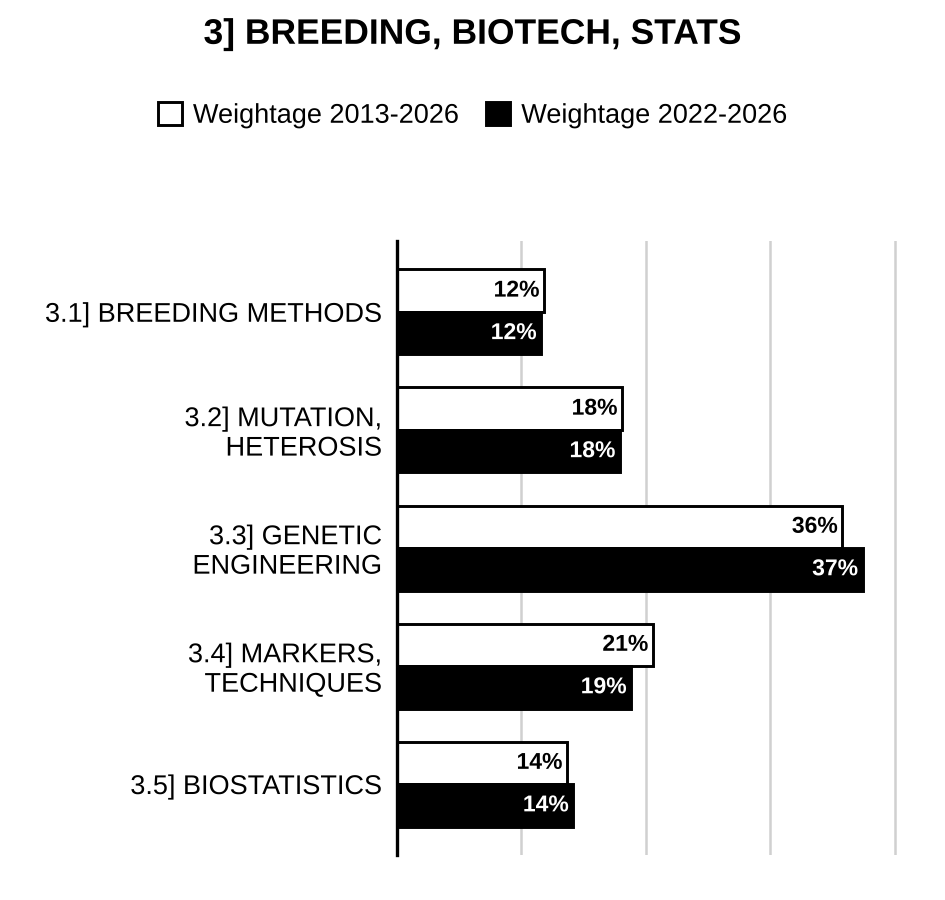
3.1] Methods of plant breeding
20 questions
Explain in detail the various methods of plant hybridization. [2025/15m/3c]
Explain how mass selection will be of help in a successful breeding program. Elaborate the answer with a suitable example. [2024/15m/4b]
What are the major requirements for a successful back-crossing programme? Describe its procedure, advantages and limitations. [2023/15m/3a]
Write brief notes on the following: (i) Southern blotting (ii) RT-PCR (iii) Mass selection. [2017/15m/4c]
Back cross method. [2016/10m/4a]
Describe the method of developing disease and insect resistant varieties through back cross method of breeding crop varieties. [2015/15m/3c]
Discuss briefly the mechanism of disease resistance. [2015/15m/4c]
How would you develop improved variety of basmati rice for organic farming conditions? [2014/20m/2c]
Explain interspecific and intergeneric hybridization. Comment on Raphano-brassica. [2011/15m/5a]
Backcross method of breeding. [2009/20m/200w/1d]
Describe the methods of selection and hybridization used in plant breeding. [2007/30m/4a]
Techniques of breeding self-pollinated crops. [2006/20m/3a]
Define hybrid vigour. Describe anyone method of hybridization for crop improvement. [2005/60m/4]
Mass selection. [2004/20m/200w/1c]
Describe the back-cross method of breeding in crop varieties. [2004/30m/4a]
Describe in detail the various uses of back-cross method of breeding and its limitations. [2004/30m/4b]
Pure Line Selection. [2003/20m/200w/1c]
Give a brief account of hybridization work on India crop plants. [2000/60m/4]
M.S. Swaminathan. [1995/20m/4a]
Write a note on green revolution. [1995/20m/200w/5b]
3.2] Mutation, polyploidy and heterosis breeding
28 questions
Explain the significance of polyploidy in Agriculture. [2026/7m/3c(ii)]
Explain the causes of Heterosis and its impact in Agriculture. [2026/15m/4b]
Discuss in detail the role of mutations in plant breeding and crop improvement. [2025/15m/4c]
Explain briefly the process and importance of the following:
(i) Male sterility and heterosis breeding. [2024/5m/2a(i)]
(ii) Molecular basis of cell cycle. [2024/5m/2a(ii)]
(iii) Gene silencing. [2024/5m/2a(iii)]
Explain what is apomixis and how this may be of help in plant breeding? Elaborate the answer with suitable examples. [2024/15m/2c]
How male sterility helps in heterosis breeding? Discuss the application of barnase-barstar system in achieving heterosis. [2022/20m/4a]
Use of apomixis in plant breeding. [2021/10m/1e]
Describe the significance and uses of the following: (i) Male sterility (ii) Polyploidy in plant breeding. [2020/15m/2b]
Enumerate the different causes of heterosis. [2018/10m/3b(ii)]
Briefly describe the following terms and emphasize their applications: (i) Restriction endonucleases (ii) Mutation breeding (iii) Gene mapping. [2018/15m/4a]
Explain the importance of numerical and structural variations in chromosomes with respect to crop varieties. [2017/20m/2a]
What is apomixis? Write about its relevance in plant breeding. [2017/15m/2c]
Discuss Inbreeding depression versus Heterosis. [2016/15m/3b]
Hybrid vigour. [2015/10m/1d]
Giving reasons explain the following: Selection of cytoplasmic-genetic male sterility in the development of hybrid varieties. [2014/10m/1b]
Discuss the use of apomixes in plant breeding. [2012/15m/4d]
Describe the method of developing maize hybrids. [2010/30m/4b]
Discuss the origin, production and uses of haploids. [2009/30m/3a]
Male sterility. [2007/20m/200w/1c]
Define hybrid vigour. Describe anyone method of hybridization for crop improvement. [2005/60m/4]
Describe in detail the method of producing hybrid seeds using Cytoplasmic-genetic male sterility system. [2003/30m/3c]
Critically examine the following alternatives and substantiate with reasons which of the two is preferable: Mutation for breeding versus protoplast fusion for crop improvement. [2001/20m/4c]
Heterosis. [2000/20m/3a]
Genetic basis of inbreeding depression and heterosis. [1999/20m/200w/1d]
Male sterility in plants. [1998/20m/200w/5c]
What is male sterility? Explain its importance. [1995/20m/200w/1b]
What is mutation and how can it be induced? Write a note on mutation breeding with special reference to achievements made in India. [1995/60m/2]
Explain the term Hybrid vigour and write about its importance. [1995/30m/3b]

Preparing for Prelims too?
Our UPSC Prelims Topic-wise PYQ eBook covers every Prelims question with detailed explanations, so you can see exactly where UPSC asks from.
View the BookDownload Free Sample3.3] Genetic engineering and transgenic crops
41 questions
Reporter genes. [2026/10m/150w/1c]
What are the different methods of DNA sequencing? Elaborate the shotgun sequencing method. [2025/20m/2a]
What are transgenic crops? Discuss the prospects and risks involved in their cultivation. [2025/20m/6a]
What are the different gene transfer methods in plants? Give a brief account of direct gene transfer methods. [2025/20m/7a]
Discuss briefly the following and comment on their significance:
(i) In what way the transfer of genes in plants help in their sustainable development? Support the answer with an example. [2024/10m/4a(i)]
(ii) Importance of biosafety aspects of transgenic crops. [2024/5m/4a(ii)]
(iii) Polytene chromosomes. [2024/5m/4a(iii)]
Describe the problems associated with gene transfer in plants. Write a note on the status of transgenic research in India. [2023/20m/2c]
What is gene editing? Discuss its applications and advantages for genetic engineering. [2022/20m/3c]
How male sterility helps in heterosis breeding? Discuss the application of barnase-barstar system in achieving heterosis. [2022/20m/4a]
Describe the steps in DNA sequencing. What are its applications? [2022/15m/4b]
Discuss the biosafety concerns of transgenic plants. [2021/15m/3c]
Describe various methods of gene transfer in plants. [2021/20m/4a]
Transgenic technology is a breakthrough innovation. Justify with examples. [2020/20m/2c]
Describe sequentially the steps of T-DNA transfer process from Agrobacterium cell to plant nuclear genome. Write a brief note on achievements of ‘gene transfer technology’ in crop improvement. [2019/20m/3b]
Discuss two DNA sequencing methods with suitable illustrations. Name two fully sequenced eukaryotic genomes with their sizes. [2019/20m/4b]
Briefly describe the different methods of gene transfer in plants. [2018/10m/1e]
How are insect resistant transgenic plants developed? Which gene is used in this technology? Briefly explain the rationale of the technology. [2018/20m/2b]
Briefly describe the following terms and emphasize their applications: (i) Restriction endonucleases (ii) Mutation breeding (iii) Gene mapping. [2018/15m/4a]
Explain the significance and importance of the following with at least one example: (i) Gene silencing (ii) Multigene families (iii) Transgenic crops and their future. [2017/15m/3c]
Restriction endonucleases. [2016/10m/4b]
Transgenic plants as living bioreactors. [2016/10m/4c]
Retroviruses as vectors. [2016/10m/4e]
Biosafety and Bioremediation. [2016/10m/8d]
Describe briefly the various methods of gene transfer. [2015/20m/2c]
Explain antisense RNA technology with an example. Highlight its applications. [2011/15m/1c]
Discuss the mechanism of T-DNA transfer from Agrobacterium tumefaciens to host plant. [2011/15m/2a]
Comment on ‘EPSPS’ and ‘Tra’ genes. [2011/15m/3a]
Describe different methods of gene transfer in plants. [2011/15m/4a]
Highlight the biosafety aspects arising out of plant genetic engineering. [2011/15m/6b]
Explain the current developments in transgenic technology contributing to crop improvement. [2011/15m/7b]
How will you identify the expression of a cloned gene? [2011/15m/8b]
Describe in detail the Agrobacterium-mediated gene transfers in the development of transgenic crop plants. [2010/30m/4a]
Describe biosafety regulatory measures for raising transgenic crops. [2009/30m/3b]
Explain the methods of transfer of genes into plants. [2007/30m/3b]
Transgenic plants. [2005/20m/200w/1c]
What do you understand by genetic engineering? [2003/15m/4a]
Describe in detail the agrobacterium-mediated gene transfer method for producing transgenic plants. [2003/45m/4b]
How is recombinant DNA produced? What applications have been found for recombinant DNA? [2002/60m/3]
Describe the techniques of gene transfer to produce transgenic plants. Add a critical note on the importance of genetic engineering with special reference to the Indian agriculture. [2001/20m/200w/1c]
Critically examine the following alternatives and substantiate with reasons which of the two is preferable: Gene and genome mapping for selective cloning versus cloning without any restriction. [2001/20m/4b]
What is genetic engineering? Discuss its importance to agriculture, forestry and medicine. [1996/60m/8]
Genetic transformation. [1995/20m/4d]
3.4] Molecular markers and techniques
24 questions
DNA finger printing. [2026/10m/150w/1e]
Elaborate on the significance of molecular markers. [2026/8m/3c(i)]
Discuss on the tools and techniques involved in PCR and FISH. [2026/20m/4a]
Describe the procedure, requirements and efficiency level of gene amplification through Polymerase Chain Reaction (PCR). [2023/15m/4c]
Southern blotting. [2022/10m/150w/1e]
RAPD PCR – strength, weakness and application. [2022/10m/150w/5b]
Applications of probes in Southern blotting. [2020/10m/1a]
“DNA fingerprinting is important in any plant breeding programme.” Justify the statement with suitable examples. [2019/10m/1a]
Explain the importance of the following techniques: (i) FISH (ii) Molecular probe. [2018/10m/3c]
Elaborate on the use of molecular markers in plant breeding. [2017/15m/4b]
Write brief notes on the following: (i) Southern blotting (ii) RT-PCR (iii) Mass selection. [2017/15m/4c]
Explain and describe the tools and techniques of FISH. [2016/20m/2a]
Molecular markers. [2016/10m/4d]
Giving reasons explain the following: Use of FISH technique in tracking the target organisms. [2014/10m/1c]
What are molecular probes? Mention their applications in biology. [2014/15m/2b]
Explain how GISH can be used for identifying the putative ancestors of a plant. [2013/15m/2c]
Explain the importance of DNA–DNA hybridization techniques in the study of biodiversity. [2012/15m/4b]
What are gene markers? Explain their importance in biological studies. [2012/15m/4c]
What are primers? Explain their role in PCR. [2012/15m/7b]
What is the principle of blotting? Give an illustrated account of the steps involved in Southern blotting. [2012/15m/8b]
RFLPs. [2010/15m/150w/1c]
Explain FISH technique and its importance in understanding genomic relationships among species. [2010/30m/2a]
Give an account of the PCR based molecular markers and their applications in plant breeding. [2009/30m/4b]
Molecular markers in plant breeding. [2006/20m/200w/1d]
3.5] Biostatistics
22 questions
Correlation and Regression. [2026/10m/150w/5b]
Tests of significance. [2025/10m/150w/5a]
Probability and distribution are two important factors which should always be taken into account to establish a successful breeding programme. Explain with a suitable example. [2024/10m/150w/1e]
Correlation, its types and significance. [2023/10m/150w/1e]
In a cross between pea plants with green and yellow coloured pods, the individual segregated into 787 green and 277 yellow pod coloured individuals. If you have to test that these results agree with the expected ratio , then apply Chi-square . The control value of Chi-square at 0.05 for is . [2022/15m/2c]
What do you understand by standard deviation and coefficient of variation? Discuss their significance. [2021/15m/2c]
Describe Chi-square test and its applications in genetic study. [2020/10m/1e]
Which statistical test is used to determine whether the observed progeny of a cross fits or differs from the expected values? Name the test and briefly describe the steps involved. [2018/10m/2c]
Student’s -test is a test of significance. Explain. [2017/10m/1e]
Chi-square test as a test of goodness of fit. [2016/10m/1c]
Giving reasons explain the following: Tests of significance in biology. [2014/10m/1e]
Chi-square test. [2013/10m/4d]
Normal distribution. [2010/15m/150w/1e]
.
(i) Comment briefly on the contributions made by Herman Nilsson-Ehle. [2009/15m/4a(i)]
(ii) List the important statistical methods of studying association and relationship between two variables. [2009/15m/4a(ii)]
Probability and distributions, with suitable illustrations. [2007/20m/200w/1d]
Uses and applications of correlation and regression analysis in plant genetics. [2006/20m/3c]
Standard deviation. [2005/20m/200w/1d]
-test (Chi-square test) [2004/20m/200w/1d]
Explain ‘test of significance’ and comment on its application in Botanical Research. [2002/20m/200w/1c]
Binomial Distribution and Poisson Distribution. [2002/20m/4c]
Explain the concept of ‘standard error’ and comment on its application in various research programmes. [2001/20m/200w/1d]
Test of significance. [2000/20m/200w/1d]

Strengthen your GS papers
Our UPSC Mains Topic-wise & Year-wise PYQ eBook (2013–2026) maps every GS question to the syllabus, so you know what UPSC asks and how often.
View the BookDownload Free Sample« Previous: Genetics, Molecular Biology and Evolution | Next: Physiology and Biochemistry »
Back to: Botany Optional PYQs – Topic-wise | Also see: Botany Optional year-wise question papers
Last updated: 31 October 2026