
Here are all 160 Microbiology and Plant Pathology questions asked in UPSC Botany Optional Paper I from 1995 to 2026, arranged under the 5 topics of the official syllabus. Within each topic the latest questions come first.
Each question ends with a code such as [2024/15m/3b] – the year, the marks, the word limit (where UPSC set one) and the question number in the paper.
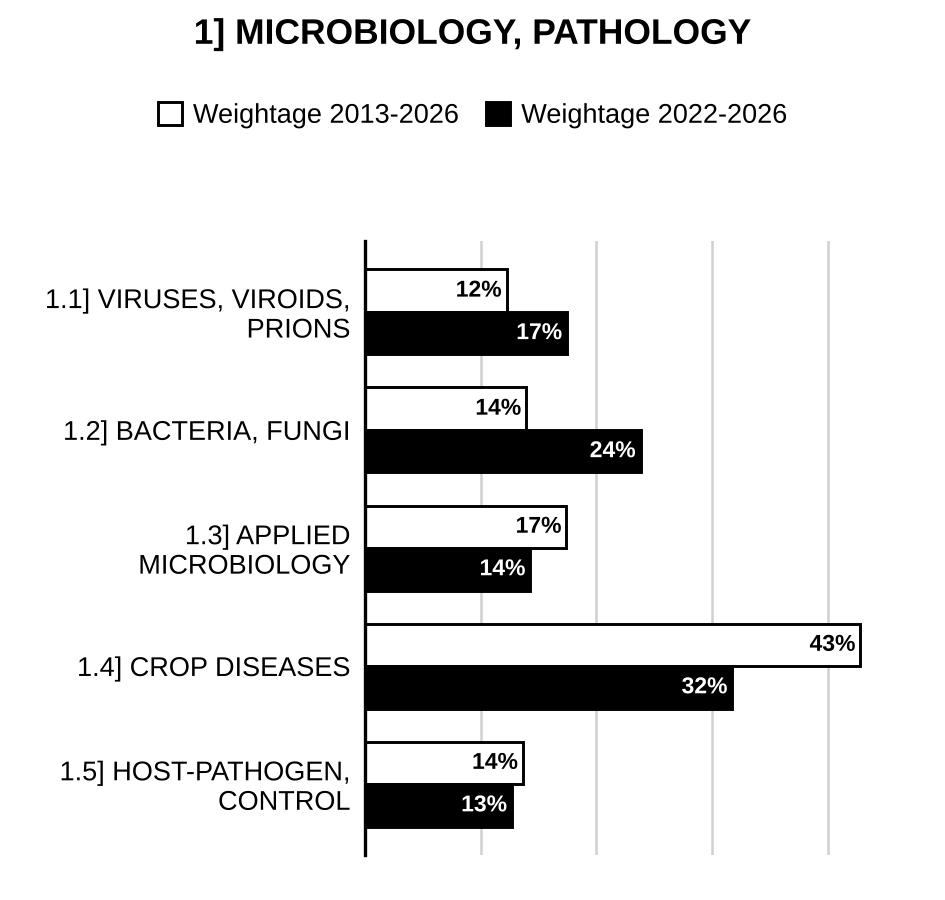
1.1] Viruses, viroids and prions
20 questions
What do you mean by virus of bacteria? Describe their application in medical sciences. [2026/10m/150w/1b]
How are viruses classified based on their symmetry? With a suitable diagram, explain the structure of T4 phage. [2024/10m/150w/1a]
What are prions? How do they differ from viruses? Mention few diseases caused by prions in animals and human beings. [2023/10m/150w/1a]
Explain the general features of viroids. How do they differ from viruses? Name two diseases caused by virions. [2023/15m/3b]
Write a comparative account of the icosahedral and helical symmetry of viruses. [2022/10m/150w/1e]
What are prions? How are these different from viroids? How are prions transmitted? [2021/10m/150w/1b]
Describe lytic and lysogenic cycle of viruses. [2020/15m/2c]
Describe the characteristics and replication of viroids. [2019/15m/2b]
Replication of plant viruses. [2018/10m/150w/1b]
Lytic cycle of bacteriophage. [2016/10m/150w/1d]
Chemical nature of viroids and their transmission in plants. [2015/10m/150w/1d]
Lysogenic type of life cycle in viruses. [2013/10m/150w/1e]
Prions and Viroids. [2012/12m/4b]
Citing suitable examples, explain the following: What are prions and why is there a need to understand them thoroughly? [2011/20m/2a]
Prions. [2007/20m/200w/1b]
Draw neat and well-labelled diagrams to show: Lytic cycle. [2006/20m/4a]
Describe the lysogenic life cycle in viruses. [2003/20m/200w/1a]
Distinguish between bacteriophages and plasmids. Give their molecular structure. How are plasmids useful in genetic engineering? [2001/20m/200w/1a]
Give a general account of plant viruses, their ultra structure and mode of transmission. [1996/20m/3b]
Give an account of the structure and mode of reproduction of bacteriophage. [1995/20m/3a]
1.2] Bacteria, mycoplasma and fungi
24 questions
What are Mycoplasmas? How do they differ from spheroplast and protoplast? Describe their salient features. [2026/15m/3b]
“Mycoplasma causes serious diseases in humans, animals and plants.” Substantiate the statement with suitable examples. [2025/10m/150w/1d]
Describe the three modes of sexual reproduction in bacteria. [2023/15m/2b]
What is mycoplasma? Describe its types and importance in plant pathogenesis. [2022/10m/150w/1a]
Describe the ultrastructure of endospore of Bacillus sp. [2022/10m/150w/1b]
Draw and describe the cell wall structure of Gram-positive bacteria. What are the major differences between the cell walls of Gram-positive and Gram-negative bacteria? [2022/15m/2b]
Explain conjugation and transformation in bacteria. Write a brief note on their significance. [2021/20m/2a]
Gram negative and Gram positive bacterial cell walls. [2020/10m/150w/1a]
Structure of mycoplasma and its importance. [2018/10m/150w/1a]
Give an account of genetic recombination in bacteria. [2017/15m/4a]
Describe the various methods of genetic recombination in bacteria. [2013/18m/2b]
Describe the process through which the bacterial genes are transferred from one bacterium to another by the viruses. [2010/15m/150w/1b]
Iron bacteria. [2009/20m/200w/4a]
Ultrastructure of a bacterial cell. [2007/20m/3c]
Differentiate between conjugation and transduction in Bacteria. [2005/20m/200w/1a]
Differentiate between bacteria and cyanobacteria. [2004/20m/200w/1a]
Recent studies reveal that mesosomes are artifacts and not true structures. Discuss. [2002/20m/200w/1a]
Distinguish between bacteriophages and plasmids. Give their molecular structure. How are plasmids useful in genetic engineering? [2001/20m/200w/1a]
Write the different types of genetic recombination found in bacteria. [2000/20m/200w/1b]
What is mycoplasma? How does it differ from a fungus? Describe the important mycoplasma diseases of plants and their methods of control. [1999/20m/200w/1a]
What are extremophylls? Why are they getting lot of attention now? [1998/20m/200w/1c]
Give structure of a bacterial cell. [1997/15m/3c]
Transduction and Bacterial Transformation. [1996/15m/3b]
What are plasmids? How are they related to bacteria? [1995/20m/200w/1a]

Preparing for Prelims too?
Our UPSC Prelims Topic-wise PYQ eBook covers every Prelims question with detailed explanations, so you can see exactly where UPSC asks from.
View the BookDownload Free Sample1.3] Applied microbiology
30 questions
Describe mineralization, symbiotic and non-symbiotic nitrogen fixation. How do they help in improving the soil quality for agriculture? [2026/10m/150w/1c]
With suitable examples, bring out the industrial uses of microorganisms. What are the advantages of using immobilised enzymes and cells in commercial processes? [2024/15m/2b]
Define microbial biopesticides. What are their types? With suitable examples, evaluate the potential of microbial biopesticides in pest and disease control in crop plants. [2023/20m/3a]
Discuss the applications of microbes in bioremediation of soil and water. [2021/10m/4c]
Write applications of Microbiology in medicine. [2020/15m/4c]
Mycorrhizal association and its importance in plants. [2019/10m/150w/1a]
Differentiation between bioremediation and bioleaching. [2019/10m/150w/1b]
Nature and significance of plant-endophyte relationship. [2019/10m/150w/1c]
State the applications of Microbiology in Agriculture. [2019/15m/4c]
Describe the role of micro-organisms in medicine and industry. [2018/20m/2a]
Role of microbes in mining and pharmaceuticals. [2016/10m/150w/1a]
Role of microbes in soil nutrient cycling. [2015/10m/150w/1a]
Role of fungi in agriculture and medicine. [2014/10m/150w/1a]
Role of microbes in medicine industry. [2013/10m/150w/1a]
Various kinds of biofertilizers and their uses. [2013/10m/150w/1b]
Microbes in bioremediation. [2011/10m/1d]
What is the importance of Bacillus thuringiensis in the current efforts to raise crop productivity? [2010/20m/3b]
With suitable examples, briefly describe the microbial processes occurring in the rhizosphere which help in plant growth. [2010/25m/4b]
Semi-moist preservation of food. [2009/20m/200w/3a]
Microbes in the control of water pollution. [2009/20m/200w/3c]
What is bioremediation? [2006/20m/200w/1a]
Microbes as indicators of pollution. [2006/20m/3c]
Give the role of bacteria in fermentation and mention the products. [2004/30m/4b]
What are biosensors? Describe the applications of microbiology in industry. [2002/30m/2a]
What are mycorrhizae? Describe economic potential of mycorrhizal fungi in agriculture and forestry. [2002/30m/2b]
Describe the role of microbes in medicine industry. [2001/30m/2b]
Write an account of the role of microbes in environmental pollution management programmes. [1999/30m/3a]
Bio-fertilizers improve soil fertility. [1999/20m/200w/5d]
Give an account of the role of microbes in industry. [1996/20m/200w/1a]
Discuss the usefulness of microbes in agriculture. [1995/20m/4b]
1.4] Crop diseases
63 questions
Name the organism that causes stalk rot disease in maize. Describe its symptoms, disease cycle, control and management. [2026/20m/3a]
What are the various modes of infection and dissemination of plant diseases caused by viruses? Describe. [2025/15m/2b]
Describe the causal organisms, disease cycle and control measures of Early Blight of Potato and Blast of Rice. [2025/20m/4a]
Explain various modes of entry of plant pathogens into their hosts. [2024/10m/150w/1b]
Describe the symptoms, causal organism, disease cycle and control measures of red rot of sugarcane. [2023/15m/4b]
What is brown spot disease of rice? Describe its causal organism, symptoms, disease cycle and its control. How does this disease damage the rural agroeconomy of India? [2022/20m/2a]
Discuss about the names of causal organisms, symptoms, disease cycle and management of loose smut of wheat. What are the differences between rust and smut fungi? [2021/20m/3a]
Write the names of causal organisms, symptoms and control measures of citrus canker and late blight of potato. [2020/20m/3a]
Write the name of causal agent, symptoms and control measures of yellow vein of Okra and Tundu disease of wheat. [2019/20m/3a]
Green ear disease of Bajra. [2018/12.5m/3a]
Paddy blast. [2018/12.5m/3b]
Angular leaf spot of cotton. [2018/12.5m/3c]
Sandal spike. [2018/12.5m/3d]
Describe the symptoms, causal organisms and control measures of white rust of crucifers and red rot of sugarcane. [2017/20m/3a]
Give an account of different modes of transmission of plant viruses. [2017/15m/4c]
Give the name of the causal organism, symptoms and control measures of any four important crop diseases caused respectively by a fungus. [2016/12.5m/4a]
Give the name of the causal organism, symptoms and control measures of any four important crop diseases caused respectively by a bacterium. [2016/12.5m/4b]
Give the name of the causal organism, symptoms and control measures of any four important crop diseases caused respectively by a virus. [2016/12.5m/4c]
Give the name of the causal organism, symptoms and control measures of any four important crop diseases caused respectively by a mycoplasma. [2016/12.5m/4d]
Chemical nature of viroids and their transmission in plants. [2015/10m/150w/1d]
Describe the disease symptoms, causal organism and the control measures of the loose smut of wheat. [2015/15m/2b]
Describe the symptoms, causal organism and the control measures of white rust of crucifers. [2015/15m/3b]
Give the name of the causal organism, disease symptoms and disease control measures of the following: Red rot of sugarcane and Late blight of potato. [2015/25m/4a]
Give the causal organism, symptoms and control measures of the following: Tikka disease of groundnut. [2014/12.5m/4a]
Give the causal organism, symptoms and control measures of the following: Citrus Canker. [2014/12.5m/4b]
Give the causal organism, symptoms and control measures of the following: Rust of wheat. [2014/12.5m/4c]
Give the causal organism, symptoms and control measures of the following: Ergot of Rye. [2014/12.5m/4d]
Give the causal organism, symptoms and control measures of the following: Wilt of Arhar. [2013/12.5m/4a]
Give the causal organism, symptoms and control measures of the following: Green ear disease of Bajra. [2013/12.5m/4b]
Give the causal organism, symptoms and control measures of the following: Tundu disease of Wheat. [2013/12.5m/4c]
Give the causal organism, symptoms and control measures of the following: Red rot of Sugarcane. [2013/12.5m/4d]
Rust and Smut diseases. [2012/12m/4c]
Downy mildews and Powdery mildews. [2012/12m/4e]
Describe the types of plant diseases caused by viruses. Explain their control measures. [2007/20m/200w/1a]
Draw neat and well-labelled diagrams to show: Diagnostic stages of any two powdery mildews. [2006/20m/4b]
Mention the causal organism, symptoms and control measures of bacterial blight in paddy, sandal spike and leaf spot in groundnut. [2004/30m/4a]
Give causal organism, symptoms and control measures of the following: Ergot of Bajra. [2003/20m/3a]
Give causal organism, symptoms and control measures of the following: Blast of Rice. [2003/20m/3b]
Give causal organism, symptoms and control measures of the following: Stem gall of coriander. [2003/20m/3c]
Give the causal organism, symptoms and control measures of the following Peach leaf curl. [2000/20m/2a]
Give the causal organism, symptoms and control measures of the following Tikka disease of groundnut. [2000/20m/2b]
Give the causal organism, symptoms and control measures of the following Little leaf of brinjal. [2000/20m/2c]
What is mycoplasma? How does it differ from a fungus? Describe the important mycoplasma diseases of plants and their methods of control. [1999/20m/200w/1a]
White rust and Black rust. [1998/15m/3a]
Downy mildews and Powdery mildews. [1998/15m/3b]
Root-knot and Root-rot disease. [1998/15m/3c]
Late blight and Early blight of potato. [1998/15m/3d]
Give a concise account of the life cycle of the causal organism, symptoms and control measures of any four of the following diseases Root knot disease of tomato. [1997/12m/2a]
Give a concise account of the life cycle of the causal organism, symptoms and control measures of any four of the following diseases Late blight of potato. [1997/12m/2b]
Give a concise account of the life cycle of the causal organism, symptoms and control measures of any four of the following diseases Leaf curl disease of papaya. [1997/12m/2c]
Give a concise account of the life cycle of the causal organism, symptoms and control measures of any four of the following diseases Red rot of sugarcane. [1997/12m/2d]
Give a concise account of the life cycle of the causal organism, symptoms and control measures of any four of the following diseases White wart of cucurbits. [1997/12m/2e]
Give a concise account of the symptoms, disease cycle, life cycle of the causal organism and control measures of any four of the following: Powdery mildew of wheat. [1996/12m/2a]
Give a concise account of the symptoms, disease cycle, life cycle of the causal organism and control measures of any four of the following: Downy mildew of grapes. [1996/12m/2b]
Give a concise account of the symptoms, disease cycle, life cycle of the causal organism and control measures of any four of the following: Early blight of potato. [1996/12m/2c]
Give a concise account of the symptoms, disease cycle, life cycle of the causal organism and control measures of any four of the following: Bacterial blight of paddy. [1996/12m/2d]
Give a concise account of the symptoms, disease cycle, life cycle of the causal organism and control measures of any four of the following: Yellow vein mosaic of bhindi. [1996/12m/2e]
Give a general account of plant viruses, their ultra structure and mode of transmission. [1996/20m/3b]
Give a concise account of the life cycle of the causative organism, symptoms and control measures of any four of the following: Powdery mildew of Pea. [1995/12m/2a]
Give a concise account of the life cycle of the causative organism, symptoms and control measures of any four of the following: White rust of Brassica. [1995/12m/2b]
Give a concise account of the life cycle of the causative organism, symptoms and control measures of any four of the following: Blast of rice. [1995/12m/2c]
Give a concise account of the life cycle of the causative organism, symptoms and control measures of any four of the following: Little leaf of brinjal. [1995/12m/2d]
Give a concise account of the life cycle of the causative organism, symptoms and control measures of any four of the following: Damping off of seedlings. [1995/12m/2e]
1.5] Host–pathogen interaction and disease control
23 questions
Describe in brief the major strategies adopted for plant disease control and management. [2026/15m/4b]
How does the infection of a pathogen affect the host plant physiology? [2025/10m/150w/1e]
Describe the ‘Koch’s postulate’. How does it help in avoiding the wrong identification of any plant pathogen? [2022/15m/2c]
Plant Quarantine. [2018/10m/150w/1c]
Write an account of defense structures in plants against pathogens. [2018/15m/2b]
What is meant by Modelling and how does it help in disease forecasting? [2017/15m/2a]
Role of soil solarization in disease control. [2016/10m/150w/1c]
Explain the molecular basis of infection and disease resistance in plants. [2016/20m/2a]
Mycotoxins. [2015/10m/150w/5a]
Plant quarantine. [2014/10m/150w/1d]
Discuss about the physiology of parasitism. [2014/15m/2c]
Fungal Toxins. [2012/12m/150w/1c]
Plant quarantines. [2012/12m/150w/1e]
What is meant by modelling and how does it help in disease forecasting? [2011/15m/4c]
Citing suitable examples, explain how laxity in quarantine procedure can have disastrous effects. [2011/15m/6d]
Molecular basis of infection. [2006/20m/3a]
Write in short about mycotoxins. [2005/20m/200w/1c]
Discuss the sequential steps involved in host pathogen interaction. [2004/20m/200w/1c]
Describe various types of Pathotoxins and their role in plant diseases. [2003/20m/200w/1d]
How does a parasite recognize its host? Describe the molecular basis of host-parasite relationship. [2001/20m/200w/1c]
Fungal toxins. [2000/30m/4a]
Briefly describe the physiological changes induced in a host plant by a parasite. [1995/20m/200w/1c]
Write notes on the following: (i) Mycotoxins (ii) Megasporophyll of Isoetes (iii) Reproductive structures of Chara (iv) Heterothallism in Fungi. [1995/20m/4c]

Strengthen your GS papers
Our UPSC Mains Topic-wise & Year-wise PYQ eBook (2013–2026) maps every GS question to the syllabus, so you know what UPSC asks and how often.
View the BookDownload Free SampleNext: Cryptogams »
Back to: Botany Optional PYQs – Topic-wise | Also see: Botany Optional year-wise question papers
Last updated: 31 October 2026