
Here is the complete set of Indus Valley Civilization History Optional PYQs from UPSC Mains 1995–2026, taken from our topic-wise question bank. It is unit 3 of Paper 1, Section A – Ancient India, with 24 questions, the latest from 2026.
Indus Valley Civilization – History Optional PYQs (1995–2026)
3.1] Origin, date and extent
1. The urban character of the Harappan Civilization was a result neither of any outside influence nor a sudden act but a gradual evolution of regional socio-economic factors. Comment. [2022/20m/2a]
2. Did the mastery over agriculture act as a leverage for the rise of Harappan towns and cities? Discuss. [2019/20m/2c]
3. Explain why the majority of the known Harappan settlements are located in the semi-arid areas with saline groundwater. [2016/20m/2b]
3.2] Characteristics
1. “Harappan architecture reflects an integrated vision of environmental adaptation, technological rationality and urban aesthetics, going beyond functionality.” Examine the statement. [2026/15m/2b]
2. The Indus-Saraswati cultural zone exhibited both homogeneity and diversity. Discuss. [2023/15m/2b]
3. Did the mastery over agriculture act as a leverage for the rise of Harappan towns and cities? Discuss. [2019/20m/2c]
4. There are no literary sources for the Harappan culture and no archaeological evidence for the Vedic period. Explain the phenomenon. [2019/20m/3c]
5. Do you think the Harappan civilization had a diversity of subsistence base? [2014/15m/3b]
6. Discuss the water management and its conservation planning in the Harappan (Indus-Saraswati) cities. [2013/20m/2b]
7. Evaluate the significance of seals and sealings in the reconstruction of socio-economic and religious life of the Harappan people. [2012/30m/2a]
8. Trace the development of urbanization from the third millennium B.C.E. to 6th century B.C.E. [2011/60m/2]
9. Analyze the elements of urban civilization in the Harappan Culture. What factors were responsible for its decline? [2002/60m/2]
10. Discuss salient features of the Indus Valley Civilization. Mention important places from where relics of civilization have been recovered so far. Examine causes of its decline. [1999/60m/2]
11. Write a short essay on: The religion of the Indus Civilization. [1996/20m/200w/1a]

Preparing for Prelims too?
Our UPSC Prelims Topic-wise PYQ eBook covers every Prelims question with detailed explanations, so you can see exactly where UPSC asks from.
View the BookDownload Free Sample3.3] Decline, survival and significance
1. Do you agree that ecological factors influenced the flow and ebb of the Harappan Civilization? Comment. [2021/20m/2a]
2. “Archaeological evidence does not give direct access to the possible social and political dimensions of the decline of the Harappan civilization. What it does indicate very clearly is that the Harappan culture underwent a gradual process of de-urbanization”? Comment. [2018/15m/2b]
3. Critically examine various views regarding the Vedic-Harappan relationship in light of the latest discoveries. [2017/15m/3a]
4. The decline of Harappan civilization was caused by ecological degradation rather than external invasion. Discuss. [2015/20m/2b]
5. Analyze the elements of urban civilization in the Harappan Culture. What factors were responsible for its decline? [2002/60m/2]
6. Discuss salient features of the Indus Valley Civilization. Mention important places from where relics of civilization have been recovered so far. Examine causes of its decline. [1999/60m/2]
7. “The continuity of the Indus Civilization into later ages was not confined to the religious and spiritual fields alone.” Analyse the statement. [1997/60m/2]
3.4] Art and architecture
1. “Harappan architecture reflects an integrated vision of environmental adaptation, technological rationality and urban aesthetics, going beyond functionality.” Examine the statement. [2026/15m/2b]
2. “The Harappans were not an artistic people.” Comment. [2025/15m/2b]
3. Harappan art contributes to our understanding of their aesthetic sensibilities in addition to spiritual and ritualistic life. Comment. [2024/20m/2a]
Summary of Indus Valley Civilization PYQs (1995–2026)
| Total questions (1995–2026) | 24 (20 unique – a few questions are listed under more than one sub-topic) |
| Total marks asked | 540 (unique questions) |
| Questions in last 5 years (2022–2026) | 6 (5 unique) |
| Most recent year asked | 2026 |
| Sub-topics | 4 (3.1 to 3.4) |
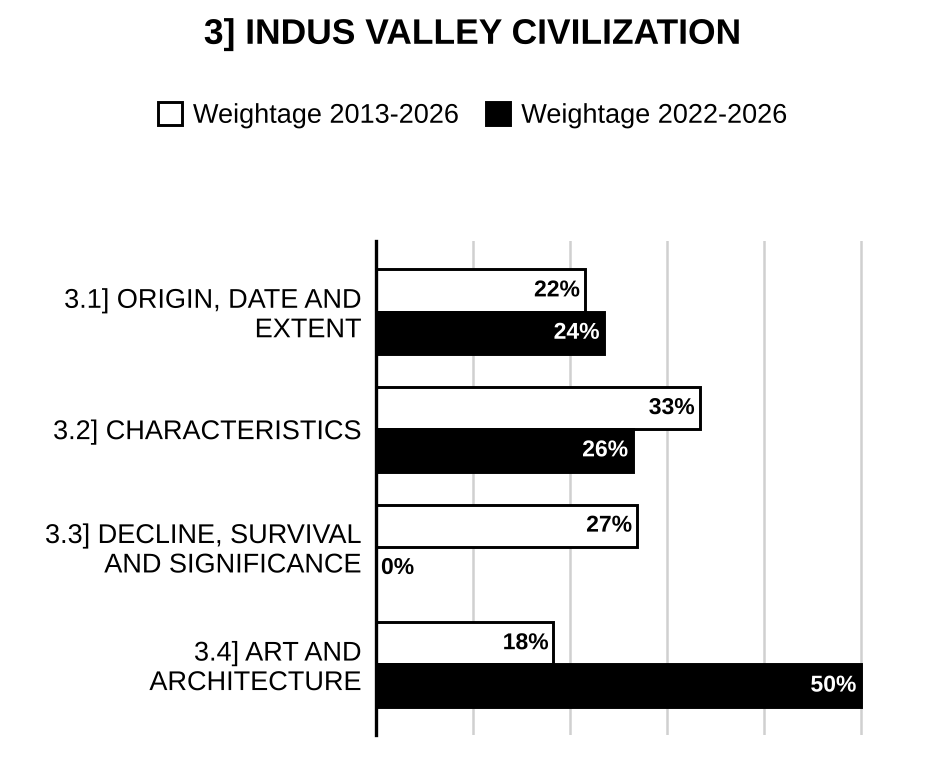
The earliest question here dates from 1996 and the latest from 2026; UPSC has drawn on this unit in 19 of the 32 years. In the last five years (2022–2026), 6 questions were set from it.
Official Syllabus
3. Indus Valley Civilization: Origin, date, extent, characteristics-decline, survival and significance, art and architecture.
Source: UPSC Civil Services Examination 2026 notification.
Where this unit stands in Ancient India
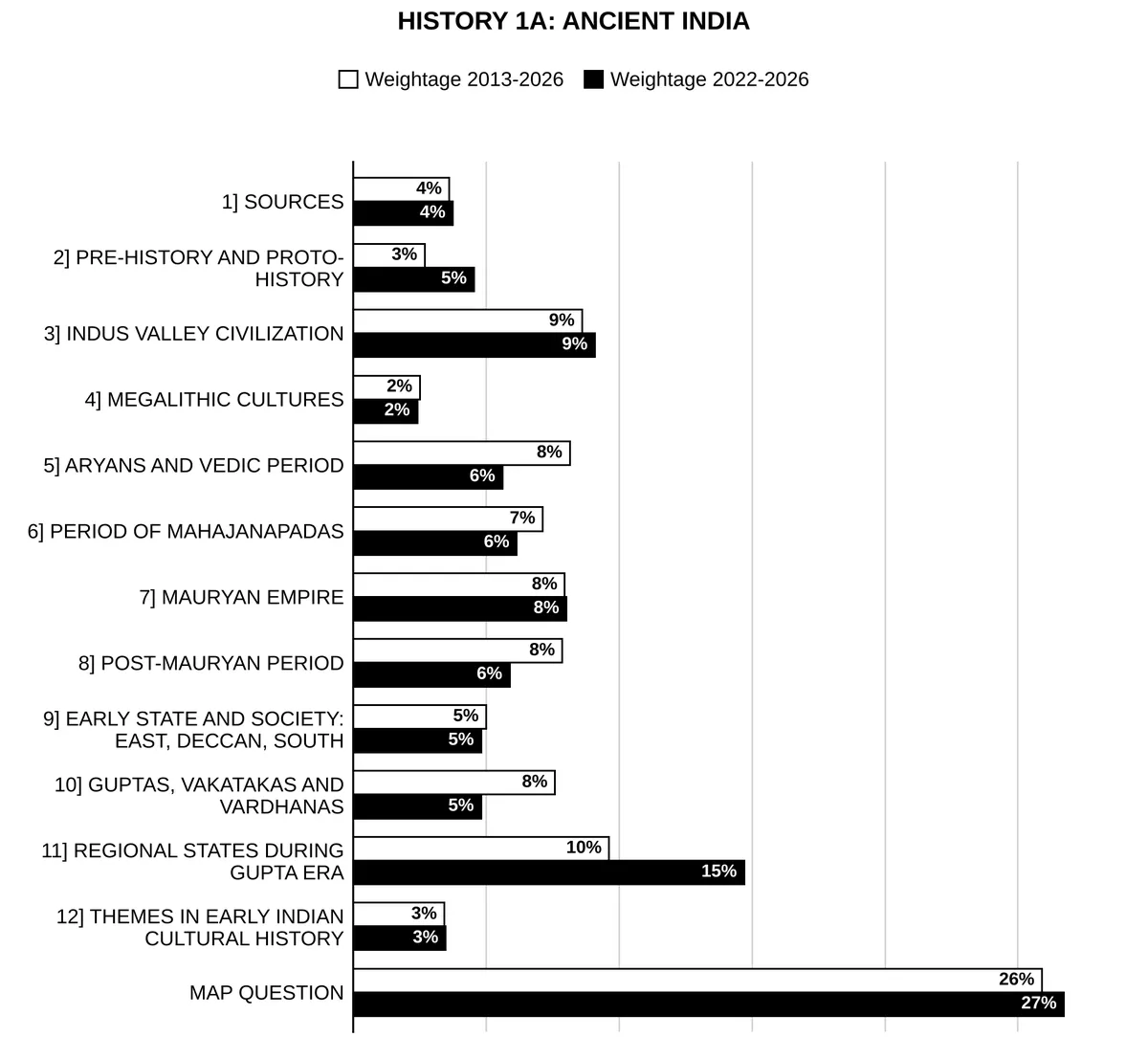
Indus Valley Civilization accounted for about 9% of the marks asked in Ancient India (the map question included) in 2022–2026, the same as 9% over 2013–2026, ranking 2nd of the 12 units in the section by recent weightage.
How to use these PYQs
- Map every question to a phrase of the official syllabus shown above; recurring phrases show where UPSC’s interest lies.
- Start with the latest questions at the top of each list to see how UPSC frames this unit today; the older 60-mark questions are still useful for depth and content.
- Write timed answers to a few questions every week, keeping to the marks and word limit in each code, and revisit questions you found difficult.
Frequently Asked Questions
How many History Optional questions have been asked from Indus Valley Civilization?
This collection lists 24 question entries from Indus Valley Civilization (unit 3 of Paper 1) between 1996 and 2026, of which 20 are unique questions; the rest are listed under more than one sub-topic. They were asked in 19 of the 32 years and 6 came in 2022–2026.
When was Indus Valley Civilization last asked in History Optional?
Most recently in 2026, with 1 question (2026/15m/2b). Before that, it was asked in 2025.
Where can I find all History Optional PYQs topic-wise?
All units of Paper 1 and Paper 2, the map question and the earlier-syllabus questions are linked from History Optional PYQs Topic-wise (1995–2026).
« Previous: Pre-history and Proto-history – History Optional PYQs (1995–2026)
Next: Megalithic Cultures – History Optional PYQs (1995–2026) »
Back to: History Optional PYQs Topic-wise (1995–2026) | Also see: History Optional year-wise question papers (1995–2026)