
This page brings together all Mughal Empire in the Seventeenth Century History Optional PYQs asked in UPSC Civil Services Mains from 1995 to 2026, arranged topic-wise. It is unit 21 of Paper 1, Section B – Medieval India, with 32 questions, the latest from 2026.
Mughal Empire in the Seventeenth Century – History Optional PYQs (1995–2026)
21.1] Major administrative policies of Jahangir, Shahjahan and Aurangzeb
1. Discuss the role of Nur Jahan in the Mughal court politics during the reign of Jahangir. [2023/20m/6a]
2. Aurangzeb’s Deccan policy was a major factor in Mughal decline. Discuss. [2022/15m/8b]
3. Identify the broad contours of the Mughal foreign policy and their impacts on the Mughal empire. [2016/20m/6c]
4. Compare the Peshwas’ bureaucratic management with that of the Imperial Mughal administration. [2015/15m/8c]
5. Write a short essay on: Spanish ulcer ruined Napoleon Bonaparte, the Deccan ulcer ruined Aurangzeb. [1999/20m/200w/5d]
6. Write a short essay on: Nurjahan. [1998/20m/200w/5c]
7. Comment on: Changes in the composition of nobility from Akbar to Aurangzeb. [1995/20m/200w/6d]
21.2] The Empire and the Zamindars
1. Evaluate the impact of Mughal revenue administration on the agrarian structure of North India. To what extent did it bring continuity and change in the rural socio-economic fabric? [2025/20m/7c]
2. Discuss the working of Zamindari System under the Mughal rulers. Also describe the role played by the Zamindars in the agrarian economy of Mughal India. [2018/20m/8a]
21.3] Religious policies of Jahangir, Shahjahan and Aurangzeb
1. “Aurangzeb’s religious policy was a reflection of the changed political realities of the Mughal Empire.” Elucidate. [2025/15m/8a]
2. “Akbar built the Mughal Empire by enlisting the support of the Rajputs; Aurangzeb destroyed it by alienating the Rajputs.” Discuss critically. [2007/60m/8]
3. Write a short essay on: Dara Shukoh. [2006/20m/200w/5d]
4. In what ways were Aurangzeb’s Rajput and religious policies different from those of his predecessors? What were the consequences of the changes made by him? [2004/60m/8]
5. ‘Akbar built the Moghul Empire by enlisting the support of the Rajputs, Aurangzeb destroyed it by alienating the Rajputs.’ Do you agree? [2003/60m/8]
6. Describe the Rajput policy of the Mughal emperors. Do you agree with the view that the reversal of Akbar’s Rajput policy by Aurangzeb was responsible for the disintegration of the Mughal empire? [2000/60m/8]

Preparing for Prelims too?
Our UPSC Prelims Topic-wise PYQ eBook covers every Prelims question with detailed explanations, so you can see exactly where UPSC asks from.
View the BookDownload Free Sample21.4] Nature of the Mughal State
1. Trace the formulation of the Mughal imperial authority from Akbar to Aurangzeb. Focus on the influence of Persian ideas of kingship in the construction of Mughal royalty. [2026/20m/7b]
2. Discuss the nature of the Mughal State under Akbar. [2023/15m/8c]
21.5] Late seventeenth century crisis and the revolts
1. Examine the causes and consequences of peasants uprising during the reign of Aurangzeb. [2024/15m/6c]
2. The late seventeenth century Mughal India is considered to be a period of Jagirdari crisis. Discuss. [2021/20m/7c]
3. Do you think that the agrarian crisis of the 17th century led to the disintegration of the Mughal empire? Discuss. [2016/20m/8a]
4. On the basis of the accounts of Europeans bring out the agrarian crisis of the 17th century CE India. [2013/20m/7a]
5. “The major causes of revolts against the Mughal Empire during the latter half of the 17th century were economic, rather than religious.” Discuss. [2009/30m/8b]
21.6] The Ahom kingdom
1. Give a brief account of resistance offered by Ahom State against the Mughal rule. [2014/10m/150w/5d]
2. Write a short essay on: The Ahom Kingdom. [2008/20m/200w/5a]
21.7] Shivaji and the early Maratha Kingdom
1. How did the Maratha guerrilla warfare tactics contribute to their military successes against larger and more established armies? [2024/15m/7b]
2. The Marathas posed a significant threat to the integrity of the Mughal Empire. Discuss. [2023/20m/7a]
3. Examine the sources of the history of Chhatrapati Shivaji with special reference to Shivabharat and Sabhasad Bakhar. [2020/10m/150w/5e]
4. Shivaji was not merely a military conqueror but also was an enlightened ruler. Discuss. [2019/15m/8c]
5. Give social background to the rise of the Maratha movement during the seventeenth century. [2012/12m/150w/5e]
6. How did Shivaji organise his administration and finances to consolidate his power? [2010/30m/7b]
7. Examine circumstances leading to rise of Shivaji. Throw light on his legacy. [1999/60m/7]
8. Shivaji’s rise to power cannot be treated as an isolated phenomenon in Maratha history. It was as much the result of his personal daring and heroism as of the peculiar geographical situation of the Deccan country and the unifying religious influences that were animating the people with new hopes and aspirations in the 15th and 16th centuries. Explain. [1996/60m/8]
Summary of Mughal Empire in the Seventeenth Century PYQs (1995–2026)
| Total questions (1995–2026) | 32 |
| Total marks asked | 837 |
| Questions in last 5 years (2022–2026) | 9 |
| Most recent year asked | 2026 |
| Sub-topics | 7 (21.1 to 21.7) |
The earliest question here dates from 1995 and the latest from 2026; UPSC has drawn on this unit in 26 of the 32 years. In the last five years (2022–2026), 9 questions were set from it.
Official Syllabus
21. Mughal Empire in the Seventeenth Century
- Major administrative policies of Jahangir, Shahjahan and Aurangzeb.
- The Empire and the Zamindars.
- Religious policies of Jahangir, Shahjahan and Aurangzeb.
- Nature of the Mughal State.
- Late Seventeenth Century crisis and the revolts.
- The Ahom kingdom.
- Shivaji and the early Maratha Kingdom.
Source: UPSC Civil Services Examination 2026 notification.
Where this unit stands in Medieval India
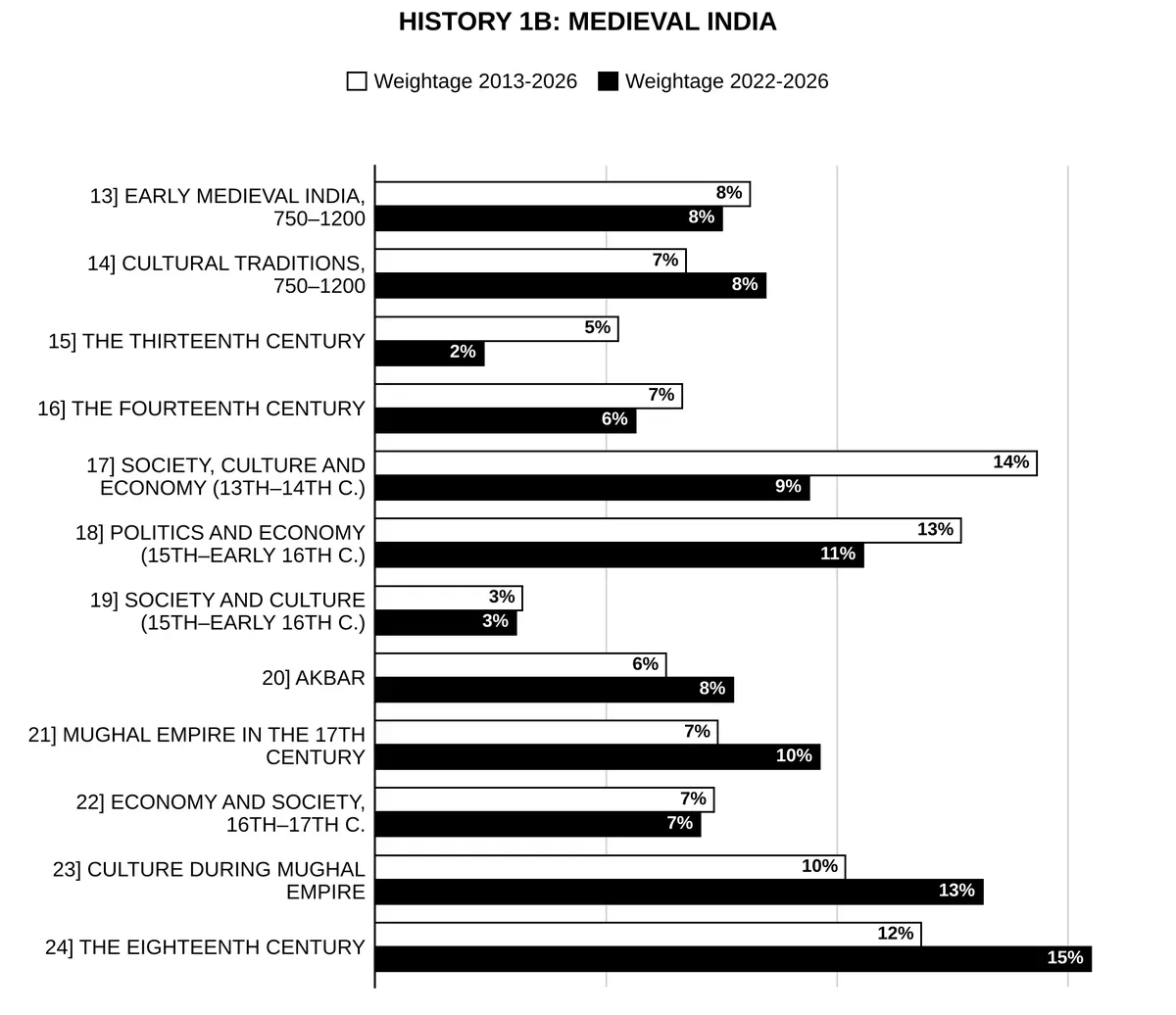
Mughal Empire in the Seventeenth Century accounted for about 10% of the marks asked in Medieval India in 2022–2026, up from 7% over 2013–2026, ranking 4th of the 12 units in the section by recent weightage.
How to use these PYQs
- Map every question to a phrase of the official syllabus shown above; recurring phrases show where UPSC’s interest lies.
- Start with the latest questions at the top of each list to see how UPSC frames this unit today; the older 60-mark questions are still useful for depth and content.
- Write timed answers to a few questions every week, keeping to the marks and word limit in each code, and revisit questions you found difficult.
Frequently Asked Questions
How many History Optional questions have been asked from Mughal Empire in the Seventeenth Century?
This collection lists 32 question entries from Mughal Empire in the Seventeenth Century (unit 21 of Paper 1) between 1995 and 2026. They were asked in 26 of the 32 years and 9 came in 2022–2026.
When was Mughal Empire in the Seventeenth Century last asked in History Optional?
Most recently in 2026, with 1 question (2026/20m/7b). Before that, it was asked in 2025.
Where can I find all History Optional PYQs topic-wise?
All units of Paper 1 and Paper 2, the map question and the earlier-syllabus questions are linked from History Optional PYQs Topic-wise (1995–2026).
« Previous: Akbar – History Optional PYQs (1995–2026)
Next: Economy and Society in the 16th and 17th Centuries – History Optional PYQs (1995–2026) »
Back to: History Optional PYQs Topic-wise (1995–2026) | Also see: History Optional year-wise question papers (1995–2026)