
Every question in this collection of Social and Religious Reform Movements History Optional PYQs (1995–2026) is given below with its year, marks and question number. It is unit 6 of Paper 2, Section A – Modern India, with 35 questions, the latest from 2026.
Social and Religious Reform Movements – History Optional PYQs (1995–2026)
6.1] Ram Mohan Roy and the Brahmo Movement; Devendranath Tagore
1. “Raja Rammohan Roy stands in history as the living bridge over which India marches from her unmeasured part to her incalculable future.” Explain. [2026/20m/3a]
2. Critically examine: “The chief value of Raja’s (Raja Rammohan Roy) labours seems to lie in his fight against the forces of medievalism in India.” [2017/10m/150w/1b]
3. “The contact of the new Indian middle class with the West proved to be a catalyst. The social and religious movements launched by Rammohan or Iswar Chandra Vidyasagar have to be understood in this context.” — Elaborate. [2012/30m/2b]
6.2] Iswarchandra Vidyasagar
1. How far was the widow remarriage movement effective in arousing social concern for Indian women? [2019/10m/3c]
2. “The contact of the new Indian middle class with the West proved to be a catalyst. The social and religious movements launched by Rammohan or Iswar Chandra Vidyasagar have to be understood in this context.” — Elaborate. [2012/30m/2b]
6.3] The Young Bengal Movement
1. Critically evaluate: “Young Bengal left little distinctive or permanent impression on the plane of religion and philosophy.” [2011/20m/200w/1b]
6.4] Dayananda Saraswati
1. Critically examine: “The Arya Samaj may quite logically be pronounced as the outcome of conditions imported into India from the West.” [2017/10m/150w/1d]
2. “Swami Dayananda’s philosophy represents both elements of extremism and social radicalism.” Substantiate. [2015/20m/2a]
3. Comment on: “The Arya Samaj may quite logically be pronounced as the outcome of conditions imported into India by the west.” (Lala Lajpat Rai) [2009/20m/200w/1b]
4. Comment on: The Arya Samaj “did not, however, succeed in capturing the imagination of modern India as a whole”. [1998/20m/200w/1b]

Preparing for Prelims too?
Our UPSC Prelims Topic-wise PYQ eBook covers every Prelims question with detailed explanations, so you can see exactly where UPSC asks from.
View the BookDownload Free Sample6.5] Social reform movements: Sati, widow remarriage, child marriage etc.
1. How far was the widow remarriage movement effective in arousing social concern for Indian women? [2019/10m/3c]
2. “Peace hath her victories no less renowned than war.” Examine this statement with reference to Lord William Bentinck. [2016/20m/2b]
3. How did social legislation in the nineteenth century improve the condition of women in India? [2009/30m/3a]
4. Comment on: “Of the evils which corroded Indian society in the nineteenth century were probably those which stunted its womanhood.” [2007/20m/200w/1b]
5. Discuss the important social reform legislation passed in the 19th century and elucidate the reaction of Indian leaders to the measures adopted. [2000/60m/3]
6. Comment on: The British Indian State experienced the ‘wind of change’ with the arrival of Lord William Bentinck. [1999/20m/200w/1b]
6.6] Contribution of Indian renaissance to the growth of modern India
1. “The tensions between cultural revivalism and modernization shaped the trajectory of the socio-religious reform movements in 19th century India.” Discuss. [2025/20m/4a]
2. Critically examine: In course of the 19th century, the agenda of social reform was gradually replaced by revivalism. [2024/10m/150w/1c]
3. The universalist perspective of socio-religious reform movements was not a ‘purely philosophic concern; it strongly influenced the political and social outlook of the time’. Examine. [2023/20m/4a]
4. Critically examine: “In the initial stages, when Indian nationalism was immature, just sprouting, it found expression in many liberal religio-reform movements.” [2020/10m/150w/1b]
5. Critically examine: “Two important intellectual criteria which informed the reform movements were rationalism and religious universalism.” [2019/10m/150w/1c]
6. Critically examine: “Faced with the challenge of the intrusion of colonial culture and ideology an attempt to reinvigorate traditional institutions and to realize the potential of traditional culture developed during the nineteenth century.” [2018/10m/150w/1c]
7. Critically examine: “Sri Narayana guru’s was a major intervention in the social reform movement from a subaltern perspective.” [2017/10m/150w/1e]
8. Do you agree with the view that the growth of vernacular literature in the 19th and the 20th centuries paved the way for social reform and cultural revival in India? [2016/10m/150w/1c]
9. “Though Sri Ramakrishna became the prophet of neo-Hinduism, he never claimed to have founded any new religion.” Elaborate. [2014/20m/4a]
10. Critically examine: Swami Vivekananda opined that “We should give our ancient spirituality and culture and get in return Western science, technology, methods of raising the standard of life, business integrity and technique of collective effort.” [2013/10m/150w/1b]
11. “The first point to note is the continuing importance of religion and philosophy as vital ingredients in the modern Indian Renaissance. Indeed, there is as much reason for regarding it as a reformation as there is for treating it as a Renaissance.” Critically examine. [2013/25m/2b]
12. Critically evaluate: “The educated middle class in the 19th century often found the domain of reason to be oppressive, as it implied the historical necessity of ‘civilizing’ colonial rule.” [2010/20m/200w/1a]
13. Discuss the extent to which the Indian Renaissance movement contributed towards the rise of nationalist consciousness. [2010/30m/3b]
14. Comment on: “So long as the millions live in hunger and ignorance, I hold every man a traitor who, having been educated at their expense, pays not the least heed to them.” [2006/20m/200w/1c]
15. Comment on: ‘The national democratic awakening of the Indian people found expression also in the religious sphere.’ [2005/20m/200w/1d]
16. Examine the impact of British rule on Indian Society in the 19th Century. [2004/60m/3]
17. The 19th century Indian renaissance was both an acceptance and rejection of western values. Do you agree? [1997/60m/2]
18. Comment on: The religious reform movements of the 19th century were “endeavours to recast the old religion (Hinduism) into a new form suited to meet the needs of the new society.” [1996/20m/200w/1c]
19. Trace the course and comment on the character of caste movements in south India in the 20th century. How far was their object achieved? [1995/60m/4]
Summary of Social and Religious Reform Movements PYQs (1995–2026)
| Total questions (1995–2026) | 35 (33 unique – a few questions are listed under more than one sub-topic) |
| Total marks asked | 755 (unique questions) |
| Questions in last 5 years (2022–2026) | 4 |
| Most recent year asked | 2026 |
| Sub-topics | 6 (6.1 to 6.6) |
The earliest question here dates from 1995 and the latest from 2026; UPSC has drawn on this unit in 26 of the 32 years. In the last five years (2022–2026), 4 questions were set from it.
Official Syllabus
6. Social and Religious Reform Movements in Bengal and Other Areas: Ram Mohan Roy, The Brahmo Movement; Devendranath Tagore; Iswarchandra Vidyasagar; The Young Bengal Movement; Dayananda Saraswati; The social reform movements in India including Sati, widow remarriage, child marriage etc.; The contribution of Indian renaissance to the growth of modern India; Islamic revivalism – the Feraizi and Wahabi Movements.
Source: UPSC Civil Services Examination 2026 notification.
Where this unit stands in Modern India
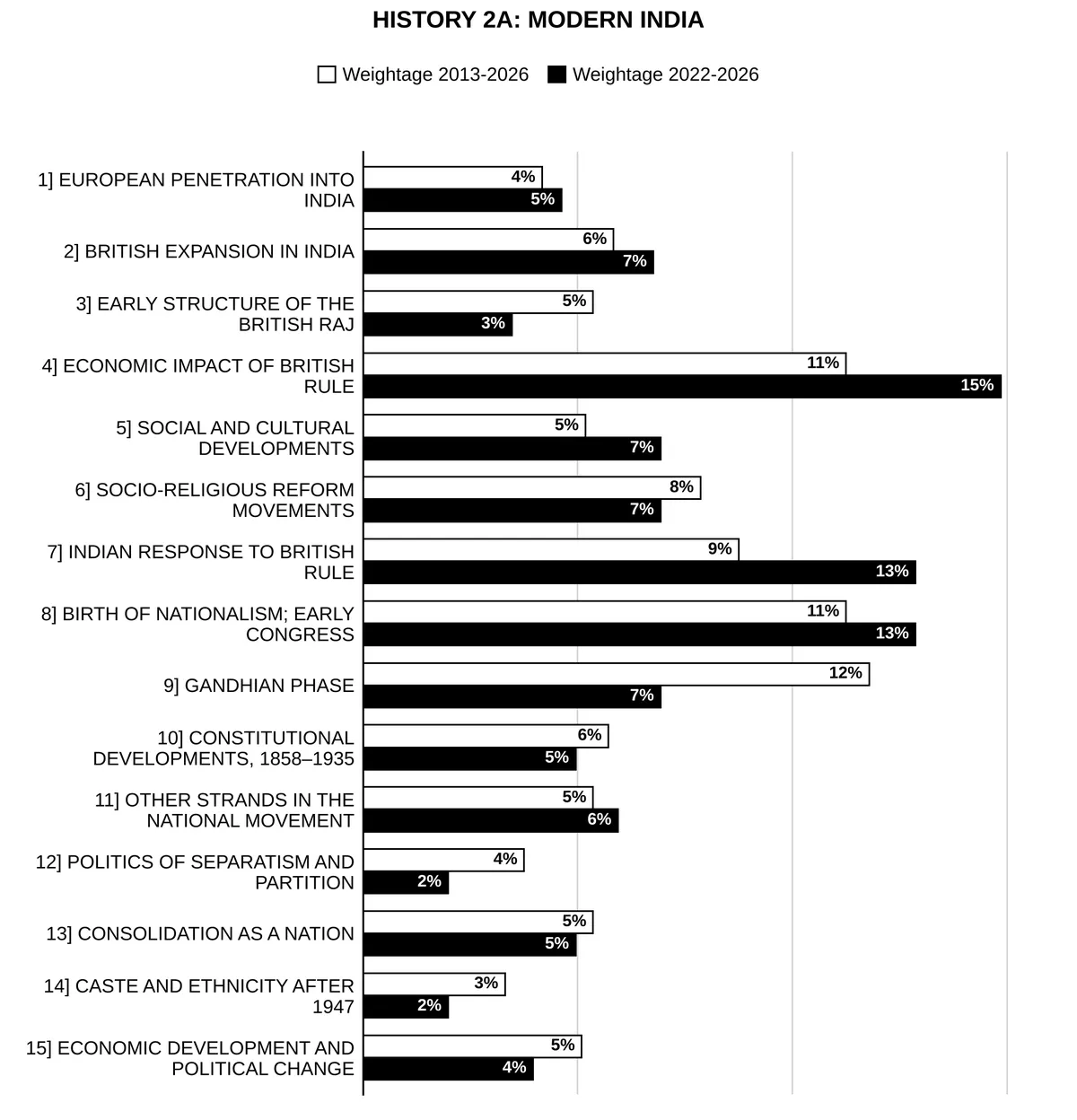
Social and Religious Reform Movements accounted for about 7% of the marks asked in Modern India in 2022–2026, down from 8% over 2013–2026, ranking 5th of the 15 units in the section by recent weightage.
How to use these PYQs
- Map every question to a phrase of the official syllabus shown above; recurring phrases show where UPSC’s interest lies.
- Start with the latest questions at the top of each list to see how UPSC frames this unit today; the older 60-mark questions are still useful for depth and content.
- Write timed answers to a few questions every week, keeping to the marks and word limit in each code, and revisit questions you found difficult.
Frequently Asked Questions
How many History Optional questions have been asked from Social and Religious Reform Movements?
This collection lists 35 question entries from Social and Religious Reform Movements (unit 6 of Paper 2) between 1995 and 2026, of which 33 are unique questions; the rest are listed under more than one sub-topic. They were asked in 26 of the 32 years and 4 came in 2022–2026.
When was Social and Religious Reform Movements last asked in History Optional?
Most recently in 2026, with 1 question (2026/20m/3a). Before that, it was asked in 2025.
Where can I find all History Optional PYQs topic-wise?
All units of Paper 1 and Paper 2, the map question and the earlier-syllabus questions are linked from History Optional PYQs Topic-wise (1995–2026).
« Previous: Social and Cultural Developments – History Optional PYQs (1995–2026)
Next: Indian Response to British Rule – History Optional PYQs (1995–2026) »
Back to: History Optional PYQs Topic-wise (1995–2026) | Also see: History Optional year-wise question papers (1995–2026)