
Every question in this collection of Akbar History Optional PYQs (1995–2026) is given below with its year, marks and question number. It is unit 20 of Paper 1, Section B – Medieval India, with 28 questions, the latest from 2026.
Akbar – History Optional PYQs (1995–2026)
20.1] Conquests and consolidation of empire
1. Trace the formulation of the Mughal imperial authority from Akbar to Aurangzeb. Focus on the influence of Persian ideas of kingship in the construction of Mughal royalty. [2026/20m/7b]
2. Discuss the nature of the Mughal State under Akbar. [2023/15m/8c]
20.2] Establishment of jagir and mansab systems
1. Discuss the structural features of Todar Mal’s revenue system and evaluate its effectiveness in standardized land revenue assessment in India. [2025/15m/6a]
2. Examine the nature of the Mansabdari system during the reign of Akbar. [2022/15m/6b]
3. The late seventeenth century Mughal India is considered to be a period of Jagirdari crisis. Discuss. [2021/20m/7c]
4. Critically analyse whether the success of the Mughals is to be credited to their robust Jagirdari and Mansabdari system. [2019/15m/8a]
5. How was Iqta system of the Sultans different from the Jagir system under the Mughals? [2014/15m/8b]
6. Examine the mansab and jagir system by Akbar and its subsequent failure in the 18th century. [2011/30m/7b]
7. Write a short essay on: Mansabdari System. [2002/20m/200w/5c]
8. Comment on: Changes in the composition of nobility from Akbar to Aurangzeb. [1995/20m/200w/6d]
20.3] Rajput policy
1. Akbar’s Rajput policy was shaped by considerations of factional politics in the Mughal court. Discuss. [2025/15m/7b]
2. Discuss with relevant illustrations the relations between Akbar and the Rajput states. [2021/15m/8b]
3. Do you think that Akbar’s Rajput policy was a conscious attempt to incorporate the Indian ruling elite with the Mughal Imperial System? [2017/15m/7b]
4. Analyze how the political process of state formation of Mewar from 10th–15th century CE was challenged in the 16th century CE by the imperialist policy of Akbar. [2013/15m/8a]
5. “Akbar built the Mughal Empire by enlisting the support of the Rajputs; Aurangzeb destroyed it by alienating the Rajputs.” Discuss critically. [2007/60m/8]
6. In what ways were Aurangzeb’s Rajput and religious policies different from those of his predecessors? What were the consequences of the changes made by him? [2004/60m/8]
7. ‘Akbar built the Moghul Empire by enlisting the support of the Rajputs, Aurangzeb destroyed it by alienating the Rajputs.’ Do you agree? [2003/60m/8]
8. Describe the Rajput policy of the Mughal emperors. Do you agree with the view that the reversal of Akbar’s Rajput policy by Aurangzeb was responsible for the disintegration of the Mughal empire? [2000/60m/8]
9. Write a short essay on: Rana Pratap’s patriotism was his only offence. [1999/20m/200w/5c]

Preparing for Prelims too?
Our UPSC Prelims Topic-wise PYQ eBook covers every Prelims question with detailed explanations, so you can see exactly where UPSC asks from.
View the BookDownload Free Sample20.4] Evolution of religious and social outlook; theory of Sulh-i-kul and religious policy
1. “Instead of bringing credit, the Ibadat Khana brought growing discredit to Akbar.” Comment. [2024/20m/7a]
2. “Akbar wished to assert his strong belief in God, but his concept of the way God is to be worshipped was independent of either orthodox Islam or Hinduism.” Comment. [2018/10m/150w/5d]
3. “In medieval Indian history Akbar was unique for his religio-political ideas and policies.” Analyse this statement. [2015/20m/8a]
4. Write a short essay on: Implications of Akbar’s notion of Sulh-i-Kul. [2009/20m/200w/5c]
5. Write a short essay on: Religious Tolerance of Akbar. [2006/20m/200w/5c]
6. Was Din-i-Ilahi ‘a monument of Akbar’s folly’? [2004/20m/200w/5c]
7. Trace the evolution of the religious views of Akbar. Write a note on his policy of Sulh-i-kul. [2002/60m/7]
8. Highlight the catholicity of Akbar’s regime with suitable examples. [1997/60m/8]
20.5] Court patronage of art and technology
1. Give an estimate of Akbar as a promoter of technology. [2009/30m/7b]
Summary of Akbar PYQs (1995–2026)
| Total questions (1995–2026) | 28 |
| Total marks asked | 765 |
| Questions in last 5 years (2022–2026) | 6 |
| Most recent year asked | 2026 |
| Sub-topics | 5 (20.1 to 20.5) |
The earliest question here dates from 1995 and the latest from 2026; UPSC has drawn on this unit in 23 of the 32 years. In the last five years (2022–2026), 6 questions were set from it.
Official Syllabus
20. Akbar
- Conquests and consolidation of empire.
- Establishment of jagir and mansab systems.
- Rajput policy.
- Evolution of religious and social outlook. Theory of Sulh-i-kul and religious policy.
- Court patronage of art and technology.
Source: UPSC Civil Services Examination 2026 notification.
Where this unit stands in Medieval India
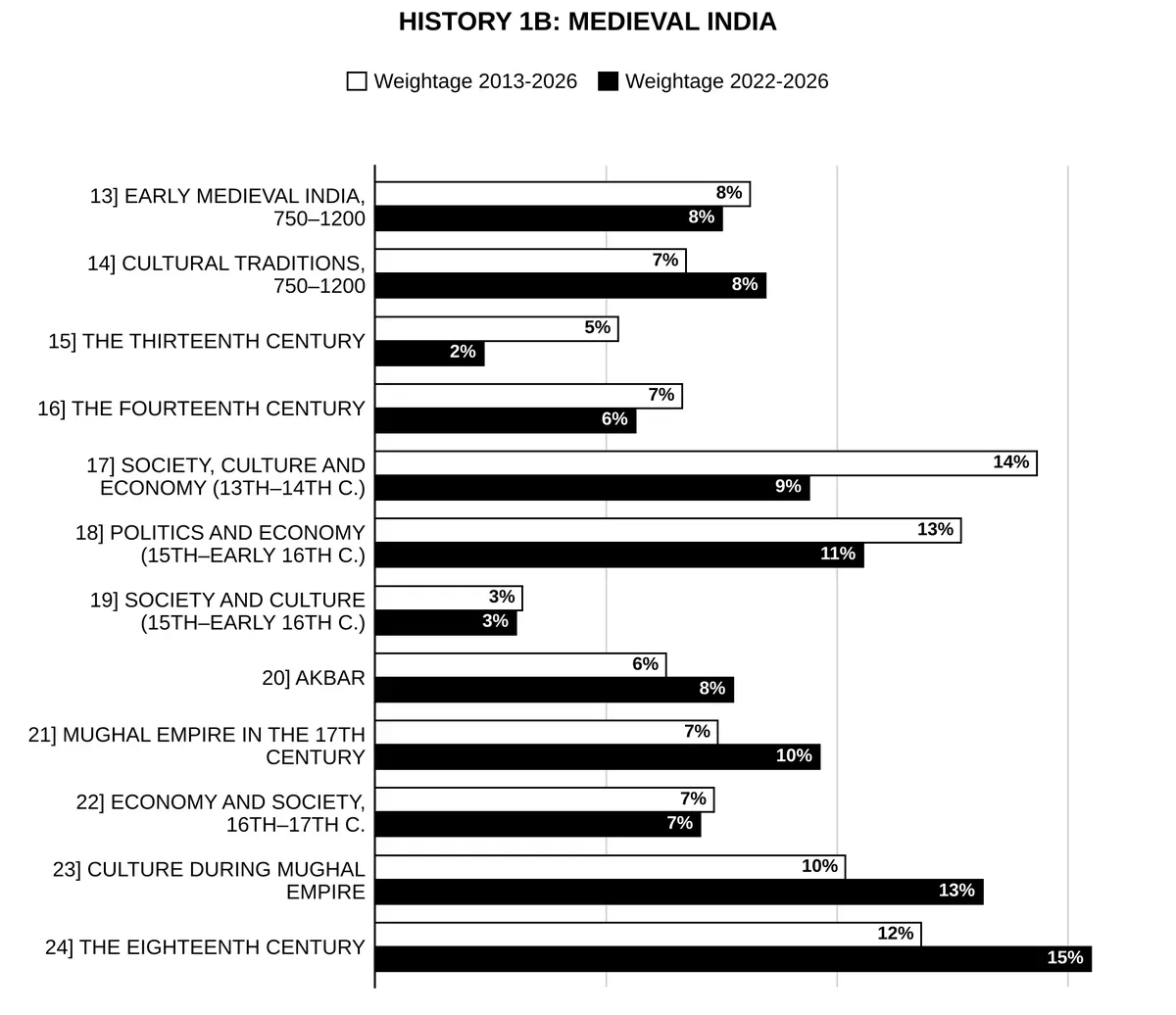
Akbar accounted for about 8% of the marks asked in Medieval India in 2022–2026, up from 6% over 2013–2026, ranking 7th of the 12 units in the section by recent weightage.
How to use these PYQs
- Compare the questions with the official syllabus wording above – themes that recur across years deserve the deepest notes.
- Give priority to the recent questions (2013 onwards follow the present 250-mark paper pattern); use the pre-2013 questions to test your depth of content.
- Practise answers within the word limit shown in the question code (for example 150w or 250w) and under timed conditions, then revise them after a week.
Frequently Asked Questions
How many History Optional questions have been asked from Akbar?
This collection lists 28 question entries from Akbar (unit 20 of Paper 1) between 1995 and 2026. They were asked in 23 of the 32 years and 6 came in 2022–2026.
When was Akbar last asked in History Optional?
Most recently in 2026, with 1 question (2026/20m/7b). Before that, it was asked in 2025.
Where can I find all History Optional PYQs topic-wise?
All units of Paper 1 and Paper 2, the map question and the earlier-syllabus questions are linked from History Optional PYQs Topic-wise (1995–2026).
« Previous: Fifteenth and Early Sixteenth Century: Society and Culture – History Optional PYQs (1995–2026)
Next: Mughal Empire in the Seventeenth Century – History Optional PYQs (1995–2026) »
Back to: History Optional PYQs Topic-wise (1995–2026) | Also see: History Optional year-wise question papers (1995–2026)